Publication notice — editorial draft. This page describes the proposed mission and editorial standards for iGaming Technology. It must be approved by the actual publisher before the statements about operating practices are presented as established fact. No authors, reviewers, publisher identity or contact details have been supplied for verification. Named credits and live policies must be added before publication.
A credible engineering publication should help its readers understand how a system works, where evidence begins and ends, and which assumptions still require testing. iGaming Technology is planned as a technical reference library about online casino systems: platform architecture, game runtimes, testing, certification processes, live-game operations and applied AI. The intended editorial emphasis is on reproducible reasoning rather than promotional claims.
The site is organized into four related subject areas. Platform Architecture examines integration boundaries, wallet correctness and service reliability. Behind the Technology explains game-state transitions, RNG, RTP and live video. Technical Research covers testing methods, standards and release evidence. AI in iGaming reviews analytical tools, their failure modes and appropriate human oversight. A cross-cutting glossary provides terms and directs readers to fuller explanations.

Purpose, audience and editorial scope
The intended audience includes backend developers, game engineers, platform architects, QA practitioners, security specialists, technical product managers, compliance staff and readers who want a precise understanding of iGaming infrastructure. A strong article should tell a reader what is authoritative, what is illustrative and how to validate the result in their own environment. It should also reveal the limits of the method: a passing unit test is not a certified game; a successful HTTP response is not necessarily a settled financial transaction; a statistically plausible random sequence is not proof of cryptographic security.
We aim for concepts that transfer across providers without erasing differences among them. For example, providers may use different naming schemes for bet, win, cancel, refund and end-round messages. An article can explain the invariant that each economic effect must have a stable identity, but it should not invent a universal provider callback contract. Likewise, a reference architecture can suggest services, queues, databases and caches without claiming that every operator or supplier implements them in that form.
The editorial scope is explanatory and technical. It does not include investment recommendations, betting tips, player-acquisition promotions, advice for bypassing compliance controls, or guarantees of individual game outcomes. Examples of gameplay interfaces, test dashboards and data are conceptual and should be labeled as such. A story about a software weakness should focus on defensive engineering, verification or remediation rather than operational instructions for abuse. When work may affect actual players or money, articles should distinguish sandbox testing from production action.
An important organizing principle is authority. Gameplay animations are presentation. An outcome engine determines an authorized result under its defined architecture. A wallet or ledger records economic effects. Reconciliation compares independent financial facts. A model monitoring anomalous behavior provides investigative signals rather than a new source of accounting truth. An editor should preserve those boundaries throughout an article instead of collapsing every process into the word “transaction.”
The site should also serve readers from different legal and technical environments. No definition of a gaming standard should silently imply universal regulatory applicability. Where a particular version or jurisdiction matters, the article needs the edition, effective context and a link to a primary source. Informal industry practice may be useful, but it must be distinguished from enforceable requirements and provider-specific contracts.
Research methods and source validation
A publishable technical explanation should be built from traceable materials wherever possible. Preferred source types are current official specifications and standards, documented provider contracts supplied with appropriate permission, authoritative engineering documentation, test reports with defined scope, peer-reviewed research where relevant, and reproducible code or sample data. Secondary articles can provide context, but should not be the sole support for a claim about licensing, certification or cryptography.
The proposed research workflow begins by writing the exact question the article answers and defining what would count as evidence. For an API guide, that means naming the operation, request and response semantics, error contract and retry boundaries. For game mathematics, it means stating the sample space, payout units, probability model and configuration. For a latency benchmark, it means specifying clock assumptions, capture points, devices, media settings and treatment of outliers. For regulatory writing, it means checking the primary standard and applicable jurisdiction, not quoting a generic summary.
Source validation should include currency, provenance and scope. A page may have been updated after the article’s first draft; a draft API endpoint may have changed; a testing standard may have a new edition that has not yet been adopted in a particular market. Before publication, the editor should record the retrieval or review date of material claims and ensure that the cited version is the version being discussed. Where sources disagree, the article should explain whether they cover different contexts rather than silently blending them into a single rule.
Claims should be classified. A documented requirement can be connected to a primary source, jurisdiction and version. A recommended engineering control is reasoned from a threat or failure model but is not necessarily mandatory. An illustrative example demonstrates a concept with synthetic identifiers or sample data. A test result records actual measured inputs, methodology and uncertainty. Those categories should not share the same unsupported confidence language. A diagram of a hypothetical architecture should explicitly say it is a reference model; a test report must state what was actually executed.
Evidence should remain auditable where publication resources permit. For computed charts, retain the code or formula, random seed, dataset provenance and units. For diagrams, retain editable source material and compare labels with the accompanying article. For security material, limit disclosure of sensitive keys, credentials or exploit details. For graphics generated by AI, do not treat depicted interfaces, people, certificates or numbers as observations about a real company. Prefer diagrams or real calculations when accurate labels or metrics are essential.
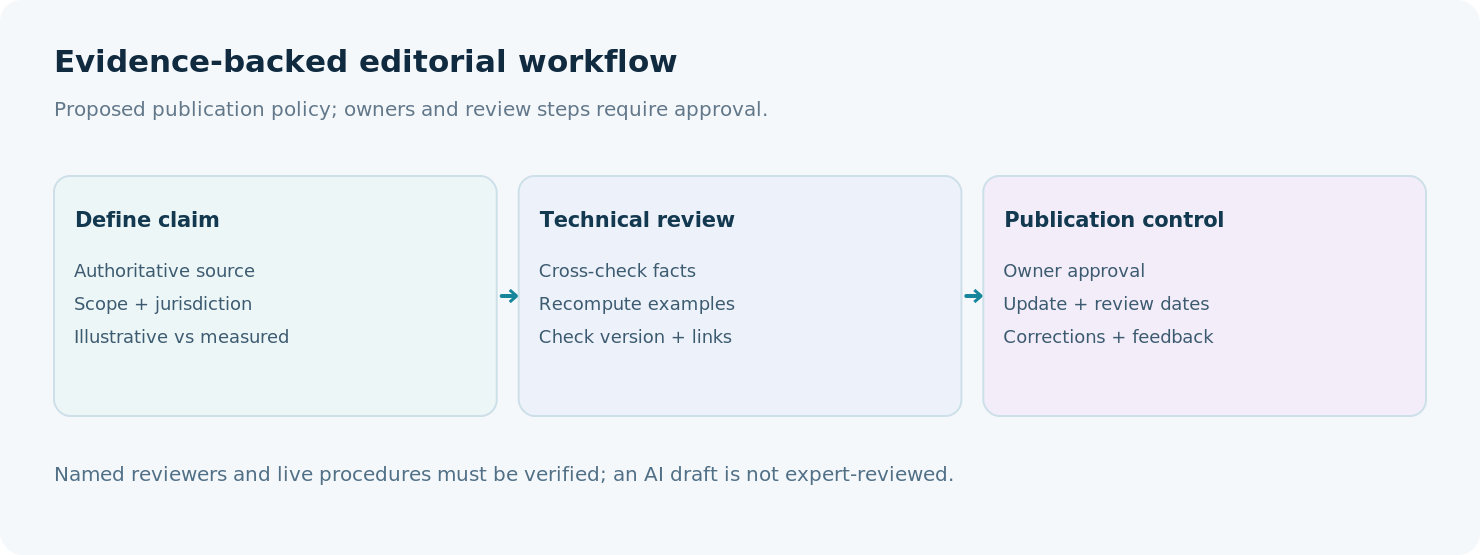
A final pass should look for internally inconsistent monetary units, invalid state transitions, jurisdictional overstatements, missing caveats, broken references and unsupported extrapolation. In financial architecture, reviewers should ask what happens if a remote operation commits but its response is lost. In RNG writing, they should distinguish source entropy, algorithm design, outcome mapping and mathematical fairness. In AI coverage, they should challenge whether labels, prevalence and false-positive rates reflect operational reality.
Technical authors and reviewers
Author and reviewer information is not yet available. The final site should list a named person or accountable editorial entity for substantive articles, a verifiable bio or relevant expertise, the date of the latest material review, and any meaningful disclosures. Where independent review actually occurred, the reviewer should be credited with their scope of involvement and consent. Until those details are confirmed, articles should be marked as editorial drafts, not “expert-reviewed.”
Responsibilities should be separated according to the claim. A backend engineer can evaluate message ordering and idempotency, while a finance-domain reviewer may be needed to validate ledger treatment. A game mathematician should check payout examples. A cryptography specialist should assess statements about entropy or RNG security. A compliance practitioner or qualified legal adviser should verify interpretations of standards and changes that could alter regulatory duties. No single title should be treated as automatic authority across all these areas.
The publication should maintain an editorial owner who can answer correction requests and coordinate updates. That owner is accountable for what appears on the page, whether draft prose was originally written by a person, generated by a model, or adapted from external materials. A reviewer should have access to relevant source material and be free to require clarifications or remove statements that are not supported.
Disclosures, conflicts of interest and AI-assisted workflows
Contributors should disclose material relationships with referenced platform vendors, software suppliers, regulators, labs and sponsors. Disclosure is especially important in comparisons and certification coverage, where a commercial relationship could affect the selection or framing of evidence. The site should distinguish editorial material from paid placement if any exists; no arrangement should be represented as present until confirmed. A disclosure does not excuse inaccuracies, and a lack of stated conflict is not proof that none exists.
AI tools may be used to help outline, draft, edit, translate or create illustrative images and diagrams. Such use does not confer expertise, source verification or independent validation. A responsible workflow requires human checking of factual and mathematical claims and explicit labeling when images are synthetic. Model-generated screen values must never be presented as observed financial performance, certification results or genuine audit evidence. Where a proposed test was generated with AI, a deterministic test oracle and reviewer approval remain necessary.
Prompt inputs, retrieved documents and screenshots must respect privacy, confidentiality and licensing limits. Sensitive provider agreements, real player records, credentials and proprietary operational logs should not be copied into an external model environment without the responsible organization’s authorization and controls. AI-assisted proofreading does not authorize the publication of confidential material or the misrepresentation of externally sourced claims.
Corrections, updates and review dates
Corrections should be specific and traceable. A reader should be able to report the affected URL, quoted sentence, relevant evidence and why it matters. High-impact issues—such as unsafe money-movement advice, wrong mathematical formulas, outdated standards interpretation or exposed personal data—should receive prompt triage once a contact channel and editorial owner are in place. A correction workflow should preserve context for both readers and reviewers.
Different edits deserve different treatment. A spelling fix can be made without altering the technical conclusion; a newly released edition of a standard can require a clear note, source re-check and revision date; a corrected RTP formula or wallet invariant should be visibly documented because earlier readers may have relied on it. When a claim cannot yet be verified, qualify it or temporarily remove it rather than leaving unsupported certainty on the page.
The final publication should distinguish first published, last updated and last technical review dates. These fields are not interchangeable: changing navigation links does not mean a standard was revalidated. The publisher should define an update cadence proportionate to the volatility and risk of each subject, and maintain a change log for substantive corrections where feasible.
Publication metadata to supply: [EDITORIAL OWNER / PUBLISHER], [REAL AUTHOR NAMES AND BIOS], [REVIEWER DETAILS AND CONSENT], [CONTACT CHANNEL], [REVIEW DATE], [AI/DISCLOSURE POLICY APPROVAL]. Until these exist, this page is a proposed editorial standards draft rather than verification that any process has occurred.
How to contribute or contact the editorial team
Readers can improve a technical library by pointing to the exact behavior or requirement that needs attention. A useful correction submission identifies the article, source version, reproducible observation, expected behavior, measured result if applicable and any confidentiality restrictions. For example, “the callback can arrive after settlement” is more actionable when paired with the provider contract’s relevant section than with a general statement that retries are unreliable.
Expert contributors may propose narrowly framed technical explanations, reproducible test methods, new glossary terms and standards updates. An effective proposal describes intended readers, the question being answered, authoritative sources, sample artifacts that can be shared and material conflicts of interest. The editorial owner should evaluate a proposed article’s fit, depth and independent validation requirements before accepting it.
Visit Contact to see the planned inquiry categories and the currently unconfigured submission route. A functioning address or form should be added and tested before launch; the text must not promise response times until the publisher can meet them. The Privacy Policy must accurately describe how messages and any uploaded files are processed after the contact system is chosen. The goal is accountable engineering communication, not the appearance of an editorial team that has not been identified.