iGaming technical testing is most useful when it produces a narrow, repeatable answer to a precisely framed question. A provider API contract test can establish that a particular payload still conforms to an agreed version. It does not prove that an interrupted wallet transaction will settle exactly once. A statistical test can identify a suspicious output pattern. It does not establish that a random number generator is unpredictable to an attacker. A laboratory report can document the evaluation of an identified software build under a defined scope. It is not a perpetual approval for every later revision of that product.
This research library organizes testing methods by the claims they can support, the artifacts they produce and the decisions that consume them. It is written for platform architects, game developers, QA engineers, compliance teams and technically interested operators. It favors reproducible methods, explicit limitations and identifiable source revisions over generic declarations that a system is “certified” or “secure.”

What technical validation can and cannot prove
A strong technical claim has five components: an object under test; a version or configuration; a test method; a documented outcome; and a statement of what remains outside scope. For example, “the consumer’s version 2.4 bet callback contract was verified against provider build 5.8 using the six recorded interactions” is more useful than “the API integration passed QA.” It tells another engineer which system was tested and which uncertainty the result reduced.
Validation should be risk-based rather than a checklist of tests performed without purpose. Financial state mutation requires carefully designed idempotency, reconciliation and fault-injection cases. Game mathematics requires specification-to-implementation comparisons, statistical diagnostics and independent review. Security requires threat modeling, design controls, dependency and configuration review, and operational checks. Compliance additionally requires the correct jurisdiction, adopted document edition, testing role and approval or notification process.
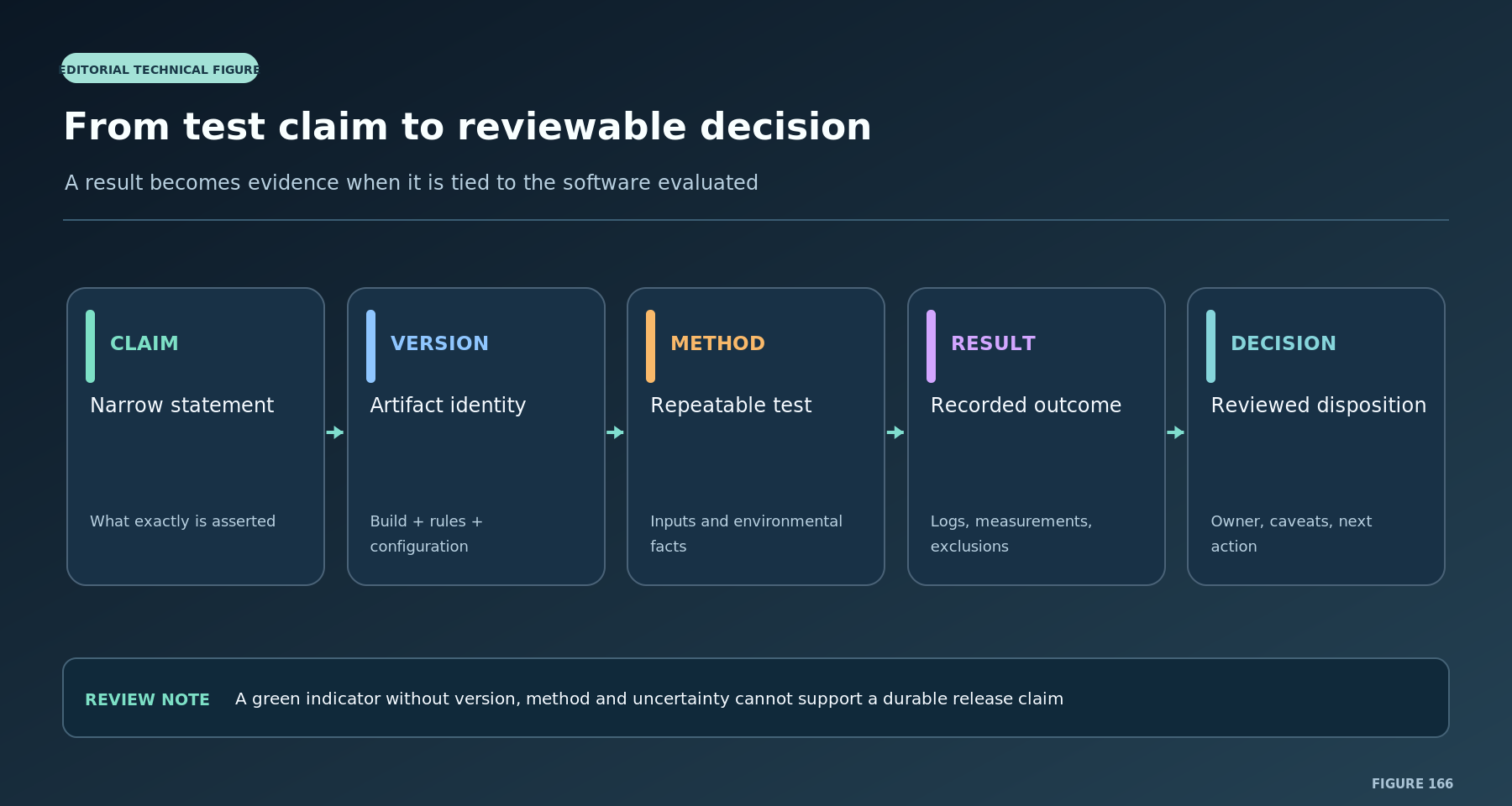
A test’s failure also needs context. A flaky integration test might indicate race conditions, unstable staging infrastructure, a changed provider environment or a faulty assertion. Record environment health and raw evidence before concluding that the product itself is defective. Conversely, a green dashboard is insufficient evidence if the test data omit the retries, invalid states and adversarial timing that matter most in production.
Software certification and applicable standards: reading path
Start with the product boundary. Are you evaluating a remote gaming server, a client game, a back-office function, a wallet, a platform component or a specific release of game mathematics? The applicable obligations can differ. Then identify the market and regulator; finally identify the document, revision and effective date that actually apply. An industry’s technical standard is not automatically a license condition in every jurisdiction.
The GLI standards catalog presently lists GLI-19 Interactive Gaming Systems v4.0. That is a relevant technical reference for interactive gaming systems, but the applicable edition or modified requirements may be set by a jurisdiction or certification program. In Great Britain, the UK Gambling Commission’s remote gambling and software technical standards and separate testing strategy set out a jurisdiction-specific framework; the latter distinguishes cases requiring approved third-party test houses from circumstances allowing in-house testing under specified controls.
Read iGaming Software Certification: Testing Process, Labs, and Evidence for the workflow from scope identification to evidence packages, findings and maintenance. Also read the dedicated guides to GLI-19 and UKGC RTS 7 when those pages are available in this library. Those articles are interpretation aids, not substitutes for signed lab reports, current regulator documentation or professional compliance assessment.
RNG testing, security reviews and model validation: reading path
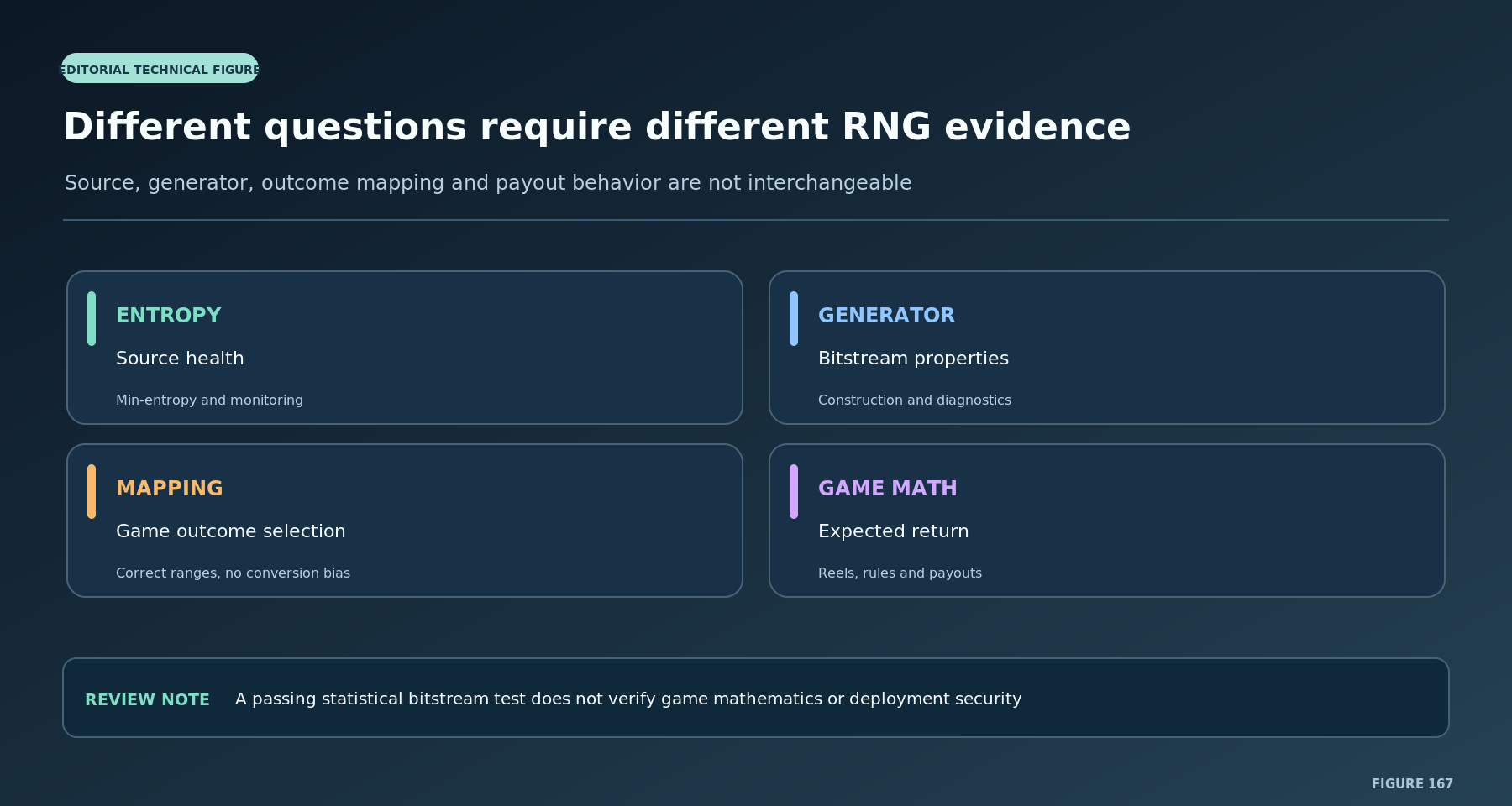
Randomness assessment has several distinct layers. Source assessment asks about entropy and health monitoring. Generator construction review asks how the random-bit mechanism is initialized, protected and used. Output analysis asks whether observed streams show unexpected distributions or dependencies. Game mapping review asks whether converting raw random values to symbols, stops, cards or rewards introduces bias. Mathematical model review asks whether the resulting probabilities and payouts implement the specified game.
These layers do not collapse into one green pass/fail flag. NIST’s SP 800-90B addresses entropy sources and their validation. SP 800-22 Rev. 1a describes statistical tests for random and pseudorandom outputs, but statistical appearance alone is not a security proof. For a game, successful RNG bitstream tests also cannot replace unbiased mapping tests or comparison of implemented payout behavior against the approved mathematical specification.
Use the RNG Statistical Testing in iGaming guide for hypotheses, sample planning, goodness-of-fit, serial dependence, multiple comparisons and a worked sample report. Complement it with the existing guides to RNG construction, rejection sampling and Monte Carlo RTP testing. Where actual certification is required, follow the approved laboratory’s requested methods and provide the exact game and generator versions.
API contracts, load testing and benchmarks: reading path
An integration that accepts a well-formed request can still produce an incorrect financial effect. Separate syntactic contracts, semantic contracts and operational characteristics. Syntactic checks inspect types, required fields and schema versions. Semantic checks cover transaction identity, amount precision, currency, permitted callbacks, response codes and replay behavior. Resilience tests exercise timing, duplicate messages, connection loss and ambiguous outcomes. Load tests measure behavior at defined workloads rather than declaring a universal capacity figure.
The OpenAPI specification supports machine-readable descriptions of HTTP interfaces. Tools such as Pact help coordinate consumer expectations with provider verification. Neither documentation nor an isolated contract suite eliminates the need for end-to-end financial reconciliation. Record the expected contract version, provider build, consumer version, fixtures and negative tests; publish results against those identifiers.
Read Contract Testing for Casino Provider APIs before a provider upgrade or SDK change. To interpret performance measurements, distinguish controlled test throughput from production capacity; disclose payload sizes, client mix, data distribution, geographic path, warmed caches, error rates and saturation criteria.
Release evidence, retesting and traceability: reading path
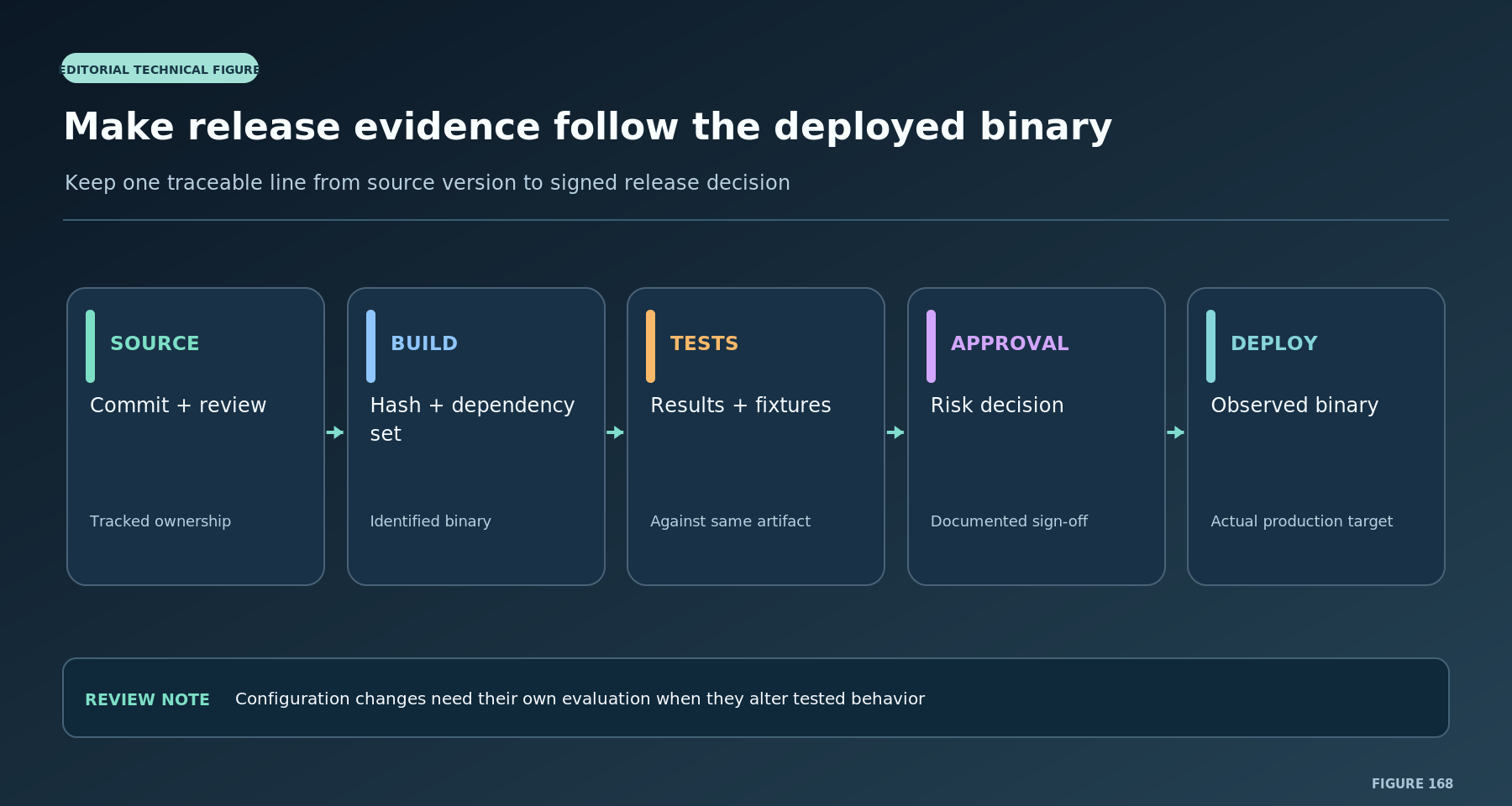
A release evidence package should allow someone who did not attend the sprint review to answer: what exactly changed, who approved it, what was tested, what was deployed, and what evidence links the running binaries to the tested versions? Connect source revision, dependency manifest, build provenance, artifact hash, configuration version, test suite result, review sign-off and deployment record. The evidence chain matters even if no formal certification obligation applies.
A previously tested binary can behave differently after a configuration change, provider contract change or runtime dependency update. A mathematically equivalent code refactor might still need regression evidence. Change classification and retesting requirements vary by regulator and adopted standard. Treat “minor change” as an assessment outcome supported by a version-specific process, not a developer-selected label.
The follow-up research guides cover software-update retesting and release traceability. They explain how to preserve evidence without logging player secrets, how to record exceptions without rewriting history and how to perform a rollback without losing auditability.
How to read results, sources and standard revisions
Check a document’s date and its authority. An older white paper may still explain a sound statistical method, but cannot establish today’s adopted regulation. A manufacturer’s specification is useful for describing a feature, not proof that a particular installation has it enabled. Lab reports should identify tested artifacts and limitations; synthetic performance results should identify the model and harness. Wherever results are illustrative, this library labels them as such.
For a numerical result, ask for sample size, unit of analysis, confidence or uncertainty statement, selection method and data exclusions. For a security statement, ask which threat model, key handling and runtime conditions it covers. For certification, ask which standard edition, authorized body, jurisdiction and software build are in scope. If the answer cannot be traced, treat the statement as editorial background rather than deployment evidence.
All technical research articles
The research collection begins with Contract Testing for Casino Provider APIs, iGaming Software Certification and RNG Statistical Testing. Its planned follow-on topics include GLI-19 technical requirements, UKGC RTS 7 random outcomes, software change retesting and release traceability; verify which pages have been published before inserting live navigation links.
A sensible reading route begins with the system’s highest-risk uncertainty, not whichever article has the longest checklist. For an API upgrade, start with contract testing and transaction identity. For a new game build, start with mathematics, RNG mapping and release evidence. For market launch, begin with the actual jurisdiction and its testing strategy. The goal is not more tests for their own sake: it is stronger, reviewable evidence behind each engineering and release decision.