iGaming software certification is not one universal stamp that can be attached to every online casino product in every market. It is a controlled evaluation process whose meaning depends on the jurisdiction, the technical requirements adopted there, the assessed system boundary, the version of the software and the decision issued by the relevant body. A laboratory may evaluate a particular game build or platform component; a regulator or licensed operator may impose additional operational obligations that the laboratory report does not settle. Treating those distinct decisions as equivalent creates a serious release risk.
This guide provides an engineering view of certification: how to define scope, identify actors, assemble evidence, structure test streams, resolve findings and maintain the version linkage after the first successful evaluation. It does not offer jurisdiction-specific legal conclusions or claim that any example below guarantees approval. Always check the current law, regulatory guidance, adopted standard edition, laboratory accreditation scope and your licensed operator’s obligations.

What certification covers and what it does not
A certification claim is only as broad as its actual scope. A report might cover game rules, the implementation of a random-number generator, payout calculations, selected wallet callbacks, software integrity controls or a specified system configuration. Different assessments may examine different subsets, and the assessor’s conclusions are conditioned on the test plan and evidence collected. Avoid broad marketing language such as “our whole platform is fully certified” unless the actual decision and covered components warrant it.
Certification generally does not transfer automatically to an arbitrary future version. If the certified build uses one game math package and a later deployment uses another, the previous result is not proof of the new behavior. An infrastructure change may have different consequences depending on its risk and jurisdiction. Likewise, an accredited lab’s analysis of RNG output does not establish that deployment secrets, live infrastructure, game configuration controls and transaction reconciliation are all correct.
A useful scope record specifies the applicant and product, market, relevant standards, assessed components, exact binaries and hashes, configuration and RNG/math versions, third-party dependencies, environment, exclusions and approved changes. The record also identifies who owns the release decision; a lab can produce a technical finding without having the same legal authority as the regulator or licensee.
Applicable jurisdictions, labs and actors
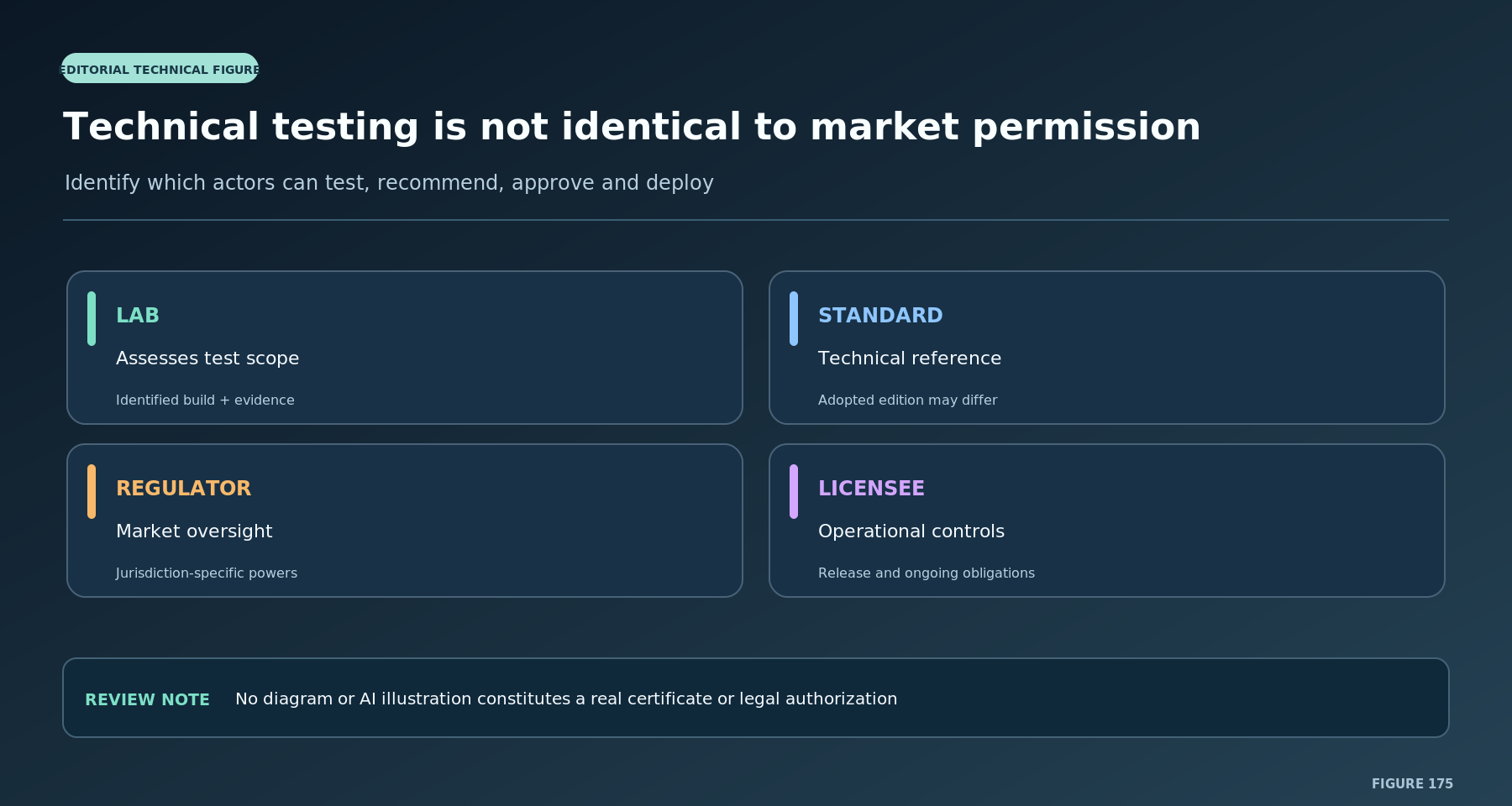
Start with the specific jurisdiction and product classification. Great Britain’s UK Gambling Commission (UKGC) publishes remote gambling and software technical standards and an associated testing strategy. Its test-house information explains when appropriately accredited providers are required. This is an example of jurisdiction-specific governance, not a model to be assumed in every market.
Independent testing bodies may work against sector standards as well as regulator-defined requirements. The Gaming Laboratories International standards catalog currently lists GLI-19 Interactive Gaming Systems v4.0; an adopted local edition may differ, and changes to an international standard do not by themselves prove immediate local adoption. Always record the reference document’s version, effective date and jurisdictional modifications.
Typical actors include the applicant (developer or supplier), the licensed operator, its compliance and release teams, an independent laboratory where required, and a licensing authority where it has an approval or oversight role. Their responsibilities may overlap technically but should not be collapsed procedurally. The person writing the game code should not be the sole authority deciding whether exceptions to a certified math model may be shipped.
Before contacting a laboratory, prepare the market and scope briefing: which products, platforms and environments are included; whether mathematical models or RNG components are shared; the identified builds; supported configurations and currencies; expected third-party endpoints; and any prior results being reused. Ask the prospective lab whether the requested activity is within its relevant approval or accreditation scope, not merely whether it has gaming-industry experience.
Test planning and evidence packages
The test plan should map each requirement to a component, method, expected evidence, owner and completion criterion. Traceability is not bureaucracy added after the tests. It is the mechanism that keeps a report tied to the software that will actually ship. For each component, preserve source revision, reproducible or controlled build details, artifact hash, dependency inventory, environment specification, configuration package, math sheets, relevant test logs and issue disposition.
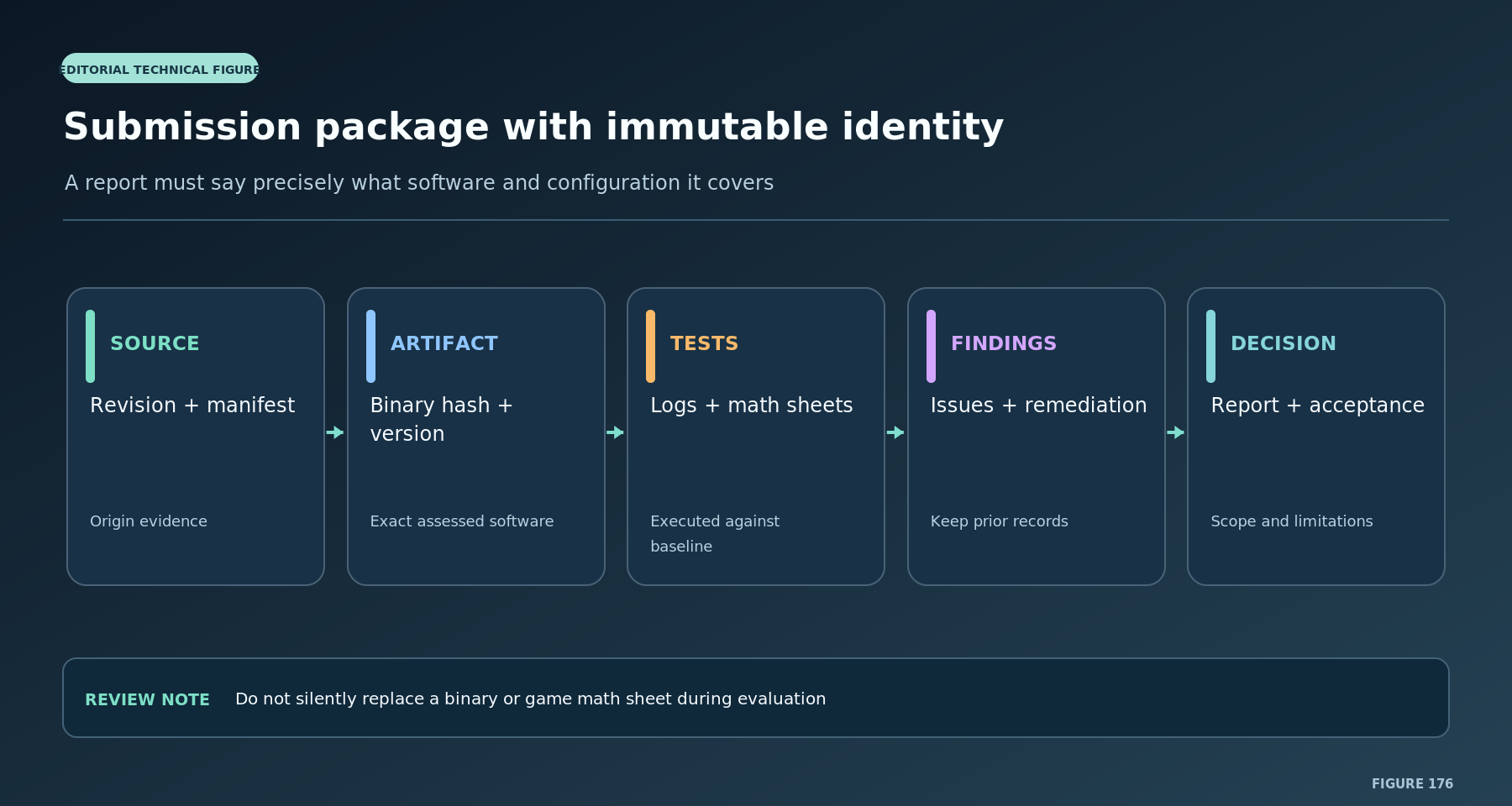
An effective package also includes readable design documentation. Explain game states and settlement, bet limits, bonus triggers, mapping from RNG output to game outcomes, transaction identities, currency and amount representations, jackpot behavior and customer-facing rules where relevant. Provide a deterministic mechanism for reproducing test conditions without exposing production secrets. A test build may support instrumented outcomes, but instrumented modes must be clearly segregated from any production executable and included in the evaluator’s agreed methodology.
For the laboratory, prepare a stable submission baseline and a known point of contact for questions. Last-minute edits to binaries, math tables or server configurations can invalidate evidence or trigger fresh testing. Introduce a controlled change request rather than quietly substituting a “small fix” while the submission is under review. Capture the reason and risk classification whenever a previously certified component is reused as evidence.
Functional, security and RNG test streams
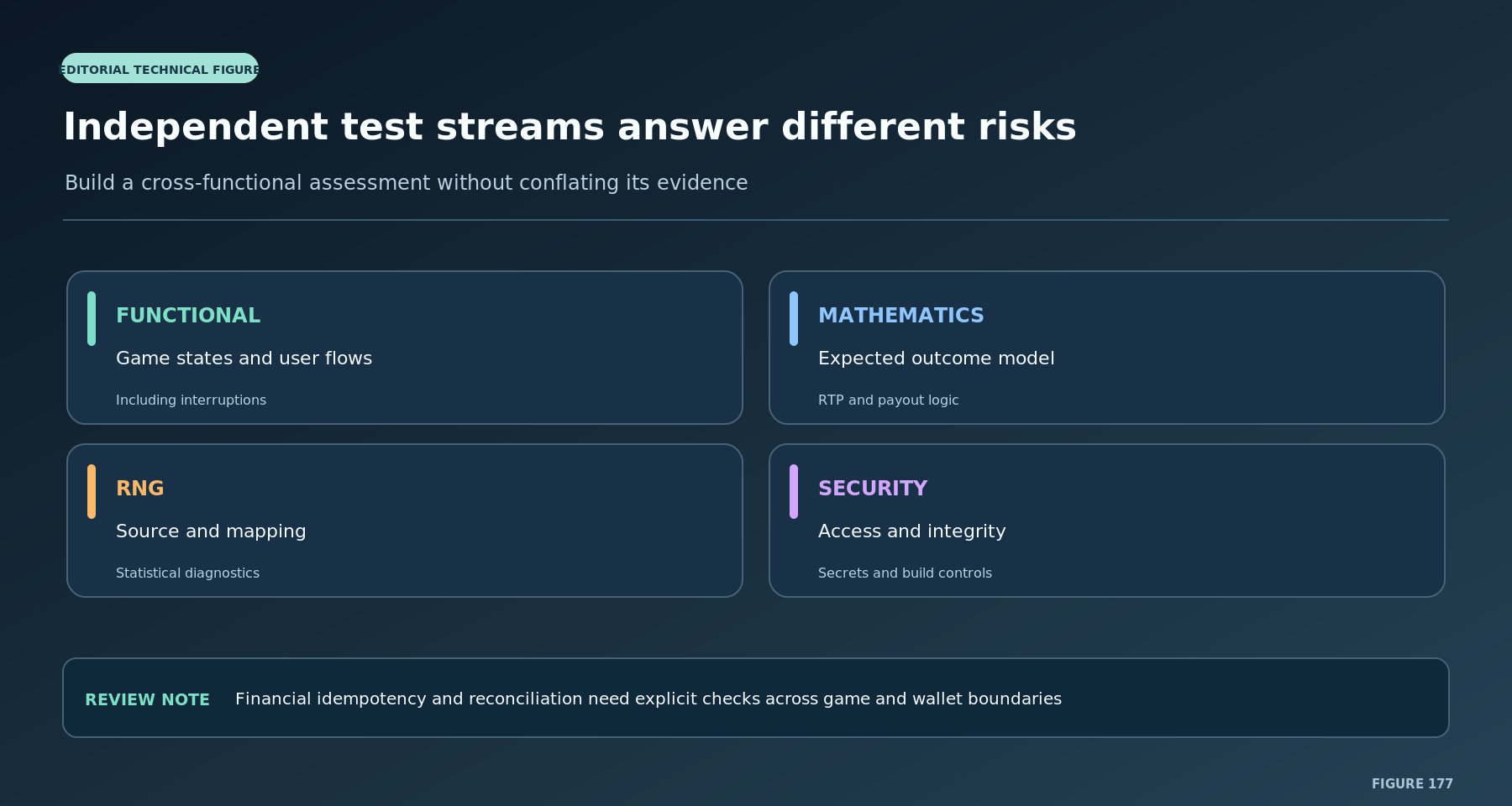
Functional testing checks gameplay rules, state transitions, permitted limits and the observable behavior of the system. It can include interrupted rounds, duplicate requests, refunds, disconnections and consistency of displayed and authoritative results. Mathematical testing checks the specified probabilities, symbol/reel mapping, win evaluation and expected return; a long simulation is useful but may not replace independent theoretical analysis.
RNG assessment is distinct from mathematics. It may include generator construction, entropy or seed handling, statistical diagnostics and game outcome mapping. NIST SP 800-90B deals with entropy sources, while SP 800-22 Rev. 1a provides statistical testing methods. Those publications are methodological references, not a blanket statement that a particular iGaming jurisdiction requires every NIST test or that passing such tests proves unpredictability.
Security review addresses trust boundaries, privilege management, deployment integrity, key handling, logging, third-party code and operational controls, to the extent required by the assessment. Financial correctness often crosses the streams: a perfectly random outcome has no value if wallet callbacks can credit the same win twice. Arrange cross-functional test cases that span game logic, wallet ledger, external provider callbacks and reconciliation while maintaining a clear boundary between unit, integration and full operational evidence.
The lab or regulator may specify actual test methods, sample sizes and reporting formats. A useful internal pretest harness can reduce surprises, but it should not be described as an external laboratory certificate. Label every internal metric as internal; distinguish controlled tests from production measurements; record the exact time, dataset and software version for both.
Findings, remediation and certification decisions
A nonconformity is more useful when it names the violated requirement, tested build, reproducible steps, observed behavior, expected behavior and severity rationale. A finding that “the game sometimes hangs” is not actionable. A finding that a canceled round remains settleable after a particular callback ordering, with a reproducible event trace and versioned fixture, gives engineering and laboratory teams a shared problem statement.
Triage a finding by impact on game fairness, fund integrity, security, correctness and user harm. Create a controlled remediation branch or fix, run targeted regression plus neighboring tests, and submit replacement artifacts with hashes and a change narrative. Do not overwrite earlier logs: traceability requires a clear trail from initial finding to approved correction, including any unresolved risk accepted by an authorized decision-maker.
A test report is not automatically the entire market authorization. Identify exactly what the output document says: laboratory test result, certificate of conformity, assessment report or advisory observation. Its acceptance and the product’s launch eligibility depend on the legal and licensing framework. The UKGC testing strategy, for example, separately discusses testing procedures, laboratory results and permitted in-house controls; a project should follow those actual procedures rather than substitute a generic sign-off meeting.
Version-specific obligations and maintenance
Certification evidence has a lifecycle. After approval, track source changes, game math versions, RNG libraries, compiler and runtime changes, provider interfaces, feature flags and configuration values that might affect the assessed behavior. A release gate should decide whether each change requires regression evidence, third-party retesting, regulator notification or another documented action. The decision must reference the market and currently applicable testing strategy, not a permanent informal rule that “patch changes are always minor.”
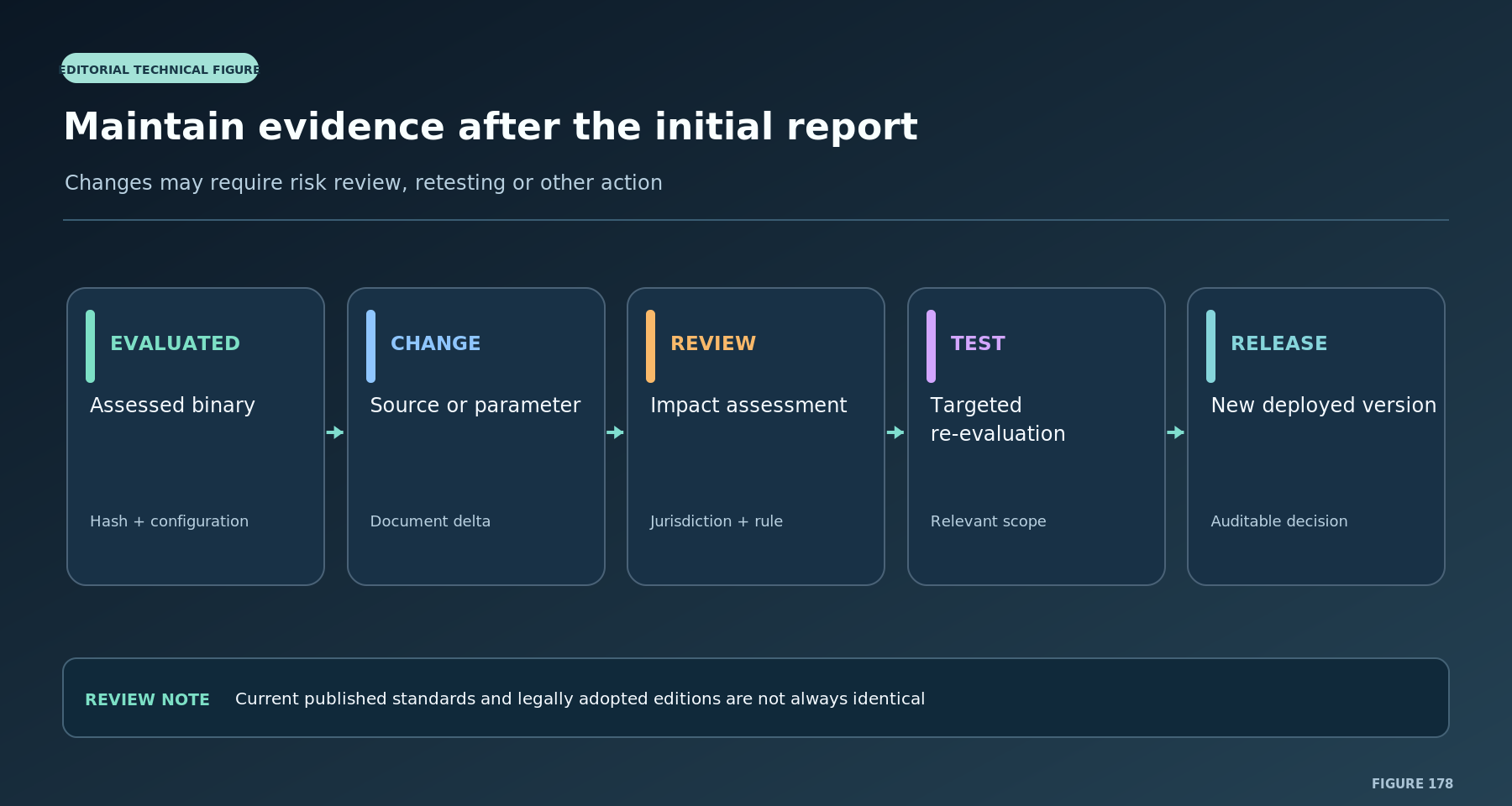
A practical version record has immutable identifiers for submitted binary, hash, game rules package, RNG implementation, configuration, test report, findings, approvals and deployed release. If the deployment uses a different version, expose the mismatch as a release blocker or a review exception with an owner. Store audit artifacts with access controls and retention appropriate to their sensitivity and legal requirements; data minimization still applies when capturing evidence.
Plan for changes in standards too. A document may be revised before all jurisdictions adopt it. Track “published reference,” “adopted edition,” “effective date” and “internal evaluation baseline” as separate fields. Reconfirm the current status before the next submission. Certification then becomes a maintained chain of accountable decisions rather than a one-time badge whose meaning gets weaker with each release.
For publication, this guide remains a general engineering framework. It should be read with current primary-source requirements and the actual laboratory’s scope and instructions; it is not a regulatory opinion and cannot certify any product by itself.