A regional outage is not merely a traffic-routing problem for an iGaming platform. A game may be running in a browser, a provider may be processing a wallet callback, and a ledger may have committed a bet whose response never reached the caller. Redirecting requests to another region without considering those states can turn a short infrastructure failure into duplicate transactions, unresolved rounds and difficult reconciliation work. High availability begins by defining what must continue, what must pause and how correctness is preserved when infrastructure disappears.
An important distinction: availability means users can complete a defined journey, while consistency means the platform reports and applies business state correctly. A page that opens during a database outage is not proof that a financial operation is safe to accept. Likewise, a temporary pause on new wagering can be the correct behavior if a platform cannot establish single-writer authority for an account. For money-state guarantees, see Casino Wallet Architecture and Idempotency in Bet and Win APIs.

Availability requirements and failure domains
Write requirements in user journeys, not only in infrastructure percentages. For example: a player can authenticate and see the lobby; an existing session can read its status; a new round can start; a provider can settle an already placed bet; the operator can freeze a suspect account; finance can retrieve an audit trail. Each journey crosses a different set of services and has its own permitted degraded modes.
Map failure domains from smallest to largest: a process, a container node, a database replica, a network zone, an availability zone, a region, an identity provider, an external game provider and a shared control plane. Multi-region design does not help if every region depends on one global authentication gateway, secrets store, DNS control plane or payment connector without a fallback. Draw the dependency chain for the critical journey and mark what happens when each dependency is unavailable.
An architecture diagram should distinguish stateless services from stateful authorities. A web frontend is relatively easy to start in a second region; a wallet ledger is not. A session manager may need to preserve token validity, provider-side session identifiers and current configuration version. A reconciliation process may need to operate even when new round creation is disabled. Separate “continue accepting new work” from “finish or recover work already accepted.”
Do not promise a blanket 99.99% service level without specifying the scope, measurement window and exclusions. A meaningful SLI might be the fraction of valid bet requests that receive an authoritative final result within a defined deadline. A simple HTTP 200 rate ignores cases where the system returns a success page but fails to record the wager. Reliability budgets should be linked to these business-level outcomes.
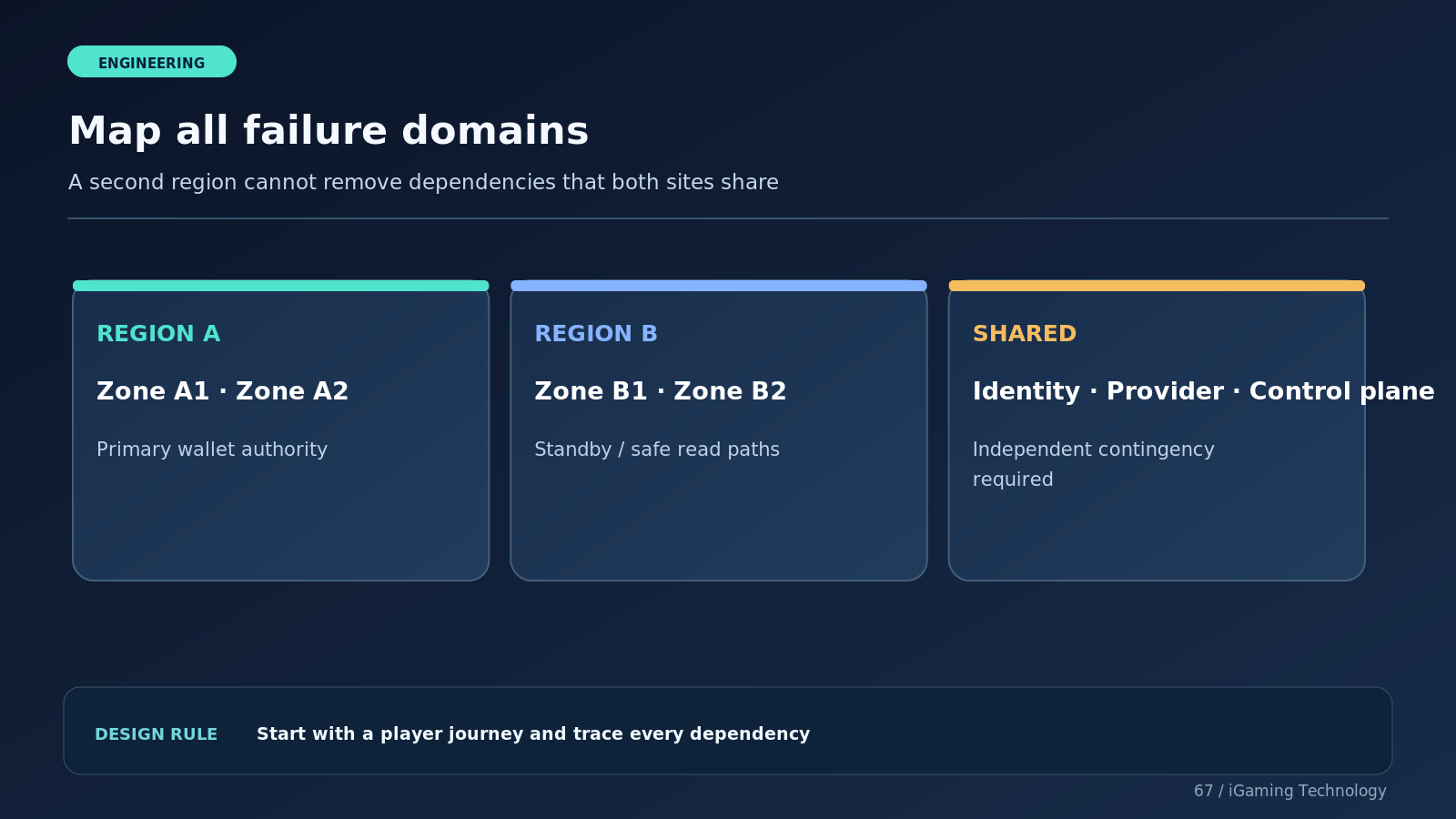
Active-passive versus active-active regions
In active-passive, the primary region serves traffic and a prepared secondary region waits to take over. The passive side may be a pilot-light footprint, scaled-down warm standby or a fully provisioned but idle environment. A warm standby trades standby cost for faster capacity restoration; its recovery speed still depends on data replication, routing changes, credential availability and tested orchestration.
In active-active, two or more regions serve traffic at the same time. This can improve regional latency and reduce reliance on one site, but it makes state ownership more difficult. If the same wallet account can be written independently from two regions, conflicting debits and balance races become possible. Some architectures use account-level regional affinity, single-writer partitioning or consensus-based storage to maintain a clear authority. Others restrict active-active to stateless and read-only operations while financial writes remain single-region per account.
A useful hybrid often separates planes. The lobby and static catalog can be served from multiple regions; game orchestration may route sessions by assigned home region; wallet posting follows a single-writer policy; analytics can replicate asynchronously because reporting latency is tolerable. Treat these as design options, not guarantees of universal suitability. Contractual and regulatory limits can constrain where game and player records may be processed or stored.
Capacity planning matters as much as topology. A nominally healthy secondary region that can handle only 20% of ordinary load will not sustain a full failover without shedding traffic. Define what is shed first: marketing content, noncritical queries or expensive optional analytics before essential wallet and settlement functions. Measure cold caches and database connection storms during tests; they often dominate first-minute recovery behavior.
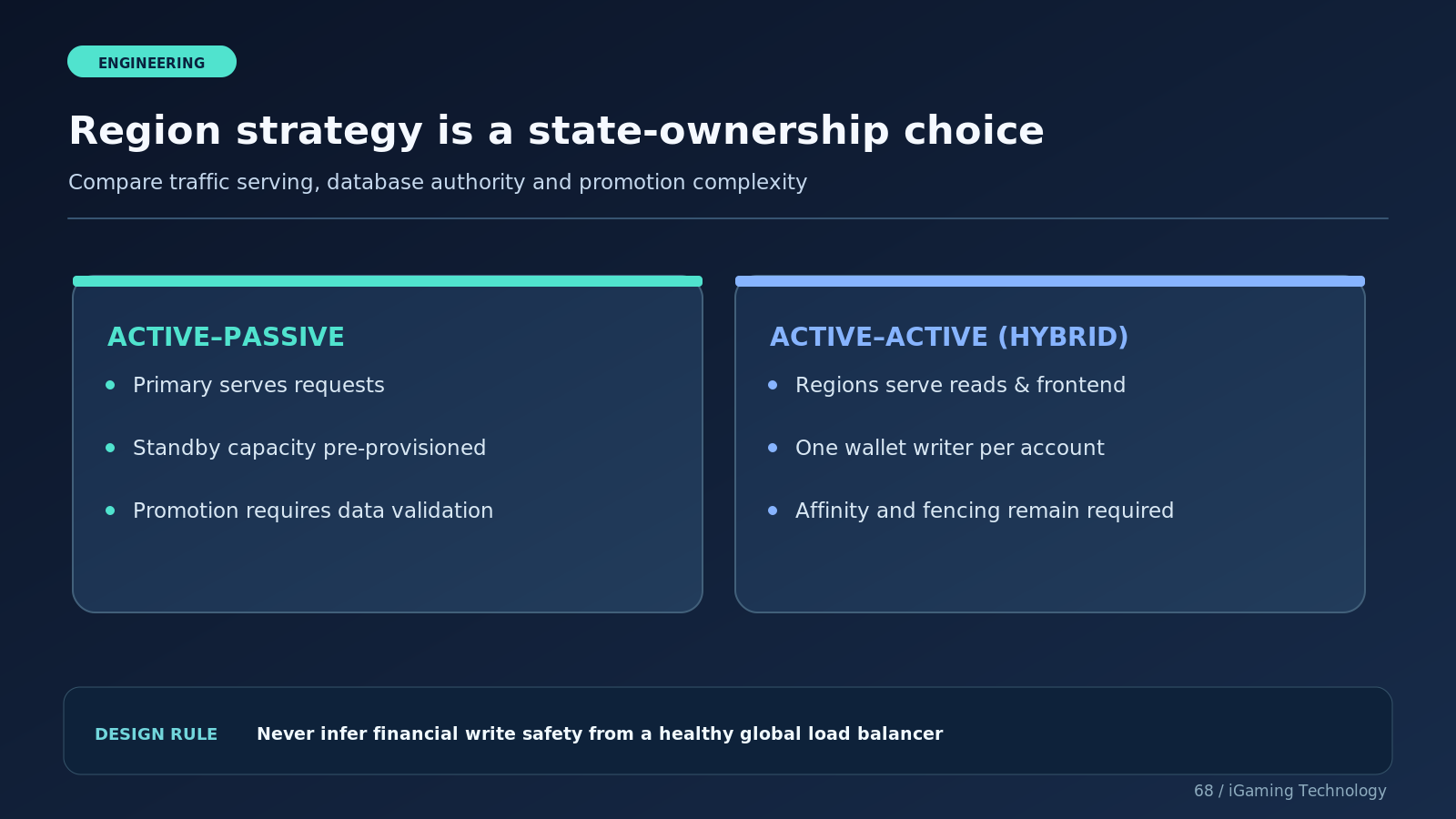
Replication, quorum and consistency constraints
For transaction state, replication semantics determine what can be lost or observed after a failover. Asynchronous replication allows the primary to acknowledge before a remote replica confirms persistence; therefore an acknowledged write may not yet be present in a newly promoted replica. Synchronous or quorum-based schemes can reduce the unreplicated window but add latency and may sacrifice write availability during inter-region partitions. The trade-off is specific to the data system, placement and fault model.
A single wallet update should have a stable transaction identity and durable accounting entries. If an API response times out during a region transition, the caller must be able to query or retry safely using the same identifier. The failover controller must not expose two independent authorities for the same account. Fencing tokens, leadership epochs or comparable mechanisms can invalidate an old leader that returns after a network partition. A DNS switch alone cannot fence a database writer.
Session state introduces another layer. An in-flight game session may reference an RGS-specific token, a provider endpoint or a versioned game configuration. Copying the browser session cookie does not necessarily re-create provider session state. Recovery logic should distinguish “resume,” “read final outcome,” “settle pending callback” and “start a fresh session.” At the provider boundary, negotiate which callback endpoint receives late results after a regional switchover and how transaction identifiers survive the move.
Backups are necessary even with replicas. Replication can faithfully copy accidental deletes, corrupt data or destructive administrative actions. Maintain tested point-in-time recovery, access separation and immutable or protected backup copies where appropriate. Document which data groups require consistent restore points, including outbox records and ledger tables needed for replay or financial proof.
RTO, RPO and disaster recovery playbooks
Recovery Time Objective (RTO) is the targeted maximum duration to restore a defined service after an incident. Recovery Point Objective (RPO) is the tolerated amount of data loss measured in time. Neither target is automatically achieved by buying a multi-region service. Both must be translated into recovery procedures and tested against worst credible failures.
As an illustration, a team might set an RTO of 15 minutes for non-financial dashboards, five minutes for lobby browsing and a stricter objective for already accepted wallet settlements. It might allow minutes of lost rebuildable analytics projections but target no loss of acknowledged ledger entries. These are examples, not recommended universal numbers. Define the business and regulatory implications of each proposed limit.
A usable playbook names the incident commander, technical approver, failover trigger, data-consistency validation, promotion procedure, traffic-shift owner, provider communications and rollback trigger. Precompute the decision: if replicas are behind, is it safer to suspend wallet writes than to promote immediately? If the identity service is down, can existing sessions continue with limited permissions? If a provider callback arrives at a former region, how is it acknowledged without posting twice?
Include a return-to-primary procedure. “Failback” is another migration, often riskier than the first switch because the old primary may contain divergent data. Verify reconciliation status, replay backlog, account-writer ownership and external provider routing before restoring ordinary traffic. Preserve all operator actions as incident evidence.
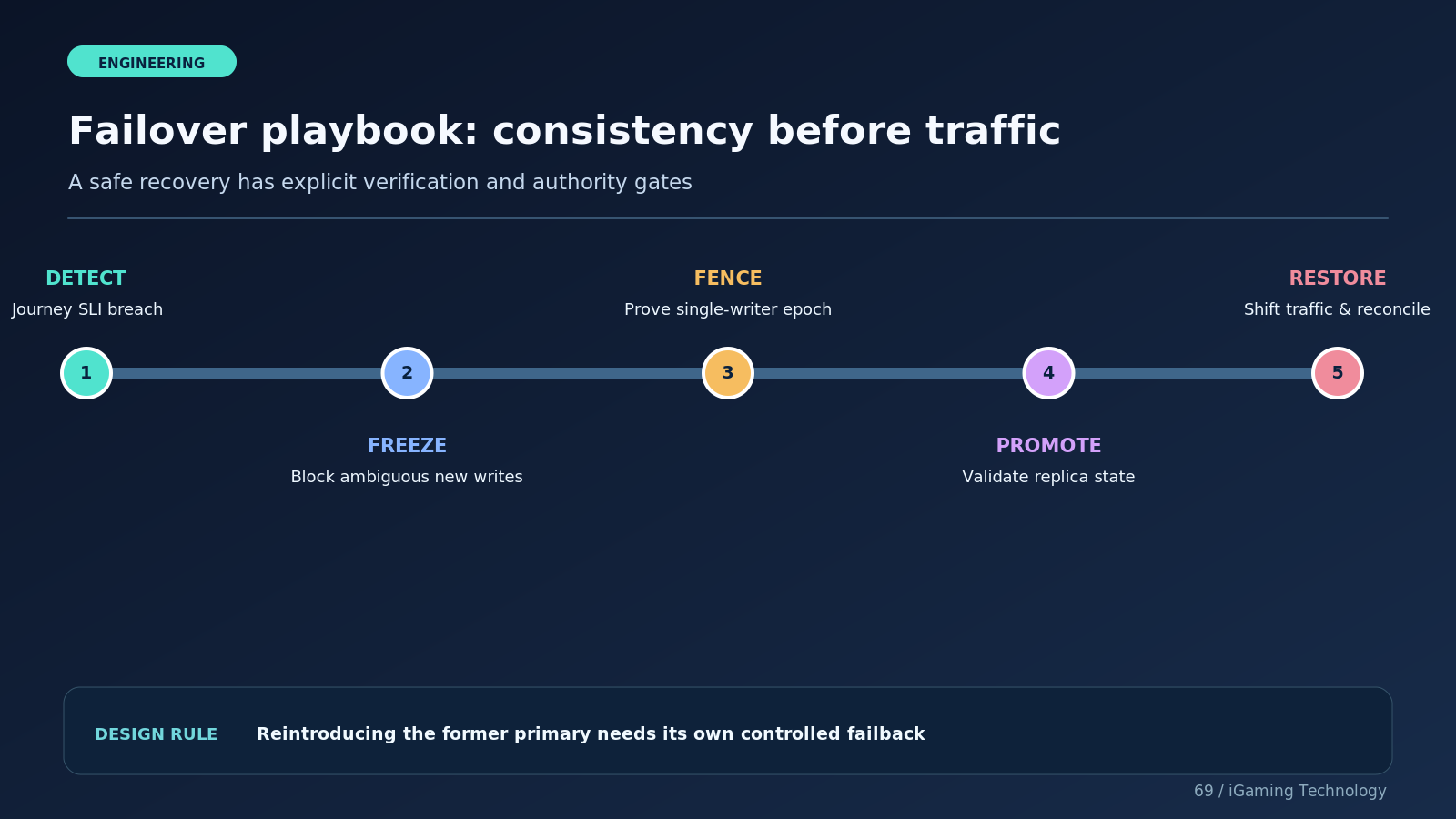
Failover/fencing and split-brain prevention
Split brain occurs when two components both believe they are entitled to act as the primary authority. For read-only content this may cause stale pages; for wallet writes it can produce conflicting account histories. A regional network partition is particularly dangerous because both sites may still be running and locally healthy. The health probe that says “process alive” is not sufficient evidence of leadership.
A robust failover sequence normally quiesces or rejects new writes on the old authority when feasible, confirms the leader lease or fencing epoch, validates candidate replica state, promotes exactly one successor and then opens write traffic. If the system cannot prove authority, it should fail closed for money movement while continuing safe read-only paths. Provider callbacks during the transition need durable buffering or repeatable acknowledgement semantics and a reconciliation queue.
Do not confuse idempotency with fencing. Idempotency can prevent the same business instruction from posting twice at a single authoritative storage boundary; it does not necessarily resolve conflicting writes to two independently active ledgers. Likewise, eventual convergence is not a safe replacement for immediate account-balance constraints when money is at stake.
Design for partial recovery. Maybe the lobby is back but the provider VPN is not; maybe account reads work but posts do not; maybe one jurisdiction is restricted to a region that remains unavailable. Your load balancer, feature controls and incident dashboard should communicate these separate states rather than reporting a misleading universal “green.”
Failure drills and architecture decision matrix
Exercises should inject the failures that matter: kill the active wallet process, isolate a zone, block primary-to-secondary replication, fail a provider DNS endpoint, corrupt a configuration cache, overload the standby capacity and reintroduce the old leader after promotion. Record observed RTO, actual missing or delayed data, callback retries and financial reconciliation outcomes. Repeat after major architecture or provider changes.
A compact comparison helps stakeholders choose a model:
| Architecture | Operational complexity | Write-consistency burden | Typical fit |
|---|---|---|---|
| Single-region with zone redundancy | Lower | Local authority relatively simple | Services with acceptable regional outage risk |
| Active-passive with warm standby | Medium | Clear writer during steady state; careful promotion | Financial core prioritizing single-writer control |
| Active-active reads, single-writer wallet | Medium–high | Wallet authority still centralized by key | Multi-region user experience with strict money controls |
| Multi-region active-active financial writes | Very high | Requires proven distributed consistency design | Only when justified and validated against fault model |
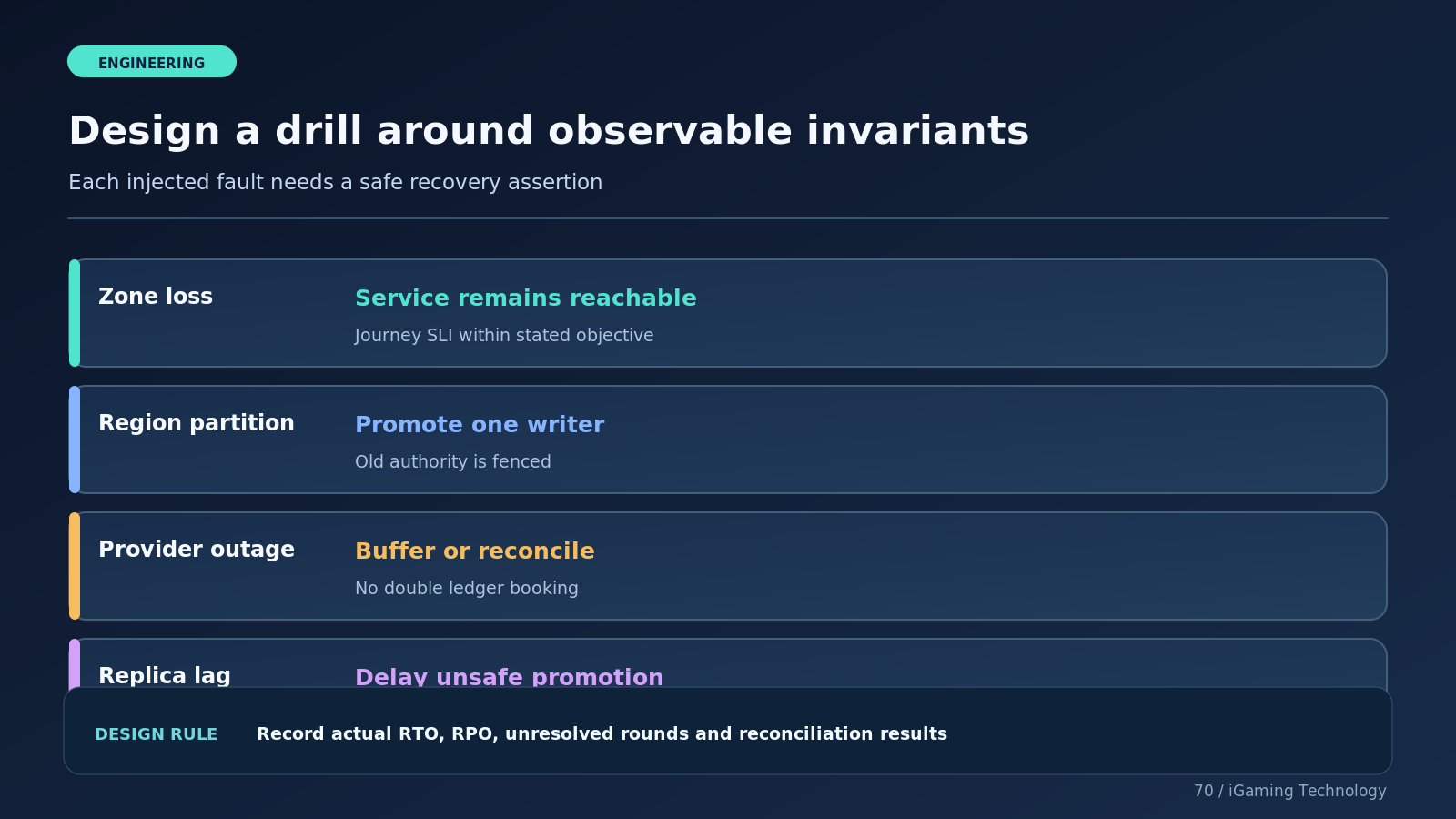
A strong review asks: Is there exactly one active wallet writer per account? Can we prove the RPO for acknowledged posts? Can pending game rounds be recovered without double settlement? How long until secondary capacity is truly usable? Does recovery require a shared control plane that may be down? Who can authorize a financial failover, and where is the evidence captured? These questions are more predictive than a generic claim of multi-region readiness.
Technical references
- AWS Well-Architected: recovery strategies — backup and restore, standby and active-active trade-offs.
- AWS disaster recovery overview — planning patterns and recovery objectives.
- Google SRE workbook: implementing SLOs — reliability measurement and ownership.
Editorial note: DR objectives and the example topology are illustrative. Financial recovery controls and jurisdictional constraints require implementation-specific review.