A progressive jackpot looks simple from the outside: eligible activity adds value to a shared pool, then one qualifying event wins a prize. Behind that interface is a demanding distributed-systems problem. Many game instances can contribute concurrently, a winner may be selected during network failure, and wallet settlement may complete without its acknowledgement reaching the jackpot service. The consequence of a bookkeeping mistake is not merely a stale display; it can be a duplicated payout, an incorrect liability, or a disputed result.
A sound jackpot service architecture separates the jackpot’s authoritative economic state from its presentation cache and event feed. Each eligible contribution must have a stable business identity and a contractually defined amount. Winner selection must have a linearizable or otherwise explicitly serialized decision point. Payout and reset must preserve financial invariants even when requests are retried, applications restart or events are delivered more than once.
The following design is a conceptual reference for an operator- or provider-managed progressive jackpot. It is not a statement of a particular product’s mathematics, payout rules or certified operating procedure. The final transaction model, trigger method and cash-liability ownership depend on game rules, contracts and jurisdictional requirements.

Jackpot state and event sources
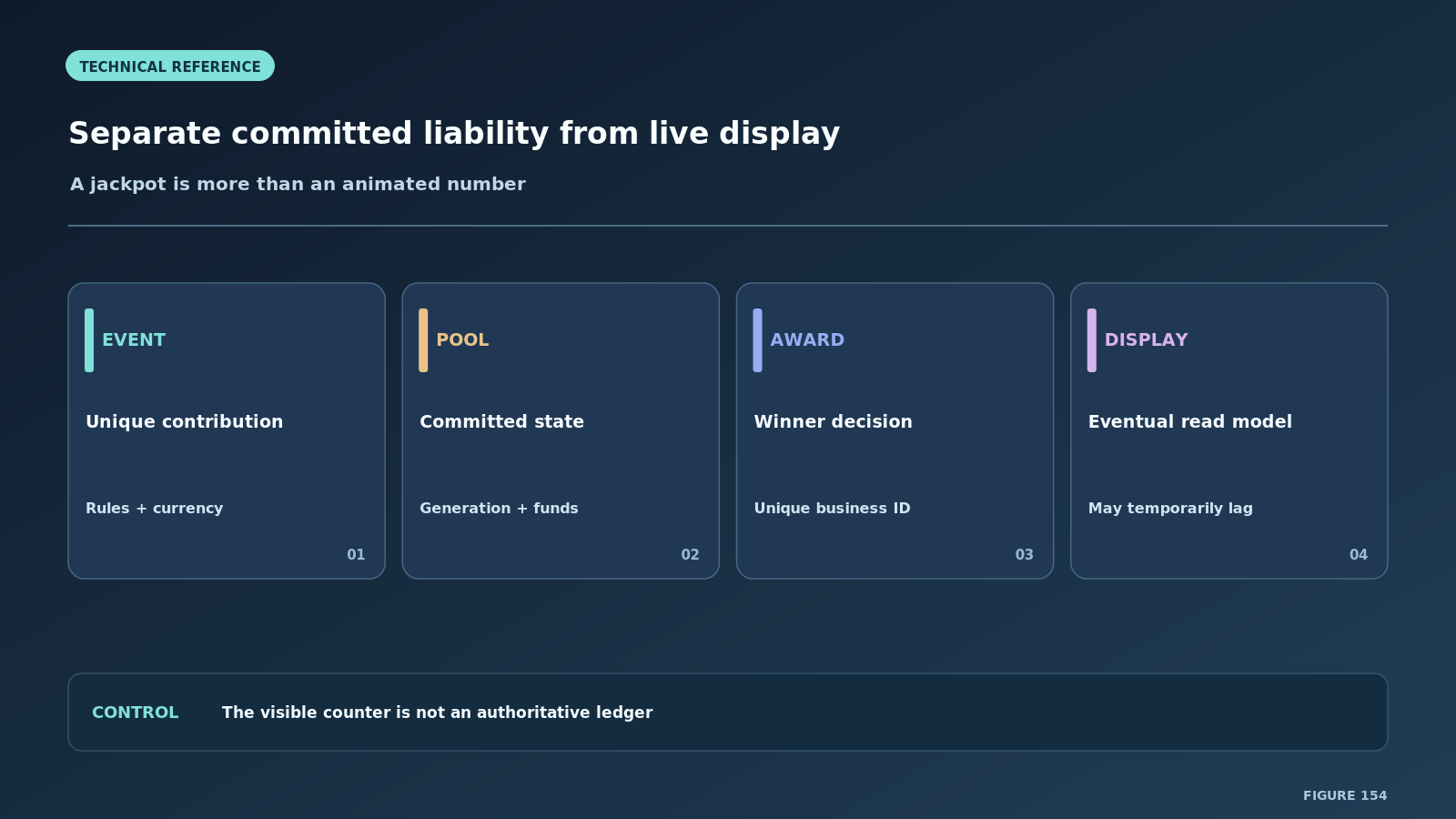
A jackpot system generally tracks more than a visible number. Its core records may include pool_id, currency, generation, seed_amount, eligible_contributions, available_pool, reserved_liability, award_id, rule_version and committed lifecycle state. The generation distinguishes one jackpot cycle from the next. Without it, a delayed contribution from a previous cycle can corrupt the amount shown after a reset. The exact fields vary with fixed, local and network-wide progressive models.
Contributions originate from approved game events, not from arbitrary UI animation. A provider callback may report an eligible stake component, a game result or a validated jackpot trigger according to the contract. A consumer must verify source identity, currency, eligibility, unique event ID, round identity, game/rule version and replay status. Do not calculate an additional contribution from every delivery of the same event; delivery guarantees and financial posting guarantees are different things.
For example, a normalized contribution command might carry source_event_id, pool_id, cycle_id, round_id, amount_minor, currency and rules_version. Amounts should be integer minor units or another exact fixed-decimal representation. Floating-point accumulation is unsuitable for authoritative balances. A separately maintained read model can display an approximate live total, but the client must not be able to write that value back as the pool’s financial truth.
The jackpot balance may reflect both contractual liability and an operating reserve, which should not be conflated. A visible marketing counter may include animated or estimated increments; a liability ledger must reflect only committed obligations as defined by the product’s rules. Decide whether a trigger locks the pool value before or after a particular contribution, then make that ordering explicit in the transaction protocol and tests.
Concurrency hazards and serialization guarantees
The classic failure is a lost update: two consumers read pool 1,000, each add 5, and both write 1,005 rather than 1,010. An atomic update in a transactional database can avoid that narrow problem, but a jackpot also has cross-record decisions: does a contribution belong before or after a trigger, which generation owns it, and can a second winner commit at the same time? Those questions need a consistent order of authority.
One practical model uses a single transactional writer or a database row locked per pool. In PostgreSQL, SELECT ... FOR UPDATE can serialize changes to the locked row, while transaction isolation and uniqueness constraints guard dependent records. A distributed lock held outside the database is not by itself a guarantee; lock leases can expire and multiple processes can believe they hold the resource. If external fencing tokens are used, every authoritative writer must enforce the token at the storage boundary.
An alternative model serializes pool events through a partitioned log and a single active processor per pool, but it still requires durable state, fencing across failover and a strategy for exactly-once economic effects. A message broker’s processing semantics cannot replace unique database constraints, idempotent wallet contracts or atomic jackpot award records. Even with an ordered event stream, rebalances and replay can reprocess messages.
Illustrative constraints include a unique key on (pool_id, generation, source_event_id) for contributions and on (pool_id, generation) for a terminal jackpot award. The database transaction that finalizes the winning generation should insert the award and advance the generation in one coherent decision. The winner is not “whoever gets the green success screen first”; it is the unique validated business action committed under the approved rules.
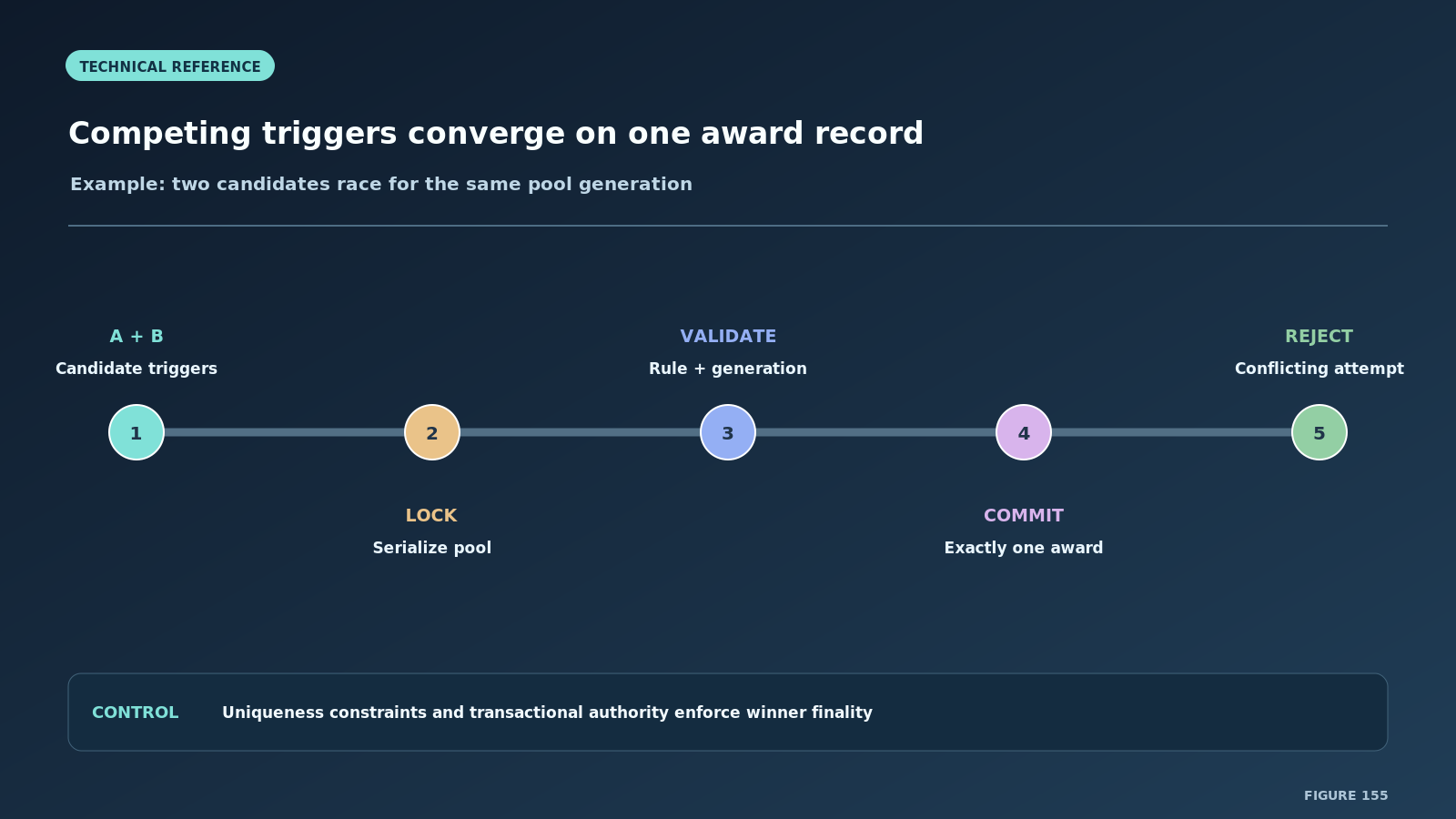
If the system can process several pool generations at once, carefully scope locks and unique constraints. A row lock on a summary total does not automatically serialize an update to another table. Design the transaction so the update, award insertion, cycle transition and outbox publication are consistent. Be explicit about isolation errors: SERIALIZABLE transactions can abort and require a safe retry using the original business identity.
Winner selection, finality and payout boundaries
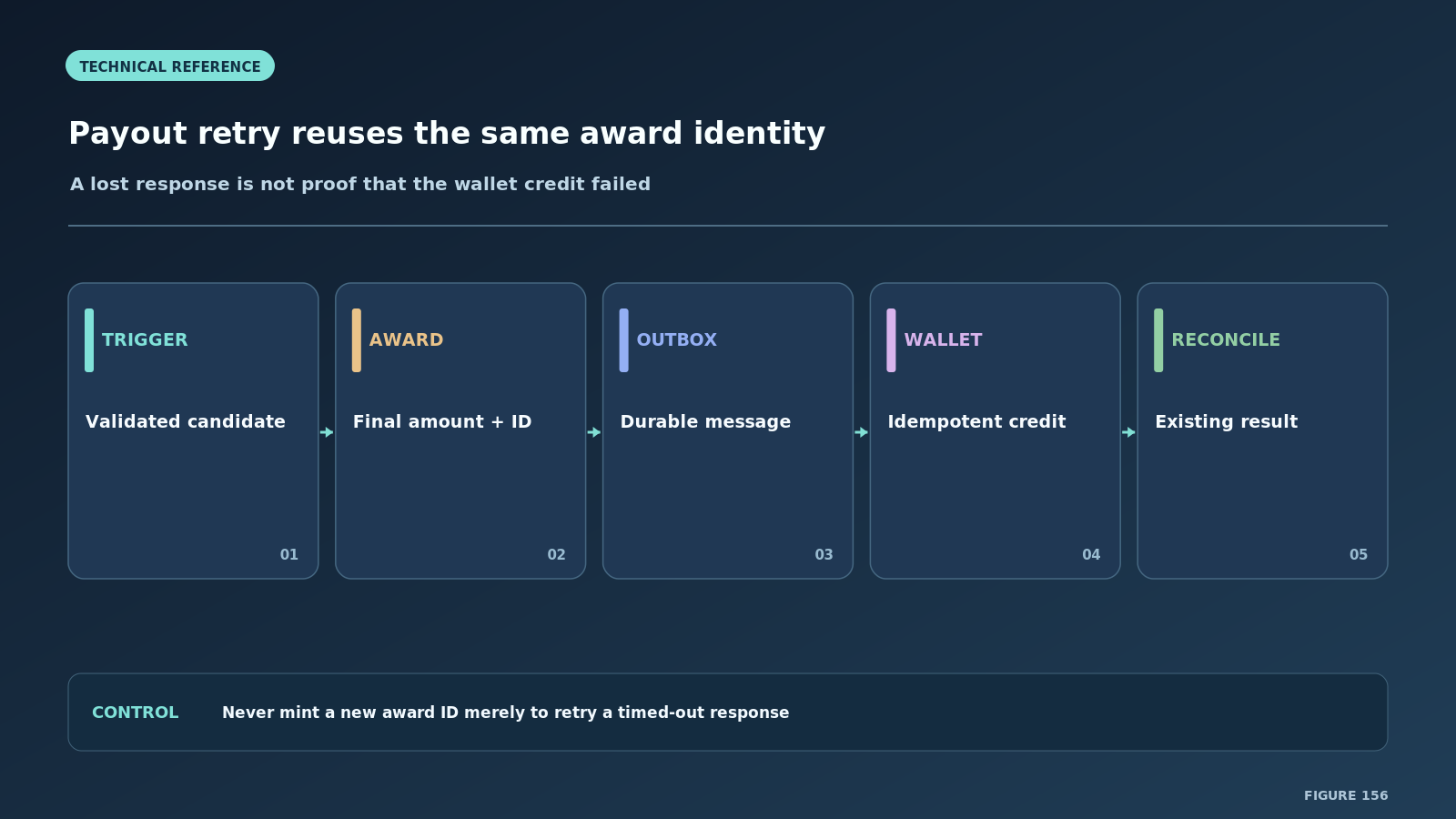
Winner selection and payout are distinct operations. The game authority may produce a validated jackpot trigger. The jackpot service validates eligibility and records a final award identity with a decided amount. The operator wallet or another financial authority then books the obligation under that award identity. A transport timeout between these stages is not proof that the payout failed. Reissuing a credit with a new identifier can pay twice.
A robust award lifecycle might be CANDIDATE, DECIDED, PAYOUT_PENDING, PAID, or EXCEPTION. Avoid a generic FAILED state that silently erases a final award decision when only acknowledgement was lost. Once DECIDED, the winner and amount should be immutable except through a formally audited correction process permitted by the game rules. The display can show a pending confirmation, but it must not choose a different winner to restore the user interface.
If jackpot and wallet share one database and transaction domain, atomic booking may be possible. If they are separate services, use a durable outbox or equivalent reliable publication and an idempotent wallet API. The wallet should accept an award_id that uniquely identifies the intended credit and return the original result on duplicate delivery. The jackpot service should reconcile PAYOUT_PENDING awards against wallet records, not invent a second liability after a timeout.
The jackpot reset deserves equal care. Is the next generation available immediately after the winner is decided, or only after the payout is confirmed? There is no universal answer, but the permitted transition must be explicit. A new generation must not inherit delayed events from the prior one, and its seed should be recorded consistently with the game rules. Display updates and celebratory animations happen after the authoritative decision, not as the decision mechanism.
Failure recovery and duplicate-event handling
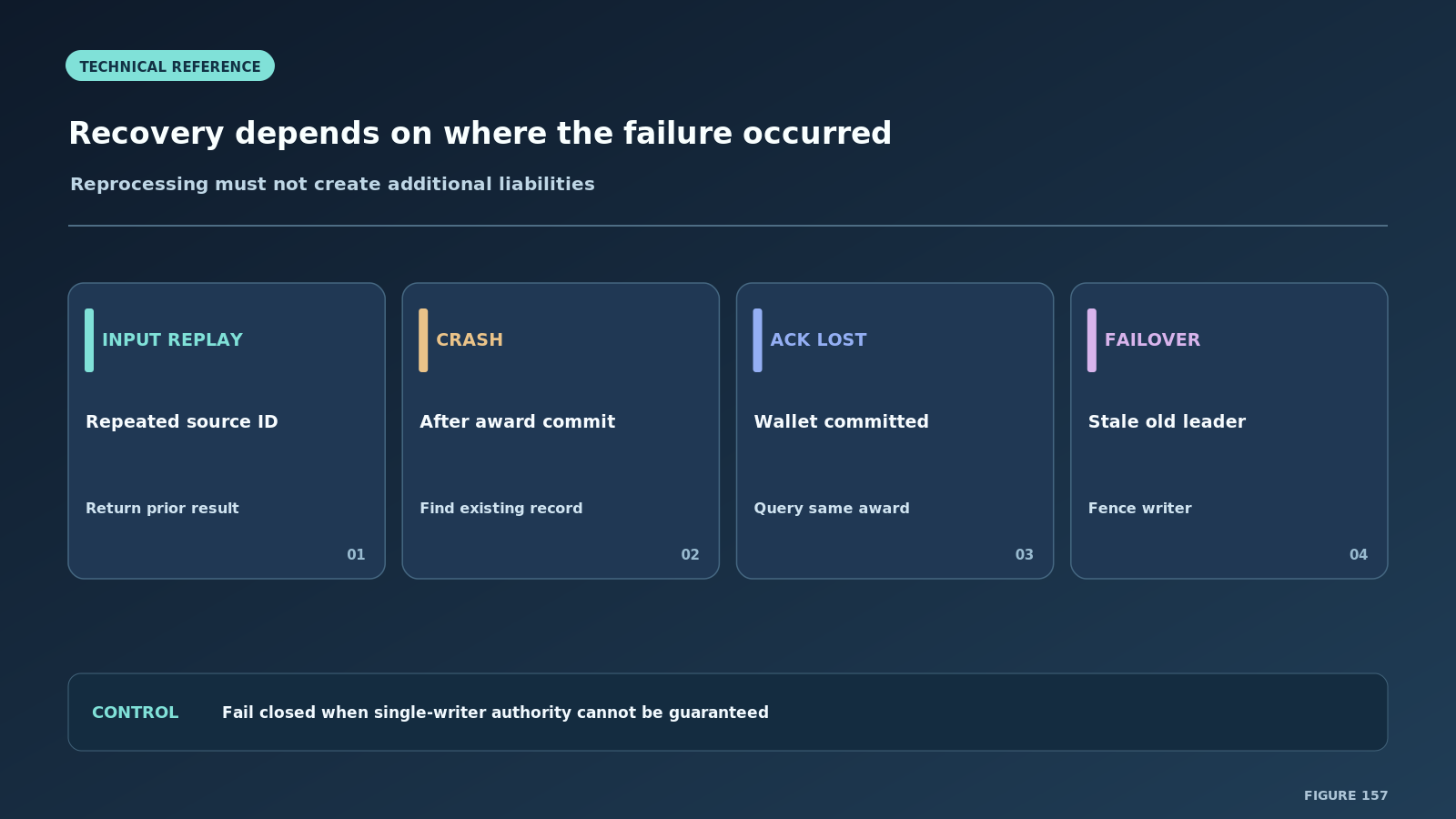
Test the awkward cases, not only the successful path. A callback can be delivered three times. A process can crash after inserting the award but before sending an acknowledgement. A wallet can commit a payout and lose its response. A standby processor can begin while the previous leader has not fully shut down. Each failure should have a bounded, documented recovery procedure that does not require an operator to guess whether money moved.
During replay, the service should first look up the event’s durable identity and prior result. For duplicates, return or publish the previously committed business result. For a genuinely late contribution whose cycle has already closed, the system must follow a defined exception or late-event policy; silently applying it to the new cycle can change liability. Where a durable event has not been applied, process it under the same pool serialization rules as new traffic.
Leader failover requires fencing at the datastore. A lock that exists only in process memory is not protection against an old leader waking up. Keep an epoch or term number and reject writes from stale leaders. Use readiness signals to stop unsafe writes on degraded replicas, and check how long asynchronous replication can lag. If the infrastructure cannot guarantee a single authority for a pool during a partition, rejecting or buffering economic updates is safer than allowing two independent winners.
Human support workflows need the same idempotency discipline. An operations user can query an award and trigger an authorized reconciliation; they should not have a prominent “credit again” button that creates a fresh financial transaction. Manual adjustments, if permitted, require separate reason codes, approvals and audit trails. Separate recovery from discretionary compensation.
State invariants and audit logs
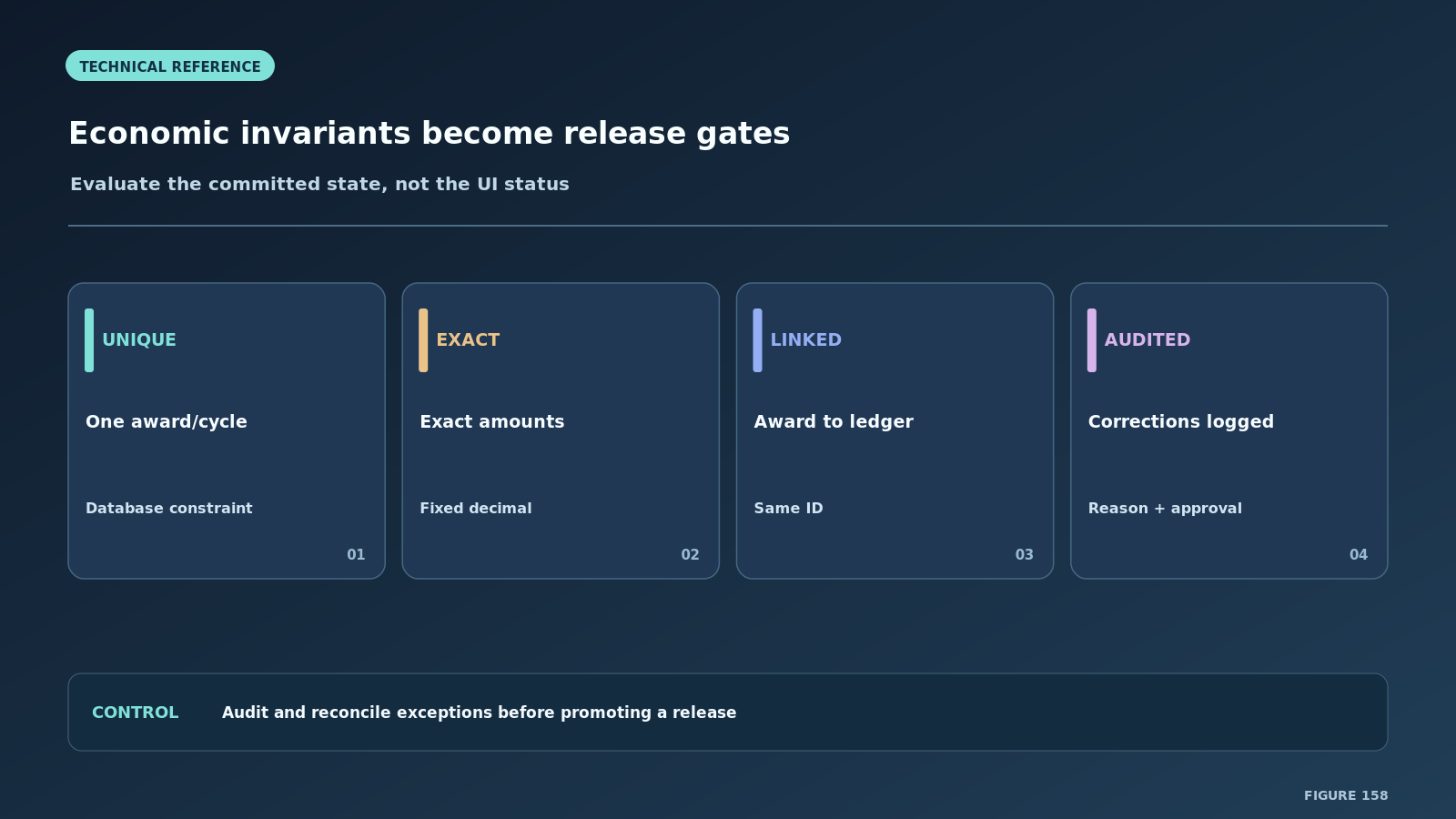
Useful invariants should be executable assertions, not only documentation. For each pool generation: at most one terminal winning award; every applied contribution has one unique source identity; the final award references one rule version; every paid award has exactly one intended wallet credit; no settlement silently targets the wrong generation. If the defined model requires conservation of pool value, reconcile seed, qualifying contributions, awards and retained balances using exact amounts and currencies.
An audit trail should preserve the validated input, transformation rules, actor or service identity, database commit reference, state version, award amount, payout request identity, wallet response and any correction history. Sensitive personal data should be minimized or tokenized according to approved retention policies. Do not rely solely on a mutable application log; preserve economically material records in suitable durable and access-controlled storage.
Monitoring should compare cached visible totals with committed state and highlight divergence without automatically overwriting the ledger from the display. Watch duplicate-event rates, unresolved payout pending age, failed serialization retries, leader changes, lagging pool processors and reconciliation exceptions. An incident dashboard with “0 errors” is not proof of financial correctness unless these invariants are checked independently.
Reference design and race-condition tests
A practical reference design has a validated event ingress layer, a per-pool serialized command handler, transactional jackpot records, a durable outbox and a wallet adapter that uses the award ID for idempotency. A separate read model powers the animated pool total. Independent reconciliation compares winner/award records, pool transitions and actual wallet postings. This is one viable design, not the only sound one.
Representative tests include two simultaneous winning triggers against the same cycle; contribution and trigger arriving concurrently; duplicate contribution delivery; outage after the award commit but before the response; payout committed before its acknowledgement is lost; and failover with a stale writer. Inject a clock skew if timing is relevant to eligibility, and a database serialization error to prove the retry path does not change winner identity. Verify ledger balances and invariant counts after the system recovers, not merely API success responses.
End-to-end correctness is stronger than a concurrency benchmark. A load test may show that the service processed thousands of events each second while still missing one duplicate liability. Make the acceptance gate a set of economic properties: one valid award per generation, one intended credit per award, no lost valid contribution, no unauthorized mutation of final results, and a traceable reconciliation path. Optimize throughput only after those guarantees are enforceable and observable.
Source notes: PostgreSQL explicit locking and transaction isolation explain the relevant database mechanisms; their use does not remove the need for application-level economic invariants. Specific jackpot winner rules and approved payout procedures must be verified against the product’s own audited requirements.