A remote game server (RGS) is not merely another web workload. Its deployed binaries can determine how a game round is processed, what configuration is loaded, which provider-facing callbacks are emitted and how evidence is recorded for later investigation. A change made in a dependency repository or build runner may therefore affect far more than availability. Remote game server supply chain security is the discipline of proving that the software actually running in production is the reviewed software that the organization intended to release.
Consider a seemingly routine release. A developer updates a JSON parser used by an RGS adapter. The pull request is reviewed and the build passes, but the CI job downloads a mutable dependency at deployment time. The image that reaches production differs from the artifact exercised by integration tests. Nothing in a successful HTTP health check identifies that discrepancy. A sound release system needs evidence about source, dependencies, build environment, resulting artifact and the decision to deploy it.

Supply-chain threat model for an RGS
Start with the path code takes, not with a list of security products. The path typically includes developer workstations, source control, code review, third-party packages, build runners, artifact storage, signing infrastructure, deployment controllers and runtime environments. Each boundary has a different attacker opportunity and a different evidence requirement.
An attacker might compromise an upstream library, steal a CI token, substitute a container image in a registry, modify a deployment manifest or obtain a privileged emergency-access credential. A less dramatic but frequent failure is unintentional release drift: an engineer builds from an unreviewed branch, uses a mutable image tag or deploys a configuration inconsistent with a tested version. Treat inadvertent and malicious changes as distinct causes that can create similar bad outcomes.
An RGS adds domain-specific assets to the model. The runtime may consume mathematical configuration, paytable data, game assets, jurisdiction switches and a versioned rules package. Some are data, not executable code, but that does not make them harmless. A signed container that loads an unauthorized paytable at startup has not achieved the intended integrity. Identify which assets change behavior, what governs their approval and how their hashes are bound to a release.
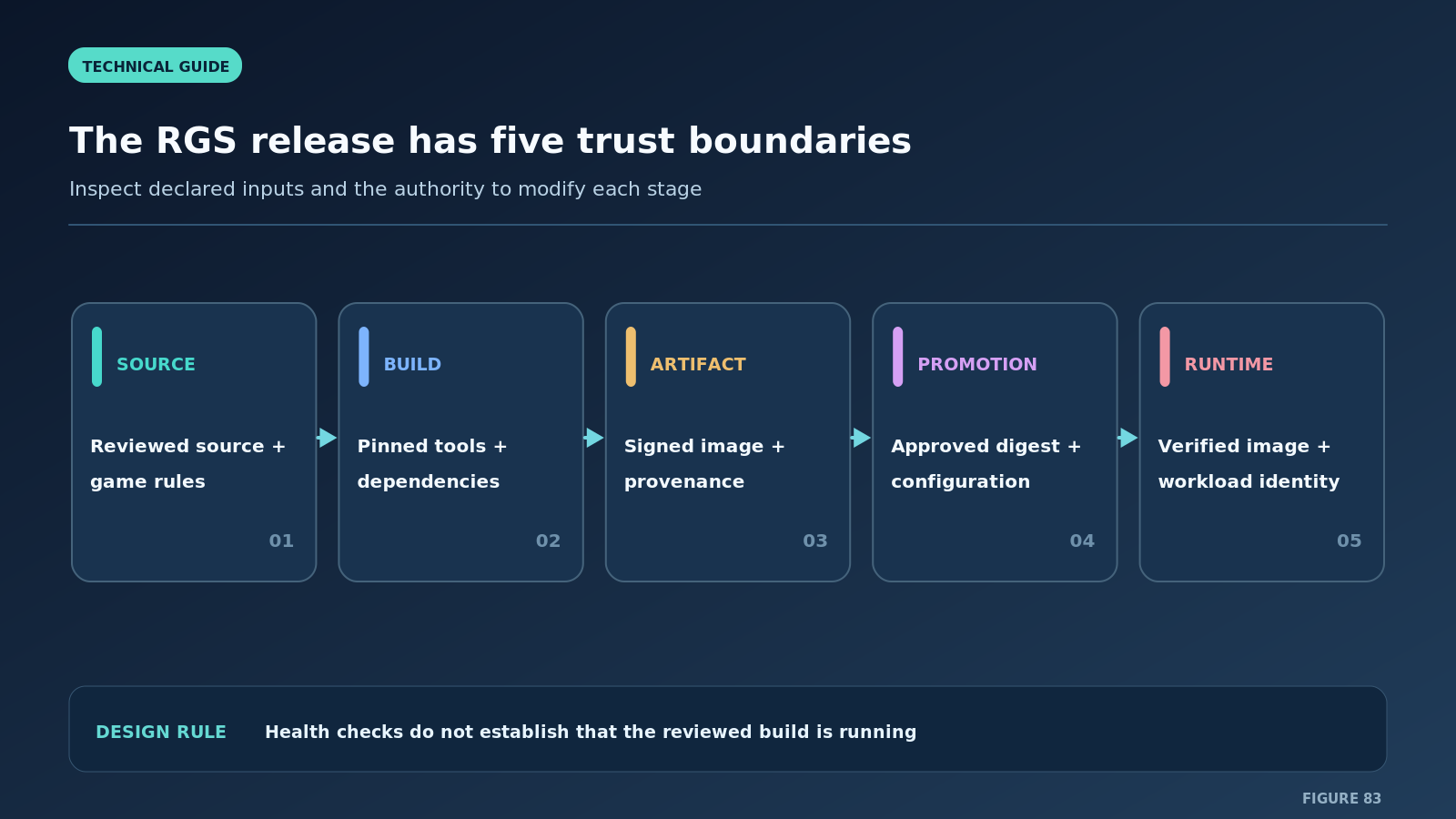
A useful threat model asks four questions. What can be modified? Include source, dependencies, parameters, environment variables and deployment selectors. Who can modify it? Distinguish authors, reviewers, builders and deployers. What proves the modification was approved? Seek immutable artifacts and independently verifiable records. How would an incident be contained? Make rollback, key revocation and traffic isolation real operational capabilities.
Keep security boundaries separate from game outcome guarantees. Supply-chain controls support the integrity of an implementation; they do not, by themselves, certify game mathematics, RNG behavior or regulatory approval. Those require their own review and test programs. Likewise, an external game studio may operate its own RGS. The operator can validate contractual artifacts, version claims and integration behavior without pretending to control the studio’s internal build pipeline.
Dependency control and reproducible builds
Create an inventory of direct and transitive dependencies: language packages, OS libraries, base images, build tools, generated clients and any native modules. A software bill of materials (SBOM) is useful for incident triage because it answers where a compromised package appears. It is not a guarantee that components are safe or that the SBOM accurately reflects what was shipped.
Pin package versions and, where possible, resolved content digests. Treat lockfiles as reviewed release inputs. Build images from immutable references rather than floating tags such as latest; a tag can be rebound without changing the deployment manifest. Restrict package sources to approved registries or mirrors, record resolved origins and define how new dependencies are introduced. Monitor vulnerability advisories, but also require a path for evaluating exploitability rather than treating every scanner finding as equal.
Reproducibility is desirable because two builds from the same declared inputs should produce the same content. In practice, timestamps, compiler versions, network fetches and nondeterministic packaging can prevent byte-for-byte equality. Teams can improve this by fixing toolchain versions, setting deterministic build parameters and removing undeclared network dependencies. Where complete reproducibility is not yet feasible, document the gaps and make provenance an explicit release requirement.
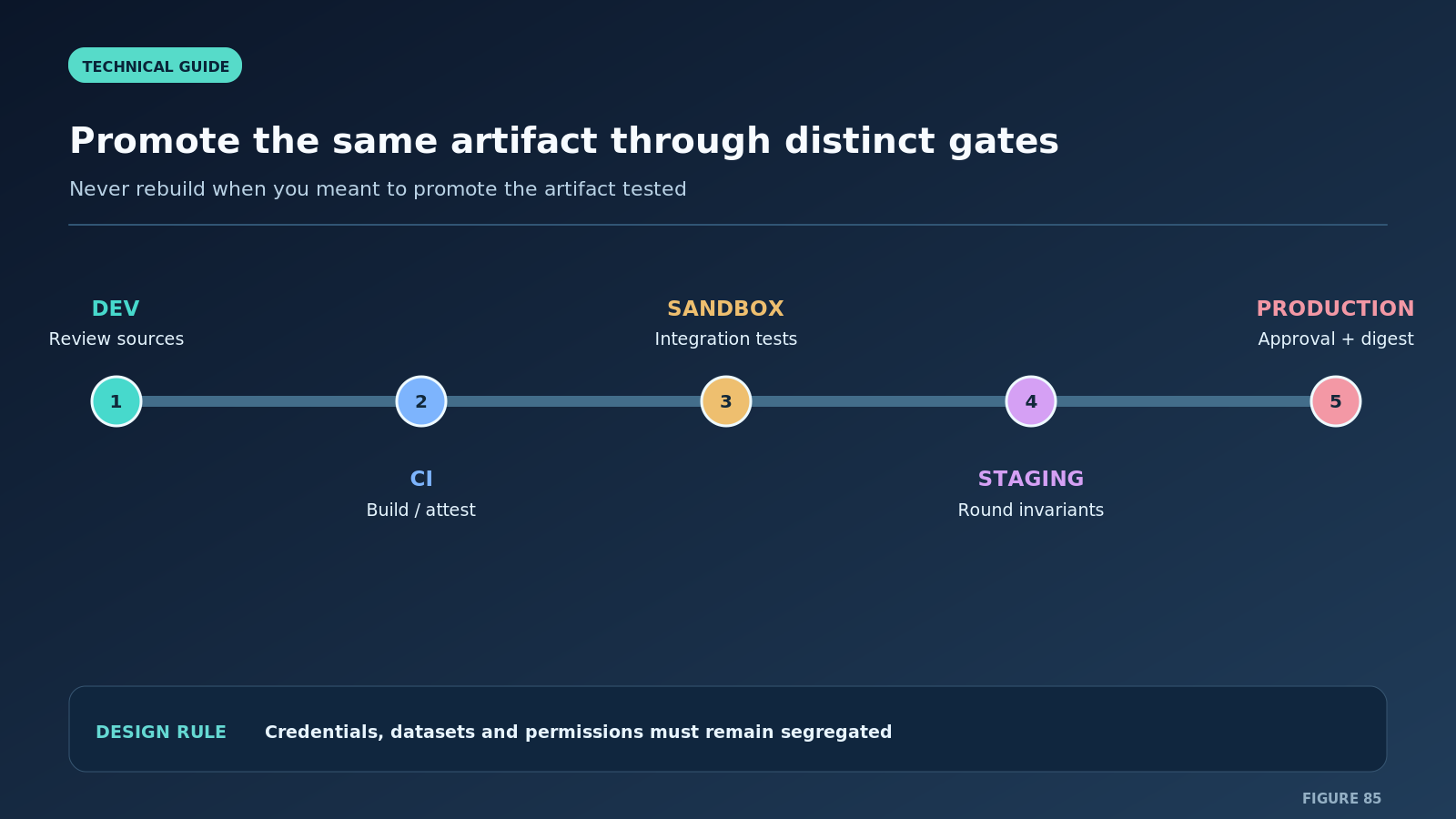
For RGS development, watch generated configuration bundles and assets. A build that compiles the same source but downloads an updated game manifest is not the same release. Include those manifests or their immutable hashes among the declared inputs. Verify that staging tested the exact digest scheduled for production rather than a freshly rebuilt approximation.
A secure dependency change workflow is incremental: a request explains why a new package is needed; automated checks enumerate licenses, advisories and provenance; reviewers assess sensitive transitive additions; integration tests exercise game/session contracts; and the new artifact is promoted by digest. When an urgent fix is required, speed can be achieved through preapproved narrow procedures, not by removing the evidence trail.
Signed artifacts, attestations and provenance
A cryptographic signature answers a narrow but valuable question: did a trusted signing identity attest to this artifact or statement, and has it been altered? It does not answer whether the code is bug-free, the signer was authorized for this release, or the build process was trustworthy. An admission policy must validate the right identity, subject digest, workflow and environment, not merely that “a signature exists.”
SLSA describes build provenance as a verifiable account of how artifacts were produced. A practical RGS provenance record can link the output digest to a source revision, a reviewed build definition, builder identity and declared inputs. Add the relevant configuration package digests, test results and an approved change reference. The deployment controller should reject artifacts whose digest, provenance or authorization does not match policy. See the SLSA build provenance specification and NIST SSDF for general frameworks.
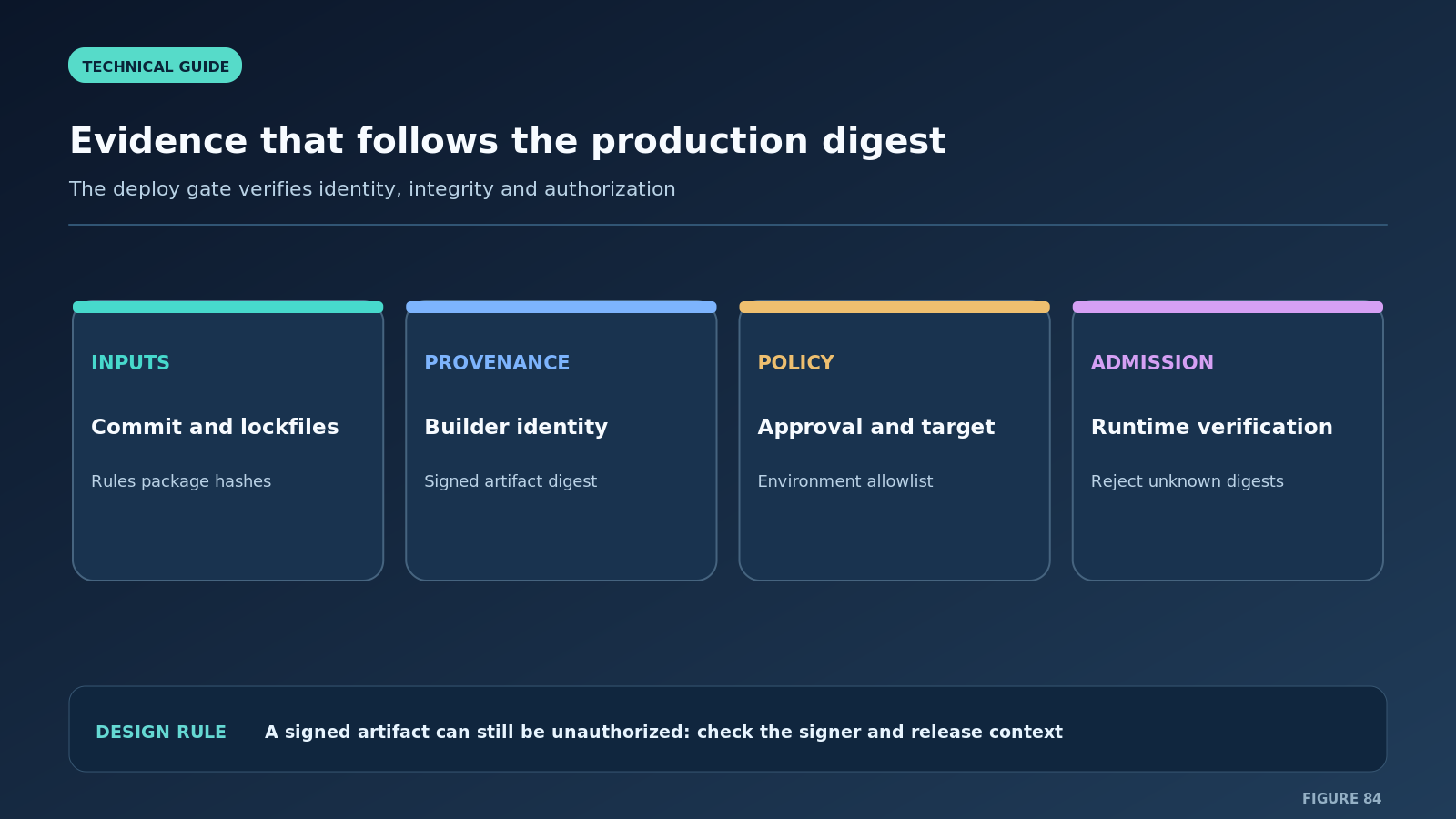
Protect signing capabilities more carefully than ordinary build credentials. Separate build execution from approval where practical, use short-lived credentials or workload identities, and avoid exporting long-lived private keys to ephemeral runner logs or build containers. Verify the artifact at the point of deployment, not only when it enters the registry. If an image has changed or a signature is unverifiable, the safe action is to block promotion and investigate.
Retention matters. If an RGS regression becomes visible weeks after release, incident responders need the exact artifact, immutable provenance, approval record and configuration version. A Git commit by itself may not reconstruct a production image, especially when registries, dependencies or generated assets have changed. Define how long records remain accessible under the organization’s evidence and regulatory obligations.
Secrets and deployment permissions
An RGS environment may hold provider credentials, signing keys for API callbacks, database access identities and certificates for service-to-service transport. Do not put secrets in images, test fixtures, screenshots, source history or unredacted CI logs. Use a secrets manager with auditable access, automatic rotation where supported and scoped runtime identities. CI jobs should request ephemeral permission for exactly the task they perform; a test job should not inherit production deployment credentials.
Separate who can build, who can approve, and who can deploy. In smaller teams, one person may hold multiple responsibilities, but the system can still require two independently recorded actions for high-impact releases. A deployment controller should accept only approved artifacts and environment-specific configuration. Break-glass access needs a limited time window, a reason and post-use review; otherwise emergency paths become the normal path that bypasses controls.
Secrets should not cross the provider integration boundary unnecessarily. The provider-facing adapter might need a credential to sign an outbound request; a math engine rarely needs that credential. Use separate service identities and network restrictions to reduce blast radius. Logs should show that authentication succeeded or failed without exposing the header, secret or bearer token used.

Rotate keys with a compatibility window where the protocol permits. If an HMAC key must change, receivers may need to accept signatures from a narrowly defined set of active key IDs for a short interval. Avoid the temptation to accept every historical key indefinitely. Test both successful rotation and fail-closed behavior for revoked material. Keep revocation and deployment rollback procedures distinct: rolling back a binary must not silently restore a compromised secret.
Environment segregation and change approvals
Treat development, sandbox, staging and production as independent security domains. Segregation requires separate credentials, network rules, datasets and authorization—not just distinct namespace names. Production data should not be copied into a provider emulator simply because test cases are difficult to create. Build synthetic fixtures with stable transaction IDs and predictable balances; where production-derived evidence is legally necessary, apply documented controls and minimization first.
A release approval should identify the exact artifact digest, game titles or runtime components affected, target jurisdictions, configuration revisions, planned rollout cohort, rollback option and validation evidence. For certified or controlled game behavior, approvals may also depend on external review or retesting. Do not imply that automated CI approval replaces those obligations. Documentation of the relevant jurisdiction and supplier contract belongs in the release packet.
The first production cohort should be observable. Track launch failures, provider callback rejections, round state mismatches, wallet ambiguity and reconciliation backlog. A clean CPU chart does not prove a safe release. If an unexpected behavioral difference appears, freeze new activations and use the documented version switch or rollback path. Running sessions may need to finish under their original rules/configuration rather than suddenly changing behavior mid-round.
Verification checklist and incident scenarios
A release gate can be evaluated with a short, observable checklist rather than a vague “security reviewed” flag:
| Control | Evidence to retain | Failure that should block promotion |
|---|---|---|
| Source review | Approved change and immutable revision | Unreviewed source commit |
| Dependencies | Lockfile, SBOM, resolved digests | Mutable or unknown dependency |
| Build provenance | Builder identity and signed statement | Missing or untrusted provenance |
| Artifact | Image digest and signature | Re-tagged or substituted image |
| Config assets | Approved version and manifest hash | Unapproved paytable/rules package |
| Access | Scoped deploy identity | Cross-environment token reuse |
| Verification | Staging tests and release approval | Missing critical round/ledger tests |
| Recovery | Retained prior digest and runbook | No safe rollback or key-revocation path |
Scenario: compromised package registry. Freeze affected builds, identify impacted dependency versions from the SBOM, verify the deployed artifact digests and rebuild from known-good immutable inputs. A simple redeploy of the same tag may reintroduce the compromised component. Reconcile release records before restoring the promotion pipeline.
Scenario: stolen CI credential. Revoke the identity, disable its deployment path, review audit events and verify whether any unapproved artifact or configuration reached a runtime. Preserve logs and attestations. Rotating a token alone cannot prove that a malicious artifact was not deployed earlier.
Scenario: unauthorized change to game configuration. Contain new activations, identify all sessions and rounds bound to the affected version, and determine which financial outcomes require investigation. Roll back the activation pointer for new sessions when safe; do not rewrite historical rounds or assert that all settlements were invalid without evidence.
Scenario: supply-chain alert after release. Match the vulnerable package to an exact production digest, not a branch name. Estimate exposure based on whether the vulnerable code path is reachable. Decide whether emergency rollback, feature gating or credential rotation reduces risk fastest. Record affected titles, operators and versions for downstream communication.
The practical definition of success is straightforward: an engineer can select a running RGS instance and show the exact reviewed inputs, a verifiable build, an authorized promotion and a recovery route. That evidence closes the gap between “we tested something similar” and “we know what software is operating.”
Technical references
- SLSA v1.2 specification and build provenance
- NIST SP 800-218: Secure Software Development Framework
- OWASP API Security Project
Editorial note: the security architecture and scenarios are conceptual. External provider obligations, certification approvals and production controls must be checked against applicable contracts and jurisdictions.