The question WebRTC vs Low-Latency HLS for live gaming video is often framed as a race to achieve the lowest possible delay. A live casino architect needs a more useful question: which delivery model can keep enough viewers watching a coherent studio feed, across their actual networks and devices, while the game server preserves authoritative betting and settlement rules? A visually instant stream is unhelpful if it collapses during a mobile network handover. Conversely, a highly scalable stream can mislead a player if the user interface implies that a delayed picture is an authoritative statement about an open betting window.
Both approaches can deliver low-delay live video. Neither protocol decides whether a wager was accepted, when a round closed, or what balance a player owns. Those decisions belong to a separately authenticated game service and financial system. The video platform must expose its actual playback condition so the client can present a truthful experience as the two timelines diverge.
This article compares transport paths, adaptive behavior, network recovery and observability, then proposes a testing and selection framework. The descriptions are architecture guidance, not measured latency promises. Live casino implementations differ in player concurrency, studios, browser support, network geography and regulatory requirements.

WebRTC and low-latency HLS delivery models
WebRTC was developed for real-time communications. A typical browser player establishes a peer connection, negotiates media capabilities and connectivity, and receives continuously paced audio/video. An SFU or other media routing layer can redistribute the studio feed to many clients without encoding a separate copy for every viewer. Real deployments require signaling, media ingress, TURN capacity when direct paths fail, and careful handling of congestion. WebRTC is not inherently peer-to-peer from each casino client to a studio camera; large deployments commonly use managed server infrastructure.
Low-Latency HLS (LL-HLS) is an evolution of HTTP Live Streaming. The encoder and packager produce a playlist with short partial segments, supported reload controls and associated media objects. Clients request these over an HTTP delivery network, often through caches and a CDN. The Apple specification describes mechanisms such as partial segments and blocking playlist reloads, but real end-to-end delay also depends on the producer’s segment schedule, cache behavior, player live-edge policy, buffer choices and network conditions.
The two approaches trade different forms of complexity. WebRTC concentrates attention on session negotiation, real-time congestion control and connection state. LL-HLS emphasizes packaging correctness, HTTP caching, live-edge tracking and segment availability. A studio using an already-established broadcast workflow may find the LL-HLS supply chain easier to operate; a product prioritizing tightly coupled conversational interaction may find WebRTC attractive.
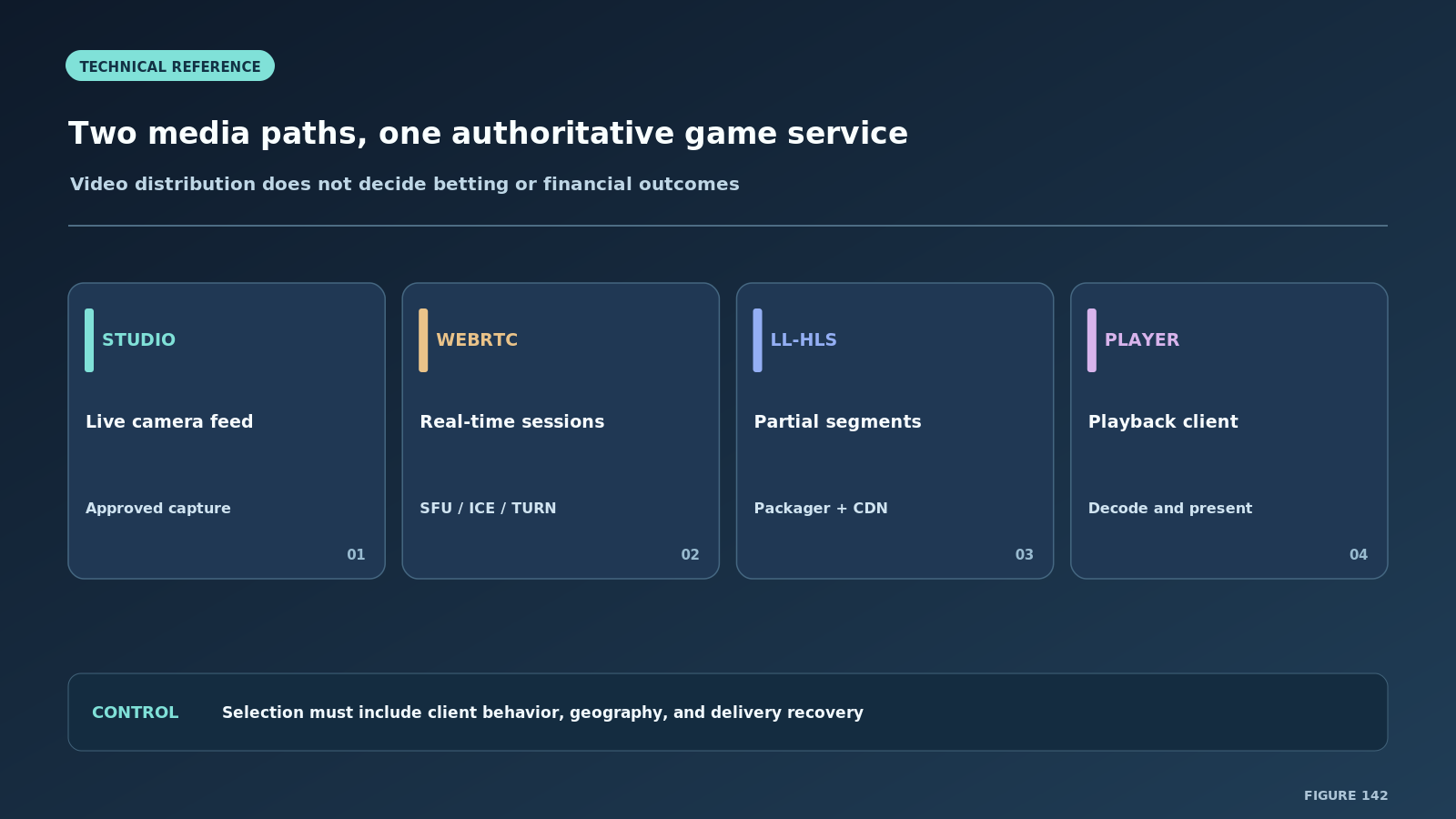
Importantly, do not compare an excellent WebRTC deployment with a deliberately slow traditional HLS deployment. The relevant comparison is a tuned configuration of each, tested at the same source, geography, device mix, throughput and reliability target. Inspect how the players recover, not just the fastest steady-state screenshot.
Latency, scale, bandwidth and client support
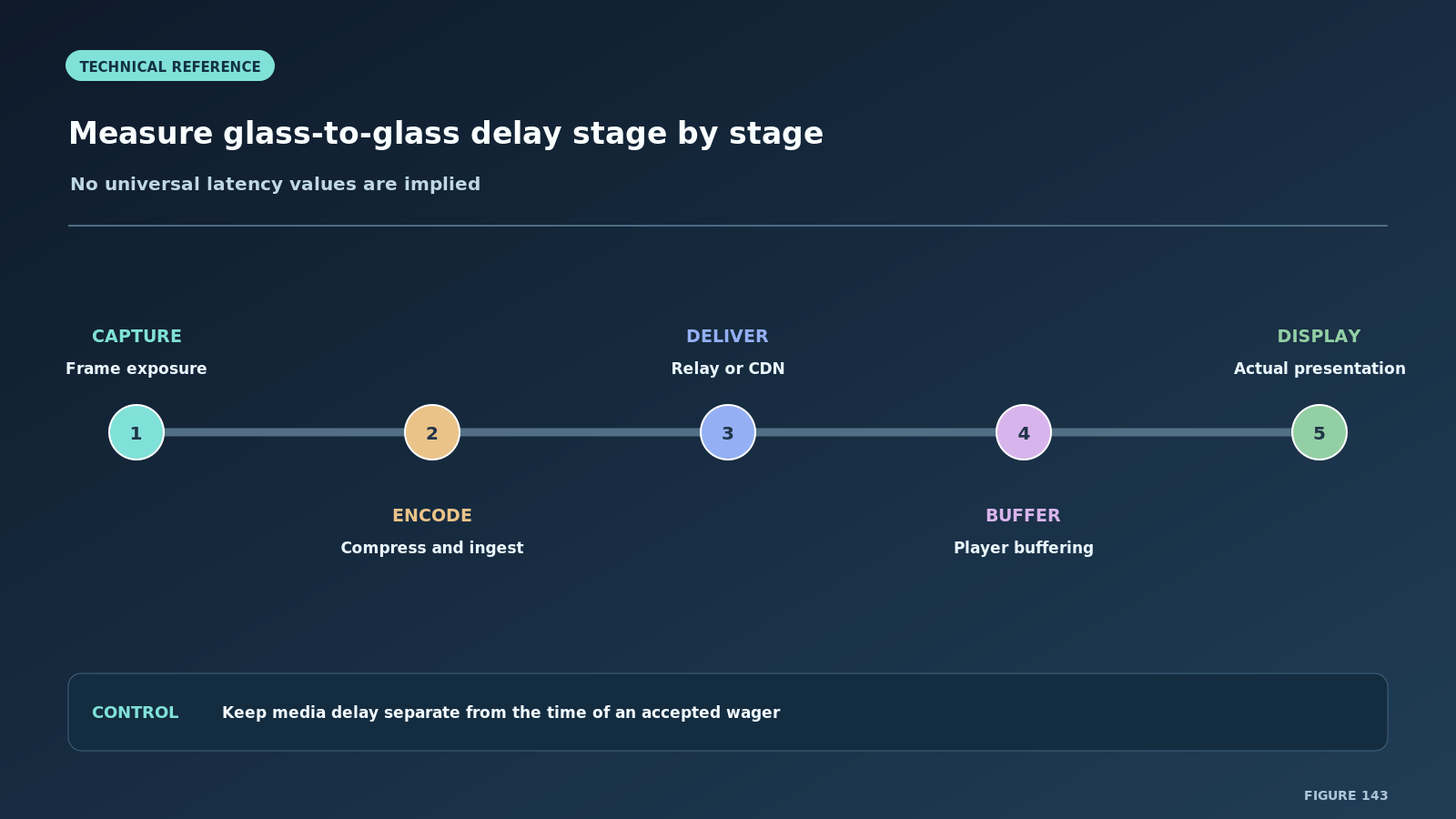
A meaningful latency budget starts at camera exposure and ends at actual player presentation. Include capture, video production, encoding, ingest, relay or packaging, transport, buffering and rendering. If the business asks for glass-to-glass delay, use an observable test mark in the source image and measure when it appears on the device. Server-to-server or packet round-trip measurements are not substitutes for that measurement.
WebRTC can support very low interactive delay with small jitter buffers, but low buffer reserves make it sensitive to path variation and packet loss. Its server fan-out also consumes forwarding bandwidth and, depending on topology and deployment, relay resources. LL-HLS commonly offers convenient HTTP distribution through mature CDN systems, with practical advantages for extremely broad audiences. It introduces its own control-plane costs in manifests, partial segment requests and cache coordination. There is no universal concurrency threshold at which one technology automatically wins.
Browser and device coverage must be validated against the actual operating systems, webviews, browsers and embedded hardware in the audience. “Supports HLS” does not imply that the available player supports every low-latency extension. “Supports WebRTC” does not guarantee a successful media connection behind restrictive corporate networks. Browser policy, autoplay constraints, codec availability and hardware decoding also affect behavior.
| Evaluation area | WebRTC-oriented design | LL-HLS-oriented design |
|---|---|---|
| Distribution | Stateful real-time media sessions, often with an SFU | HTTP media objects and playlists, often through a CDN |
| Typical tuning priority | Keep interactive latency low under path changes | Control live-edge distance and buffering while preserving scale |
| Player recovery | ICE restart, media reconnection, track continuity | Playlist reload, segment re-acquisition, live-edge seek |
| Operational concern | Session count, relay use, congestion and media path | Packager correctness, cache behavior, request rate |
| Important shared question | How is the game UI corrected after a transport disruption? | How is the game UI corrected after a transport disruption? |
The table describes architectural tendencies, not performance guarantees. Test access restrictions, device power usage, geographic edge capacity, bandwidth caps and usage at event peaks. For live casino, the tail of latency and rebuffering across real customers is often more important than a pristine median in a lab.
ABR, buffering and jitter trade-offs
Adaptive bitrate (ABR) control attempts to choose a media quality that the connection can sustain. WebRTC implementations adjust send rate, resolutions or layers through congestion feedback and media policies. An SFU may expose simulcast or scalable coding options. LL-HLS generally presents an encoded ladder of variants; the client switches between renditions while maintaining a safe live edge. Each method can still stall if its control loop and encoding ladder are poorly matched to the source or network.
A live casino room contains harder material than a static webcam: moving dealers, flickering graphical overlays, cards, roulette details and sudden scene cuts. The encoder must balance compression against the legibility of the actual game. Excessive compression can obscure small chips or cards even when average bitrate looks acceptable. Audio continuity also matters; a silent or desynchronized dealer can make a usable picture feel broken.
Buffering is a deliberate reliability trade. A player chasing the smallest delay may repeatedly stall; a player tolerating additional buffer can maintain smooth playback but sees older pictures. Neither choice may be hidden behind a UI that says Betting Open based on the rendered frame. The UI should display the server-authoritative round state and, when appropriate, a clear indication that the video is delayed, reconnecting or unavailable.
Jitter is variation in packet or delivery timing, not simply a small average delay. Different access networks may produce very different jitter distributions, and mobile mobility introduces abrupt discontinuities. Monitor stall count, startup time, bitrate changes, decode errors and actual distance from the live edge where measurable. Video quality should be examined alongside the player’s session state rather than in isolation.
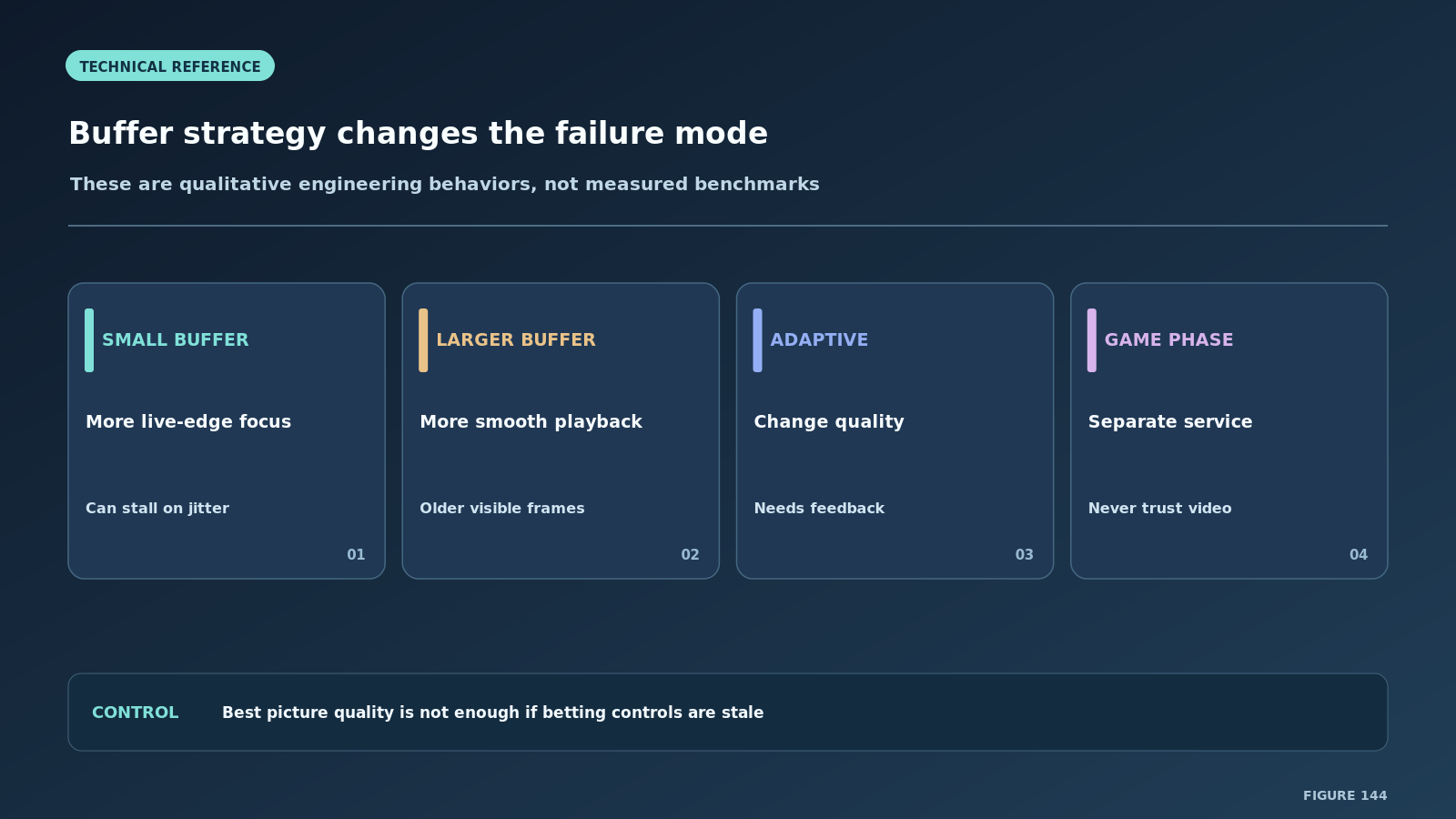
An error budget for a casino video service should therefore define more than “p95 delay under X seconds.” Add tolerable rebuffering, join success rate, audio continuity, the fraction of players with delayed live edges, and correct handling of round-state mismatches. The last metric can protect the game experience even when media quality falls.
Reconnect handling and stream discontinuities
Disconnections are normal: backgrounded tabs, device sleep, Wi-Fi-to-cellular switches, DNS failures, temporary edge overload, authorization expiry and regional route changes. Each client needs a state machine such as PLAYING, DEGRADED, RECONNECTING, CATCHING_UP and FAILED, with visible user feedback. A visual spinner alone is not a state protocol.
In WebRTC, detect failed or disconnected connectivity, distinguish short interruptions from durable failure, and recreate or restart the appropriate media path. Preserve identity and authorization checks across reconnection. In LL-HLS, confirm that manifests and media objects advance, that a playlist discontinuity is handled correctly, and that the player does not indefinitely replay a stale buffered segment while pretending to be live.
Do not simply resume the previous local game state when the picture returns. Fetch a fresh authoritative snapshot including table_id, round_id, phase, phase_deadline, and server-issued sequence or version. Reconcile any pending wager requests using their original idempotency identities. The video is then aligned to the new presentation state as best as possible without inventing a wager or changing a settlement.
Recovery behavior during a live betting window
Consider an illustrative roulette round: the player sees the wheel as betting closes. Their mobile device loses the stream for four seconds. During that period the game server closes the betting window and validates the outcome. Upon reconnection, an old video segment may still show a dealer accepting bets. The correct product response is to show the authoritative Betting Closed state, identify the active round and display pending-bet status independently of the video. If the player tapped the bet button near the cutoff, only the server response and persisted action identity determine acceptance.
A second hazard is an acknowledged bet whose response was lost. Retrying with a fresh action identity could create a second wager. The transport recovery process must not call a money-affecting API merely because a video reconnection happened. The client should query the existing action or repeat the request under the same idempotency contract, following the provider’s supported API semantics.
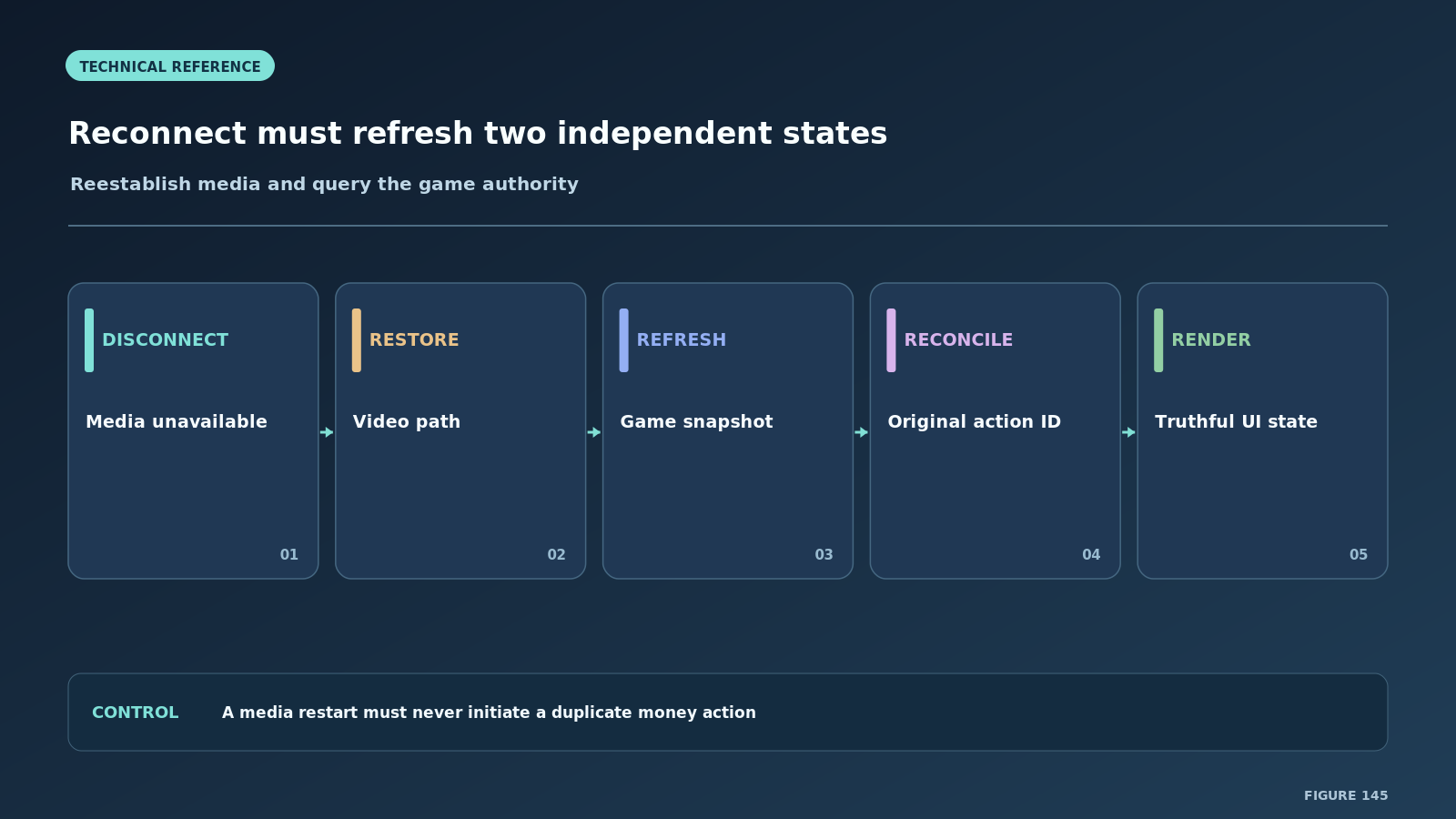
Plan for full discontinuity: a media encoder restarts, segment or RTP timestamps reset, a stream rendition is replaced, or the provider switches camera sources. A new stream epoch can be useful for telemetry. For a player, the transition should be communicated where necessary; for finance, the round still retains its own authoritative identity regardless of media continuity.
Operational costs, monitoring and test setup
Calculate total operations cost across ingest, encoding, media relay or CDN, signaling, TURN, observability, incident response and player support. For WebRTC, study relay ratio and SFU bandwidth in addition to upstream source bitrate. For LL-HLS, study the number of variant requests, cache misses, manifest traffic and origin amplification. Both need appropriately sized failover infrastructure and resilience testing.
The monitoring board should separate viewer experience, media network health and game correctness. Viewer experience covers join time, stall frequency, stream lag and whether the right live table is displayed. Media network health covers packet loss, jitter, retransmission, decode load or CDN edge status according to protocol. Game correctness covers bet cutoff acknowledgements, round-sequence gaps, recovery snapshot versions and settlement consistency. It is dangerous to aggregate all three into one green “live service healthy” badge.
A repeatable test harness should use the same source marker and device matrix across protocols. Inject packet loss, jitter, bandwidth drops, brief network partitions and a forced encoding discontinuity; repeat during a betting window. Verify visible presentation and exact wager identity after reconnect. Record distribution metrics and run counts, not anecdotal best cases. Include human accessibility and readability checks where game details are small.
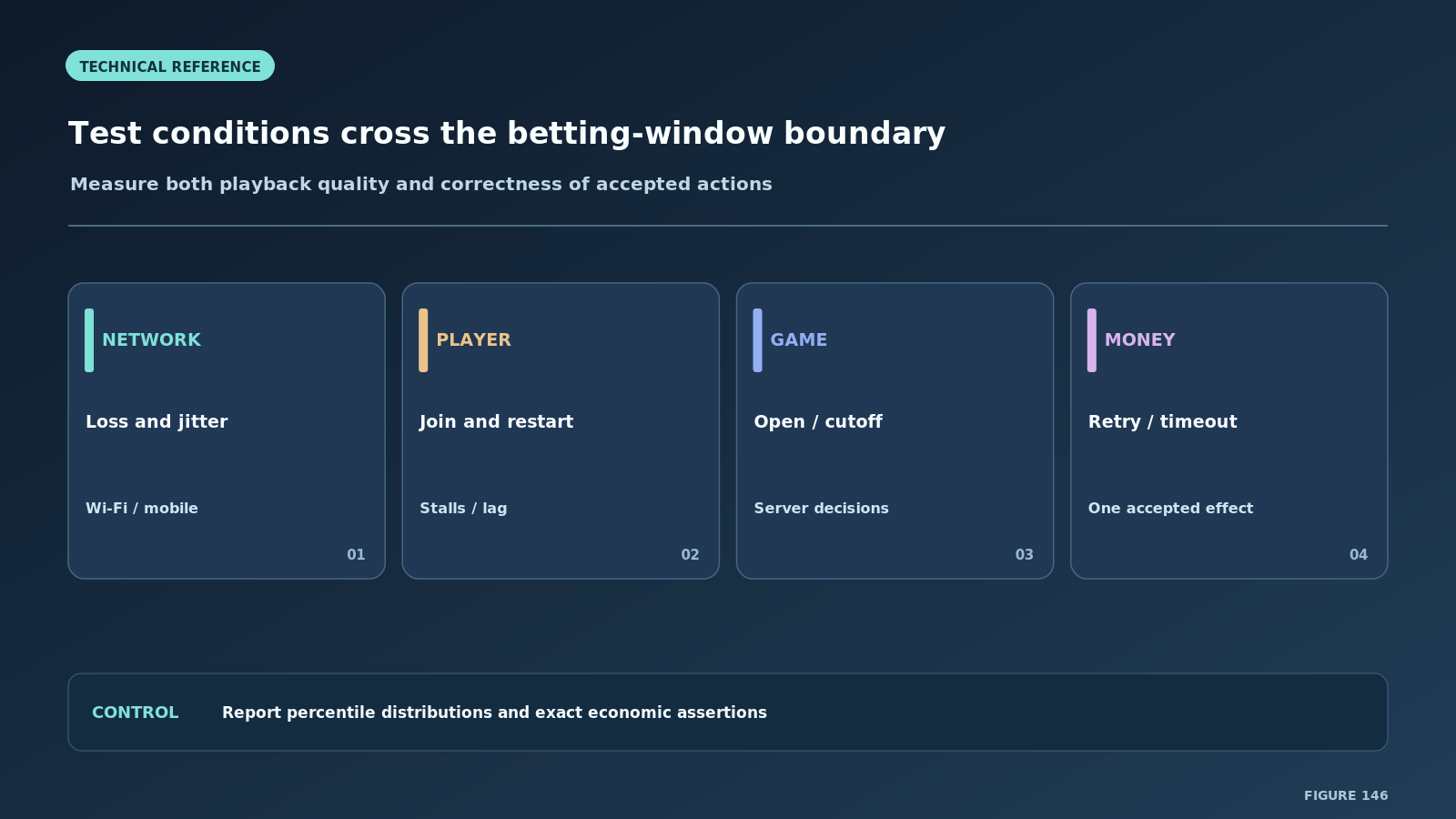
Protocol choice and resilience decision matrix
A useful decision matrix weights factors for a specific product rather than declaring an overall winner. Interactive latency, viewer scale, geographic distribution, device support, operational maturity, accessibility, recovery consistency and cost should each have explicit acceptance criteria. You may decide to deploy one protocol for most browsers and another for constrained environments, but that increases the testing surface and must not split the definition of game truth.
Choose WebRTC when real-time feedback and managed session infrastructure justify its greater operational responsibilities; evaluate LL-HLS when HTTP-based distribution, CDN efficiency and broad consumption fit the product’s acceptable latency budget. Those are starting hypotheses, not conclusions. Test both under representative load and use the measured customer experience to decide.
The safest architecture principle survives whichever protocol you use: media state is never financial authority. Always maintain server-authenticated betting windows, stable business identities, authoritative round snapshots and reconciliation after ambiguous requests. If a playback path is degraded, the system should fail clearly rather than make a wager appear valid simply because video frames are still arriving.
Source notes: Apple Low-Latency HLS documentation; Apple HLS authoring specification; W3C WebRTC specification and WebRTC Statistics. Technical guidance above is a product-neutral engineering interpretation, not a certification statement or live vendor benchmark.