A game software update can appear trivial to a developer and still affect regulated behavior. A new logging implementation may change the construction of an outcome array. A wallet service optimization may alter the order in which a round becomes final. A display-only correction may be low-risk, but only if it truly leaves game math, rules, financial behavior and accurate presentation intact. Game software retesting requirements therefore cannot be decided from labels such as patch, minor version, frontend-only or infrastructure change alone.
This article describes a risk-based triage process, anchored in the UK Gambling Commission testing strategy and GLI-19 v4.0. The illustrative decision matrix is not a universal legal classification. Its purpose is to help engineering, QA and compliance produce enough evidence for a responsible decision under the exact jurisdiction, adopted standard, licensed operator policy and laboratory scope.

Change categories and affected certified components
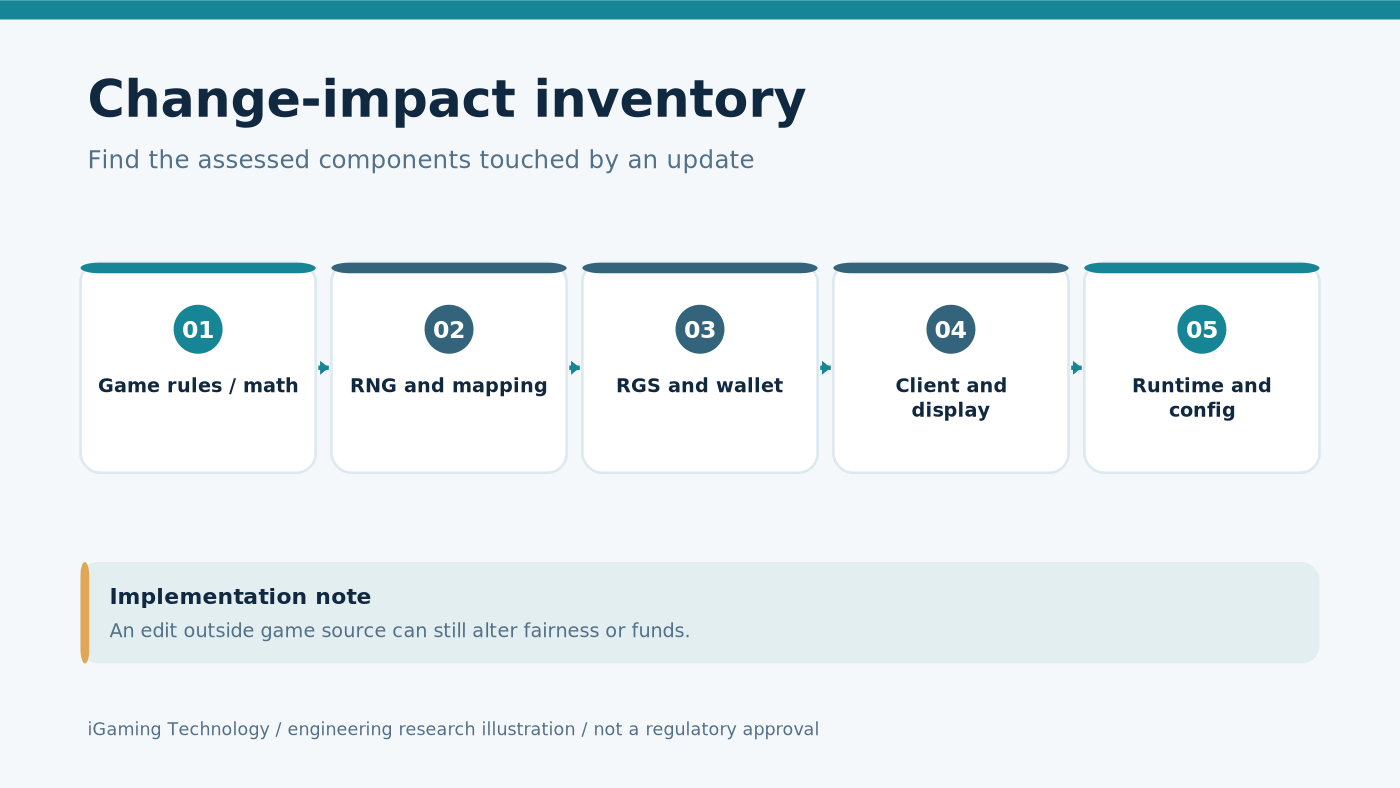
Begin with the certified boundary rather than the change ticket’s title. A product may have an independently evaluated game math package, RNG implementation, Remote Game Server (RGS), game client and platform integration. The released system can also depend on configuration parameters that select the paytable, game mode or maximum payout. One pull request can touch several of these boundaries, while a code change outside the game repository may still alter behavior the laboratory assessed.
Classify the actual changed elements. The list usually includes source code, compiled libraries, game math and mapping, RNG or entropy handling, runtime configuration, images/audio and localization, client interfaces, API contracts, wallet settlement, hosting runtime, cryptographic material and deployment process. For each element, record affected assets and the relationship to the currently tested or approved version. If the baseline is unknown, the change should not pass through an automatic ‘minor update’ gate.
Changes to game probabilities, RTP, feature rules, win calculation or outcome mapping are obvious fairness-review candidates. Less obvious are changes that modify the implementation of those rules: array handling, numeric rounding, data type precision, concurrency or a cache that changes which configuration version is loaded. A regression suite must test results, not only function signatures.
The UKGC’s Annex A on major and minor updates defines a major change in terms of potential effect on game fairness. It specifically names RNG, scaling/mapping and game-rule changes as fairness elements. The examples show why classification cannot rely solely on whether the intended rules changed: changing how a game constructs symbol arrays for performance still required independent testing because it changed the software implementation of the rules.
Why requirements vary by jurisdiction and version
A technical standard is not automatically the operative law in every market. Regulators may adopt specified standards, modify them, impose change-management obligations or define separate test procedures. A laboratory may test a component against a technical baseline without making the final authorization decision. Some jurisdictions distinguish major and minor changes; others require a different notification, submission or approval workflow. The same internal risk assessment may support decisions in more than one market but cannot replace market-specific conclusions.
The UKGC provides a concrete example: its testing strategy describes external testing for new games and fairness-affecting game updates, with some non-fairness changes managed through internal controls. The Commission also expects licensees and test houses to exercise judgment, maintain change-control records and follow responsibilities specified in the strategy. An operator should not convert “some minor changes can be released without external retesting” into “all minor releases need no further evidence.” Internal validation, change approval and audit records remain necessary.
The GLI-19 v4.0 framework provides a different but related perspective. Section 1.5.1 describes independent laboratory evaluation, possible additional integration testing and use of a regulator-adopted change management program to determine modification-testing needs. This is not an instruction that every product using GLI-19 automatically follows the UKGC major/minor definitions. Record which authority supplies the rule and which control is an internal risk recommendation.
Edition management is part of the decision. GLI-19 Version 4.0 was revised on November 3, 2026. A product with a historical evaluation against v3.0 should preserve that report’s true edition and consider a controlled crosswalk rather than silently re-labeling its certificate. Likewise, when a regulator announces updated technical standards, check effective dates and transition arrangements before assessing releases already in progress.
The most reliable workflow begins with a jurisdiction register, not an ‘if version number changes, retest’ rule. Consult the original test house when scope is ambiguous and document any regulator-specific notification or pre-release submission obligations. A laboratory email is useful evidence of consultation but is not a replacement for a formal decision when the market requires one.
Configuration, code and infrastructure changes
Configuration can be game logic. A paytable selector, symbol weights, feature trigger probability or jurisdictional game flag can determine the actual game presented to a player even though the executable binary remains identical. A configuration change that affects the likelihood or calculation of an outcome is not merely an operational setting. Freeze a versioned configuration package, compare it with the tested reference and include it in the classification record.
Code changes should be reviewed by their effect, not by file location. A refactor of a shared utility may modify rounding behavior across many games. A new client animation might not change the authoritative win amount but could display a false near-miss or hide material information. A wallet integration retry policy may not alter the game outcome model but could lead to duplicate debits, incomplete refunds or inconsistent round history. These defects require serious verification even where a particular change is ultimately categorized as outside the external retesting scope.
Infrastructure changes are highly context-dependent. Switching hosting regions or database engines may preserve the math binary while modifying transaction ordering, time interpretation, latency or recovery conditions. Patching an operating system might be routine, but changing the runtime or RNG implementation on which a game depends deserves impact analysis. The UKGC’s procedure explicitly addresses platform and RNG changes that can affect multiple games and describes representative game retesting in appropriate cases, with the sample and scope determined alongside an approved test house.
An RGS upgrade that changes game-state persistence should be tested for interrupted rounds, duplicate callbacks, restart recovery, settlement and payout history. A client-only reformat should still undergo accessibility and accurate-presentation testing. Neither scenario should be assigned a legal classification without considering the specific requirements and context.
Evidence needed for a retesting decision
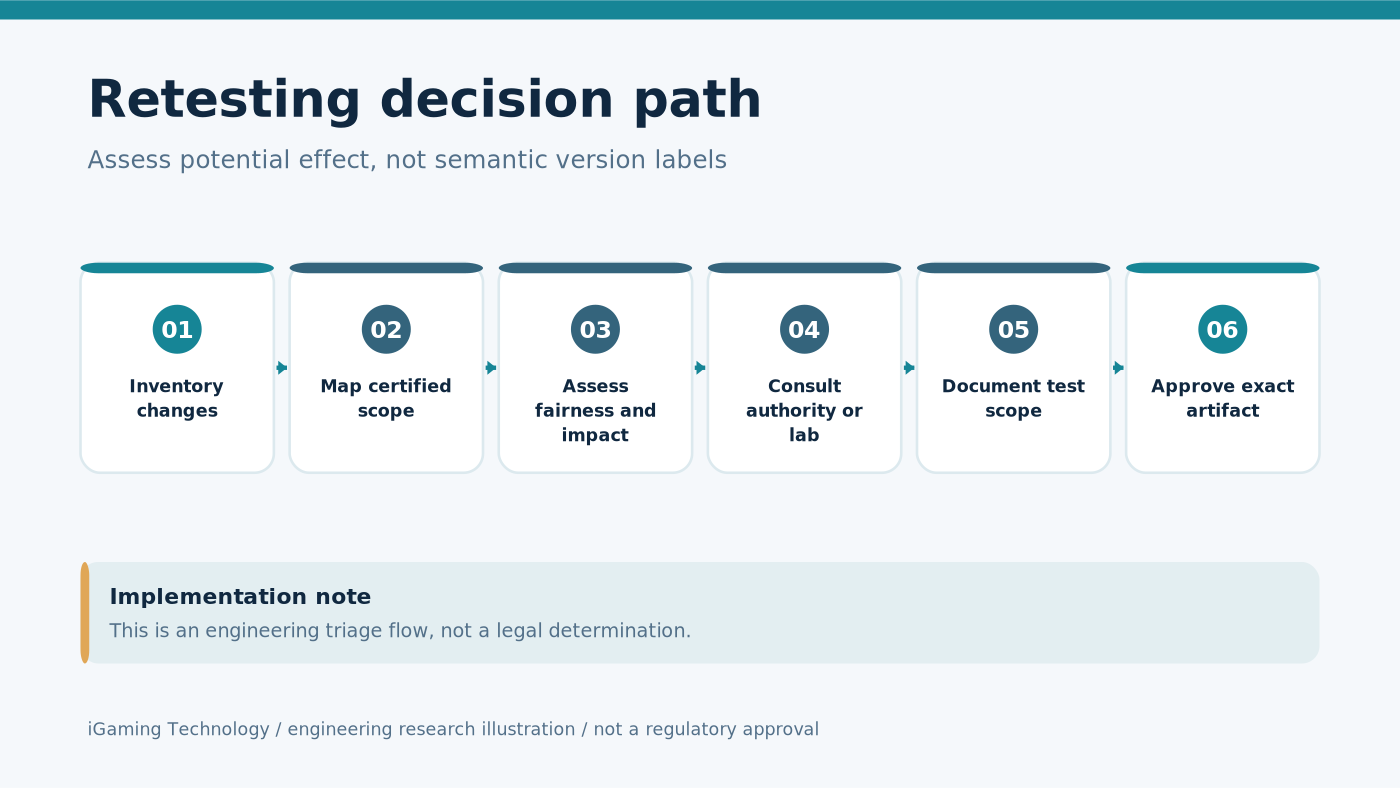
A useful decision record is short enough to complete consistently but detailed enough for a reviewer to challenge. It identifies the old and new release artifacts; source and dependency diffs; configuration changes; affected certified components; markets and approvals; game math and RNG impact; customer-facing changes; financial risks; required test levels; the lab or regulator consulted; and the documented disposition. Evidence should link to artifacts with immutable hashes, not just mutable issue-tracker URLs.
The comparison needs to cover more than successful test cases. For a changed outcome path, show boundary-value and rare-feature tests; for wallet changes, reconcile transaction identities and amounts; for an infrastructure migration, perform rollback, concurrency and failure tests; for a display change, compare the player-visible result with the authoritative game result. For shared libraries, identify the complete dependent game inventory rather than selecting one flagship title as an arbitrary proxy.
The UKGC testing strategy discusses reporting tested game details and digital signatures, the affected platform version, covered channels and references to the previous report where limited-scope testing applies. This provides a model for why exact version identity matters. The assessment should also identify whether a live environment differs from the controlled test environment in ways that could affect fairness. Record the laboratory’s rationale when it agrees to rely on previous evidence for unchanged components.
Where tests fail, preserve the initial failure, remediation change, rerun report and final reviewer decision. A clean final dashboard without the history of changed assumptions makes later audits difficult. When doubts remain, do not infer a favorable classification from test pass percentages. Escalate to the responsible compliance owner and independent test house as the market requires.
Review and approval workflow
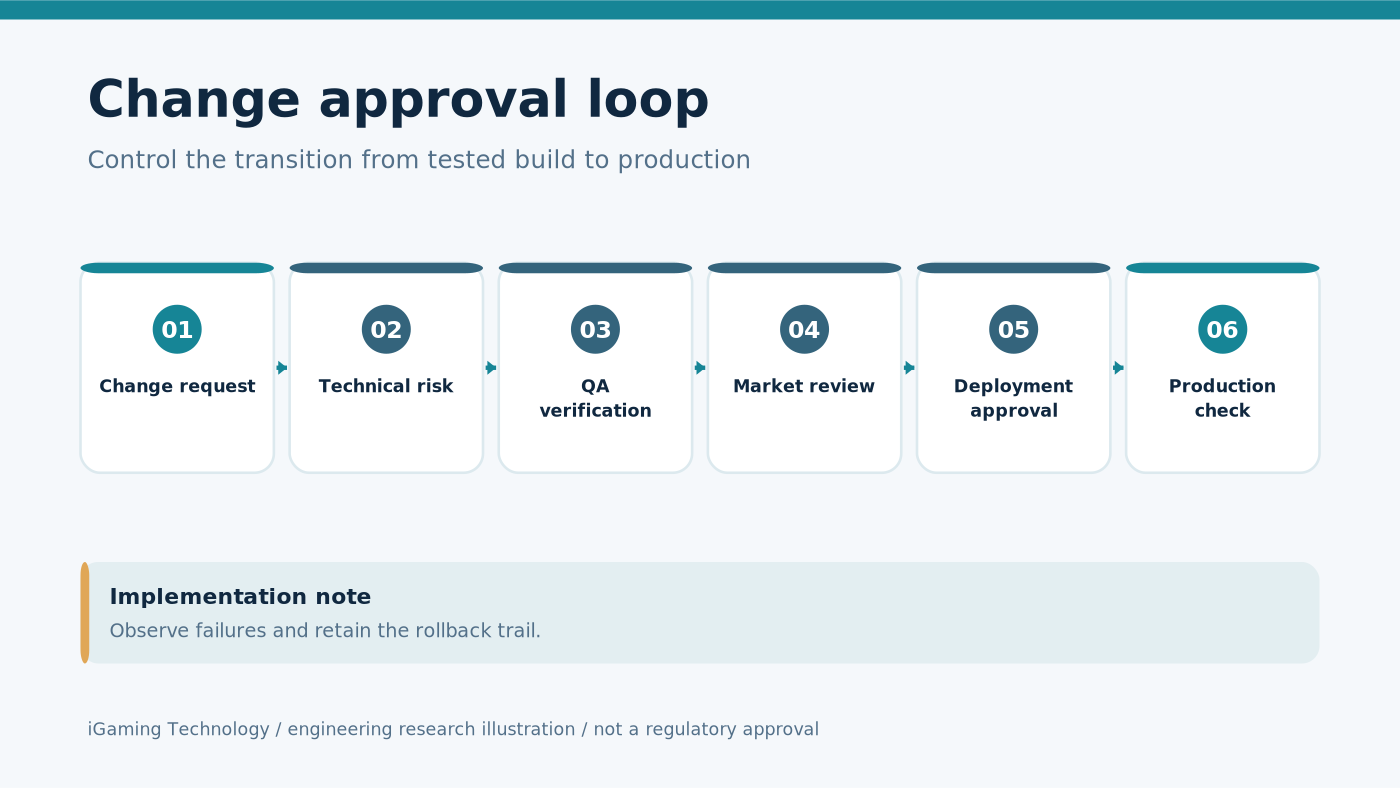
A practical cross-functional process has six steps. First, the release owner opens a formal change record with the two artifact identities and why the change is needed. Second, engineering maps changed code, configuration and dependencies to the certified boundary. Third, QA and game mathematics examine fairness, payout, result presentation and integration impact. Fourth, compliance maps the impact to each jurisdiction’s rule and the applicable test-house reporting process. Fifth, independent testing or consultation occurs where required. Sixth, an authorized release owner records the final disposition and deploys only the corresponding approved artifact.
Approval roles should be explicit. A developer may supply the technical impact narrative but should not unilaterally decide that changes touching outcome mapping are “visual only.” The QA lead may accept internal test completeness while the licensed operator or appointed person retains the regulatory release responsibility. Separate deployment approval from regulatory approval; the first controls a release action, and the second concerns whether the product may lawfully operate in the relevant market.
Emergency fixes do not eliminate these questions. A serious security incident may demand rapid mitigation; an emergency change process should document the risk, temporary safeguards, retrospective testing and any notifications or approvals mandated by the market. A controlled shutdown or feature disablement may be preferable to silently shipping a different game outcome model. Record the incident and plan for reconciling any interrupted or unsettled rounds.
After deployment, verify that the actual digest and configuration match the approved records. Monitor round completion, duplicate transactions, unexpected payout distributions and user-facing errors. Post-release monitoring supports operational assurance, but it does not retroactively satisfy an external testing requirement that should have been completed before launch.
Illustrative decision matrix, not legal advice
| Change example | Initial fairness concern | Evidence and next action |
|---|---|---|
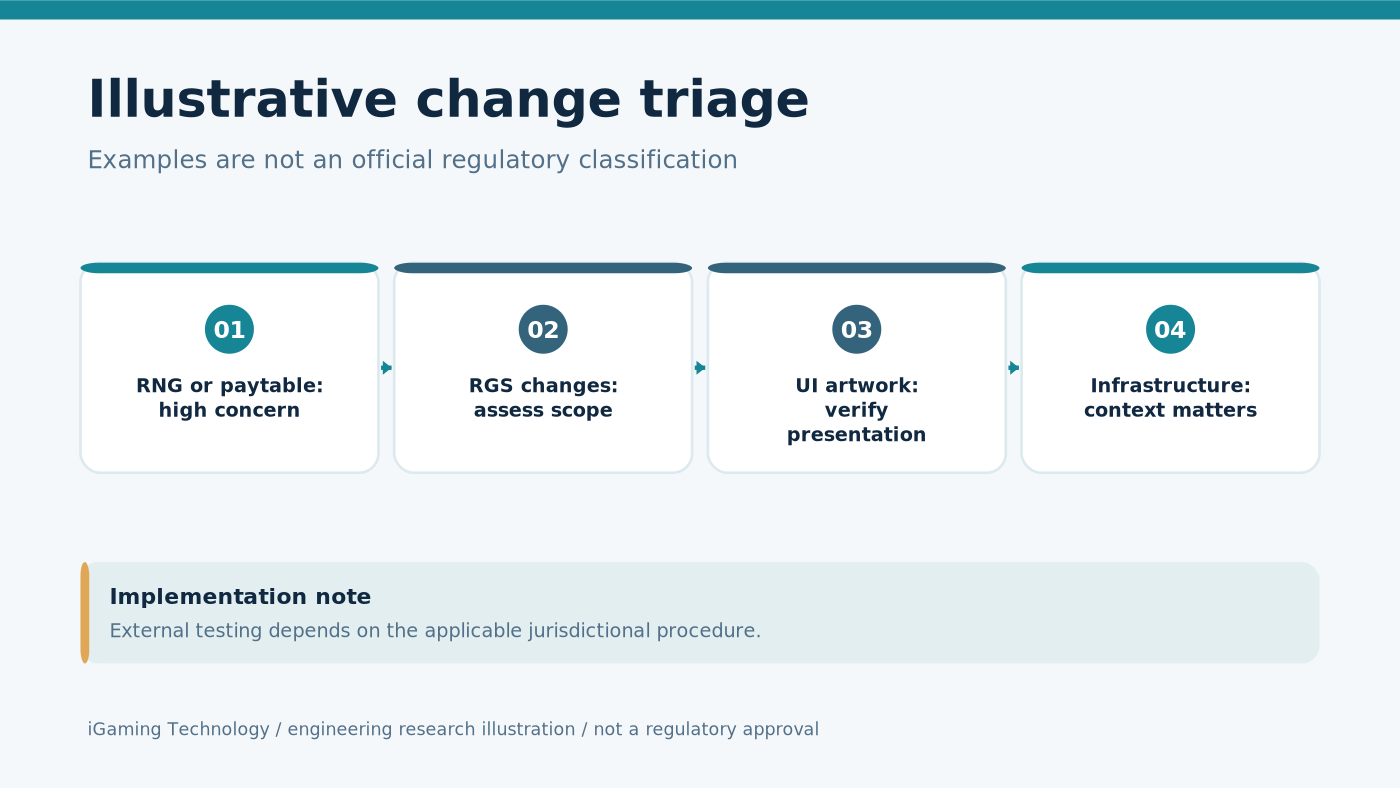
| Modify RNG algorithm, seed path or outcome mapping | High | Source/math assessment; consult required test house; external retesting where mandated |
| Change symbol weights, paytable or bonus rules | High | New math model, rules, simulations, versioned configuration and formal decision |
| Fix a rare payout-calculation defect | High | Determine previous defect scope, verify correction and assess affected games/rounds |
| Rework shared RGS runtime or persistence | Context-dependent, potentially high | Dependency inventory, representative integration tests, lab consultation |
| Update client artwork only | Potentially lower | Prove probability, result presentation and disclosed information remain correct |
| Update sounds without behavior changes | Potentially lower | Test channels and document absence of fairness impact |
| Modify wallet callback idempotency | Material financial-integrity concern | Settlement consistency, retries, reversal and reconciliation tests; regulatory assessment |
| Patch infrastructure without code changes | Context-dependent | Verify runtime, RNG dependencies, critical behavior, rollback and approval scope |
The UKGC’s Annex A supplies the actual major/minor principles for its testing framework, including the caution that seemingly visual corrections may sometimes affect misleading presentation or correct payouts. GLI-19 Section 1.5.1 provides the relevant discussion of modification testing and regulator-adopted change management programs. Use the decision matrix as a prompt for documented analysis, not as an automatic deployment policy.
Bottom line: ask whether the assessed behavior changed, not just whether the product version number changed. Preserve a clear trail from original tested component to modified artifact, requirement interpretation, test scope, approval and the exact deployed version. When uncertainty could affect fairness or market eligibility, involve the appropriate compliance authority and test house before release.