A production gaming incident often arrives as a fragmentary story: the player saw a result, the operator’s wallet timed out, a callback arrived twice and the dashboard showed pending. Engineers need to reproduce the exact conditions without initiating a second real wager, exposing sensitive data or changing the outcome of a settled round. Deterministic game debugging makes that possible by reconstructing a controlled version of the execution from recorded inputs and explicit dependencies.
A deterministic replay is not the same as rerunning a commercial game. Production outcomes may rely on protected RNG state, external provider decisions, real-world dealer events and mutable configurations that a test runner cannot or should not reproduce. The practical goal is narrower: recreate the behavior of the software boundary under investigation. For example, a wallet callback handler can be replayed with a fixed, redacted message and a deterministic fake ledger response. A state machine can be tested with an immutable event sequence and a reference model.
This article focuses on engineering replay and test fixtures, not on predicting outcomes, reversing RNG state or replaying authentic payments. Treat any method that could produce a live financial effect as out of scope. All fixture accounts and credentials below are synthetic.

Deterministic replay use cases and boundaries
Deterministic replay is especially useful after an incident with a repeatable failure signature: a duplicate debit, a late win callback, a round that remains pending after the wallet committed, an incorrect transition caused by message reordering, or a configuration-dependent response mismatch. The immediate question is not “can we recreate the same random spin?” but “can we recreate the same sequence of application decisions from the same authorized inputs?”
A replayable subsystem is usually a function of recorded domain events, a pinned configuration version and controlled external observations. It may also depend on time, queue ordering, concurrency and feature flags. Each dependency that is allowed to float reduces reproducibility. A useful fixture therefore records stable business context (round_id, request_id, currency and amount), schema version, relevant provider response classes, the expected state before each event and the intended outcome afterward.
Not every external fact belongs in a fixture. Raw personal information, access tokens, production RNG seeds, unpublished provider secrets and actual payment credentials should not be copied into engineering archives. A redaction pipeline can preserve structural properties and correlation while substituting synthetic identifiers. In a regulated environment, fixture retention and access require governance just like production logs.
There are two complementary replay levels. Unit-level replay feeds events directly to a pure transition function using a fake clock and fake dependencies. Integration-level replay exercises HTTP handlers, message queues and persistence against nonproduction emulators. The first produces fast diagnostics; the second finds serialization errors, transaction boundaries and webhook behavior that a pure model cannot see. Neither proves that the live production environment will behave identically under load.
Capturing controlled inputs and event sequences
The most valuable unit of replay is an ordered sequence of domain facts, not a stream of UI mouse clicks. For example: round created; debit request issued; wallet committed stake; acknowledgement lost; provider retries; wallet returns previous result; outcome recorded; settlement callback issued; worker crashes; retry recovers existing award. Each event should include a stable identifier, type, schema version, logical order and enough body fields to exercise the target code.
You may capture a trace ID and wall-clock timestamps for investigation, but trace timestamps do not automatically define causal order. Messages can be delayed or processed concurrently. If the system uses a monotonic sequence per round, retain that sequence and the authoritative commit evidence. Otherwise, a fixture should explicitly state the ordering assumptions and deliberately test alternative interleavings.
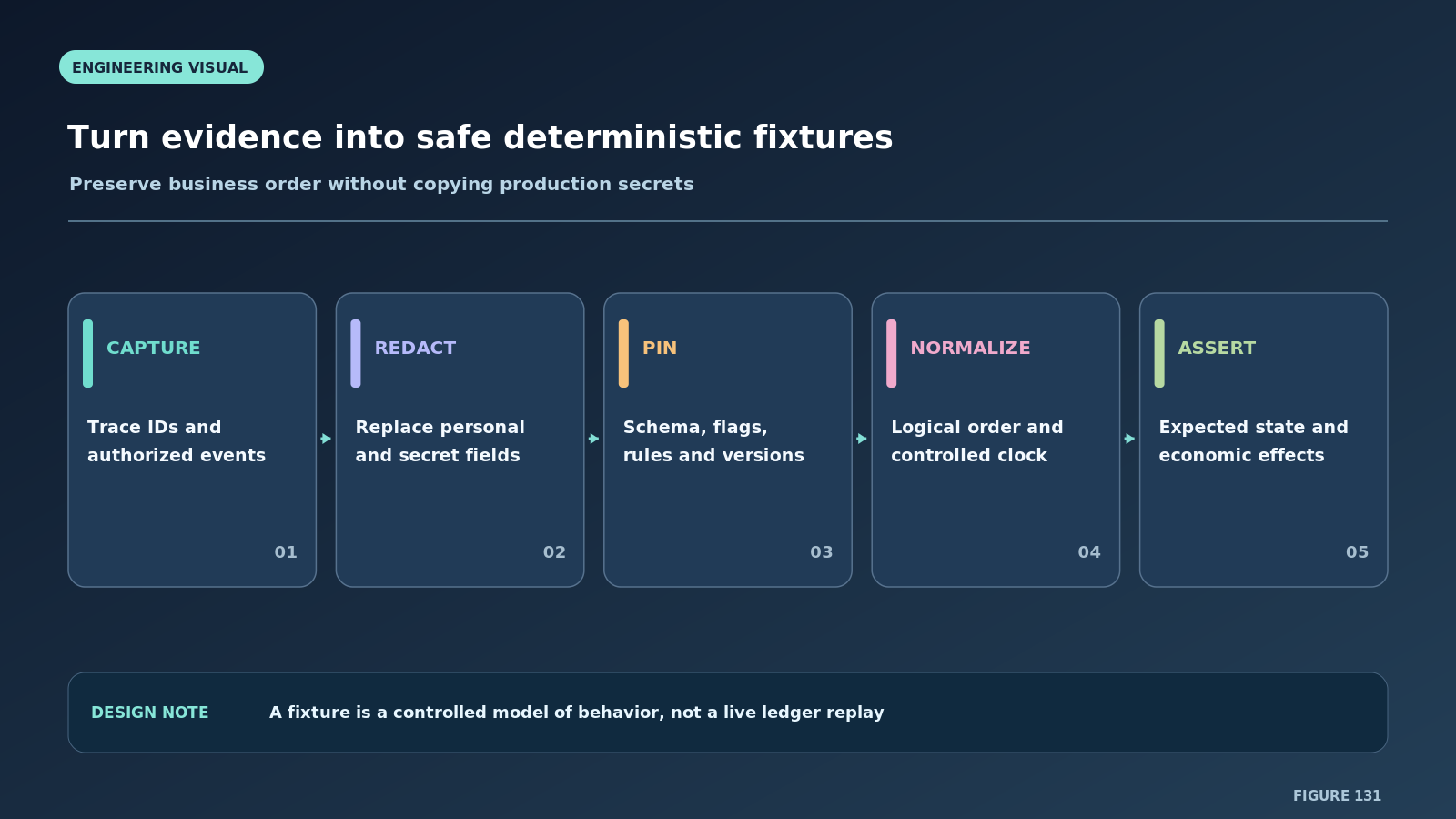
A minimal JSON-like fixture can be documented as:
{
  "fixture_version": 1,
  "case_id": "wallet-ack-lost",
  "rules_version": "test-rules-3",
  "initial_round_state": "BET_PENDING",
  "events": [
    {"seq": 1, "type": "wallet.debit_committed", "id": "debit-44", "amount_minor": 200},
    {"seq": 2, "type": "http.response_lost", "id": "transport-9"},
    {"seq": 3, "type": "provider.debit_retry", "id": "debit-44", "amount_minor": 200},
    {"seq": 4, "type": "wallet.previous_result", "id": "debit-44"}
  ],
  "expect": {
    "round_state": "BET_ACCEPTED",
    "unique_debit_effects": 1
  }
}
These names are illustrative, not an interoperable provider format. The fixture intentionally separates a committed business event from lost transport acknowledgement. The test should reject an implementation that treats http.response_lost as permission to create a second debit.
Preserve source provenance for each fixture: incident or ticket reference under access control, schema version, service build hash, approved rules version, redaction method and expected assertions. If the expectation changes after a bug fix, document why. A fixture is more than a blob of event data; it is an executable statement about intended business behavior.
Test-only clocks, seeds and external dependencies
A deterministic test runner should control time through an injectable clock rather than reading system time directly in scattered services. This lets the same fixture simulate a timeout at 500 milliseconds, a retry after exponential backoff, a betting window closing at a fixed logical instant, or an expiration scheduled for the next minute. Wall-clock manipulation alone is insufficient if one component reads a monotonic clock and another reads an NTP-adjusted UTC clock.
For generated identifiers, use a deterministic test sequence such as test-round-001, test-round-002; do not accidentally leak test identity behavior into production. For network dependencies, use scripted responses that can commit remotely and then drop the acknowledgement. That pattern is essential to reproduce the hard case in which the caller cannot tell whether a money mutation took effect. A successful fake that always returns instantly tests little about recovery.
RNG requires a careful boundary. Test-only seeded randomness is appropriate for validating a pure mapping function or reproducing a synthetic game example, provided it is isolated from production secrets and does not weaken the production entropy design. The production system may be intentionally non-replayable at the raw RNG level. In that case, inject the already-authorized outcome fact as an input to downstream replay. Do not capture or expose live secret state just to make troubleshooting convenient.
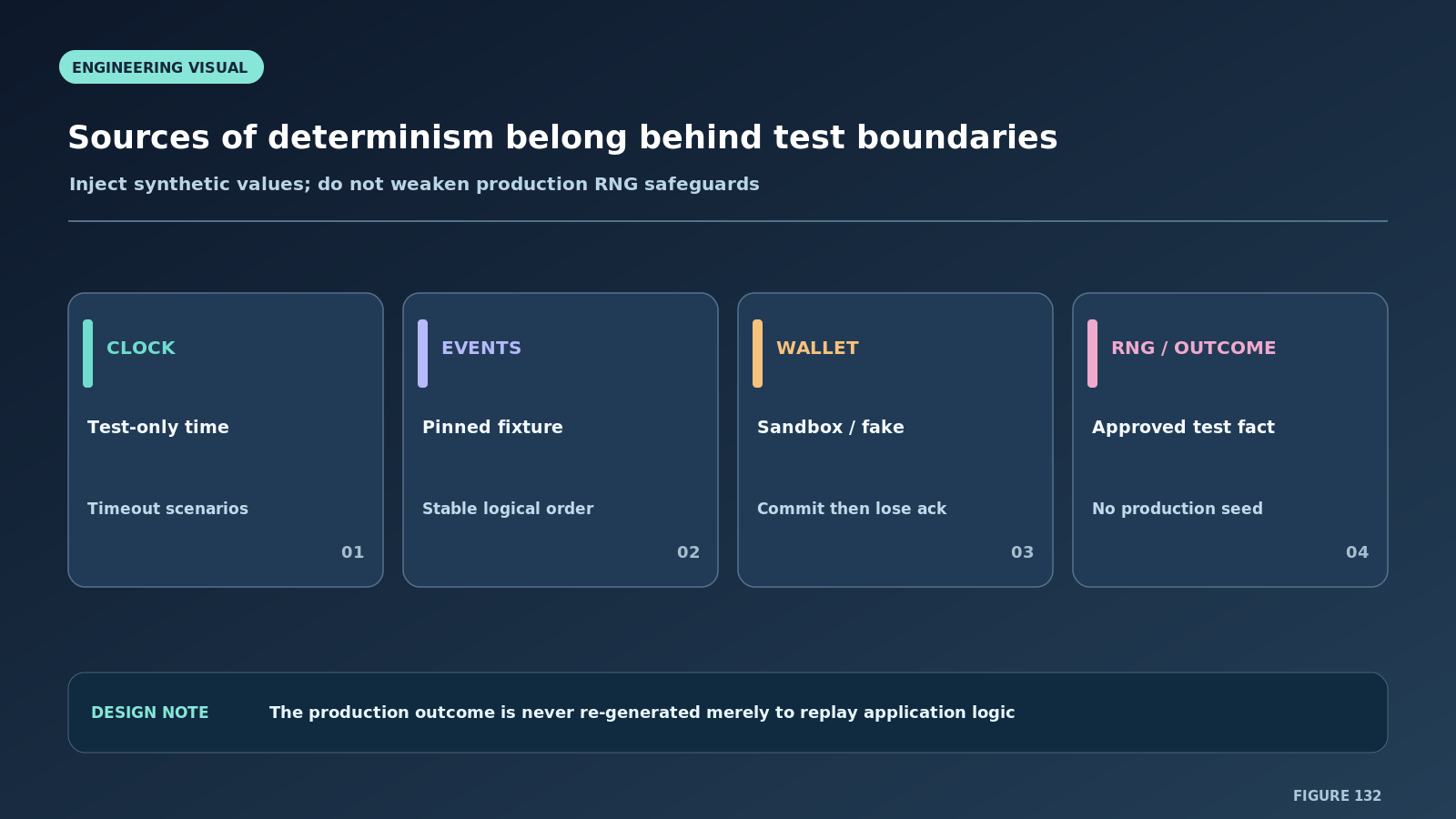
Configuration matters as much as clocks. A defect visible with feature flag wallet_adapter_v2=true may disappear with the current default. Capture relevant flags and artifact versions with the fixture. When the test replays the event sequence, it should load the specified rules snapshot instead of silently using the latest mutable configuration. Otherwise the test may “pass” because it no longer reproduces the environment where the defect occurred.
Concurrency needs separate modeling. A single sequential replay cannot reproduce all races. A schedule-aware runner can insert barriers and release two workers in a chosen interleaving; a property-based test can enumerate small schedules; a load test can probe realistic throughput. All three serve different purposes. Replay provides a specific execution trace, whereas concurrency model checking explores alternative executions consistent with the same allowed events.
Replaying state and reproducing defects
A clean replay runner begins with an isolated database or pure in-memory model. It applies the initial state, injects one event at a time and records the before/after state together with side effects. At the end it compares the actual state with the fixture’s assertions. Side effects must be routed to nonproduction adapters: a wallet double, a fake provider, a sandbox ledger or a stub notification channel. Production network credentials should be unavailable to the process by policy and environment controls.
Replaying an event-sourced aggregate may reconstruct its state by folding events through a deterministic reducer. Replaying a request-driven service might instead rerun commands against scripted external responses. These are not equivalent. An event log records facts that happened; command replay asks the system to decide what should happen. Running an old command against a new rules version can legitimately produce a different result. Always state whether the test is replaying historical facts or re-executing business decisions.
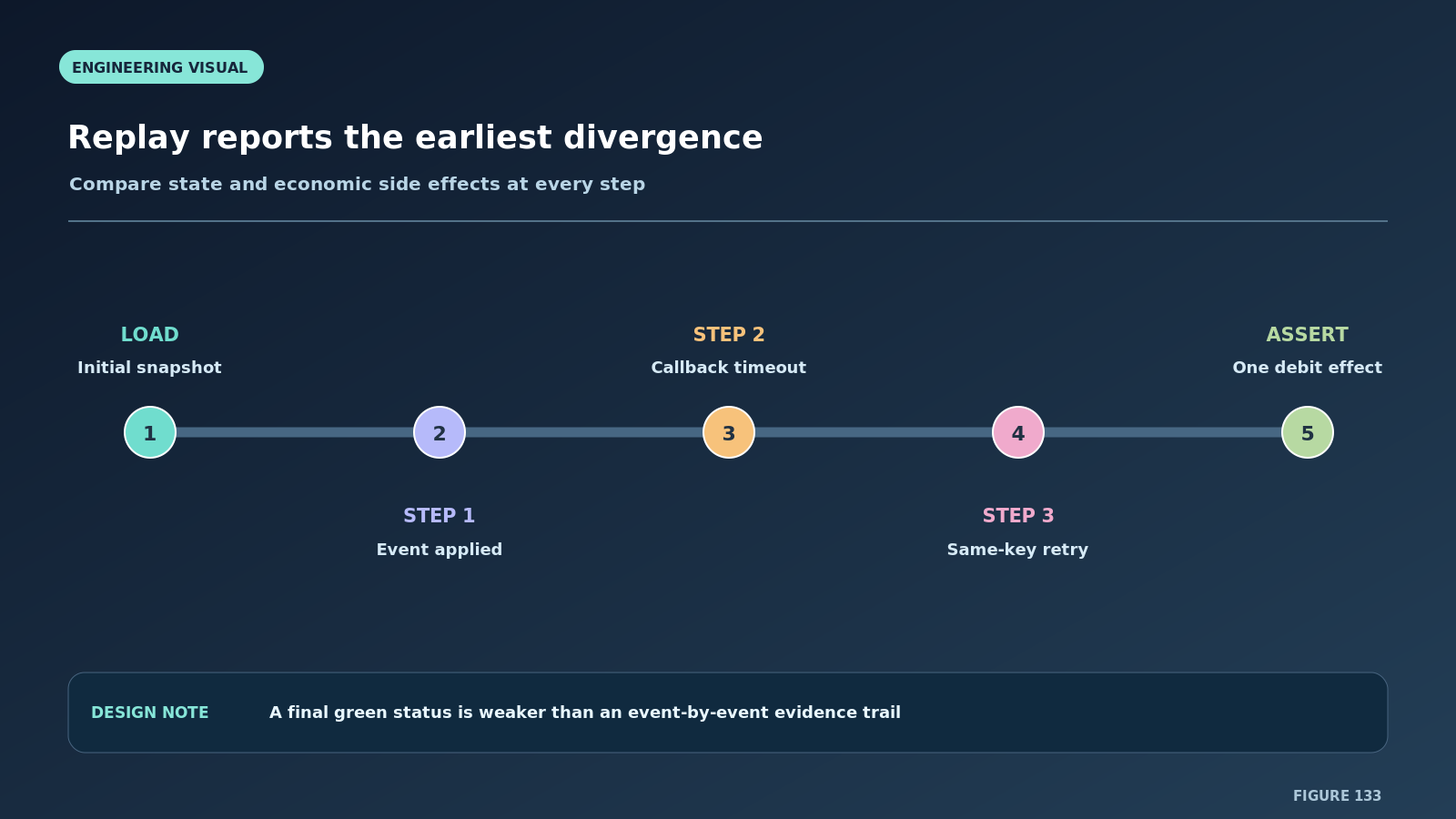
A replay report should identify the earliest divergence: event 4 was accepted but should have been ignored as a duplicate; event 6 moved from SETTLED to SETTLEMENT_PENDING; a callback with the same request ID created an additional journal entry; or the expected response class changed because a schema field was absent. Report both the domain view and the storage side effects, because a round may appear correctly settled while its ledger count is wrong.
Be explicit about what a “same result” assertion compares. Byte-for-byte JSON equality is often too strict when nondeterministic request IDs or harmless log timestamps are present. Economic invariants, state transitions and normalized business responses should be strict. Trace IDs, processing duration and database-generated housekeeping metadata can be compared under separately documented normalization rules.
Replay can also reveal a failure in observability rather than business logic. A status message may be correct but arrive without correlation IDs, making a real incident impossible to diagnose. Treat trace propagation, alert labels, retention controls and the completeness of a round timeline as testable properties when they are important operational guarantees.
Fixtures, assertions and CI integration
Store test fixtures with a clear naming convention, versioned schema and descriptive expected behavior. Organize cases around failure classes rather than around one historical incident: duplicate callback, timeout after commit, stale revision, late settlement, invalid amount, configuration mismatch, malformed event and crash during outbox delivery. Include a handful of representative negative tests that assert the service rejects an impossible transition.
A replay suite can run on each change to the round aggregator, wallet adapter and provider integration contract. The CI job should pin dependency versions, use isolated test resources and publish compact diffs when behavior changes. For sensitive fixture libraries, CI workers and artifact stores need access controls so that a redacted dataset is not casually treated as public sample data.
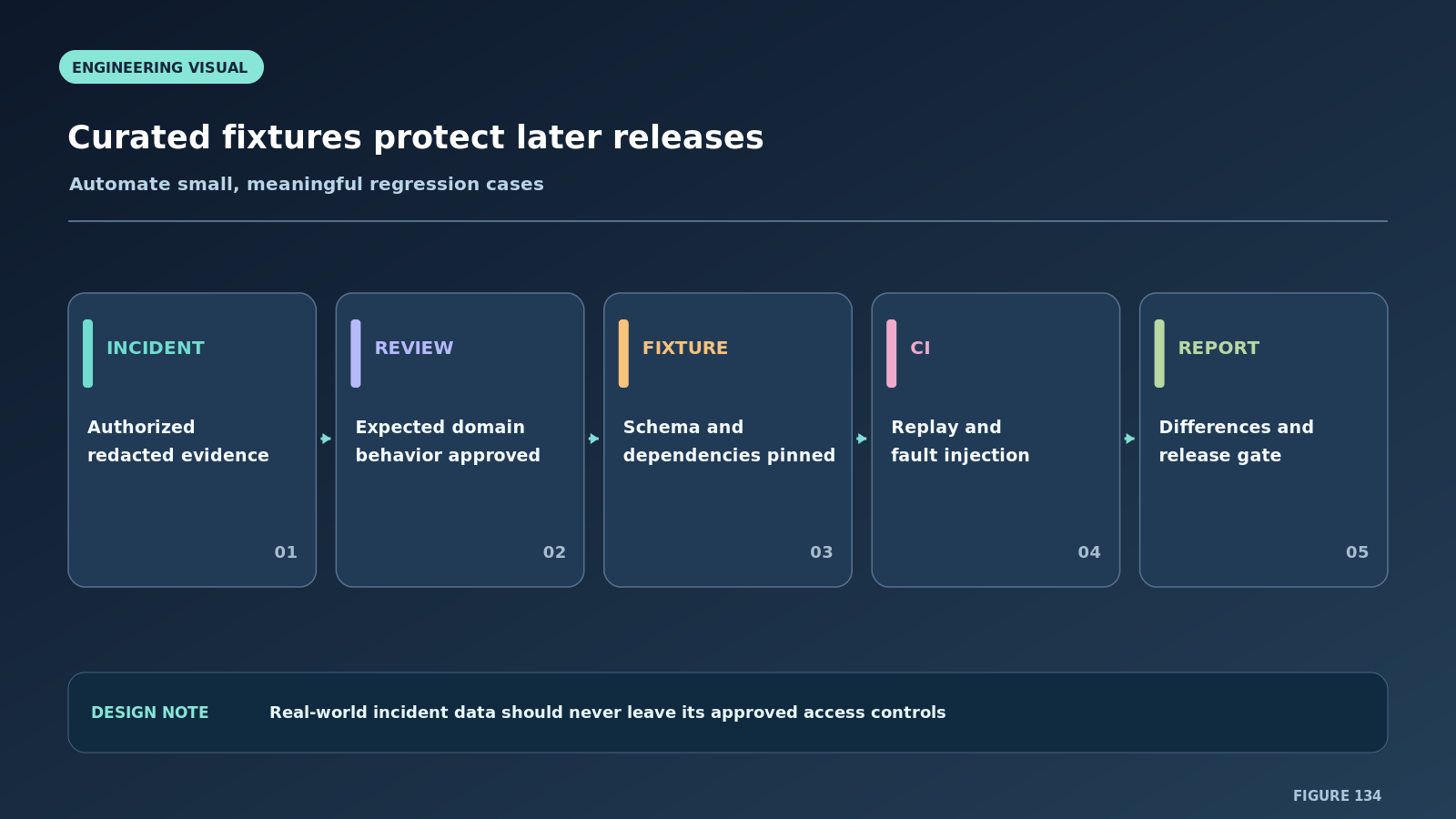
A useful assertion matrix includes: terminal round status, exactly one intended debit effect, exactly one intended award effect where applicable, matching currency and amount, preservation of authoritative outcome version, no invalid late transition, and no live external calls. Also test error reporting: if the authoritative result is unknown, the service should remain unresolved with a clear recovery action rather than manufacture a failure outcome for user convenience.
When the fixture is derived from an incident, link the repaired code change to the new regression case. A second reviewer should verify the expected behavior against the business contract, not merely bless the output the patched code currently produces. This prevents a subtle anti-pattern in which tests are updated to fit an implementation bug.
For a large suite, prioritize fast deterministic unit tests in the normal pipeline and run broader integration and fault-injection scenarios on scheduled or release-gate pipelines. A slow, flaky end-to-end suite may become ignored; a lean contract-focused suite protects the most important invariants continuously.
Security boundaries and common limitations
There is a major security difference between deterministic debugging and giving an outside party the ability to predict future production outcomes. The former injects controlled test inputs; the latter would be a catastrophic violation of a production RNG threat model. Avoid storing production seeds, bypassing outcome authorization, changing randomness policy at runtime or issuing replay commands into real player wallets.
Protect raw incident evidence, and preferably create sanitized fixtures with irreversible redaction. Synthetic examples can preserve timing relationships, missing fields and duplicate identities without keeping account identifiers or secrets. Review access policies for regulated data, especially if logs contain session references, IP addresses or support information. Redaction should preserve functional test value without allowing re-identification through secondary fields.
Another limitation is that not all bugs are deterministic. Hardware faults, scheduler races, third-party timing and live dealer actions may be difficult to reproduce exactly. When exact replay is impossible, capture a reduced state machine model, construct a fault-injection test and document the unresolved environmental assumptions. It is better to say “this reproduces the wallet callback race” than to claim a complete recreation of the player’s session.
Finally, replay is not an audit substitute. The audit trail establishes what happened in production through authoritative records; the replay test checks how software behaves under a controlled approximation. Combining both yields strong engineering evidence, but neither should be confused with the other.
In practice, the biggest benefit is cultural: a difficult bug becomes a durable, reviewable fixture instead of a story that depends on a single engineer remembering an incident. Stable event identities, controlled dependencies and explicit assertions transform ambiguous network failures into tests that can keep protecting the platform after the original incident has been resolved.
References and further reading
Replay patterns here are designed for isolated test infrastructure; never apply them as commands to live monetary systems.