Casino backend engineering is the work of making distributed gameplay and financial systems behave predictably. A browser may display a successful round in milliseconds, but the platform behind that result has to maintain session authority, game configuration, wallet correctness, provider connectivity, event consistency, and recoverability. This guide index organizes the subjects by engineering problem rather than by a list of technologies.
Most architectural mistakes begin with an unclear boundary. If a provider times out after a wager is recorded, who retries? If the player refreshes during a round, who remembers its state? If two regions accept requests during a failover, how do they avoid conflicting balance mutations? The answers depend on ownership, guarantees, and observability—not on whether the application is packaged as a monolith or a microservice.
Key subsystems and architecture decision points
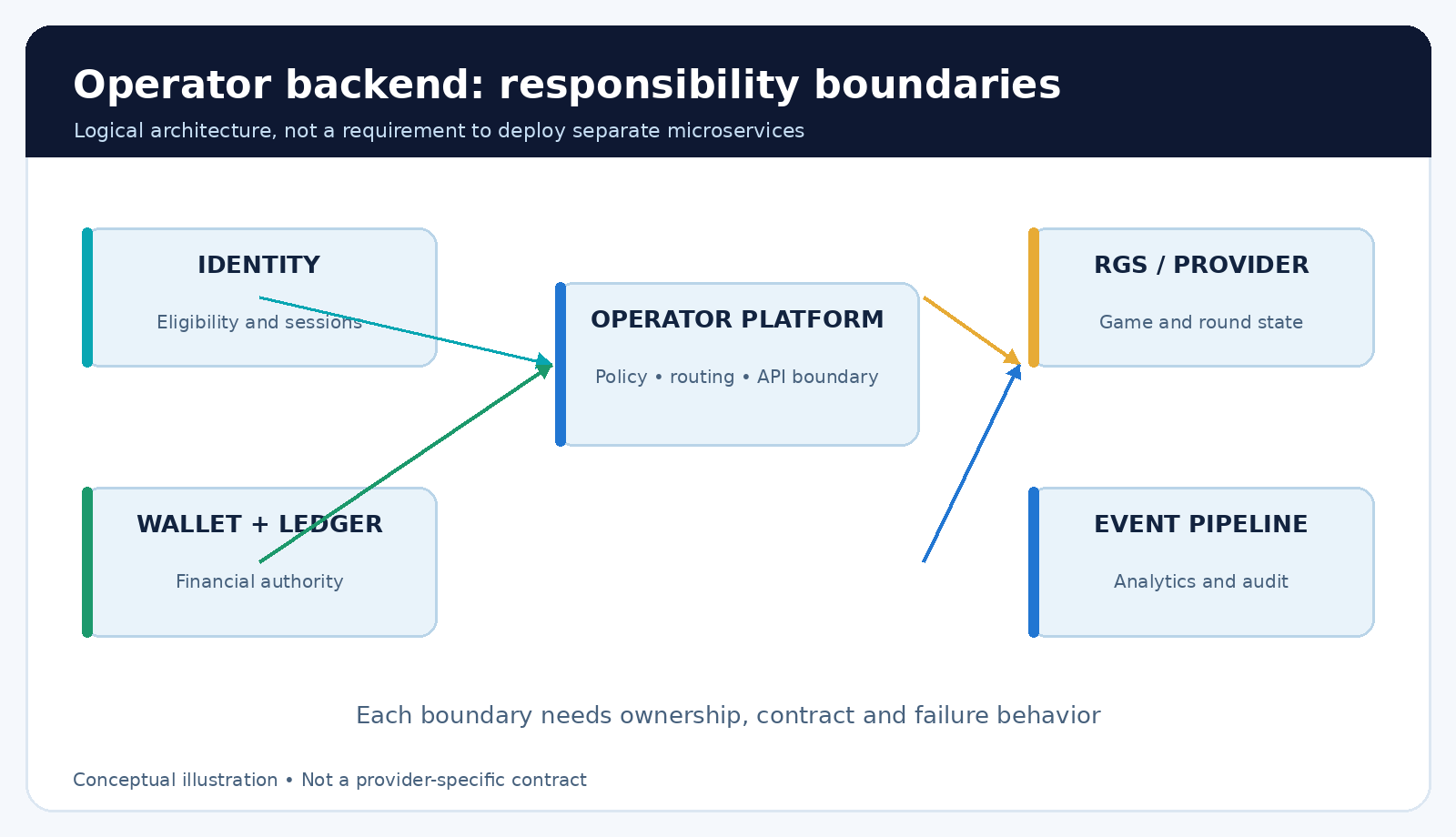
Figure 1. Responsibility boundaries, not a mandatory deployment diagram.
A typical platform contains player identity and eligibility services, a game lobby and session layer, integration services, a wallet and ledger, back-office operations, and supporting event and observability pipelines. Providers and aggregators may sit beyond the operator’s trust boundary, where contracts and authentication become especially important.
Before choosing infrastructure, document the system of record for each type of state. A session service may issue a short-lived token; a remote game server may own the outcome and round progression; the wallet must own the operator-side balance mutation; an analytics platform should consume events without silently taking over operational authority. Clarify how a response can be reconstructed when a request completed but the caller never received confirmation.
Separate architectural guarantees into three groups. Safety means money and round state do not become contradictory. Liveness means valid operations can eventually complete or be resolved. Evidence means the system retains enough identifiers, logs, ledger entries, and reconciliation records to explain what happened after the fact. A design is incomplete if it addresses only throughput and latency.
Wallets, transactions and financial consistency: reading path
Begin with iGaming Wallet Architecture: Double-Entry Ledgers and Balance Management. Its central question is how to represent balances as consequences of durable accounting records, rather than as numbers updated without a trace. It also distinguishes an accounting ledger from event sourcing: both can record events, but they make different guarantees and serve different purposes.
Next read Idempotency in Bet and Win APIs. Timeouts, retries, and at-least-once message delivery make duplicate requests an ordinary integration condition. A robust wallet must recognize a repeated business operation using a stable key, return an appropriate prior result when safe, and prevent parallel workers from posting it twice.
Then study Gaming Transaction Reconciliation: Matching Provider and Wallet Ledgers. Not every mismatch is a duplicated charge. It may be a delayed provider settlement, inconsistent status vocabulary, a timezone cutoff, or a missing reference. Reconciliation compares independently produced evidence and routes anomalies through controlled correction—not automatic, unreviewed balance changes.
A useful review exercise is to take one fictional round and test four outcomes: normal settlement, request timeout after commit, callback replay, and late refund. If the ledger and dispute trail remain understandable in all four cases, the consistency model is becoming testable.
Provider integrations and API reliability: reading path
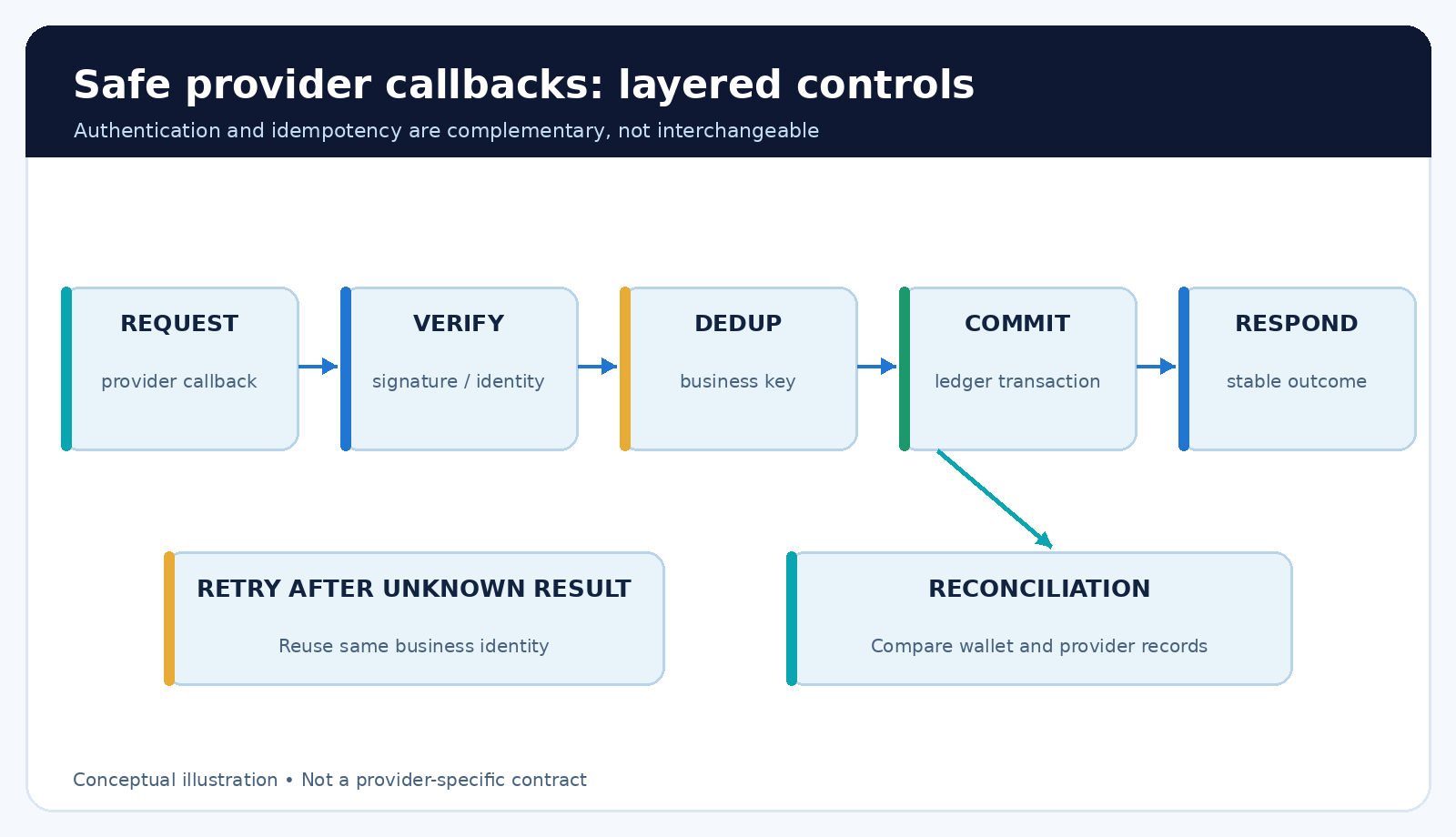
Figure 2. Authentication, idempotency, controlled retries, and reconciliation solve distinct problems.
Start with Casino Game Provider API Integration: Session Launch and Wallet Callbacks. It explains how a game session is established, what the provider expects from the operator, and how bet, win, refund, and rollback messages cross system boundaries. The related Game Aggregator Architecture guide covers normalization when several providers need to fit a common internal model.
Casino API Authentication and Request Signing addresses identity, integrity, and replay resistance. A valid signature proves something different from a successful business transaction: the message can be authentic and still refer to an already-processed bet. Authentication and idempotency should therefore be evaluated separately.
Retries, Timeouts, and Circuit Breakers for Casino APIs examines which failures are retryable and why an HTTP timeout cannot always be interpreted as a rejected operation. Webhooks vs Polling compares event delivery mechanisms, including ordering, cursors, duplicates, and recovery after downtime. Neither notification mechanism should be confused with a financial authorization rule.
Use Game Provider Integration Sandboxes to test failure paths deliberately. A sandbox that always returns 200 OK is useful for a smoke test but inadequate for validating race conditions, delayed responses, replay, or a temporary provider outage.
Analytics, observability and availability: reading path
A real-time analytics pipeline answers questions about throughput, player journeys, and operational signals, but it has different failure tolerance from a wallet ledger. Read Real-Time Gaming Analytics Pipelines for ingestion, transformation, storage, and backpressure decisions. Read Game Telemetry Governance for schemas, data ownership, retention, and privacy boundaries.
Observability for Gaming Platforms connects one player-critical transaction across launch, game, wallet, and settlement. A trace should help identify where time was spent; logs should explain decisions; metrics should show a pattern over time. Correlation IDs and provider transaction IDs need to be modeled carefully, with sensitive attributes excluded from logs and traces.
For resilience, High Availability for iGaming examines failure domains, regional strategies, recovery-time and recovery-point objectives, and split-brain protection. Replicating servers does not automatically make a wallet highly available. Teams must define whether a second region can write financial state, how leadership is fenced during failover, and what reconciliation follows recovery.
Deployment, configuration and supply-chain security: reading path
Reliable deployment includes the application, its dependencies, artifacts, environment-specific credentials, and the data that decides how game logic is configured. Game Configuration Versioning covers immutable configuration snapshots, staged rollout, and mid-session compatibility. A round started under one approved configuration should not silently continue under another.
Remote Game Server Supply Chain Security focuses on dependencies, reproducible builds, artifact signatures, secrets, deployment rights, and environment segregation. A signed binary can still contain unsafe logic, but provenance helps demonstrate which artifact was built, approved, and deployed. The practical goal is a verifiable chain from source change to running service.
Architecture diagrams and terminology cross-reference
Read diagrams as claims about ownership and message movement, not as decorative drawings. Every significant arrow should correspond to a contract or an event. Every persistent component should identify the state it owns and its recovery guarantee. Every cross-boundary call should have an authentication model, timeout behavior, and correlation identifiers.
Terms used across these guides include RGS (remote game server), wallet (balance and transaction service), ledger (durable accounting record), idempotency (repeat-safe processing of a logical operation), reconciliation (comparison of independent records), RTO (recovery time objective), RPO (recovery point objective), and SLO (service-level objective). The technical glossary provides fuller definitions.
All platform engineering articles
Use this directory to choose a guide by the problem you need to solve:
- System design: iGaming Platform Architecture; Monolithic vs Microservices; Game Aggregator Architecture.
- Money correctness: Wallet Architecture; Idempotency in Bet and Win APIs; Transaction Reconciliation.
- Provider connectivity: Provider API Integration; Webhooks vs Polling; Retries, Timeouts and Circuit Breakers; API Authentication and Signing; Provider Sandboxes.
- Data and operations: Real-Time Analytics Pipelines; High Availability; Observability and Tracing; Telemetry Governance.
- Controlled changes: Game Configuration Versioning; RGS Supply Chain Security.
The category is a map, not a substitute for the detailed guides. Use it to move from a concrete failure scenario to the relevant architectural guarantee, then validate that guarantee with a test that could actually fail.