AI in iGaming is most useful when applied to constrained engineering problems: detecting suspicious transaction patterns, triaging API failures, identifying operational anomalies and helping testers examine large sets of logs. It becomes less trustworthy when it is described as a universal substitute for financial rules, game math, independent testing or accountable operational decisions. A fraud or anomaly model can prioritize investigation; it should not secretly alter a game outcome or overwrite a ledger entry on its own.
This section is an engineering reading hub for platform architects, data teams, QA specialists and responsible operators. It separates the deterministic authoritative core—identity, wallet, settlement, game rules and approved RNG—from advisory machine-learning systems. Each guide should explain the decision boundary, data lineage, measurable performance, failure behavior and human escalation path.

Where AI helps infrastructure, testing and operations
Machine learning can identify patterns that are hard to describe with a single static rule. A monitoring system may learn typical request sequences, seasonality and error clusters, then rank unusual changes for investigation. A support engineer may use retrieval-based assistance to connect an incident log to an established runbook. A QA team may use language models to draft candidate test cases from a versioned API contract. None of those outputs should bypass a reviewer or existing automated acceptance checks.
Start with a task whose success is observable. Examples include reducing time to classify incident alerts, increasing confirmed detection of transaction anomalies at a fixed false-positive budget, or finding more contract-breaking API changes before release. Choose baselines first: static rules, simple statistics and human workflows may solve some problems with lower cost, better explainability and easier compliance.
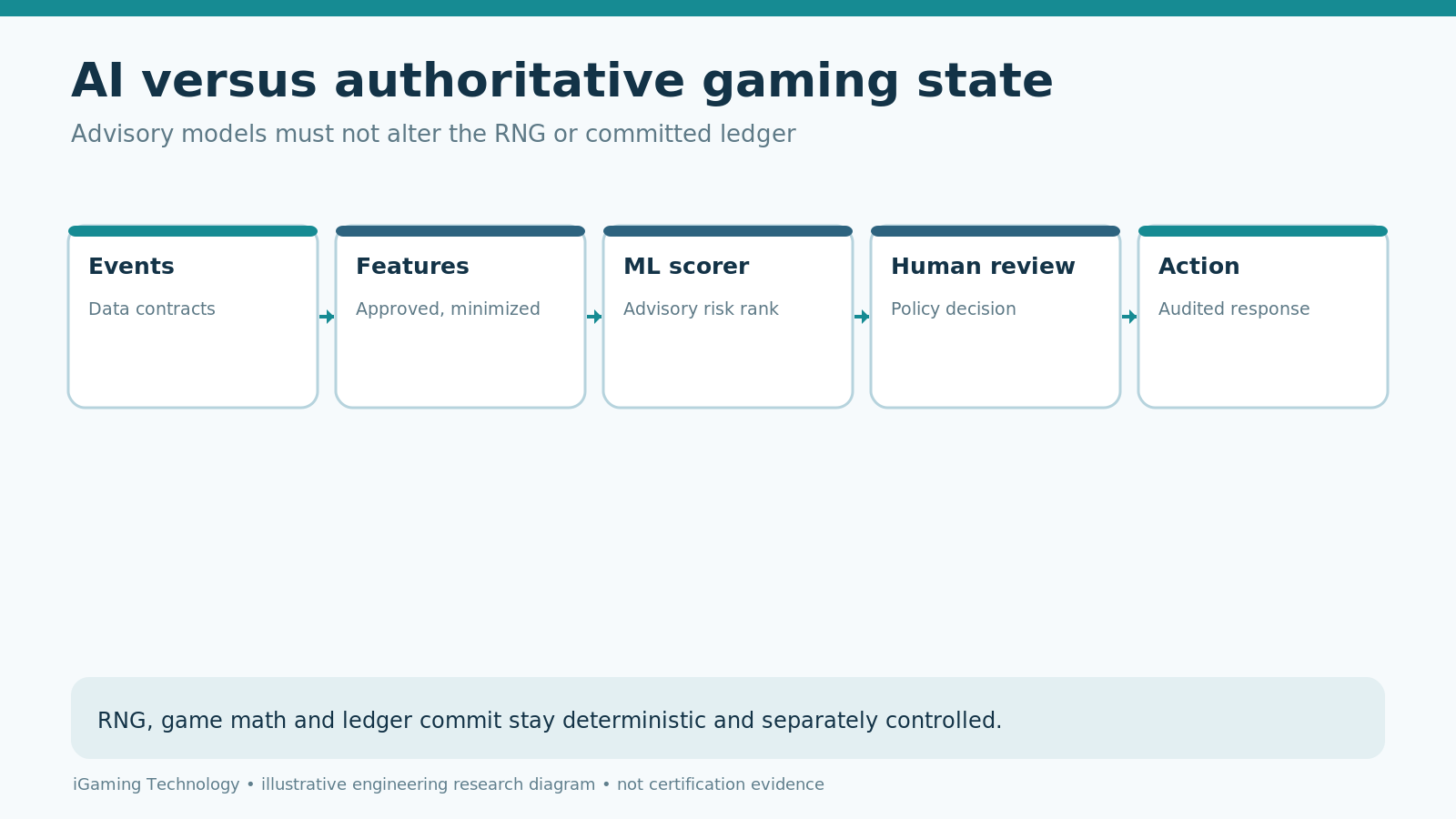
Separate prediction from authorization. A model may predict that a payment deserves review, but the financial ledger remains governed by deterministic, auditable transaction logic. A model may recommend that an API client be challenged, but critical access-control and account-recovery paths must have safe override mechanisms. An automated test generator may suggest edge cases, but a human-defined oracle determines the correct result.
Transaction anomaly detection: use cases and limits
A transaction-integrity monitor can detect unusual sequences such as a win credit without a matching round, repeated attempts using conflicting parameters, sudden reconciliation drift or a concentrated pattern of reversals. Many such conditions are better enforced as hard invariants first. A ledger should never rely on a probabilistic model to notice that a double-entry transaction is unbalanced; the posting operation itself should enforce balance and uniqueness rules.
ML becomes helpful after basic correctness controls are in place. It can rank patterns that cross sessions, providers or time windows, such as atypical retry behavior, nonstandard provider callback timing or complex shifts in reversal rates. Feature pipelines should be privacy-aware and constructed from approved, consistent event definitions. Use time-based evaluation splits so the model is not tested against near-duplicates from its own training period.
Operational thresholds matter more than raw accuracy. When genuine anomalies are rare, a classifier reporting high accuracy may still produce many costly false alerts. Measure precision, recall, detection delay, review burden and impact on legitimate customers. Route uncertain cases to analysts with evidence references and an explicit disposition process. Never present anomaly probability as proof of fraud.
Automated API abuse detection: use cases and limits
Gaming APIs face automated traffic from ordinary integrations, testing tools, mobile reconnects, bots and malicious clients. The detector must distinguish authorized machine-to-machine behavior from abuse. Raw request rate is rarely enough: a reliable game provider can legitimately send bursts of settlement callbacks, while a low-rate attacker may probe authentication or enumerate resources across accounts.
Combine deterministic safeguards—authentication, tenant rate budgets, nonces, idempotency, request validation and credential rotation—with statistical observations of request sequences, source diversity, error bursts and unusual interaction timings. A model may score events, but enforcement should use staged responses: observe, challenge or slow when safe, escalate to a reviewer and block only with policy-backed confidence. Provide appeal and override paths for false positives.
Avoid feeding the system unneeded personal data. Aggregate or pseudonymize where the use case permits, protect identifiers, set retention periods and document model access. Incident logs and training data can themselves become sensitive. Retraining on unreviewed traffic that contains sustained abusive behavior can normalize that behavior; preserve clean reference periods and analyst annotations.
ML model monitoring and AI-assisted QA: reading path
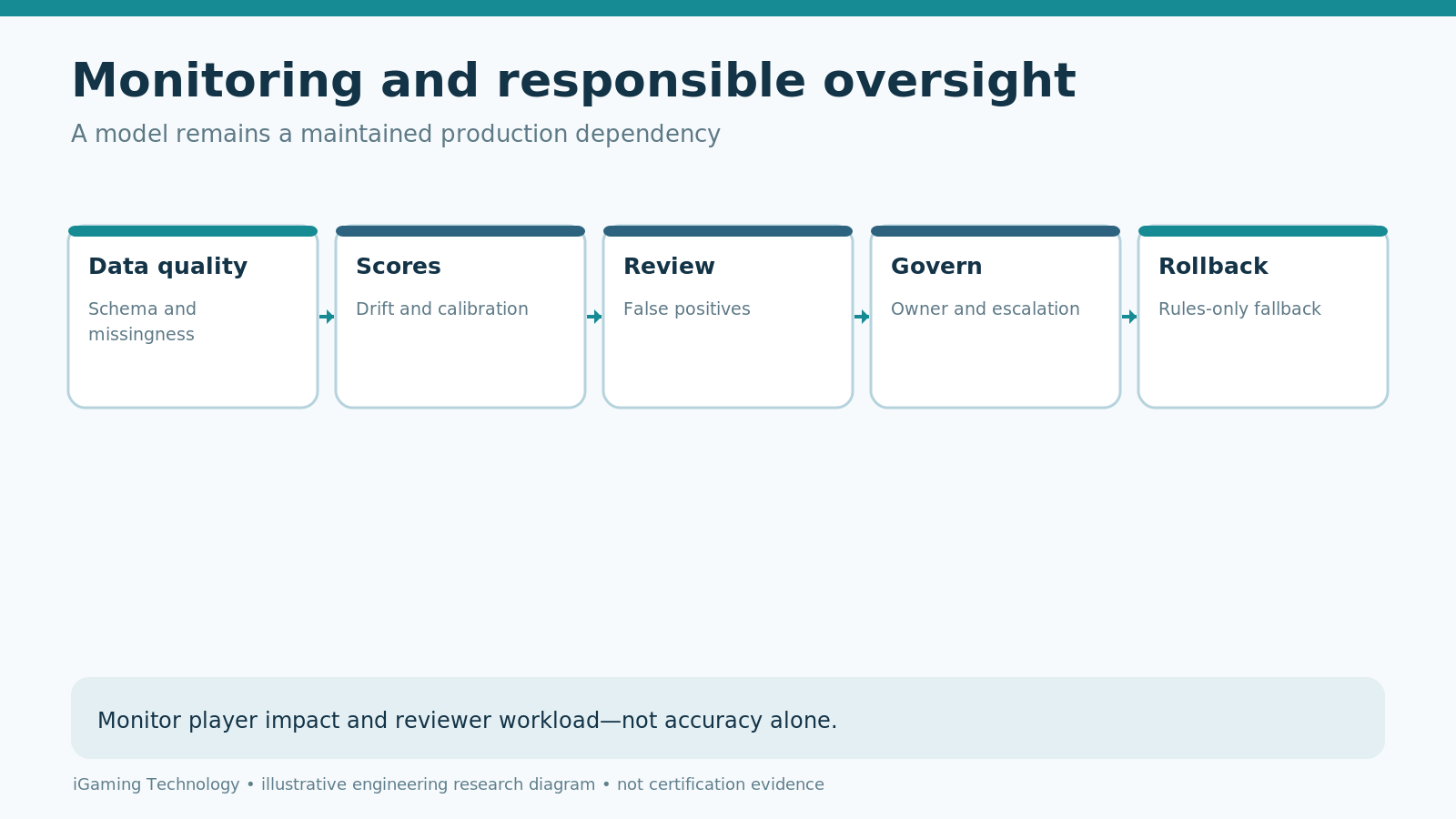
A deployed model can degrade even when its code does not change. Provider behavior, player traffic, game launches, campaigns, jurisdictional changes and adversarial adaptation can shift feature distributions. Monitor input quality, missing fields, scoring latency, output distribution, review outcomes, measured false-positive rates and calibration. Maintain rollback capability and a deterministic rules-only fallback for business-critical detection workflows.
For AI-assisted QA, treat generated scripts and test cases as hypotheses. They can be useful for suggesting unusual API messages, boundary conditions, reconnection scenarios and documentation inconsistencies, but an automated evaluator must still verify expected business behavior. Require reproducible fixtures, sanitized source material and traceability to the specification clause or bug being tested. Never let a generated assertion become the only source of truth about financial correctness.
The NIST AI Risk Management Framework offers a general structure for governing AI-related risks. It is voluntary and cross-sectoral; it should not be represented as an iGaming regulation. A practical implementation maps ownership, validation, monitoring, review and incident response to the product’s own legal and operational obligations.
Keep risk models separate from RNG and outcome services
Anomaly and risk models should not change the random bits, outcome mapping, paytable, or result after an authoritative round has been committed. Mixing those boundaries would undermine auditability and potentially create fairness concerns. Keep model-scoring interfaces downstream of or adjacent to deterministic gaming operations, with explicit data contracts and protected decision rights.
If a legitimate risk-control process must delay activity or request human review, define exactly when it runs and what happens to already accepted bets. “Model says suspicious” is not a valid substitute for a documented product rule, accountable intervention or jurisdictional requirement. Make player-impacting decisions reviewable and preserve the supporting evidence.
Data quality, false positives and human oversight
Good ML performance starts with reliable event semantics. Normalize currencies, time zones, transaction states, provider identities, sessions and effective game versions before modeling. Labeling a delayed settlement as “missing” because the ingestion pipeline is late produces a bad training signal. Infrequent confirmed incidents create class imbalance; a test dataset with artificially balanced outcomes can mislead teams about real-world alert volume.
Use shadow mode before enforcement: score live events without acting, compare outputs with existing rules and collect independent reviewer feedback. Then run bounded pilots with explicit stop criteria. Evaluate disparate impact and legitimate-customer friction, particularly for account access and payments. Keep explainable reason codes or event references for investigations, without disclosing security-sensitive detection specifics that would facilitate abuse.
Human oversight should be meaningful. Analysts need access to evidence, the ability to override a false positive and a path to report systematic model failures. Product owners need operational metrics and an authority to pause or roll back the model. Security and privacy teams need control over training data, retention, service access and audit logs. Model governance must follow the full data lifecycle, not end after an offline evaluation passes.
All AI engineering guides
This category is the entry point for four focused implementation guides in the content plan:
- Transaction Integrity Monitoring: ML-Based Anomaly Detection — define accounting anomalies, feature engineering, baselines, evaluation and review workflows (
/ai-innovation/gaming-transaction-anomaly-detection/). - ML Monitoring for Gaming Systems: Drift, False Positives, and Model Health — monitor a deployed classifier, alert fatigue, retraining and rollback (
/ai-innovation/igaming-ml-model-monitoring/). - Detecting Automated Abuse of Gaming APIs: Rate Patterns and ML Signals — distinguish legitimate integration traffic from abusive automation (
/ai-innovation/gaming-api-abuse-detection/). - AI-Assisted Quality Assurance for iGaming Systems — turn contracts and incident records into reviewable test candidates (linked when the corresponding guide is published).
Use the guides as a sequence: establish deterministic controls and high-quality data; create an interpretable baseline; evaluate ML against real workflow costs; deploy in shadow mode; and only then consider policy-backed automated actions with rollback and human review. Claims of model efficacy should always include test windows, datasets, baselines and measured false-positive costs.