What happens between pressing a game button and seeing a final balance? The visible interface is just the front of an architecture that may include a game engine, remote game server (RGS), random-outcome service, provider integration, operator wallet, audit trail and streaming infrastructure. Understanding how online casino technology works means separating those responsibilities instead of treating the whole experience as one black box.
This section is a guided map of the engineering concepts behind online games. It moves from the lifecycle of one game round to game mathematics and randomness, then to live casino distribution, jackpots and repeatable debugging. The articles focus on systems and evidence, not tips for gambling. A game with a coherent user interface can still have incorrect state transitions, misinterpreted math or inconsistent wallet outcomes; conversely, a well-designed backend may be mostly invisible to players.

Technology behind a game round: conceptual map
A player opens a title in a browser or application. The operator confirms the session is allowed and may request a launch token or URL from a game provider. Depending on the integration, the provider or RGS runs the game state and determines or records an outcome, while the operator may keep the authoritative player wallet. Bet and win messages cross boundaries with stable transaction identifiers. Both sides need to recognize replays and uncertain responses so that one accepted event does not become two ledger movements.
The exact sequence varies with wallet architecture, game genre and provider contract. For that reason, it helps to distinguish a game round from a wallet transaction. A round can contain several transactions; a completed animation is not a settlement guarantee. An outcome can be decided by the game system while the operator is still reconciling a response lost on the network. Technical evidence should make these states observable separately.
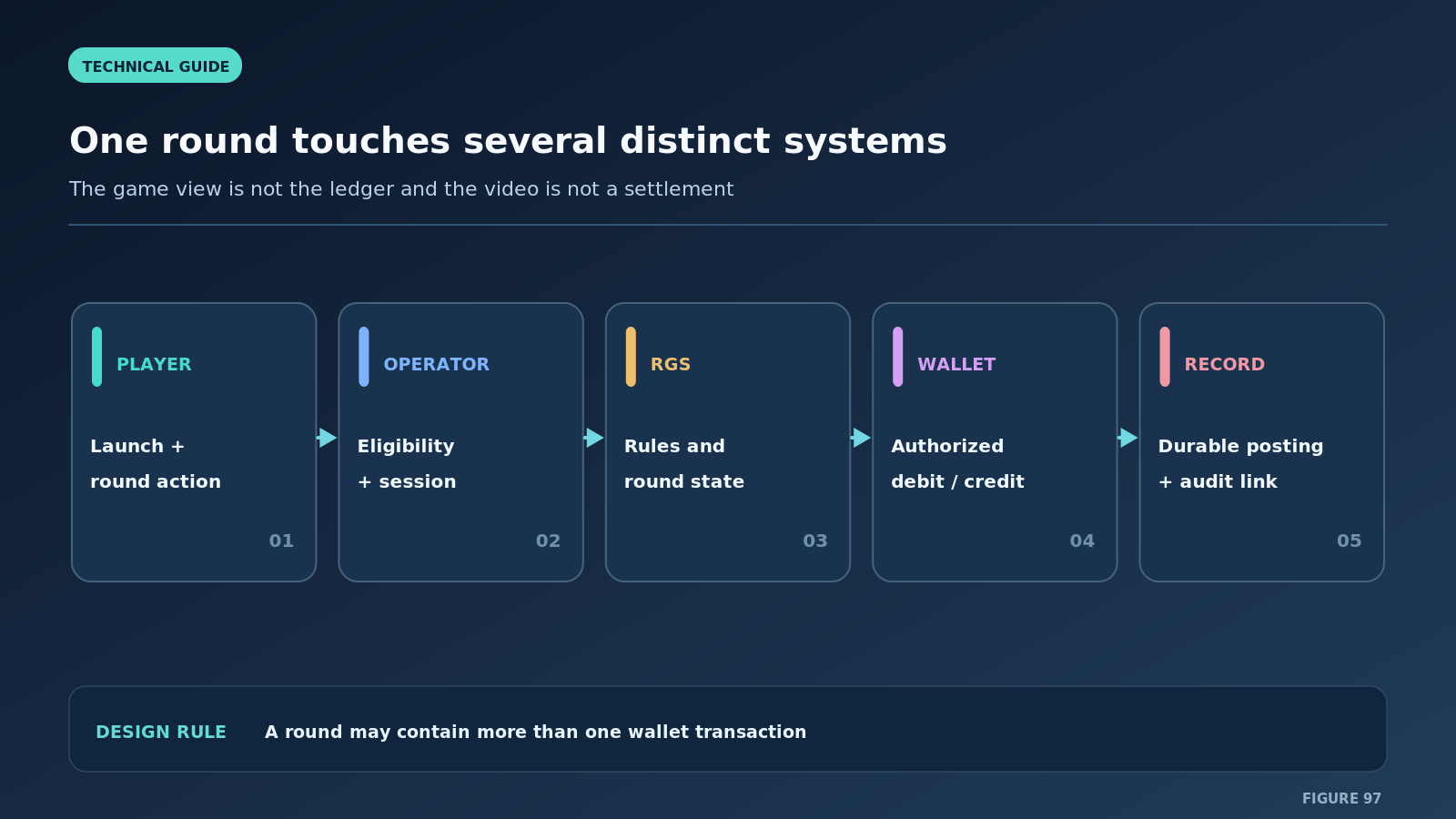
For the sequence itself, begin with Online Casino Game Round Lifecycle: From Bet Request to Settlement. The guide is scheduled in the content plan; it will cover launch context, authorized bet requests, outcome generation at a high level, debit/credit sequence, and the records visible to players and operators.
Game runtime and state management: reading path
A game engine implements game-specific rules, state transitions and presentation-related logic; a remote game server is the operational service environment that can host game execution, session control and integrations. The same studio might combine those responsibilities within one deployment, but the conceptual distinction remains valuable. The RGS can operate numerous game titles, manage sessions and communicate with an operator platform, while an individual game’s math and state machine are a narrower concern.
State is not just a temporary screen value. A robust game system defines allowed transitions such as created → wager_accepted → outcome_resolved → settlement_complete, with exceptions for cancelled, expired or unresolved operations. A crash or retry must not silently move a round into an impossible state. Design becomes easier when every transition has preconditions, an immutable identity and a durable record of what was committed.
Recommended reading path: Game Engines vs Remote Game Servers, followed by Game Round State Machines and Deterministic Game Debugging with Event Replay. These planned articles will explain responsibilities, invariants and why exact reproducibility requires controlled versions and recorded inputs.
RNG, probability and game mathematics: reading path
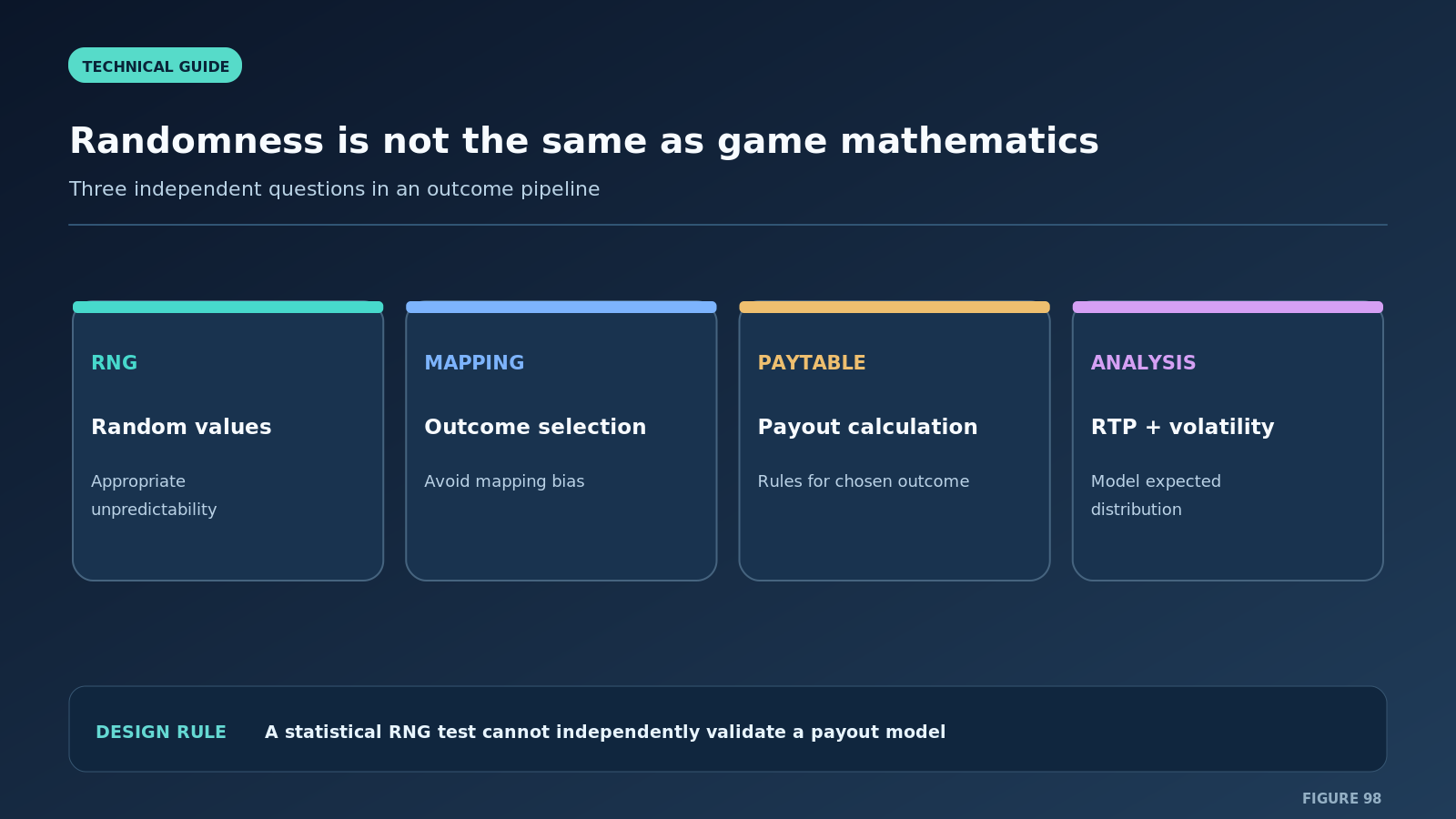
An RNG supplies unpredictable or suitably random values that a game uses within its defined rules. A random value by itself is not the whole outcome. It must be mapped to a defined outcome space, combined with relevant game state and resolved under the paytable or rules version that applies. Careless mapping can introduce distribution bias even when the underlying random source is suitable.
RTP (return to player) describes an expected return under a specified mathematical model, typically across many plays. Volatility refers to variability or dispersion of returns. RNG concerns random selection or generation. These concepts are related but not interchangeable. A short sequence of results does not establish a long-run RTP, and an RNG statistical test does not independently certify that a paytable implements the intended expected value.
A useful learning order is How RNG Works in iGaming, RTP vs Volatility vs RNG, RNG Outcome Mapping: Rejection Sampling and Modulo Bias, and Monte Carlo Simulation for Slot RTP Validation. The planned guides take readers from terminology to model assumptions, bias prevention and simulation limitations.
Live casino architecture and streaming: reading path
Live casino adds a physical studio, capture systems, streaming transport and real-time event coordination to the game and wallet stack. The challenge is not only delivering good video. Bet windows, dealer actions, recognized outcomes and settlement events must be associated with the correct game round despite variable network delay. The video stream and the financial event stream may follow different technical paths and arrive at different times.
Streaming technologies trade latency, delivery cost, compatibility and resilience. WebRTC is often considered where very low interactive latency matters; Low-Latency HLS can be appropriate when scalable one-to-many media distribution and client compatibility matter. Neither protocol decides whether a bet should be accepted. That requires an authoritative event timeline and server-side acceptance rules. The operator should not base a final financial decision on the frame a user’s device happened to display.
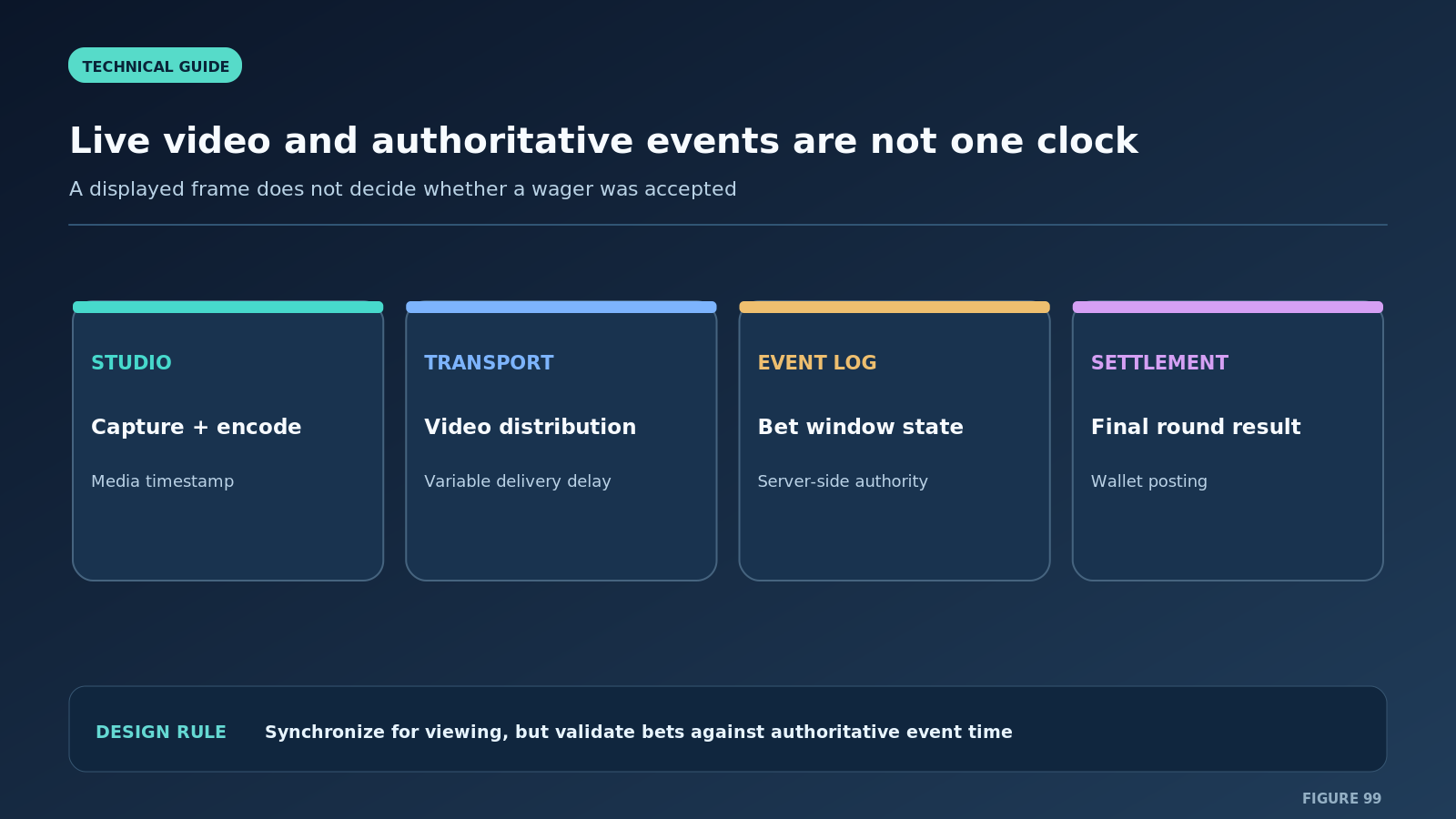
The planned sequence is Live Casino System Architecture, then WebRTC vs Low-Latency HLS for Live Casino, and Synchronizing Live Casino Video and Bet Events. These articles will separate media transport from authoritative table or game events.
Jackpot, simulation and deterministic debugging: reading path
A jackpot is more than a number shown on a display. A pooled or progressive jackpot service may need to process contributions, eligibility and claims concurrently across game instances or providers. Its design has to prevent duplicate awards, keep evidence of the winning claim and define safe recovery after network partitions. The required authority may differ from the operator’s wallet or individual game’s engine.
Simulation serves a different purpose: it tests mathematical assumptions or implementation behavior over generated trials. A Monte Carlo model can estimate distributions within sampling error, but a large simulation cannot prove the design is correct if the model contains the same bug as production. Deterministic event replay helps investigate a reported round by fixing game version, relevant state, inputs and controlled random stream or recorded outcome evidence under authorized procedures.
Explore the planned Fault-Tolerant Jackpot Service Architecture, Monte Carlo Simulation for Slot RTP Validation and Deterministic Game Debugging. These techniques complement rather than replace independent audit, certification and financial reconciliation.
Key diagrams and terms
Keep five questions in mind when evaluating any casino technical design: Who authorizes a session? Where does game state become durable? Who commits the player’s money movement? Which identity makes a retry safe? What evidence can reconstruct a disputed round? If the answer is “the game server” for all five, the system boundaries may be underspecified.
Useful terms include RGS (a remote game-server service), idempotency key (stable business identity used to avoid duplicate effects), ledger (authoritative financial record), round ID (game-level identifier), RNG (random number generator), RTP (modeled expected return), volatility (outcome dispersion), event replay (reconstruction from recorded inputs), and stream synchronization (linking media presentation with authoritative event time). These definitions should be validated against the actual provider design in use.
All game technology articles
The editorial plan schedules the following pages in this section. They are listed as planned reading paths, not claims that every page is already published:
| Topic | Planned article |
|---|---|
| Round workflow | Online Casino Game Round Lifecycle |
| Randomness | How RNG Works in iGaming |
| Runtime responsibilities | Game Engines vs Remote Game Servers |
| Game mathematics | RTP vs Volatility vs RNG |
| Durable state | Game Round State Machines |
| Fair mapping | RNG Outcome Mapping and Modulo Bias |
| Investigation | Deterministic Game Debugging |
| Studio and transport | Live Casino System Architecture |
| Streaming protocols | WebRTC vs Low-Latency HLS |
| Timing | Live Casino Video and Event Synchronization |
| Shared prizes | Fault-Tolerant Jackpot Service |
| Statistical validation | Monte Carlo Game RTP Simulation |
This reading map is most useful as a connected progression: first identify who owns the state and money, then study how outcomes are generated and audited, and finally evaluate the special timing and consistency challenges of live media and shared jackpots.
Editorial note: the links above are future article destinations from the content plan. Do not publish this index with broken links; enable each link as its corresponding page goes live.