Casino engineering uses familiar software terms in unusually sensitive contexts: an HTTP retry can affect money, a video timestamp can be confused with a betting deadline, and an apparently random game sequence can still come from a predictable implementation. This iGaming technical glossary gives concise, engineering-focused definitions and directs readers to the fuller tutorials in the library.
Definitions are conceptual, not universal provider contracts or legal advice. Different suppliers name the same operation differently; licensing requirements vary by jurisdiction and by the version of a standard in force. Follow the linked guide whenever a term affects financial posting, outcome integrity or an approval decision. The glossary is designed for architects, game developers, QA engineers, security reviewers and editors who need a shared vocabulary.

A–Z term index and search
Use the Search glossary field in the HTML version to filter definitions by term and explanation. In Markdown, the alphabetized index below provides a quick jumping-off point; the category sections retain context and link to the related technical guides.
A: Aggregator, Anomaly detection, API, API gateway, Artifact digest, Atomic transaction, Attestation, Audit trail. B: Balance, Bet callback, Buffer. C: Callback, Capture-to-glass latency, CDN, Certification evidence, Change impact assessment, Circuit breaker, Clock synchronization, Code signing, Compensating transaction, Concept drift, Contract test, Correlation ID, CSPRNG.
D–H: Data drift, Deterministic replay, Distributed trace, Double-entry ledger, Encoder, Entropy, Event time, Eventual consistency, Evidence chain, Expected value, False positive, Game engine, Game round, Game session, GLI-19, Hash, HLS, HMAC, House edge, Human-in-the-loop review.
I–P: Idempotency, Idempotency key, Independent outcomes, Independent testing laboratory, Jitter, Ledger entry, Low-Latency HLS, Message outbox, ML model monitoring, Modulo bias, Monte Carlo simulation, mTLS, Observability, Outcome mapping, Paytable, Penetration test, Polling, Precision, PRNG, Progressive jackpot, Provider normalization.
R–Z: Recall, Reconciliation, Regression test, Rejection sampling, Release manifest, Remote Game Server, Retesting, Retry, RNG, RNG seed, Round state machine, RTP, SBOM, Security review, Settlement, Settlement invariant, SLI, SLO, Software provenance, Stream watermark, Terminal state, Test fixture, Test oracle, Theoretical RTP, UKGC RTS, Variance, Volatility, Wallet, Webhook, WebRTC.
The alphabetical index intentionally groups related concepts without pretending that a naming convention is a regulatory classification. For example, HMAC and mTLS provide different layers of authentication, while RNG, RTP and volatility answer different mathematical or security questions. Search by either a name or a phrase such as “duplicate bet,” “outcome mapping,” or “model drift.”
Platform, wallet and API terminology
Systems integration terms matter most where a human-readable game round crosses a financial boundary. An operator may use different physical services, but must still specify authoritative ownership, currency units, request identity and failure recovery. Use these entries together rather than assuming that authentication, a successful API response and a completed ledger posting are synonymous.
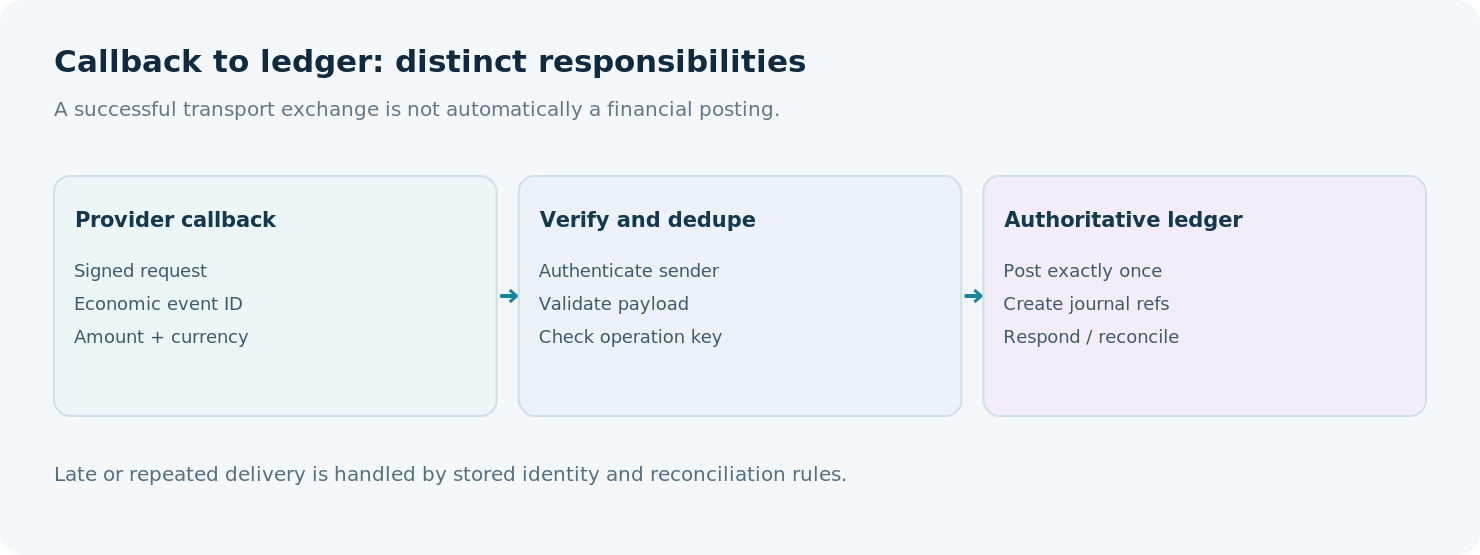
Aggregator. A service that integrates multiple game suppliers behind a normalized catalog or transaction interface. Normalization reduces integration duplication but must preserve provider-specific meanings, monetary precision, jurisdictional restrictions and event identifiers; a uniform JSON envelope alone does not guarantee equivalent behavior. Read the detailed guide for architecture, implementation constraints and related caveats.
API. An application programming interface is the documented boundary through which systems exchange requests and responses. In gaming, an API contract must specify authentication, economic semantics, identifiers, allowed retries, error handling and version compatibility—not merely successful HTTP status codes. Read the detailed guide for architecture, implementation constraints and related caveats.
API gateway. An ingress component that routes and applies shared controls to API traffic. It may authenticate, rate-limit, terminate transport encryption and produce telemetry. A gateway cannot determine whether a financial operation posted exactly once without cooperation from the wallet and authoritative ledger. Read the detailed guide for architecture, implementation constraints and related caveats.
Atomic transaction. A database change whose included operations commit or roll back together. An atomic bet debit and ledger entry can prevent a locally inconsistent balance. Atomicity normally stops at a database boundary; a remote game provider requires coordination and recovery logic. Read the detailed guide for architecture, implementation constraints and related caveats.
Audit trail. An ordered record of significant decisions, system versions, requests and financial effects that supports investigation. Useful trails include stable identifiers, timestamps, actor context, integrity controls and links to original evidence. A verbose application log is not automatically an immutable, complete audit trail. Read the detailed guide for architecture, implementation constraints and related caveats.
Balance. A derived or stored representation of funds available, reserved or otherwise accounted for in a player wallet. Available and accounting balances can differ. The system should define which ledger entries affect each figure and how concurrent bets, reversals and unsettled rounds are handled. Read the detailed guide for architecture, implementation constraints and related caveats.
Bet callback. A provider-originated request instructing the operator-side wallet to authorize or record a wager. The receiver must validate the provider, economic amount, currency, round reference and duplicate semantics before posting any effect. Delivery retries do not imply permission to debit twice. Read the detailed guide for architecture, implementation constraints and related caveats.
Callback. A request sent by one system to another after an event or as part of a transaction workflow. A callback can be authenticated and still be out of order or duplicated. Consumers need durable identifiers, schema validation and an explicit acknowledgment policy. Read the detailed guide for architecture, implementation constraints and related caveats.
Circuit breaker. A resilience control that temporarily stops requests toward a dependency after a defined failure pattern. It reduces cascading overload but does not settle an uncertain financial operation. Recovery should use operation status lookup or reconciliation rather than blindly repeating an ambiguous debit. Read the detailed guide for architecture, implementation constraints and related caveats.
Compensating transaction. A new, separately recorded accounting effect that reverses or adjusts a prior posted effect without erasing the original evidence. It is useful when a distributed action cannot be rolled back as one database transaction. Authorization and linkage to the original transaction are essential. Read the detailed guide for architecture, implementation constraints and related caveats.
Correlation ID. An identifier used to connect log messages and spans belonging to a workflow. It helps diagnose the path of a request, but it is not necessarily a business transaction ID or idempotency key. Separate identifiers should remain clearly mapped in the event record. Read the detailed guide for architecture, implementation constraints and related caveats.
Double-entry ledger. An accounting model that records balanced debit and credit entries for a defined posting. It makes monetary flows auditable and supports independent reconciliation, provided accounts and posting rules are correct. A ledger does not independently prove the associated game result was valid. Read the detailed guide for architecture, implementation constraints and related caveats.
Eventual consistency. A property in which replicas or services may temporarily disagree but converge under defined conditions. It is suitable for many catalogs and analytics projections; money movement and authoritative round settlement still require explicit invariants and careful conflict handling. Read the detailed guide for architecture, implementation constraints and related caveats.
Game session. A bounded interaction context for a player launching a title or joining a provider game. It may contain a short-lived token, jurisdiction, limits and launch configuration. A session identifier should not be reused as the sole identity of a wager or ledger posting. Read the detailed guide for architecture, implementation constraints and related caveats.
HMAC. A keyed message authentication code based on a cryptographic hash function. In an API integration, the receiver recomputes the MAC over the contractually specified bytes and compares it safely. HMAC authenticates the message under a shared secret; it does not enforce business-level replay protection by itself. Read the detailed guide for architecture, implementation constraints and related caveats.
Idempotency. A property that allows an economic operation to be requested repeatedly without multiplying its intended effect. Implementation typically stores an operation identity, validates repeated payloads and replays the canonical result. Merely returning a successful response twice does not prove financial idempotency. Read the detailed guide for architecture, implementation constraints and related caveats.
Idempotency key. A stable identifier for one intended economic operation. Its scope and retention must be contractually defined, often with provider and transaction context. Reusing the same key with conflicting amounts should trigger a documented conflict response rather than silently posting a new debit. Read the detailed guide for architecture, implementation constraints and related caveats.
Ledger entry. An immutable or append-only accounting record describing a posting, including accounts, currency, amount, reference and time. Corrections should ordinarily add reversing entries instead of overwriting the history. A ledger entry differs from a provider callback, which is a request or signal. Read the detailed guide for architecture, implementation constraints and related caveats.
Message outbox. A pattern that writes an event to an outbox in the same local transaction as authoritative state, then publishes it asynchronously. It closes a common gap between database commit and event publication. Consumers must still handle duplicates, late delivery and reordering. Read the detailed guide for architecture, implementation constraints and related caveats.
mTLS. Mutual Transport Layer Security: client and server authenticate each other’s certificates during a secured connection. It helps restrict service-to-service access. Rotation, revocation, endpoint identity and application-level authorization remain necessary; mTLS is not an accounting guarantee. Read the detailed guide for architecture, implementation constraints and related caveats.
Polling. Repeated requests asking whether new records or status changes exist. Polling can simplify integration through firewalls but raises latency and request volume. Clients need pagination or cursors, overlap recovery and duplicate-safe consumption to avoid missing updates. Read the detailed guide for architecture, implementation constraints and related caveats.
Provider normalization. The translation of supplier-specific identifiers, amounts, event types, game metadata and errors into an internal model. Good normalization preserves provenance and exceptions. It must never flatten differences that affect wallet correctness or make a provider restriction disappear. Read the detailed guide for architecture, implementation constraints and related caveats.
Reconciliation. Comparing independently recorded facts, such as provider transaction files and wallet ledger entries, to detect missing, duplicate or mismatched economic activity. A reconciler classifies and resolves exceptions using evidence; it should not auto-create ambiguous financial postings based only on message arrival. Read the detailed guide for architecture, implementation constraints and related caveats.
Remote Game Server (RGS). The server-side runtime or service boundary that controls or hosts authoritative elements of game execution, depending on the product architecture. Its responsibilities may include outcomes, round state, configuration and provider integration. The client-facing game engine may render animation without becoming the source of truth. Read the detailed guide for architecture, implementation constraints and related caveats.
Retry. Sending an operation again because a prior attempt was not completed or acknowledged. Retrying a read may be safe; retrying a monetary write requires a stable operation identity and an understanding of whether the original action committed. Backoff is useful but not enough. Read the detailed guide for architecture, implementation constraints and related caveats.
Settlement. The authoritative completion of a game round or financial obligation, with the resulting payout or loss recorded according to the contract. Presentation of an animation is not proof of settlement. Auditability requires links between the resolved outcome, round state and ledger references. Read the detailed guide for architecture, implementation constraints and related caveats.
Wallet. A subsystem that tracks player money and related balances, holds, debits, credits and reversals. Responsible implementations use defined precision, account models, authorization rules and audit trails. A wallet balance is not simply a mutable number shown by the game client. Read the detailed guide for architecture, implementation constraints and related caveats.
Webhook. An HTTP-based event notification pushed from one system to another. It can reduce update latency compared with polling, but delivery is commonly repeated or delayed. An endpoint should authenticate, validate, durably accept and process events with duplicate-safe logic. Read the detailed guide for architecture, implementation constraints and related caveats.
RNG, game mathematics and game runtime terminology
These entries distinguish an unpredictable source of random numbers from the mathematical model that turns numbers into outcomes, and from the game runtime that presents them. A mathematical expectation is an aggregate property of a defined distribution; no single round demonstrates that expectation. Terms such as game engine and RGS refer to implementation responsibility, not a universally fixed product category.
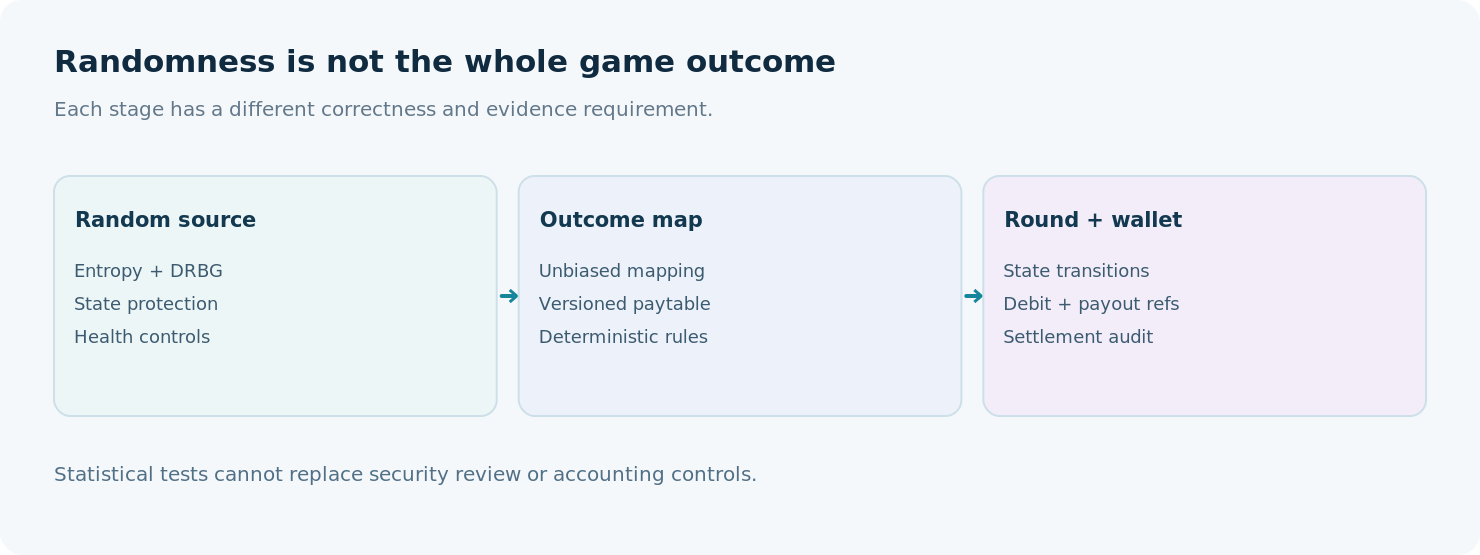
CSPRNG. A cryptographically secure pseudorandom number generator designed so that its outputs remain difficult to predict under a stated security model. Its security still depends on seed generation, state protection, implementation quality and restart behavior. Passing a frequency test does not establish cryptographic unpredictability. Read the detailed guide for architecture, implementation constraints and related caveats.
Deterministic replay. Re-executing a game or transaction scenario from a saved, approved set of events, configuration and test-controlled randomness. It can make a defect reproducible without exposing production RNG secrets. Replay harnesses must separate synthetic test state from real player credentials and funds. Read the detailed guide for architecture, implementation constraints and related caveats.
Entropy. Unpredictability present in an input source used to initialize or reseed a random generator. Entropy is not the same as an apparently noisy output graph. A security review needs evidence about the source, health tests, extraction and handling when the source degrades. Read the detailed guide for architecture, implementation constraints and related caveats.
Expected value. The probability-weighted average payout or gain of a defined random variable. For a game, the theoretical long-run return follows from the paytable and event probabilities. It says nothing definite about the profit or loss of an individual player over a short session. Read the detailed guide for architecture, implementation constraints and related caveats.
Game engine. Software responsible for presentation, input handling and possibly non-authoritative client-side game behaviors. Some architectures also use engine components server-side. The key design question is which component is authoritative for outcome selection and financial settlement, not which product calls itself an engine. Read the detailed guide for architecture, implementation constraints and related caveats.
Game round. A uniquely identified unit of play with defined lifecycle and economic references. A round may contain multiple steps, features or callbacks, depending on the game. Its completion must be distinguished from when animations end or when a third-party response reaches the player. Read the detailed guide for architecture, implementation constraints and related caveats.
House edge. The mathematical complement of a defined RTP when RTP and edge are measured over the same stake-based model: house edge = 100% − RTP. It is a long-run expectation, not a guarantee that an operator earns that percentage from each short session. Read the detailed guide for architecture, implementation constraints and related caveats.
Independent outcomes. Random outcomes whose probabilities do not depend on prior outcomes under the defined model. A succession of losses does not make a win due. Some game features deliberately include state; their conditional probabilities must be modeled as specified rather than assumed independent. Read the detailed guide for architecture, implementation constraints and related caveats.
Modulo bias. A skew caused when uniformly generated integers are mapped to a number of outcomes using remainder division and the source range is not divisible by the number of outcomes. The resulting probabilities differ slightly; rejection sampling is a common remedy for bounded integers. Read the detailed guide for architecture, implementation constraints and related caveats.
Monte Carlo simulation. A method that runs many random trials of a model to estimate statistics such as mean payout and variance. It can identify implementation errors and sampling uncertainty, but cannot replace source-code review, independent certification or proof that a production RNG is unpredictable. Read the detailed guide for architecture, implementation constraints and related caveats.
Outcome mapping. The deterministic transformation from random bits or integers into game outcomes using configured rules. Even if the generator is strong, a biased or incorrectly indexed mapping can distort the return distribution. Audits must test both randomness and the mapping logic. Read the detailed guide for architecture, implementation constraints and related caveats.
Paytable. The approved mapping from game results to payouts or multipliers for a specified configuration. It is a foundational input to RTP and volatility calculations. Different versions and jurisdictions may use different tables, making configuration identification important to reproduce a round. Read the detailed guide for architecture, implementation constraints and related caveats.
PRNG. A deterministic algorithm that produces an apparently random sequence from an internal state or seed. Many PRNGs are suited for simulation, not adversarial settings. Assess the actual algorithm and threat model rather than assuming that every library function labeled random is secure. Read the detailed guide for architecture, implementation constraints and related caveats.
Progressive jackpot. A prize pool that may grow through configured contributions and is awarded under defined conditions. Safe operation requires a single authoritative winner decision, controlled contribution accounting, duplicate-safe payout and recovery from uncertain states. The displayed total alone is not a settlement record. Read the detailed guide for architecture, implementation constraints and related caveats.
Rejection sampling. A technique for unbiased bounded-integer mapping: discard source values outside the largest range evenly divisible by the number of outcomes, then map accepted values. It avoids simple modulo bias if the source is uniform and the acceptance and retry implementation are correct. Read the detailed guide for architecture, implementation constraints and related caveats.
RNG. A random number generator, which may be hardware-based, pseudorandom or cryptographic depending on design. In gaming, selection integrity depends on entropy, implementation, outcome mapping, configuration and operational controls. The label RNG by itself establishes neither fairness nor regulatory compliance. Read the detailed guide for architecture, implementation constraints and related caveats.
RNG seed. Input material used to initialize a deterministic random generator. Predictable or repeated seeds can produce predictable or repeated sequences under some designs. A secure system documents seed sources, seeding and reseeding, isolation and what happens after restore or process cloning. Read the detailed guide for architecture, implementation constraints and related caveats.
Round state machine. A model of permitted round states and transitions, including creation, accepted bet, resolved outcome, settlement and exceptional recovery paths. Financial invariants should be enforced at transitions. A terminal state should not be reopened arbitrarily by late callback delivery. Read the detailed guide for architecture, implementation constraints and related caveats.
RTP. Return to Player: the theoretical or observed payout ratio relative to stakes under a specified model and period. Theoretical RTP follows game mathematics; observed RTP fluctuates in samples, especially for high-volatility games. A quoted RTP must state its basis. Read the detailed guide for architecture, implementation constraints and related caveats.
Settlement invariant. A condition that must remain true across all legitimate settlement paths, such as one net accepted debit and at most one canonical payout per economic round, subject to explicit correction rules. Invariants are testable statements, not informal assumptions about callback ordering. Read the detailed guide for architecture, implementation constraints and related caveats.
Terminal state. A defined round state after which ordinary transitions are no longer permitted. Settlement, voiding and cancellation can have different economic implications. Late events require explicit reconciliation or compensating workflows rather than silently mutating a completed round. Read the detailed guide for architecture, implementation constraints and related caveats.
Theoretical RTP. The probability-weighted payout ratio derived from a specific game’s approved mathematical model. It should include the relevant base game and eligible features according to the tested scope. A finite simulation approximates, but does not define, the theoretical figure. Read the detailed guide for architecture, implementation constraints and related caveats.
Variance. The average squared deviation of payout outcomes from their mean, in a specified unit of measure. Higher variance often contributes to larger short-run fluctuations. Comparing volatility across titles requires consistent definitions; simple promotional labels are not a standard statistical unit. Read the detailed guide for architecture, implementation constraints and related caveats.
Volatility. The degree to which a game’s payout distribution fluctuates around its expectation, often described informally as low, medium or high. A title can have the same theoretical RTP as another while exhibiting very different patterns of wins and losses. Read the detailed guide for architecture, implementation constraints and related caveats.
Certification, testing and security terminology
Certification language requires careful source checks. A vendor standard, a regulator’s licence conditions, laboratory accreditation, tested version and deployed artifact can be related without being interchangeable. A publication should identify the jurisdiction and current standard revision before turning general engineering controls into compliance assertions.
Artifact digest. A cryptographic checksum identifying the exact bytes of a compiled or packaged release artifact. It enables a lab report, build record and deployment inventory to refer to the same bits. A digest alone does not prove the build process was trustworthy. Read the detailed guide for architecture, implementation constraints and related caveats.
Attestation. A signed or otherwise verifiable statement about a build, test or other software-supply-chain step. Its value depends on trustworthy identity, scope and evidence. A self-issued attestation does not automatically satisfy a gaming authority or independent laboratory requirement. Read the detailed guide for architecture, implementation constraints and related caveats.
Certification evidence. The set of identified build artifacts, configurations, test plans, reports and decisions used in a conformity assessment. Evidence should be traceable to exact versions and applicable requirements. A generic badge or screenshot without its provenance is not a reliable certification record. Read the detailed guide for architecture, implementation constraints and related caveats.
Change impact assessment. A structured examination of how a proposed software, content or configuration change may affect approved behavior, security, game mathematics or compliance. It informs the scope of testing and any external submission required under the applicable regime; it is not itself a certificate. Read the detailed guide for architecture, implementation constraints and related caveats.
Code signing. Applying a digital signature to software using a controlled signing key, enabling authorized recipients to verify artifact identity and integrity. It helps counter tampering but does not prove the signed code has been fully reviewed or approved for every jurisdiction. Read the detailed guide for architecture, implementation constraints and related caveats.
Contract test. A test that checks an API interaction against an agreed schema and behavior contract, including requests, responses and documented errors. Financial integrations also need semantic assertions about amount, currency, idempotency, ordering and status—not only JSON shape. Read the detailed guide for architecture, implementation constraints and related caveats.
Evidence chain. The link from source revision through build, configuration, tests, independent review and deployed artifact. Each step should preserve IDs and timestamps sufficient to audit an installed release. Missing links make even individually valid reports hard to interpret. Read the detailed guide for architecture, implementation constraints and related caveats.
GLI-19. Gaming Laboratories International’s technical standard for interactive gaming systems. Its edition, clause and regulatory adoption must be identified before treating a control as binding. GLI technical standards and a jurisdiction’s enforceable licensing rules are related but not interchangeable. Read the detailed guide for architecture, implementation constraints and related caveats.
Hash. A cryptographic digest function converts arbitrary input into a fixed-size result. Hashes help detect changed files and link evidence, but security relies on suitable algorithms and trust in how digests are obtained. A file name that includes a hash is not a signature. Read the detailed guide for architecture, implementation constraints and related caveats.
Independent testing laboratory. An external body that evaluates game or system behavior against an agreed scope, applicable standards and methods. Its authorization and accepted results vary by regulator. Laboratory involvement in one release does not automatically approve later changes or every deployment environment. Read the detailed guide for architecture, implementation constraints and related caveats.
Penetration test. An authorized assessment that attempts to uncover exploitable vulnerabilities in a defined system and time window. It complements security architecture, code review and continuous monitoring. A clean test report does not establish that all vulnerabilities were absent or that game math was correct. Read the detailed guide for architecture, implementation constraints and related caveats.
Regression test. A repeatable check that previously accepted behavior remains intact after a change. For games this includes economic invariants, callback recovery and versioned mathematics where applicable. Passing a regression suite does not by itself determine whether an independent regulator-required retest is needed. Read the detailed guide for architecture, implementation constraints and related caveats.
Release manifest. An inventory of the exact application, game-content, configuration and dependency versions shipped in a release. It should link to build digests, approvals and rollback targets so auditors can reproduce what was actually deployed, rather than what a release note claimed. Read the detailed guide for architecture, implementation constraints and related caveats.
Retesting. Re-evaluating software or game behavior after a relevant change. The scope depends on impact and regulatory requirements: a small user-interface edit and a change to outcome mapping have different implications. The governing jurisdiction and its documented change-control process decide obligations. Read the detailed guide for architecture, implementation constraints and related caveats.
SBOM. A software bill of materials listing components and dependency relationships in a product. It supports vulnerability tracking and supply-chain transparency, but may omit operational configuration or embedded artifacts if the generation process is incomplete. An SBOM is evidence, not a safety certificate. Read the detailed guide for architecture, implementation constraints and related caveats.
Security review. A systematic examination of architecture, code, configuration and operations against relevant threats and requirements. For RNG, it includes entropy, state management and deployment behavior. Evidence and scope matter more than a checkbox claiming that security was reviewed. Read the detailed guide for architecture, implementation constraints and related caveats.
Software provenance. Evidence of where source or build inputs originated and how an artifact was produced. It can support trust in a deployed release when paired with verified identities and controlled build infrastructure. Provenance does not replace testing the artifact’s behavior. Read the detailed guide for architecture, implementation constraints and related caveats.
Test fixture. A controlled set of inputs, dependencies and expected results used to run a repeatable test. A valid fixture records its exact version and uses isolated accounts or simulated money. Reproducibility depends on deterministic execution and independently checked expected outcomes. Read the detailed guide for architecture, implementation constraints and related caveats.
Test oracle. An independent criterion that determines whether observed results are correct. A reference ledger, approved paytable or state-transition invariant can serve as an oracle. A generated test that merely repeats the application’s output as its expectation has no independent validating power. Read the detailed guide for architecture, implementation constraints and related caveats.
UKGC RTS. The UK Gambling Commission’s Remote Gambling and Software Technical Standards, including provisions about random outcomes. Requirements should be read in their current published form and in the context of the relevant licence and testing arrangements. They are not a global definition of compliant gambling software. Read the detailed guide for architecture, implementation constraints and related caveats.
Live video, observability and AI terminology
Streaming engineers measure frames, clocks, throughput and display delay; backend engineers measure requests, states and economic finality. AI and monitoring systems add statistical signals and useful alerts, but neither a model’s score nor a video frame should silently become authority over a wallet posting.

Anomaly detection. A rules-based or statistical technique for finding unusual patterns relative to a defined baseline. In a financial system, an anomaly is a lead for investigation—not conclusive evidence of cheating or an automatic instruction to alter a ledger balance. Read the detailed guide for architecture, implementation constraints and related caveats.
Buffer. A temporary reservoir of media or data that smooths uneven delivery. A larger video buffer can improve continuity while increasing delay. An operator must decide how visual presentation delay interacts with server-authoritative betting deadlines. Read the detailed guide for architecture, implementation constraints and related caveats.
Capture-to-glass latency. The elapsed time between a scene being captured by a camera and the corresponding image appearing on a viewer’s display. Measurement should describe timestamp locations, clocks, device setup and sampling method. Video delay differs from bet authorization latency. Read the detailed guide for architecture, implementation constraints and related caveats.
CDN. A content delivery network that distributes cached or streamed content closer to viewers. A CDN can improve delivery scale and resilience, but does not determine authoritative game results or wallet settlement; those operations follow separately governed transactional pathways. Read the detailed guide for architecture, implementation constraints and related caveats.
Clock synchronization. Methods that align system clocks within known error bounds, often using network time services or dedicated timing systems. Correlating a video frame with an accepted bet requires confidence in clock offset and drift, rather than assuming timestamps from different machines are identical. Read the detailed guide for architecture, implementation constraints and related caveats.
Concept drift. A change in the relationship between model inputs and the outcome being predicted. A model may continue receiving similar-looking input distributions while becoming less accurate. Labeled performance, delayed feedback and review workflows are important to distinguish it from ordinary traffic changes. Read the detailed guide for architecture, implementation constraints and related caveats.
Data drift. A change in input-feature distributions compared with a reference period or training population. Drift may be caused by genuine user behavior, a broken pipeline or a new product. A threshold breach is a diagnostic signal, not automatic proof that the model is invalid. Read the detailed guide for architecture, implementation constraints and related caveats.
Distributed trace. A record of causally related operations across services, represented by spans and identifiers. It helps explain latency, failure paths and retries. A trace should be linked to authoritative transaction records but does not itself replace ledger evidence. Read the detailed guide for architecture, implementation constraints and related caveats.
Encoder. A component that compresses or packages camera and audio signals for transmission. Its latency, bitrate and buffering affect live viewing. Encoder logs and stream timestamps help investigate delays; the encoded media is not the authority for settlement decisions. Read the detailed guide for architecture, implementation constraints and related caveats.
Event time. The time an event is understood to have occurred at its source, as distinct from when a collector received or processed it. Streaming analytics must define behavior for late and out-of-order events, especially when computing session aggregates or windowed rates. Read the detailed guide for architecture, implementation constraints and related caveats.
False positive. A detector flags an event as abnormal or abusive when the underlying case is not actually a violation. False positives impose review costs and can harm legitimate players. Evaluation must define labels and account for delayed ground truth and changing event populations. Read the detailed guide for architecture, implementation constraints and related caveats.
HLS. HTTP Live Streaming, a segment-based media delivery family used for scalable playback. Its latency depends on configuration, segment delivery and player behavior. Low-Latency HLS is a specialized mode, not a promise of one universal end-to-end delay. Read the detailed guide for architecture, implementation constraints and related caveats.
Human-in-the-loop review. A control in which a person evaluates or authorizes certain model recommendations. The review must have enough evidence, clear decision rights and a way to reverse mistakes. Merely showing an alert to a human does not guarantee meaningful oversight. Read the detailed guide for architecture, implementation constraints and related caveats.
Jitter. Variation in packet arrival or network delay over time. High jitter can cause media playback instability or event-processing spikes even when the average delay looks acceptable. Benchmarking should measure distributions, not just a single mean value. Read the detailed guide for architecture, implementation constraints and related caveats.
Low-Latency HLS. An HLS delivery approach designed to reduce live edge delay using smaller delivery units and related mechanisms. Its operational trade-offs differ from real-time transport protocols. Measured performance depends heavily on client, CDN, network and encoder choices. Read the detailed guide for architecture, implementation constraints and related caveats.
ML model monitoring. The ongoing measurement of model inputs, predictions, drift, latency, reliability and eventually labeled accuracy after deployment. It should assign owners and safe rollback paths. Training-time scores alone cannot establish that a model remains fit for use in production. Read the detailed guide for architecture, implementation constraints and related caveats.
Observability. The ability to understand internal system behavior from telemetry such as logs, metrics and traces. In a gaming platform, useful observability connects service health to round state and financial invariants, while controlling exposure of personal data and secrets. Read the detailed guide for architecture, implementation constraints and related caveats.
Precision. The fraction of a detector’s positive predictions that are truly positive under the evaluated labels: TP/(TP+FP). Precision depends on class prevalence and labeling quality. High precision on a curated dataset may not transfer to live traffic. Read the detailed guide for architecture, implementation constraints and related caveats.
Recall. The fraction of actual positives identified by a detector: TP/(TP+FN). Improving recall often changes the false-positive burden. A monitoring programme should evaluate both recall and precision with representative examples and delayed labels. Read the detailed guide for architecture, implementation constraints and related caveats.
SLI. A service level indicator, the measured quantity used to assess an objective: for example, the fraction of eligible requests completed within a defined latency. Its denominator and exclusions must be stated to make the number interpretable. Read the detailed guide for architecture, implementation constraints and related caveats.
SLO. A service level objective, such as a target for successful responses or latency within a defined measurement window. SLOs should identify which operations matter; uptime alone says little about duplicate wallet postings or unresolved economic transactions. Read the detailed guide for architecture, implementation constraints and related caveats.
Stream watermark. A mechanism or assumption that marks how far event-time processing is expected to have progressed. It helps windowed analytics decide when to produce results despite late data. Watermarks do not make events arrive in order or correct broken source timestamps. Read the detailed guide for architecture, implementation constraints and related caveats.
WebRTC. A family of technologies supporting real-time media communication with interactive transport behavior. It can enable low-latency playback but imposes infrastructure, connectivity and operational trade-offs. The accepted game wager remains governed by the authoritative backend, not by video frame arrival. Read the detailed guide for architecture, implementation constraints and related caveats.
Related terms, definitions and source links
How to resolve ambiguous terms. If a provider document uses “transaction,” determine whether it means a transport request, an accepted bet, a ledger posting or the enclosing game round. If a dashboard shows “success,” confirm whether it means an HTTP response, durable processing, settlement or eventual reconciliation. If a standard says a requirement applies, identify its edition and the licensing regime that adopts it. Keep the original supplier field names in audit evidence even if an internal API normalizes them.
Start with the core guides. For the broad system picture read platform architecture, wallet architecture and game round lifecycle. For mathematical integrity read RNG engineering, outcome mapping and RTP versus volatility. For validation read technical research, GLI-19 discussion and UKGC RTS 7 discussion.
Primary reference points. NIST SP 800-90 series addresses random-bit generation design; it is not a gambling approval. OpenTelemetry documentation explains traces, metrics and logs. OWASP API Security Top 10 gives security risks and defensive framing. The UK Gambling Commission’s technical standards and the GLI standards library should be checked in their latest official form and against jurisdiction-specific applicability. Editorial definitions here are not replacements for these documents.
Suggest a correction or new term. Use Contact with the term, quoted source passage, relevant version and proposed wording. Until a verified contact channel is configured, this is a planned editorial workflow, not a live submission endpoint. For the publication’s proposed method and disclosures, see About.