When someone asks how RNG works in online casino games, the immediate answer is that a random-number mechanism supplies values that a game can use to select outcomes. But that short answer hides important distinctions. A pseudorandom generator is an algorithm, an entropy source is a source of uncertain input, and a paytable defines the economic consequence of an outcome. These pieces have separate responsibilities and separate testing questions.
The aim of this guide is to make the architecture understandable to engineers, analysts and technical readers, without pretending to audit a particular casino’s implementation. Some online games are driven by software-generated random outcomes; others rely on physical events, live dealers or different game mechanics. Where a regulator or accredited test laboratory defines requirements, those requirements take priority over generic examples.

What an RNG does in online games
An RNG produces values intended to behave according to an appropriate randomness model. A game then transforms those values into a bounded outcome space: for example, a symbol arrangement, a card selection under defined rules, a wheel result or a sequence of bonus-game events. The RNG does not intrinsically understand “cherries,” “jackpots,” “return to player” or “winning.” It produces data; the mapping and game mathematics supply the interpretation.
Consider a toy three-outcome game. Suppose its game mathematics require outcome A with probability 1/2, B with 1/3 and C with 1/6. A properly uniform source over a suitable range can be mapped into those outcomes. If the mapping is defective, even an ideal source can lead to the wrong probabilities. If the source is predictable or statistically defective, a mathematically correct mapping cannot fix it. End-to-end fairness therefore requires more than displaying a certificate number next to an “RNG” label.
Different types of unpredictability serve different threats. A simulation tool might need repeatable pseudorandom sequences so that a regression can be reproduced exactly. A live production system may require outputs that cannot be practically predicted by a player or attacker who has observed previous events. These are different design targets. The developer’s deterministic simulation seed is not an appropriate production secret simply because it passed a frequency histogram test.
The operational boundary matters too. Randomness might be generated within an RGS, by a dedicated RNG service, or by an approved module. The web browser may animate a result but should not become the sole source of trusted outcomes in a server-authoritative wagering model. A client-side effect with random-looking visuals does not establish that the authoritative outcome process used a suitable random source.
PRNGs, CSPRNGs and entropy sources
A pseudorandom number generator (PRNG) takes a state and produces a sequence of values. Its output can look random even though the algorithm is deterministic given a fixed initial state. This determinism is useful for reproducible testing. It also means that prediction resistance depends on algorithm choice, state secrecy and other properties rather than on appearances in a chart.
A cryptographically secure PRNG (CSPRNG) is designed to resist practical prediction under its stated assumptions. The NIST terminology often uses deterministic random bit generator (DRBG) for reviewed classes of constructions. NIST SP 800-90A Rev. 1 discusses mechanisms based on cryptographic algorithms; it does not imply that any code claiming to be “crypto random” has been correctly implemented, seeded or deployed. Specific product or regulatory approval requires much more evidence.
An entropy source contributes uncertain input, potentially from physical phenomena or operating-system facilities that aggregate multiple sources. Entropy is not the same as a long string of bytes, and a clock timestamp is not automatically a satisfactory high-entropy seed. NIST SP 800-90B addresses entropy-source assessment, while SP 800-90C describes constructions combining entropy sources and DRBGs. The distinctions are useful even where an implementation follows a different applicable standard.
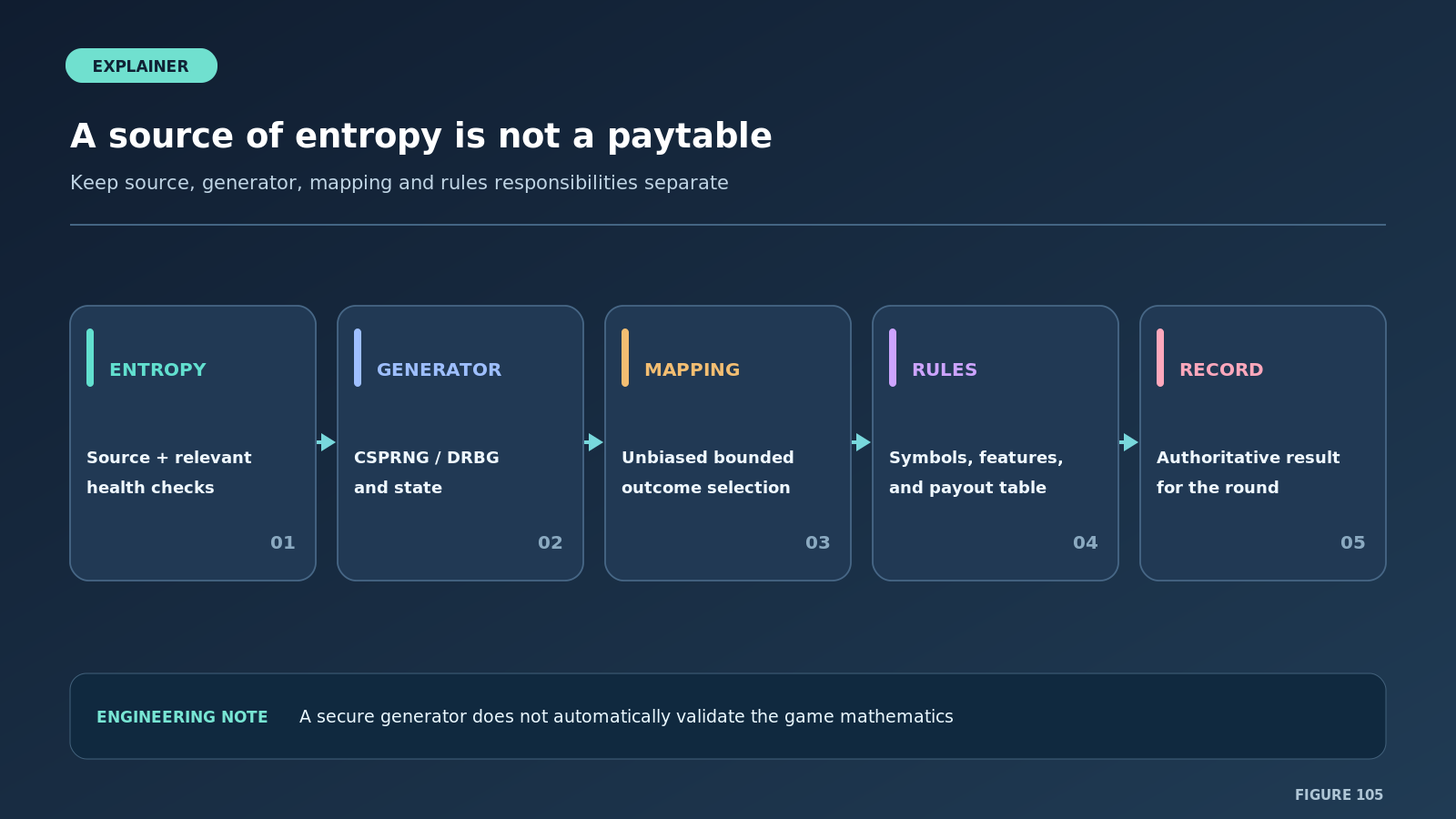
A robust engineering discussion asks where initial entropy comes from, which component conditions or validates it, how the generator is instantiated, what state must remain secret, whether health checks operate, and what happens when the source or generator fails. It also asks which framework defines the required assurance. “We use a strong library” is not a complete system-level answer.
Security terminology should be used precisely. A PRNG can be statistically well distributed and still be predictable. A CSPRNG can be cryptographically designed but deployed with an exposed or reused seed. Entropy can be collected correctly but consumed by a defective generator or mapped with bias. Each issue lives at a different layer and needs a different test or control.
Seeding, state and output generation
Seeding initializes the generator’s internal state. For deterministic generators, the same algorithm and the same effective initial state can produce the same sequence. That property is valuable in a controlled test harness, but it creates an obvious problem if the same effective state is repeatedly used in a production gaming environment. Proper instantiation and reseeding therefore form part of operational design.
A simplistic implementation that reinitializes the generator from the current second on every spin could repeat sequences or make future values easier to infer. The lesson is not that every game must reseed on a fixed schedule; it is that reseed policy and state lifecycle should follow a reviewed design appropriate to the chosen generator and the threat model. Some approved constructions specify limits or conditions for reseeding. Inventing a custom policy by intuition is risky.
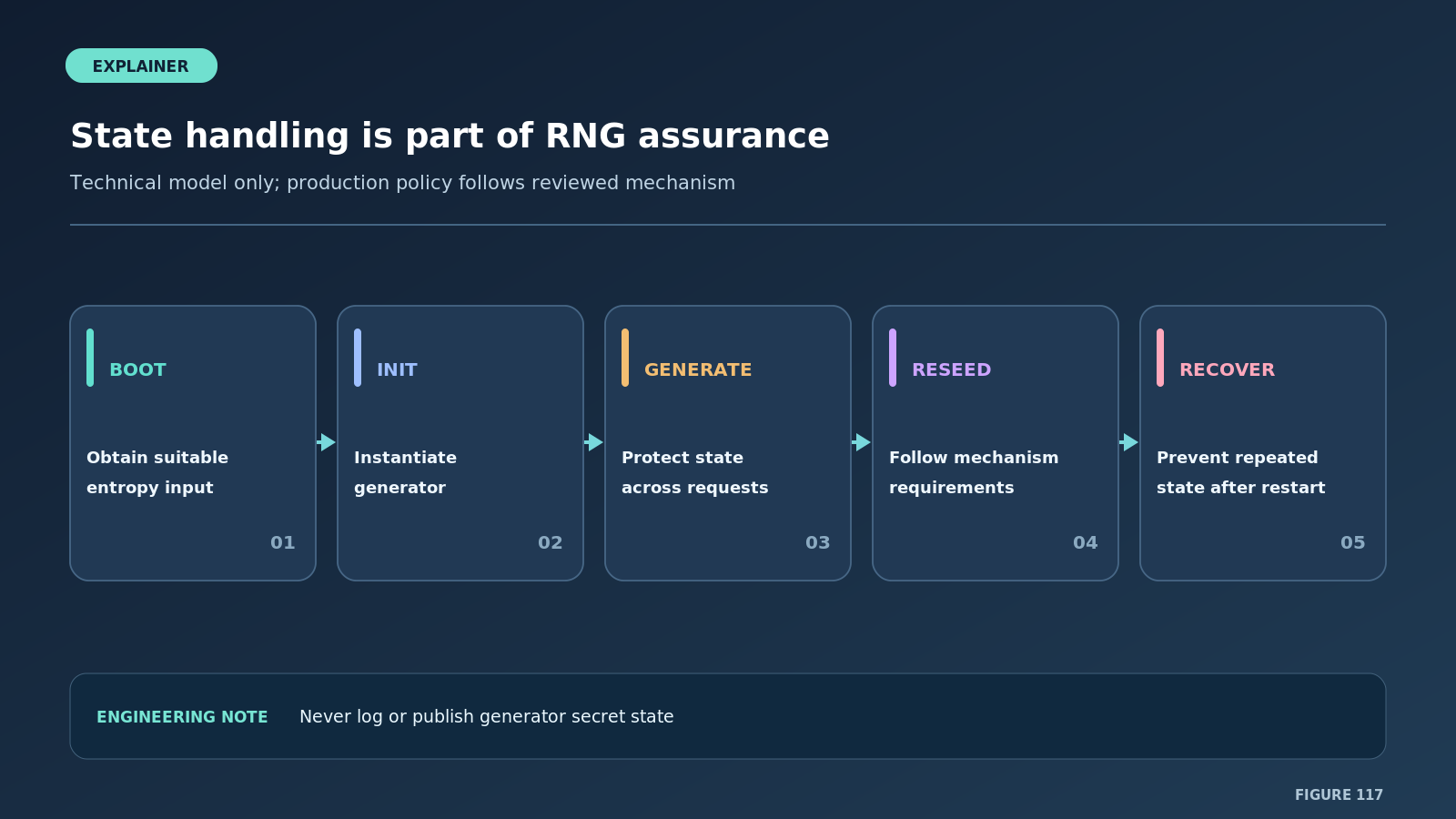
State handling extends beyond randomness generation. If a generator process restarts, it must not accidentally roll back to a previously used secret state. If thousands of worker processes start simultaneously, their streams should not become correlated because they receive identical seed material. If a snapshot restores a VM, the design must consider the implications for generator state. These are operational reliability questions as much as algorithm questions.
Do not log raw seed material or internal CSPRNG state to make troubleshooting easier. Separate reproducibility of game rules from predictability of production randomness. An incident investigation can retain a controlled outcome record, rule version and transaction identity without exposing the secrets needed to predict future outcomes. Where certified replay mechanisms are required, implement them according to the applicable tested design and access policy.
The lifecycle of an output also matters. The generator produces bits; a bounded selection function consumes them; a game rules engine interprets a selected result; an authoritative round record persists the decision. A rejected or malformed sample should not silently reuse a previous outcome. And if the bounded mapping uses integer arithmetic, rounding and modulo behavior need specific scrutiny.
Unpredictability, independence and common misconceptions
A series may look random to a player and still have defects. Conversely, a fair independent process can produce streaks, repetitions and long stretches without a high payout. Human intuition tends to expect alternation. In a sequence of independent fair coin flips, the probability of five consecutive heads in a particular specified block is 1/32; that event is unusual but not evidence that the underlying source is broken.
Independence and uniformity are related but different. Uniformity says outcomes within a defined set have the intended marginal probabilities. Independence says observing prior outcomes does not change the probabilities of later outcomes under the model. Games frequently have nonuniform outcome probabilities by design; the question is whether those probabilities match the approved mapping and rules, not whether every possible award is equally likely.
The gambler’s fallacy treats a recent streak as a force that must be balanced immediately. If each independent event has the same probability, previous results do not create a debt that the next round must repay. Conversely, a player should not infer that the next event is more likely because a desirable outcome has “not happened for a while.” Games with explicitly stateful or finite-deck mechanics are different and must be analyzed according to their actual rules.
Statistical tests provide evidence, not metaphysical proof of randomness. Frequency, runs, autocorrelation and distribution tests may reveal systematic anomalies. Passing a limited battery cannot prove that a generator is unpredictable, and failing one test does not automatically diagnose a security compromise. Test power depends on sample size, assumptions, significance choices and whether an experiment was selected after seeing the data.
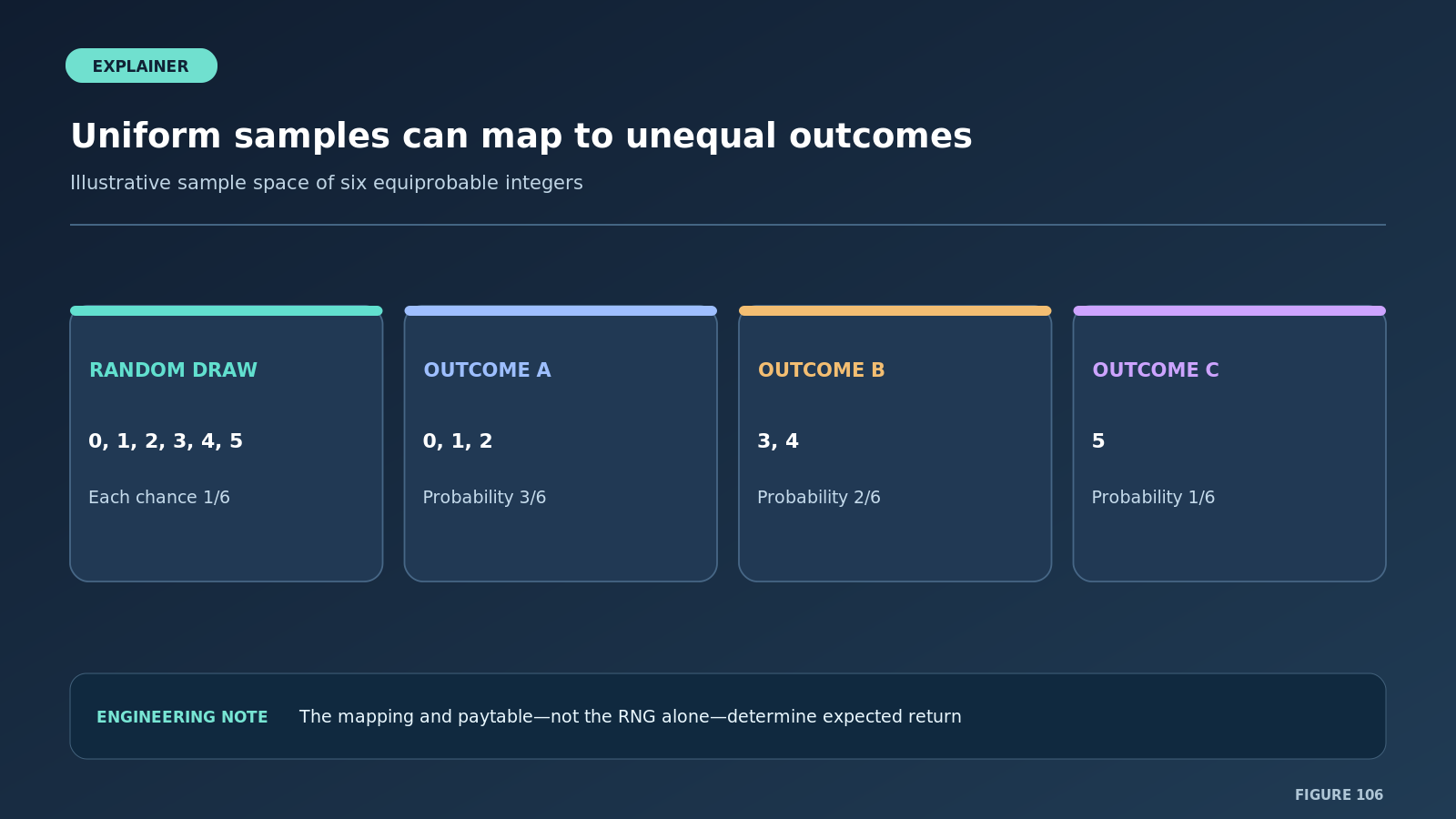
A related misconception is that the RNG establishes the game’s RTP. RTP is an expectation over the game-defined probability distribution and payout schedule, not an attribute assigned by a random-number library. Two games can use the same quality of RNG and have different RTP and volatility. An implementation can also have a perfectly good generator but the wrong paytable, or a correct paytable combined with biased scaling.
RNG system boundaries and integration points
A useful trust-boundary diagram separates the random-bit source, the bounded-outcome selector, the game rules, the RGS, the operator and the wallet. RNG state should be protected within the owner of the outcome-generation process. The operator generally needs an authoritative outcome and settlement evidence, not unrestricted access to the generator’s secrets. A network callback should carry the results and stable business references agreed in the provider contract.
Configuration control is essential. If an RNG output is mapped through a reel strip, weighted table or rule configuration, the deployed version must be identifiable. A mathematics report for rules_v5 does not automatically validate a live runtime using rules_v6. Preserve version identity at round time and guard release promotion. Testing should include impossible outcomes, boundary indices and mismatched configuration, not just happy-path spins.
An external provider is a separate trust domain. The operator may receive transaction callbacks and game metadata, while the game provider controls runtime logic and outcome selection. The operator can verify contract invariants, reconcile wallet actions and review independent testing evidence, but should not assume a browser animation exposes the internal RNG. Security logging must not turn secret state into broadly accessible operational telemetry.
Failover requires care. A regional switchover should not duplicate a committed bet or reissue an outcome solely because the original response was lost. Randomness quality and exactly-once business posting are separate properties. Both matter, but improving the generator does not resolve transaction deduplication. The round state machine needs explicit rules for accepted, resolved, settled and interrupted states.
Conceptual examples and what RNG alone cannot guarantee
Imagine a teaching model in which a uniform integer from 0 through 5 is mapped as follows: 0–2 → A, 3–4 → B, and 5 → C. If each integer is equally likely, the resulting probabilities are 3/6, 2/6 and 1/6. This demonstrates outcome mapping; it is not a proposal for production selection, seeding or cryptographic engineering. A production mapping must account for the finite range of its random source and avoid systematic bias.
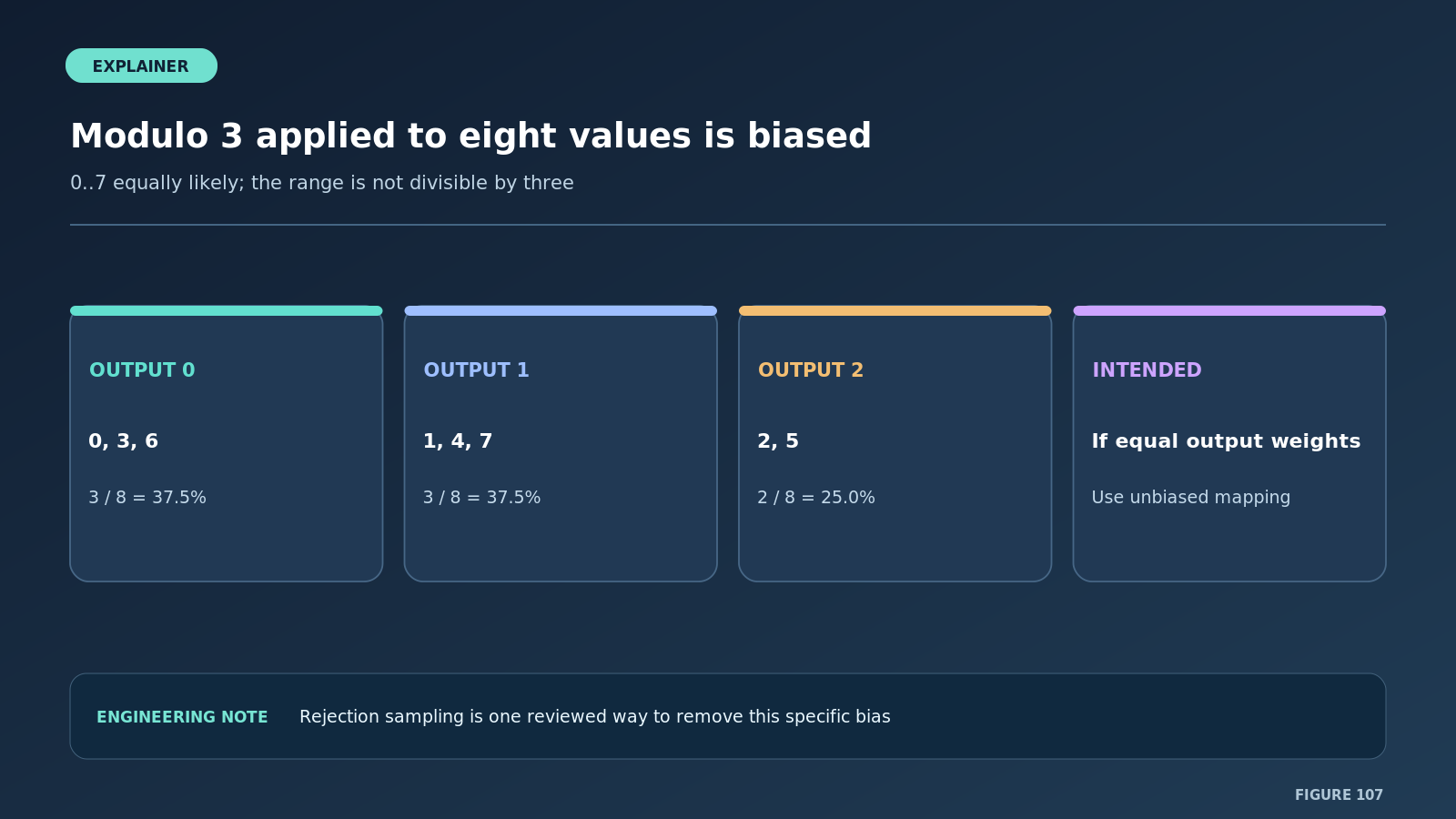
A common mapping hazard is taking a fixed-width random integer and applying % n when the source range is not divisible by n. For example, the uniform integers 0–7 mapped modulo 3 yield 0 three times, 1 three times and 2 only twice. Rejection sampling or another reviewed unbiased method can address this. The appropriate implementation depends on the generator and supported outcome space; do not substitute a toy illustration for tested production code.
A full game review therefore has multiple evidence layers. Generator review asks whether the design and entropy handling meet the applicable security or randomness criteria. Mapping review verifies that random values correspond to outcomes with the intended probabilities. Mathematics review checks paytables and expected return. Runtime review checks the same tested rules and assets are deployed. Transaction review checks that a selected outcome produces correct and unique money movements. Player-information review checks that applicable disclosures match the offered product.
RNG cannot promise a player a win, prevent a run of losses, establish a particular short-session return, guarantee ledger correctness or make an unlawful product compliant. It is one necessary technical component in a broader system. The most useful question is not “Is it random?” in isolation, but “Which result is random, by what mechanism, under which assumptions, and how does that result reach the player and the wallet without alteration?”
Primary references: NIST SP 800-90A Rev. 1, NIST SP 800-90B, NIST SP 800-90C, and UK Gambling Commission RTS 7 — Generation of random outcomes. These are background sources, not a claim that any depicted system has been tested against them.