Gaming transaction anomaly detection should begin with a precise definition of transaction integrity, not an impressive model architecture. A casino wallet can be arithmetically consistent while recording a duplicate provider event, a late settlement or an unexpected reversal. Conversely, an unusual burst of winnings may be legitimate game behavior rather than evidence of fraud. Engineers need deterministic accounting checks, reliable event history, and a separately governed statistical monitoring layer.
This guide focuses on identifying accounting anomalies across bets, wins, refunds, reversals, provider callbacks and wallet ledger entries. It does not describe using a model to choose game outcomes, to modify an approved paytable, or to override authoritative balance management. All cases and numerical examples below are synthetic; no operator-level detection accuracy is claimed.

Define integrity anomalies and relevant events
An integrity anomaly is a pattern requiring investigation because it appears inconsistent with an approved financial or operational contract. Common candidates include a provider bet received twice under differing transport request IDs, a win without an identifiable committed round, a refund posted after final settlement, a currency mismatch, or an unusual lag between an accepted bet and its compensating ledger entry. Each case needs its own decision rule and expected state transitions.
Start with the authoritative event taxonomy. A useful normalized event carries event_id, provider_id, tenant_id, player_ref, round_id, transaction_id, parent_transaction_id, event_type, amount_minor, currency, occurred_at, received_at, outcome_state, and a reference to the ledger commit. IDs should be opaque and stable; personally identifying fields should be omitted unless truly needed. Preserve original provider payloads in protected evidence storage but score only the minimum normalized attributes required by the detection use case.
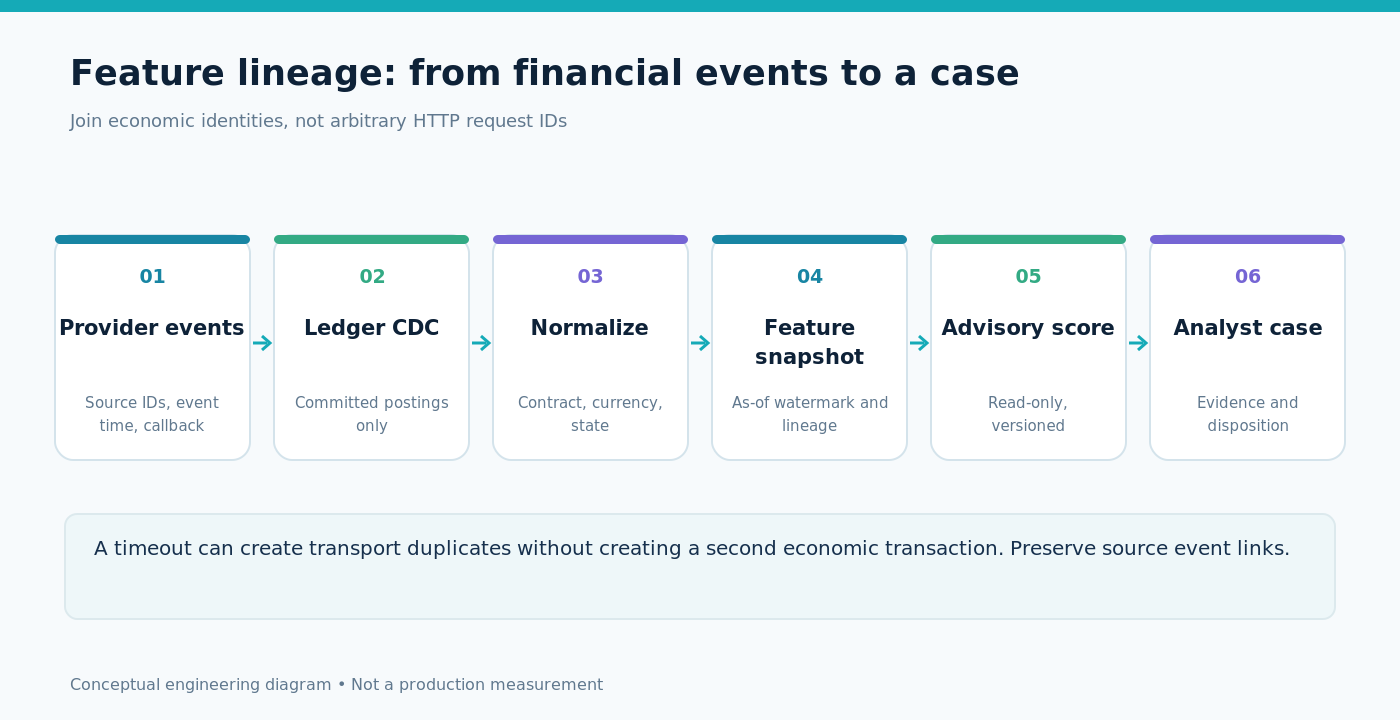
The monitoring pipeline must distinguish transport events from financial effects. A retry with a new HTTP request identifier can still represent the same economic transaction. A received callback is not proof that a ledger commit has occurred. An ingestion watermark may indicate that recent events are incomplete, so a transaction that appears unpaired should be marked pending evidence before being labeled anomalous. Use both event-time and processing-time fields and record their clock-quality assumptions.
Define high-confidence invariants outside ML: one final economic effect per stable business idempotency key; allowed transitions from open to settled or reversed; currency and amount consistency; and traceable links from every credit or debit to an approved business operation. These invariants may trigger deterministic reconciliation and incident handling independently of any model score. Statistical detectors are most useful for the gray area around this already-enforced core.
Feature engineering from transaction sequences
A flat table of isolated bets often misses the actual failure mechanism. Build sequence features over a window keyed by provider, wallet, account, round and integration version. Useful examples include unmatched-bet age, duplicate callback count, ratio of reversals to completed rounds, settlement delay relative to provider baseline, ledger-posting order violations, and unexpected differences between provider and wallet event totals. Record the denominator: ten reversals out of twelve eligible operations is very different from ten out of a million.
Treat monetary values carefully. Normalize to minor units using currency-specific exponent rules; avoid floats for authoritative amounts. Some signals should be expressed as counts, signed differences, or bounded durations rather than normalized monetary values. Pooling currencies without conversion or context can manufacture anomalies. Provider behavior should be compared with its own contract and settlement schedule, not a global average that mixes fundamentally different integrations.
Features require an as-of boundary. For a decision made at 12:00, the feature job must not use a reconciliation record that arrived at 12:20 merely because the warehouse eventually associates it with an earlier transaction. That is feature leakage and produces unrealistic offline validation. Keep feature code versioned, link rows to source event ranges and save the ingestion watermark used when a score was produced.
A minimal feature record might include unmatched_round_age_s, duplicate_economic_ids_1h, ledger_provider_gap_minor, settlement_lag_p95_ratio, reversal_rate_24h, and event_sequence_gap_count. Each field needs a null policy. A provider outage can make many features simultaneously missing; do not silently impute these to zero and then conclude everything is normal. Treat data-quality failures as their own alert class.
Rules, statistical baselines and ML candidates
Begin with transparent rules: a repeated business transaction ID with conflicting amounts; a win without an allowed predecessor; a ledger debit without a source event; and unexplained gaps after a documented reconciliation grace period. These are testable against deterministic fixtures and often deliver immediate value. Complement them with simple rolling baselines that compare settlement delay or exception rates within a provider and integration-version cohort.
Use ML only when its extra complexity solves a documented problem. A supervised classifier needs independently adjudicated incident labels and a time-aware training split. Isolation forests or density models can rank unusual configurations without labeled outcomes, but a high novelty score is not a calibrated fraud probability. Sequence methods may detect uncommon transitions; their event semantics still have to be interpretable in an analyst case. Complex embeddings add privacy, explainability and drift burdens that should be justified with measured lift over simpler baselines.
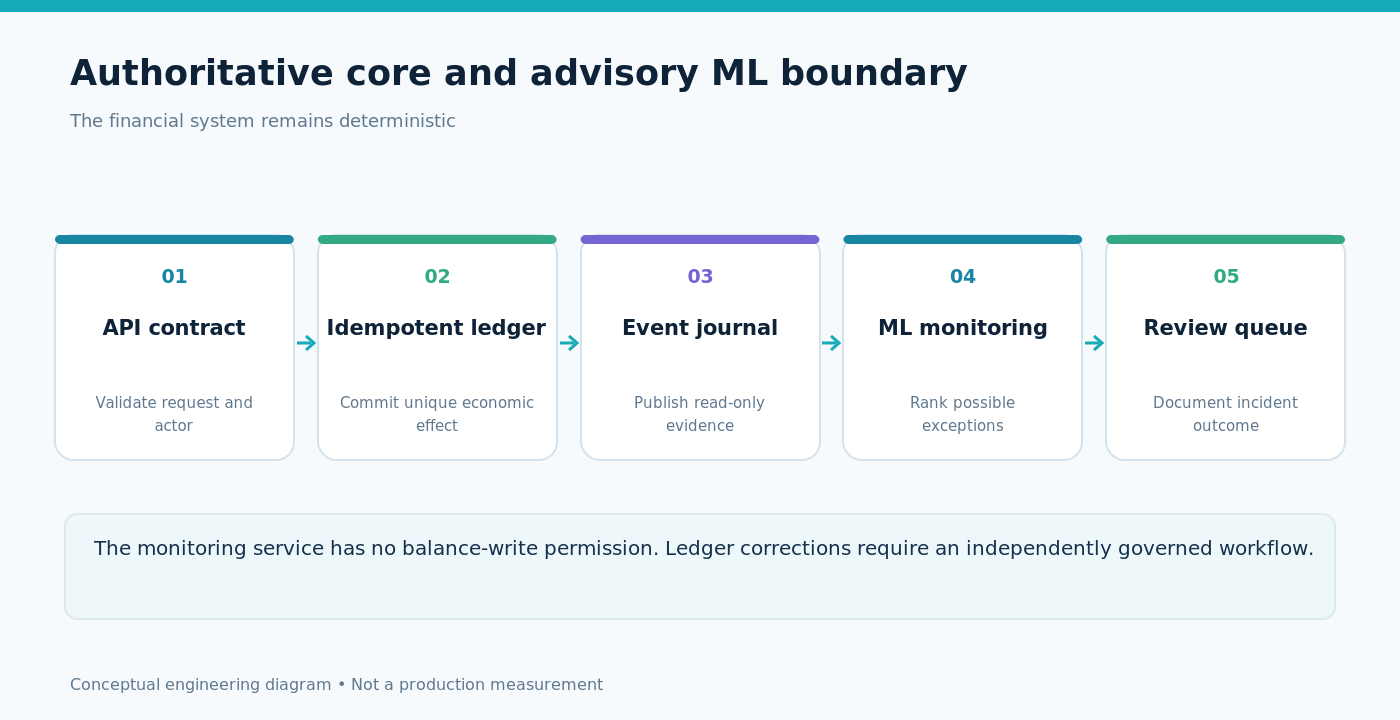
A sensible decision hierarchy is: reject structurally invalid or unauthorized requests at the API boundary; apply deterministic ledger invariants at commit time; produce anomaly alerts from reconciled or watermark-aware events; and use a statistical score to prioritize ambiguous records for review. When a model is unavailable, deterministic controls must continue to function. Never place model inference on the critical path for a debit or credit unless an explicit, approved product policy genuinely requires it.
Be careful when training on historical incidents. Labels may reflect which transactions analysts had time to inspect, not the true prevalence of defects. Provider migrations and incident campaigns can create clusters that leak across train and test sets. A randomized row split that puts transactions from the same outage into both sets will overstate generalization. Prefer time-separated holdouts, provider-aware evaluations and documented post-incident replay.
Evaluation, calibration and false positives
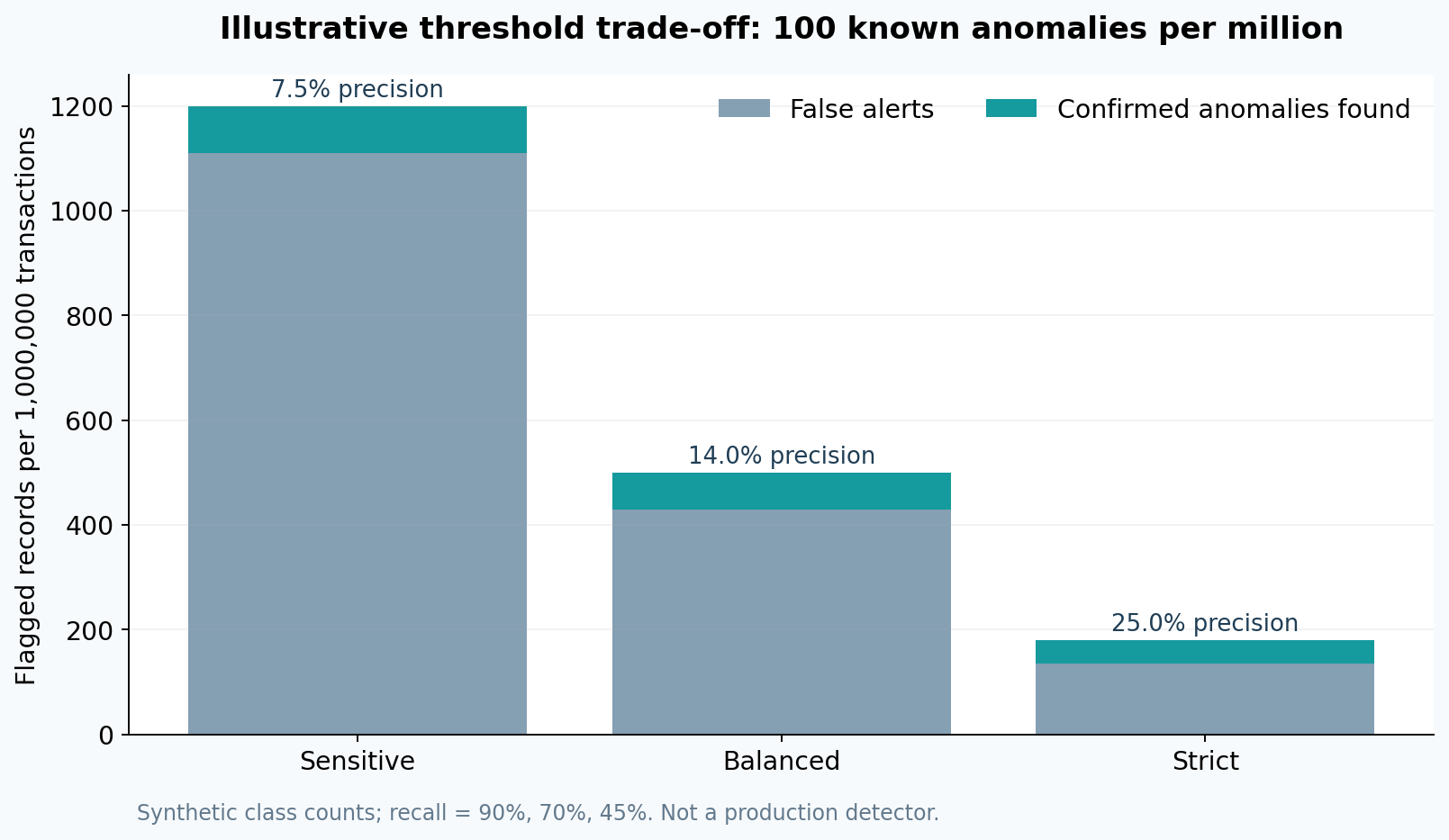
For rare integrity failures, accuracy is a misleading headline metric. Evaluate precision and recall on a realistic prevalence distribution, and report alerts per one million transactions, confirmed issues found, review hours, detection delay and missed high-impact cases. The scikit-learn precision–recall documentation explains why precision changes with class prevalence and threshold choice. Segmented results are essential: a model that performs well on one large provider can be unreliable on a newly integrated provider.
Example only: suppose one million transactions contain 100 independently confirmed integrity anomalies. A detector flags 500 records and captures 70 confirmed anomalies. Then precision is 70/500 = 14%, recall is 70/100 = 70%, and 430 flagged records are false positives under that labeling policy. The false-positive volume matters operationally even if recall improved over the existing rules. Analysts may investigate repeated records, so track unique cases as well as raw alerts.
Calibration asks whether a score bucket corresponds to observed event frequency over a specific population and period. With delayed or incomplete labels, apparent calibration can be wrong. Use time-to-label curves and preserve unresolved cases instead of assuming all unconfirmed alerts are negatives. Thresholds should be tied to a review capacity and harm budget, not chosen to maximize an offline F1 score. Severe ledger invariants remain deterministic and do not require an arbitrary statistical threshold.
Monitor subgroup stability and customer impact. False alerts can create unnecessary account holds, support calls or investigative work. Measure the outcome of actions, not merely model rankings. If labels are reviewed only for high-scoring cases, use appropriate sampling or adjudication of lower-score cases to estimate missed anomalies. Avoid automated enforcement based solely on experimental scores.
Human review and response workflows
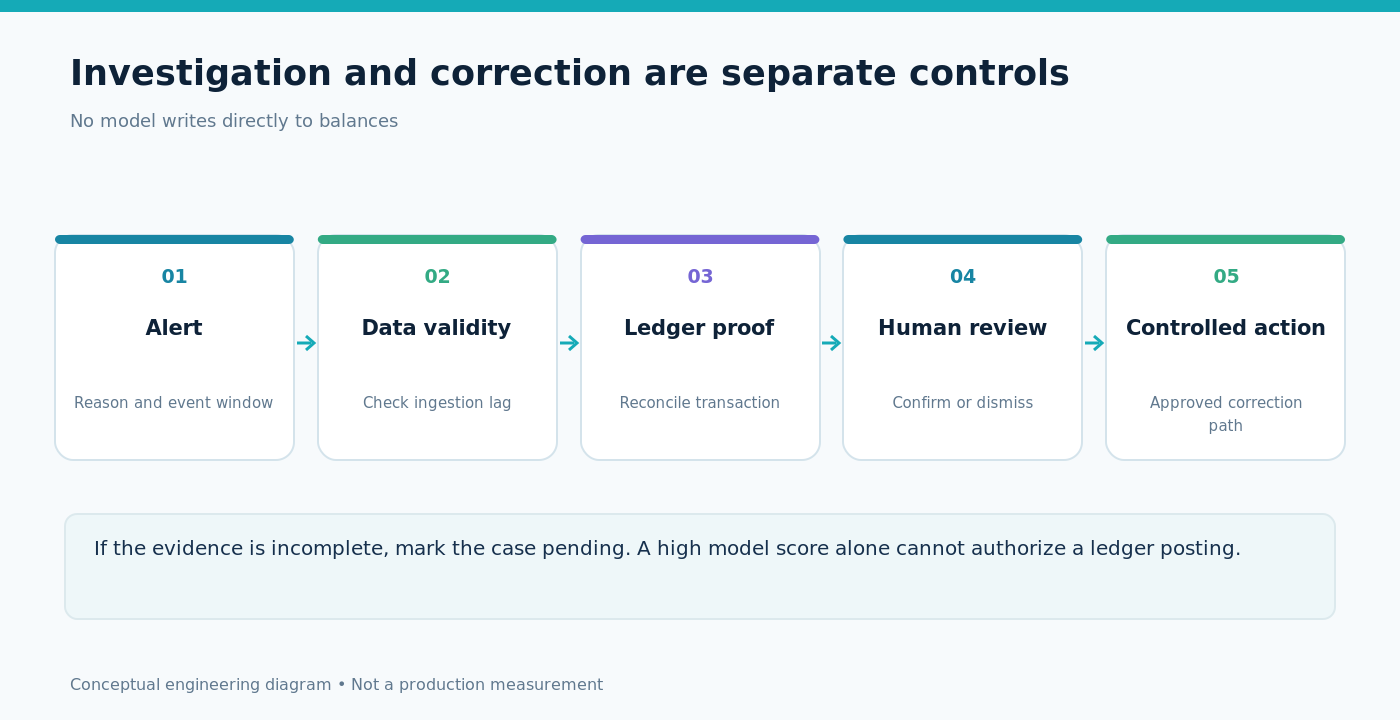
An alert is a case-opening proposal, not a judgment. Each case should include the affected business transaction, model and rules versions, score reason codes, input-event window, ingestion watermark, related ledger references, feature snapshot, and competing explanations such as provider delay or a recent configuration rollout. Analysts need a stable incident timeline that links to the underlying append-only evidence without exposing unnecessary personal information.
Use a tiered response. Observe for weak novelty signals; review for repeated gaps or potentially material mismatches; escalate deterministic financial invariant breaches to the established incident and reconciliation process. A financial correction should be executed by a controlled ledger workflow with approvals and audit trails. The anomaly model must never issue an unaudited UPDATE balance or silently replay a win.
Feedback must be structured. Reviewer dispositions might include confirmed duplicate effect, late legitimate settlement, provider mapping defect, data-pipeline defect, expected promotion activity, or unresolved. Require a second review for high-impact cases and record the evidence used, not only a yes/no label. Keep the reviewer burden visible through queue age, reopen rate and quality sampling. If analysts are overwhelmed, reducing alert noise is often safer than raising automation privileges.
There is also a privacy question: transaction telemetry can reveal sensitive activity. Pseudonymize player references, restrict cross-tenant joins, apply retention limits and log access to evidence. A governance checklist can use the voluntary NIST AI Risk Management Framework as organizational guidance, not as a claim of compliance with any particular gambling license.
Example monitoring architecture and test dataset
An implementable reference design is Provider Events + Ledger CDC → Validated Event Store → Reconciliation/Invariant Rules → Versioned Feature Pipeline → Model Scoring → Case Queue → Human Disposition → Monitoring. The event store is append-only. The scorer has read-only access to financial records and emits scores or recommendations, never ledger commands. Separate the incident channel for data-quality failures, because a blank dashboard can mean the collector stopped, not that transactions are healthy.
A useful synthetic test dataset includes normal bet–win, bet–loss, refund and reversal traces; exactly duplicated provider callbacks; a missing ledger commit; delayed settlement within and beyond the contract window; wrong currency; a unique HTTP request retry for the same economic ID; out-of-order but ultimately valid delivery; and a genuine provider outage. Label both the expected accounting effect and expected monitoring response. For every fixture, test replay and idempotency. The test should verify that a detector outage does not alter authoritative ledger behavior.
Write acceptance criteria before evaluation: zero unauthorized ledger writes from monitoring components; complete case evidence for critical alerts; known maximum ingestion-delay assumptions; measured precision at a set review capacity; and a documented fallback when the model or feature pipeline fails. Record the deployment build, feature schema, threshold and rollback plan in the change log. A successful experiment is one another team can reproduce and challenge.
Related guides: Casino wallet architecture, reconciliation, and ML model monitoring. Internal routes must be confirmed against the published site structure before deployment.