A small configuration change can affect thousands of game sessions without a single application binary being deployed. A title may be enabled for one operator, its minimum stake changed for a permitted market, a provider endpoint switched, or a promotional feature disabled. If those changes are edited directly in mutable production records, engineers may struggle to answer a basic question after an incident: which exact rules did this player session use? Game configuration versioning addresses that problem with explicit identity, provenance and controlled activation.
Configuration is not just a list of flags. It can carry commercially, financially or regulatorily significant behavior. A safe design must distinguish a harmless display label from a certified mathematical parameter or jurisdiction-specific restriction. This article focuses on the lifecycle of configuration artifacts and rollouts; it does not establish certification requirements for any particular regulated market. For service ownership around configuration see iGaming Platform Architecture and Game Aggregator Architecture.

What counts as game configuration
Define classes before building a generic settings table. Game metadata includes titles, thumbnails, descriptions and catalog tags. Routing configuration selects the provider integration, endpoint or supported currency mapping. Operator and jurisdiction policy controls availability by territory, allowed feature or account state. Session and presentation settings affect entry points, language or display. Certified game parameters, where applicable, may determine behavior that requires a formal approval process before change. Treating all of these as interchangeable key/value pairs invites accidental high-impact releases.
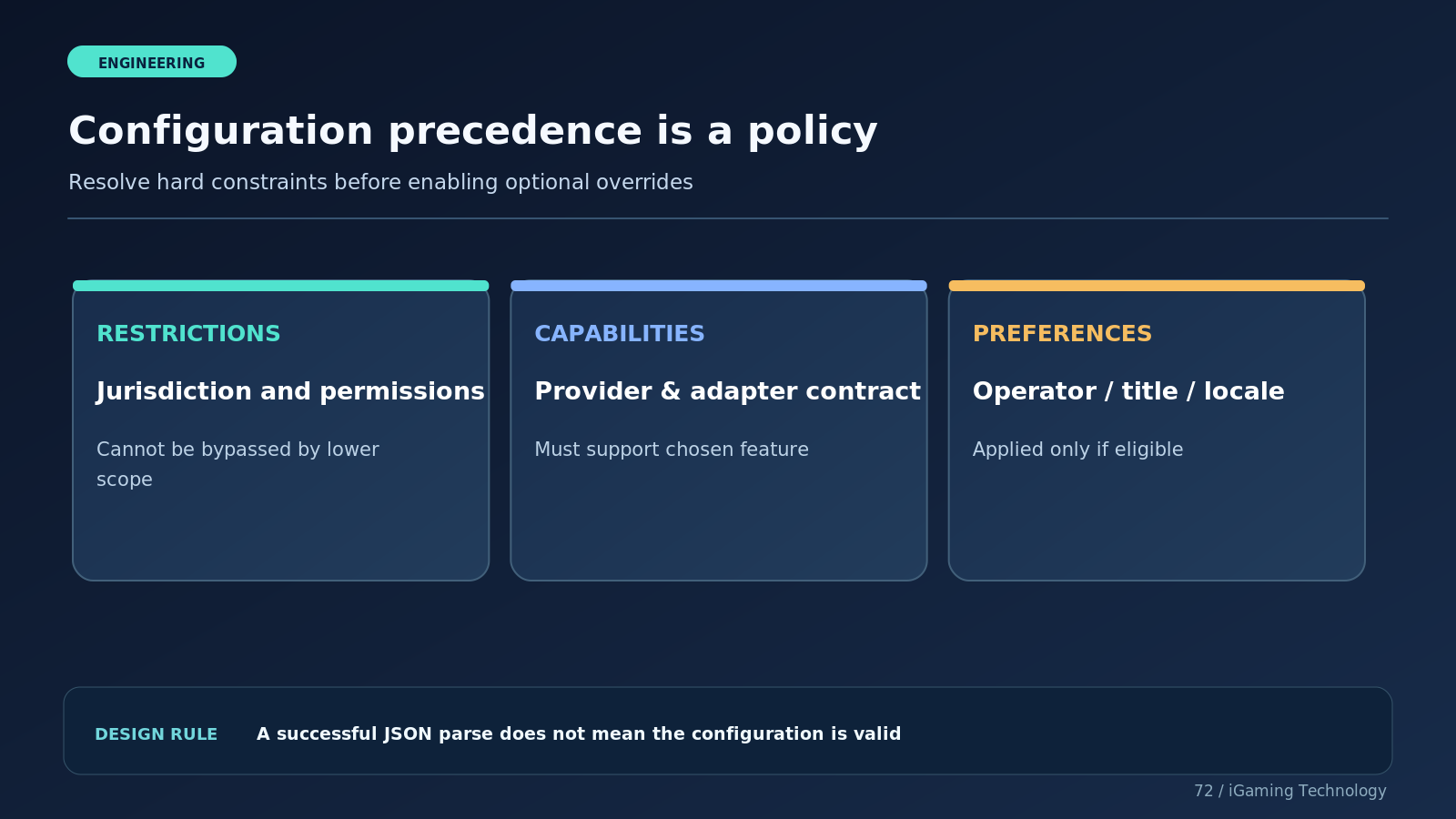
A configuration record should declare its owner, scope, effective version and risk class. Typical scopes include global default, provider, game, operator, jurisdiction and specific contract or tenant. Precedence must be unambiguous. For example, an operator-level enable flag must not override a stricter jurisdiction prohibition. Prefer a deterministic policy compiler that resolves scopes and emits an effective snapshot, rather than ad-hoc string lookups scattered across services.
Model dependencies explicitly: a game can be available only if its provider adapter version supports the required launch protocol; the currency must be accepted by both provider and wallet; a feature may be disabled for a jurisdiction regardless of an operator flag. Validate the entire resolved configuration against these constraints before publishing. A syntactically valid JSON document can still describe an impossible product state.
Most importantly, decide which settings may change during a session. A catalog image can update with little risk, but a financial or gameplay-affecting parameter should usually remain stable for the lifetime of a round or session where the relevant contract requires it. Some fields should never be changed without an approval or test boundary. Write this policy down rather than assuming all services interpret cache invalidation the same way.
Version storage, immutable snapshots and provenance
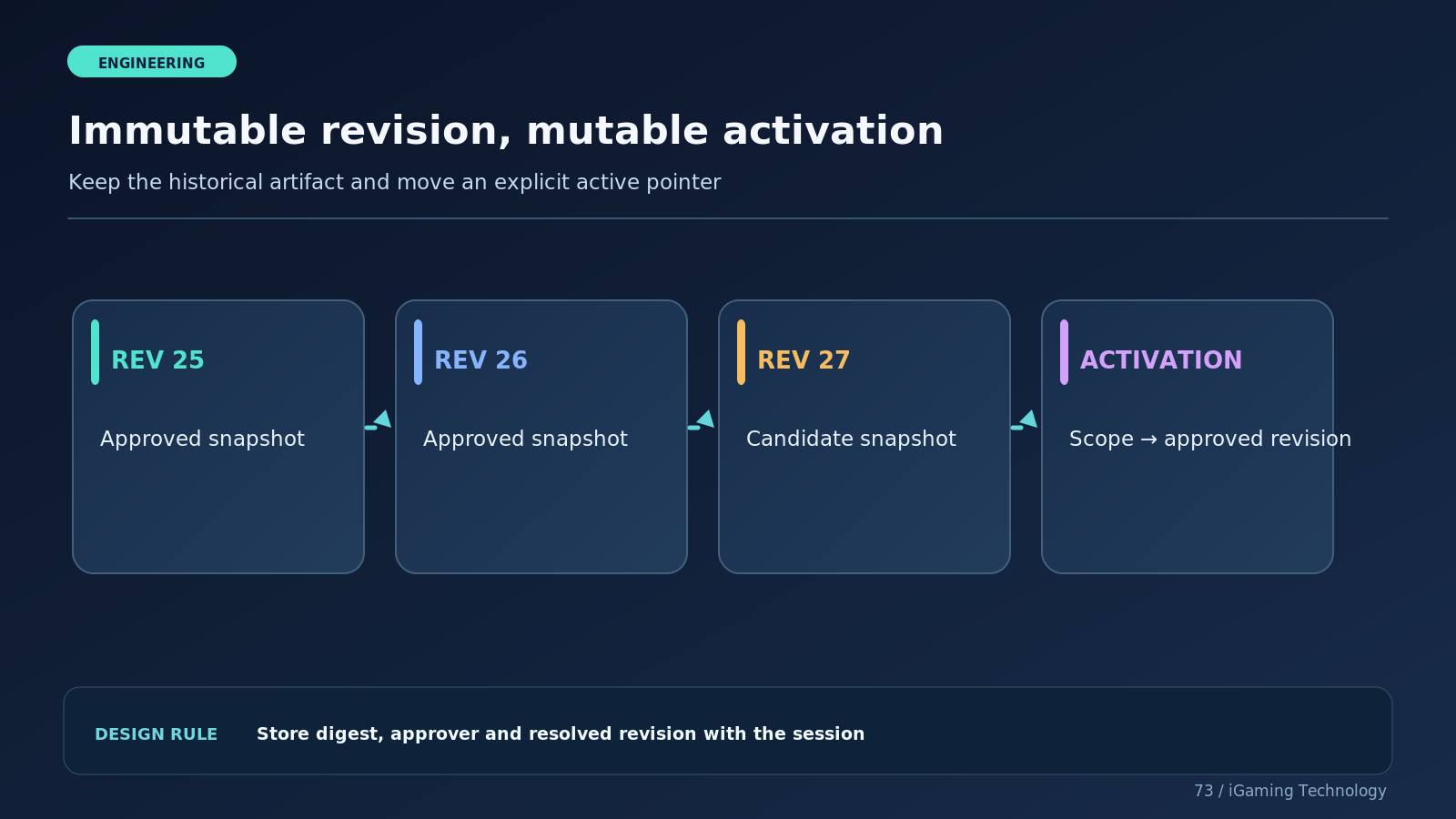
Store each approved configuration as an immutable revision with a stable identifier and content digest. An illustrative snapshot might be identified by config_set_id, revision, sha256_digest, schema_version, created_by, approved_by, created_at, effective_scope and certification_reference where relevant. An activation pointer then chooses the revision for a defined scope. Editing the old revision in place breaks reproducibility; a corrective change should create a new revision.
The canonical record can live in a configuration repository or managed configuration service, with snapshots distributed to runtime caches. Keep authoring, validation, approval and activation as separate actions. Reviewers should compare structured differences, not just whole-file text. A diff should say “provider route changed for operator X in market Y” or “minimum stake changed for a configured currency,” including defaults inherited from other scopes.
Provenance answers: who requested this change; which tests validated it; which release artifact and provider adapter it assumes; which environment received it; which reviewer approved it; and which sessions actually observed it. Git commit identifiers can help but are not sufficient alone if runtime selection, database overrides or emergency switches can diverge from the repository. Store the resolved artifact hash alongside each activation event.
Avoid using timestamps as the sole version identity. Clocks can disagree, activations can be rolled back, and changes can be staged for later. Use a monotonic revision per configuration family, an immutable digest and an explicit activation record. The version attached to a game session should identify the effective resolved configuration, not merely the latest entry in an authoring database.
An example artifact could look like this; field names and values are illustrative, and no licensed game parameters are implied:
{
  "config_set_id": "catalog-game-042",
  "revision": 27,
  "scope": {"operator": "operator-a", "market": "market-x"},
  "adapter_contract": "provider-api-v3",
  "display": {"locale": "en", "enabled": true},
  "session_policy": {"pin_revision_at_launch": true},
  "approval_ref": "CHG-2026-0421"
}
A content hash and signed or access-controlled artifact manifest can prevent an accidental substitution between approval and activation. Audit systems should keep the old snapshot even after it stops serving new sessions, subject to retention requirements.
Activation, rollouts and compatibility windows
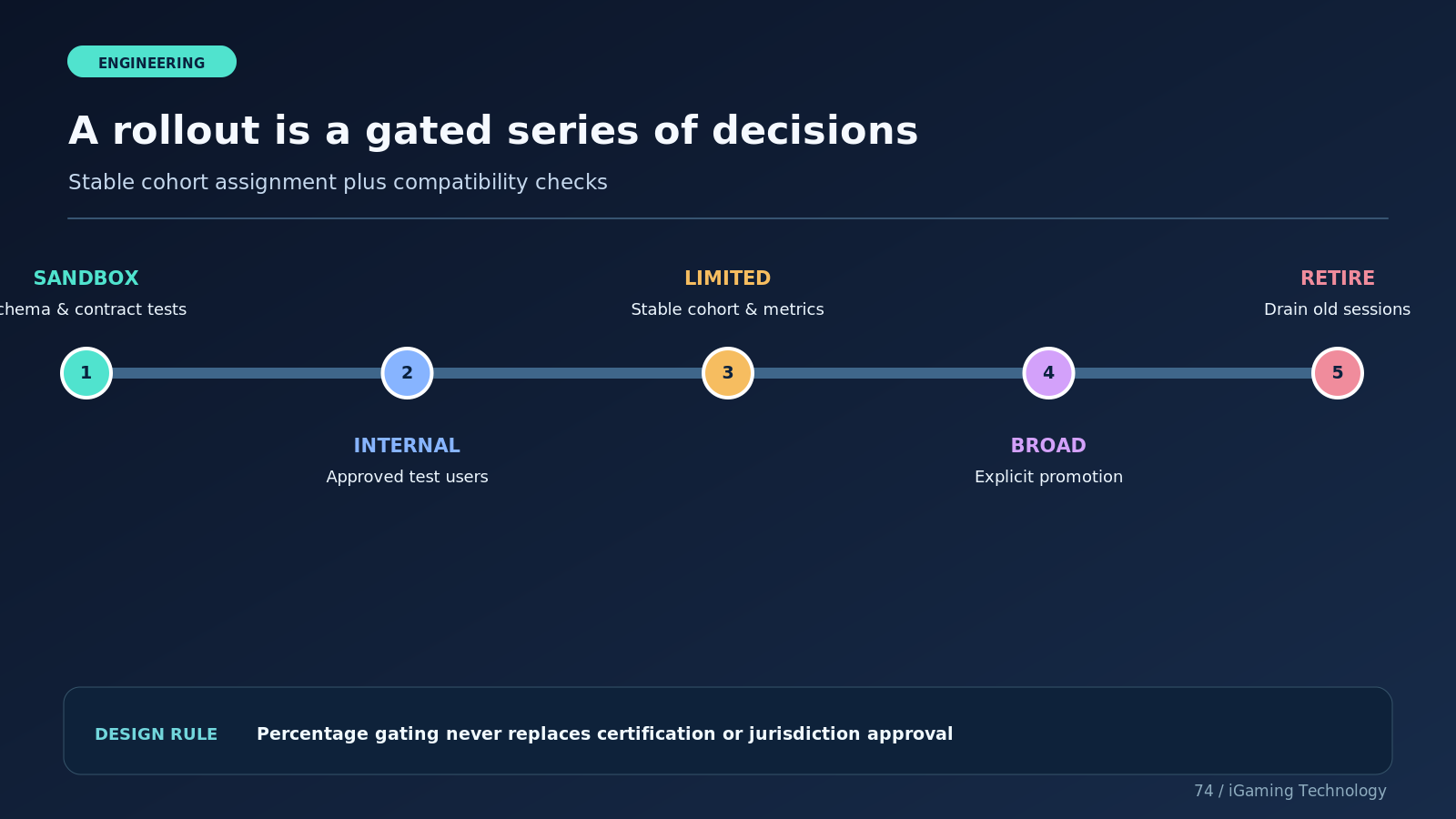
Publishing an immutable revision is not the same as making it live. A rollout controller evaluates scope rules and a release plan, then moves the activation pointer under controlled conditions. A basic staged plan may progress through development, provider sandbox, internal operators, a limited approved cohort, and broader production. Each stage should include a measurable success criterion, a maximum duration and a defined action if metrics degrade.
Percentage rollout is useful only when the cohort is stable and lawful. Hashing a durable session or account key can keep a test cohort consistent across requests. Selecting traffic randomly on every request is dangerous when the same session could alternate between incompatible behavior. For regulated features or configurations tied to certification, a cohort percentage is not permission to bypass approval requirements. Release eligibility must be enforced before sampling.
Compatibility windows matter because providers and operators rarely deploy in lockstep. A new configuration may expect provider-api-v3 while one active adapter still supports only v2. A two-phase deployment can first roll out compatible code, then activate the new configuration, then remove old adapter support after existing sessions drain. Record “minimum compatible adapter version” and “last safe rollback revision” in release metadata.
Caches need a contract. Some runtime services fetch the current activation at each launch; others subscribe to change events; still others hold a local snapshot until restart. Set maximum propagation delay and specify fallback behavior when the control plane is unavailable. Many platforms should prefer to keep using the last verified snapshot for safe read-only behavior while declining to launch new sessions if critical policy freshness cannot be proven.
A rollout checklist should check provider contract compatibility, change-class approvals, schema validity, jurisdictions, currency maps, launch smoke tests, wallet callback tests, session pinning, fallback behavior and observability coverage. Gate progression on the outcomes that matter, not simply a low HTTP error count.
Rollback and mid-session consistency
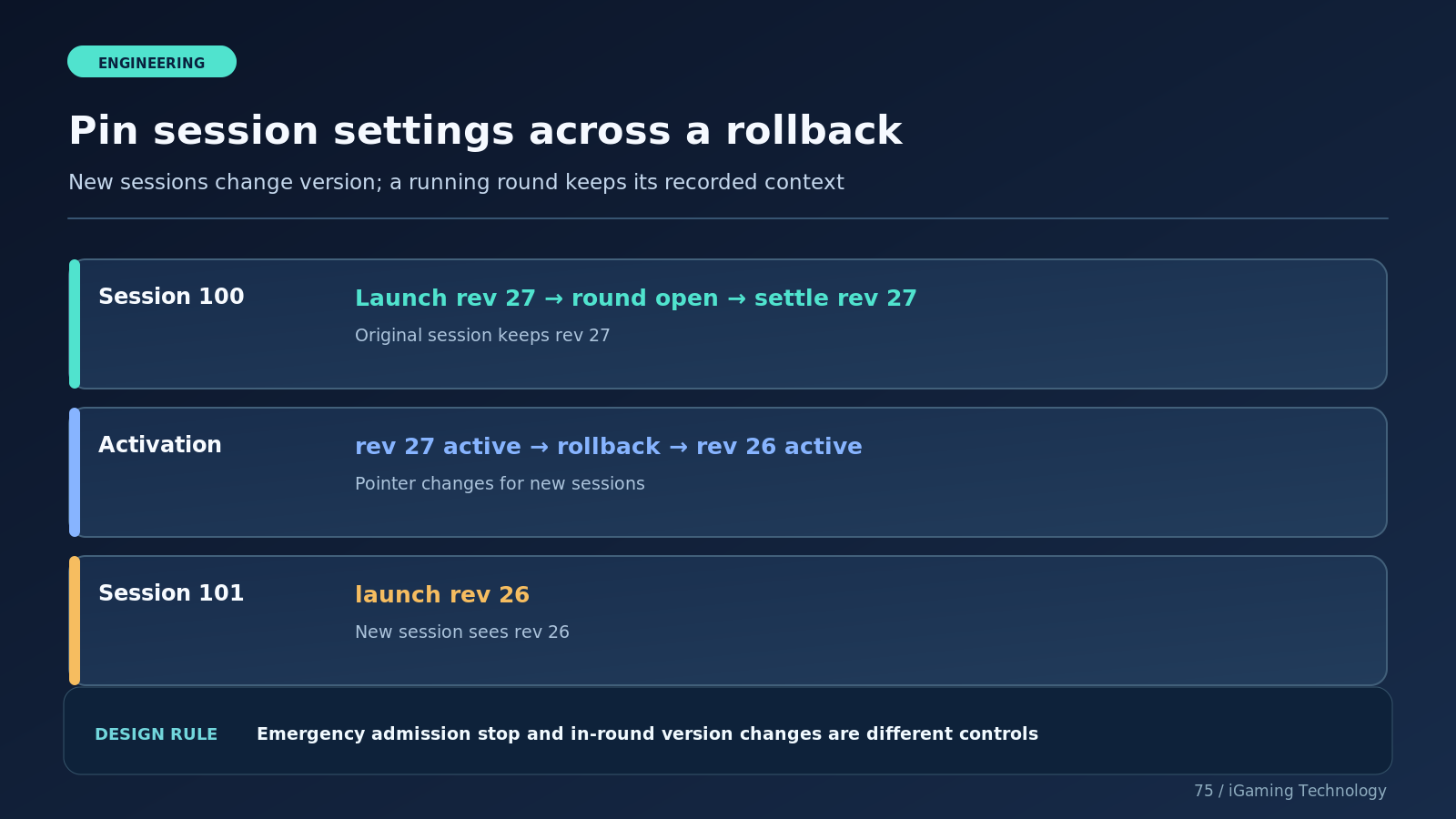
Rollback is typically an activation change, not a destructive edit to historical configuration. Repoint new-session evaluation to a previously approved immutable snapshot while keeping evidence that a later revision was briefly active. The old revision must still be compatible with the current application, provider contract and underlying data. Otherwise “rollback” might create a second incident.
Consider a game launched under configuration revision 27. Five minutes later, an operator rolls new sessions back to revision 26. If that session is still active and its provider round continues, abruptly applying revision 26 mid-round may violate the original rules or produce incompatible identifiers. For session-bound settings, store the effective configuration revision with the session and maintain it through settlement. New sessions use the revised activation pointer; existing ones either finish under their pinned revision or follow a contractually defined migration path.
Some emergency controls must take effect immediately: for example, disabling new access in a jurisdiction or responding to a confirmed security issue. Separate admission controls (“new launches forbidden”) from round execution parameters (“existing round’s committed configuration”). Emergency shutdown may be necessary but must retain evidence of unresolved rounds and settlement obligations. It should not silently rewrite historical game outcomes.
Test rollback under realistic race conditions. A provider callback may arrive after the rollout has been reversed; a worker may have cached the new revision; the analytics pipeline may label a session with the current pointer instead of the original one. Ensure all events carry session or config revision, and reconciliation can link them to the correct rule set.
Audit links to certification and retesting decisions
Not all setting changes carry the same regulatory impact. Define a review matrix with the appropriate compliance and game-integrity specialists: presentation-only change, integration route change, financially sensitive mapping, gameplay-affecting parameter, or jurisdiction policy. Each class can require different test evidence and sign-off. The classification itself should be auditable, including who made it and on which criteria.
An audit record should connect request → reviewed diff → validation results → approval → activation → affected scope → observed runtime revision → rollback or retirement. Where certification or testing laboratory approvals apply, attach references to the approved artifact and permitted operating environment. Do not imply that an engineering deployment test automatically substitutes for formal retesting or regulator notification.
When investigating a dispute, the team should be able to locate the exact session revision without relying on a mutable “latest config” endpoint. This is especially important for multi-tenant providers: a game ID alone may not be enough to reconstruct the result because operator, jurisdiction, currency and adapter versions affect the resolved configuration. Retention rules must preserve required evidence without needlessly retaining unrelated personal data.
Keep an emergency path controlled, not invisible. A high-priority disable operation can have expedited approval and an automatic expiration, but still needs author identity, a reason, a scope, timestamp, affected revisions and post-incident review. If it bypasses ordinary delivery, monitor the divergence until systems reconcile to the declared source of truth.
Deployment tests and failure scenarios
Treat configuration testing as a software discipline. Unit-test precedence and validator rules; contract-test provider adapters; integration-test launch, bet and win callbacks with pinned session versions; load-test cache convergence; and chaos-test the control plane’s unavailability. Add negative cases: a revision with an unsupported currency, a jurisdiction denial overridden by a lower priority setting, an incompatible adapter contract, and an activation racing an in-flight session.
A realistic canary should watch launch success, provider-specific errors, callback failure rate, divergence between intended and observed version, and unresolved settlement count. Guard against tiny cohorts producing misleadingly quiet metrics. Rollout decisions may need a minimum sample size or an explicit operator approval rather than an automatic promotion every few minutes.
Example failure exercise: Activate revision 27 for 5% of eligible sessions. During the test, disable the configuration service and verify that already pinned sessions continue under revision 27. Trigger a rollback so new sessions select revision 26. Then deliver a delayed provider callback for a revision-27 round and confirm it resolves with the session’s stored context. Finally, export the activation log and verify that compliance can identify all affected sessions without guessing from current configuration.
The most useful final artifact is a repeatable release dossier: immutable snapshot digest, approval references, compatibility matrix, planned cohort, rollback revision, runtime evidence, test outcomes and incident notes. This turns configuration changes from invisible toggles into changes that engineering and assurance teams can explain.
Technical references
- Azure App Configuration: snapshots — immutable configuration snapshots and controlled activation.
- Azure App Configuration: feature management — staged and percentage-based rollout mechanisms.
Editorial note: the sample configuration, scopes and approval references are invented for explanation. Validate them against the actual game, operator and jurisdiction contract before implementation.