Game engine vs remote game server sounds like an argument between two competing products, but the terms frequently describe different layers of the same gaming solution. A game engine executes gameplay rules, state transitions or presentation logic; a remote game server (RGS) commonly operates the server-side interface through which a game is launched, authorized, tracked and connected to an operator. Depending on the studio, the game-logic engine may run inside the RGS, behind it as a service, or partly on the client under a trusted server’s authority.
The boundary is not standardized across every provider. Some teams use “game engine” for their complete backend runtime. Others use the term for the HTML5 or Unity-style client renderer, and reserve “RGS” for a platform running the games of many studios. The goal is not to enforce a universal naming convention. It is to name which component owns each decision and how records, sessions and financial actions travel across the interface.

What a game engine runs
At its broadest, a game engine is the runtime that turns a game’s design into behavior. It may manage an event loop, timing, scenes, animation, audio, input, object state and rule-driven transitions. In a slot-style online game, that could include reel presentation, paylines or alternative win mechanisms, bonus-round transitions, progress indicators and celebratory effects. For a multiplayer or live game, it may also include turn logic or client rendering synchronized to a separate authoritative service.
Crucially, visual behavior and authoritative game logic are not always in the same process. A browser can animate the stopping position of reels based on an already decided outcome. The animation engine may generate a smooth transition but have no permission to select a new payout. The server-authoritative game-logic engine determines the result under the approved rules and communicates the information needed to render it. Engineers should not use the existence of a spin() method in frontend code as evidence that the browser controls the actual wager.
State can be transient or authoritative. A UI panel that remembers the last animation frame is transient presentation state; a server record of a round’s terminal outcome is authoritative business state. Client animation timers can be reset after a crash without changing the settled payout. A game engine that controls authoritative outcomes must persist or reconstruct state according to the game’s integrity requirements and recovery rules.
Games also use data assets: sprite sheets, models, sounds, localization strings, accessible text, paytables, weighted configurations, feature flags and bonus rules. These assets are not equivalent. Changing a background texture may affect presentation but not game mathematics. Changing a symbol-weight mapping could affect probability and certification. Make that distinction explicit in the release system rather than treating every asset as freely interchangeable.
The engine may expose functions such as loadGame, startRound, applyOutcome and resumePresentation. Those names are illustrative. Production implementations should define the contract between UI, engine and authoritative result service, including failure and resume behavior. For instance, a client should render a stored result after a reconnect instead of generating a new result to make the UI feel responsive.
What a remote game server owns
An RGS is commonly the operational server environment for remote game sessions. Its responsibilities may include game launch, provider authentication, session management, regulatory or operator configuration, availability, game version selection, server-side round orchestration, accounting adapters, event delivery, audit data and incident operations. A studio may host its own RGS; an aggregator may expose a normalized façade over several studio-controlled RGSs.
RGS ownership does not automatically mean the RGS stores player money. In many seamless-wallet integrations the operator wallet is authoritative for player funds, while the RGS sends bet, win and refund requests. In other models there is a prefunded or transfer wallet. Whatever the model, the integration must identify the financial source of truth and the meaning of each acknowledgement.
The RGS also manages external trust boundaries. An operator should validate that the callback is from an authorized provider and that the player, game and session references are valid. The provider needs to know whether a wager has been accepted and posted, not merely whether a game animation started. Authentication at the HTTP boundary is necessary but insufficient: the wallet needs idempotent business semantics and correct concurrent balance handling.
Beyond transport, the RGS frequently serves as the lifecycle owner for a round. It can coordinate game-specific state with the operator’s transaction response, persist a final result and support reopen/recovery flows. That does not imply every RGS implements the same sequence of debit and award callbacks. Contracts vary and must define what happens when one operation commits but its response is lost.
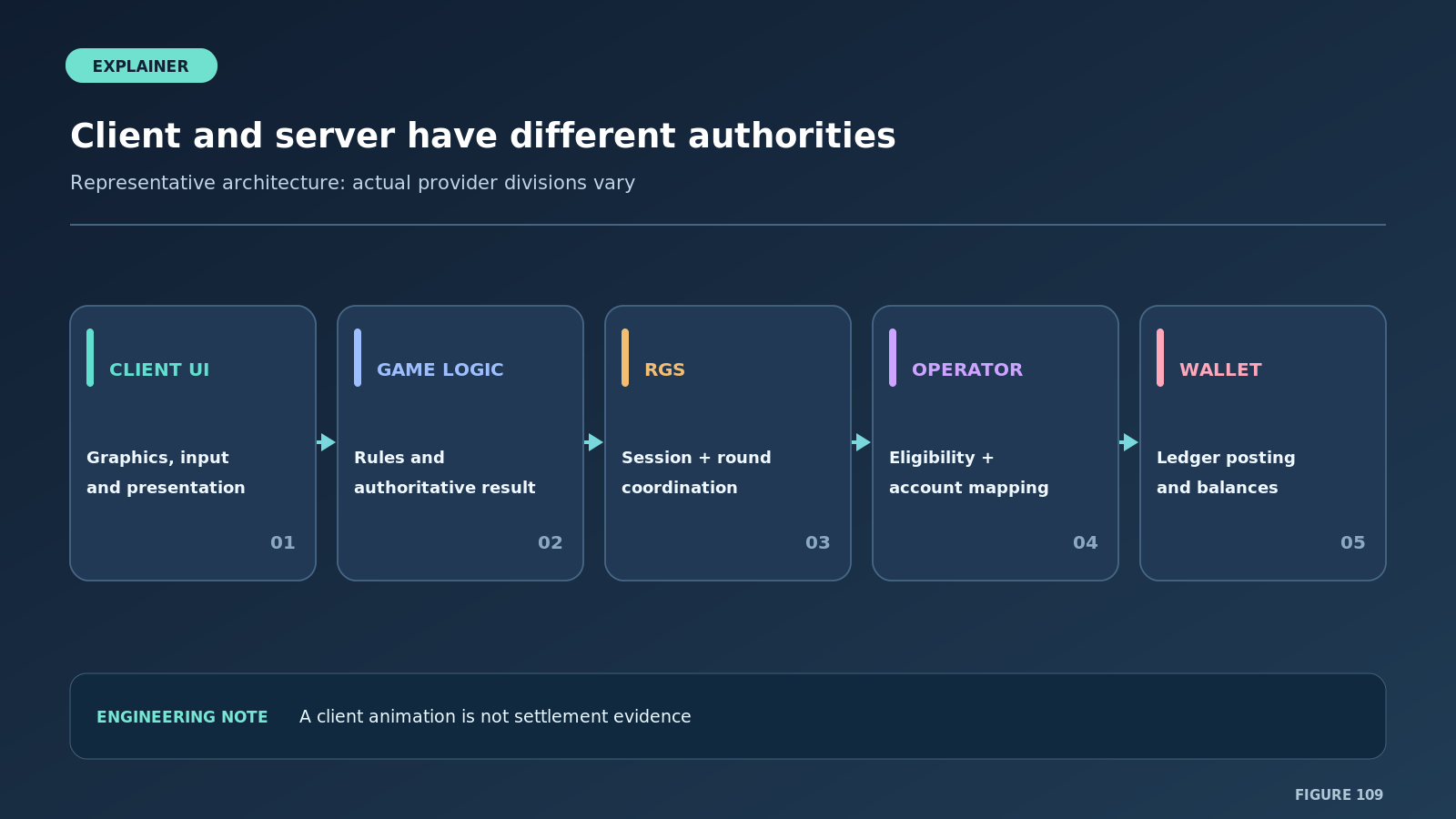
State, asset and outcome responsibilities
To decide where a function belongs, ask whether it is presentation, game authority, session orchestration, finance, or compliance. Each category has a different failure consequence. Presentation can be re-rendered. A game outcome should be unique and persistent. Session authorization may expire. A financial debit must reconcile to a ledger entry. Jurisdiction restrictions and responsible-gambling rules must be enforced at the correct owner and boundary.
A practical ownership table might read as follows:
| Concern | Typical primary owner | Important boundary |
|---|---|---|
| Reels, UI animation and audio | Client game renderer | Must not decide a new authoritative payout |
| Rules execution and outcome mapping | Trusted game-logic runtime | Binds rules version and outcome evidence |
| Game launch and session tokens | RGS/operator integration | Authentication and authorization are separate |
| Game catalog and release routing | RGS or aggregator | Use stable IDs and approved game versions |
| Bet/credit accounting | Operator wallet or defined wallet authority | Money posting must be idempotent |
| Player eligibility | Operator and regulated controls | Enforce at relevant transaction boundary |
| Round and callback reconciliation | Shared provider/operator processes | Link round IDs to transaction IDs |
| Media and game presentation assets | Game studio and delivery network | Integrity, cache versions, compatibility |
This is a typical allocation, not a universal contract. An RGS can own the engine’s authoritative logic, the operator can host an authoritative game process, or an aggregator can operate a shared integration layer. The table should be adapted to the actual contractual system boundaries before use in implementation or audit documentation.
Consider asset versioning. A new animation pack can sometimes be released without changing the mathematical model. A new paytable or feature configuration cannot be treated as a cosmetic asset update. The round must bind to the right configuration version, and rollback must be safe for in-flight states. If one service has updated rules and another service still serves old client assets, the UI can misdescribe a valid result. Compatibility between client renderer and server outcome schema matters.
Outcome evidence should be stored in an appropriate authoritative service. An engineer debugging a disputed round needs stable references: session, round, game version, outcome and the related wallet transactions. The engineer should not have to reverse-engineer a result from browser screenshots. At the same time, storage must not expose secret RNG state, personal data or credentials to every developer with log access.
Interfaces between runtime, RGS and operator
The interface between a game runtime and the RGS should describe which operations change state and what happens when they are repeated. For example, a resolveRound(roundId, actionId) concept may produce an immutable outcome, while a separate requestDebit(betTxId, amount) concept triggers a financial change. They should not be casually combined into a generic process endpoint without clear success, duplicate and pending semantics.
An illustrative request path is: the player opens the game using an authorized session; a bet action is submitted; the trusted system validates state; the RGS coordinates an authorized debit with the wallet; game logic determines the outcome according to the correct rules version; the RGS requests any necessary credit; a terminal round record is committed; the client receives a response and renders the outcome. The actual chronology may differ; some platforms choose an atomic wager-and-settlement operation or use an independent financial queue.
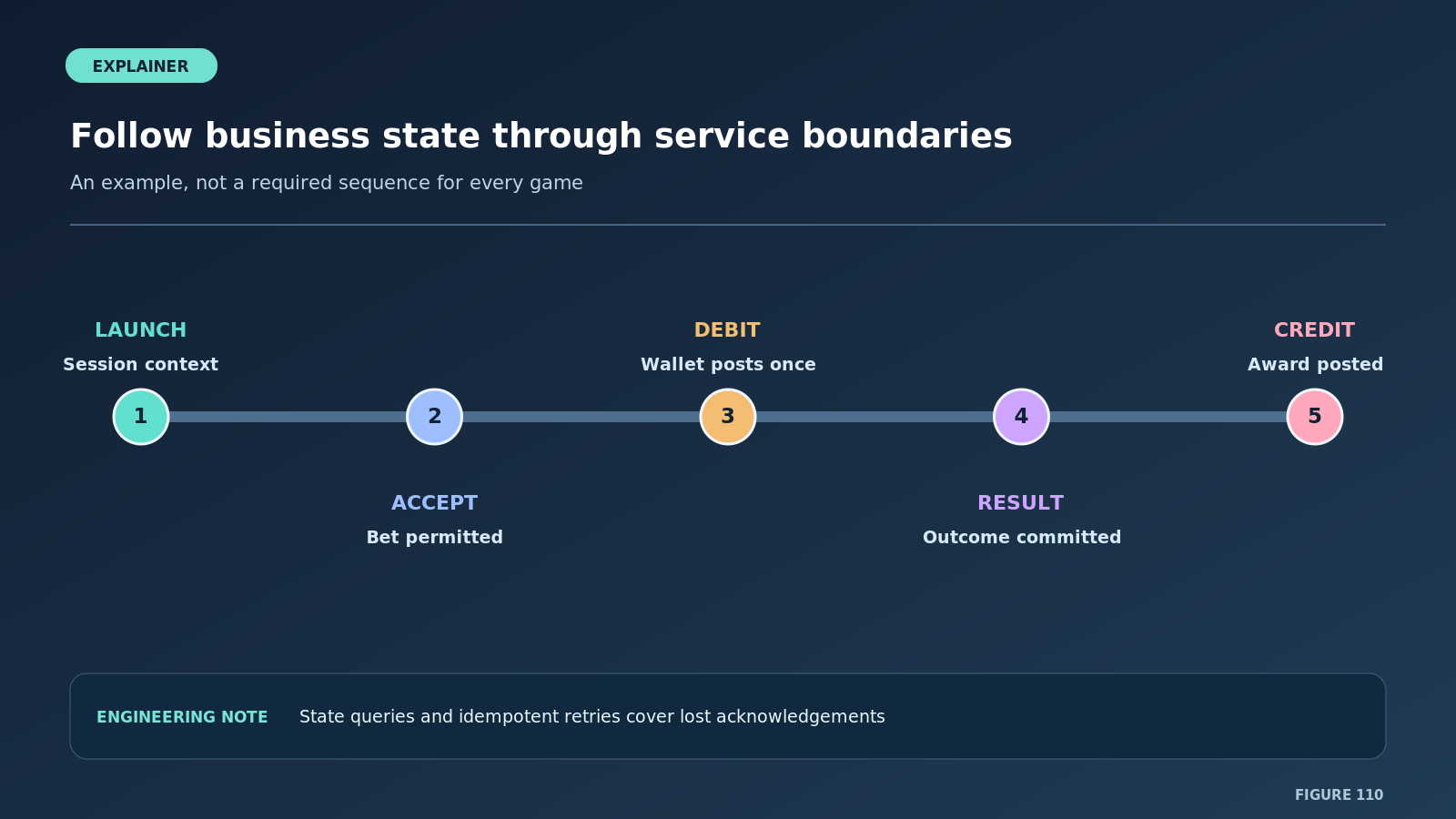
Network timeouts are especially revealing. If the RGS submits a debit and receives no response, it should not assume the debit failed. The wallet may already have committed. A retry must preserve the original business identity; the RGS must be able to query or recover the committed result. If the game-logic process has already computed a final outcome, another process must not select a second outcome simply because the original response was lost.
For the browser, reconnect behavior should expose an endpoint to retrieve the existing round state. A session renewal should not mutate the result. If multiple instances or regions serve the same player, they must respect a common authoritative state model. Optimistic UI techniques should not display settled money as if the posting were complete when the server still reports an ambiguous status.
Security is another ownership issue. A signed server-to-server request establishes origin and integrity subject to the selected mechanism, but it does not decide whether the bet is valid. Provider keys should not be placed in browser code. Logs and tracing should preserve correlation while redacting secrets and unnecessary player information. The operator should be able to investigate a settlement discrepancy with references rather than raw browser storage.
Deployment and versioning considerations
An engine and an RGS often have different release rhythms. A rendering patch might be released to fix an accessibility issue, while a mathematical model needs independent approval and coordinated release. The RGS itself may contain shared provider adapters whose changes affect many games simultaneously. A robust pipeline therefore tracks at least three version dimensions: client asset version, authoritative game-rules version, and RGS/adapter version.
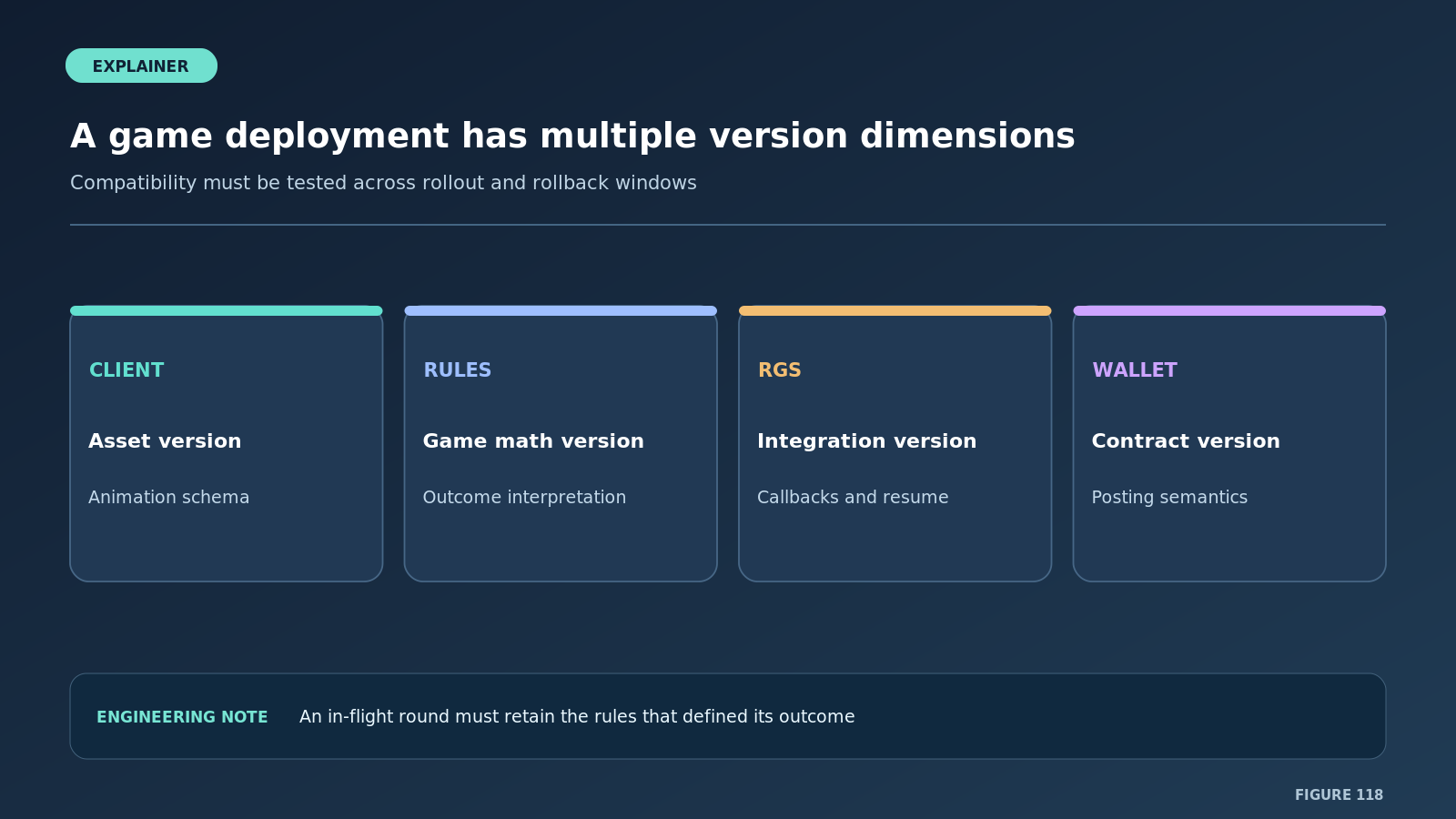
Deploying only a new HTML5 bundle can create incompatibility if it expects a field unavailable from older backend instances. Deploying an RGS adapter can break callback serialization while the game logic remains unchanged. A release plan should spell out which combinations are supported during gradual rollout and rollback. Feature flags and routing rules must not silently change the mathematical configuration for an existing round.
When an in-flight round begins under version v3, there are two common design approaches: keep enough historical executable logic to finish it under v3, or use a version-independent stored outcome and settlement path that remains compatible. Neither technique should be adopted without testing. Even a simple migration can fail if a bonus round spans sessions and includes state unknown to the new version.
Operational monitoring should distinguish game-engine faults, RGS faults, and wallet faults. A static asset CDN outage may prevent rendering while the ledger remains consistent. An RGS timeout may leave a round pending while the game client is healthy. A wallet failure can block authorized money movement even if the game engine calculates outcomes correctly. The incident response and retry policy depend on the boundary.
Responsibility matrix and example request path
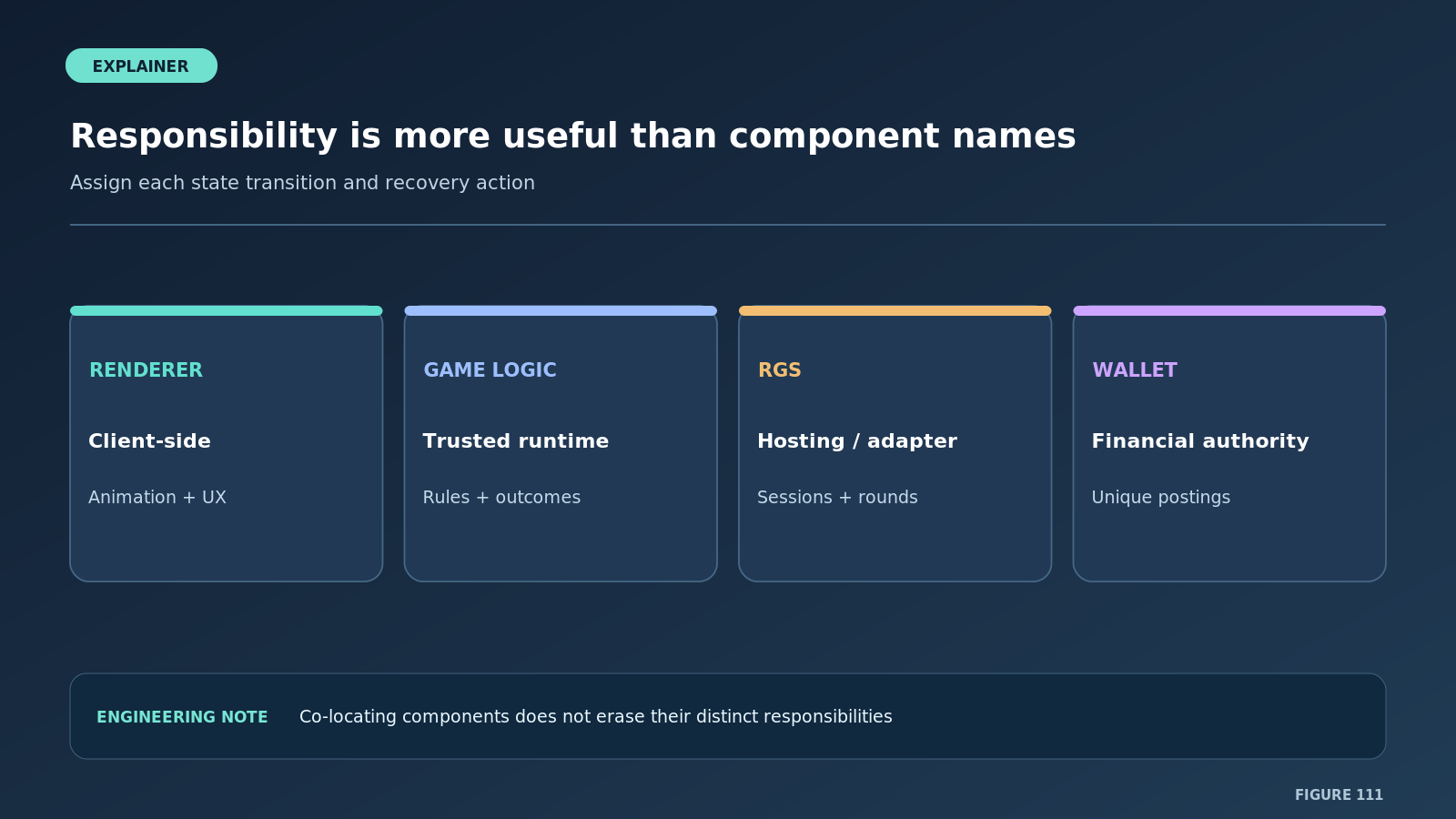
A decision framework for a new casino product should start with evidence rather than technology labels. Who operates the generator and game rules? Who owns round persistence? Who controls session and jurisdiction checks? Who has ledger authority? Who exposes recovery APIs? Which team can deploy a new mathematical configuration? Which environment has the authoritative logs? Which party must provide audit records if a dispute arises?
For example, imagine the client is updated but the RGS remains one version behind. A new animation expects bonusMultiplier and cannot display a previously stored outcome without it. The correct response is not to generate a fresh outcome or credit based on the visual bonus. The compatibility layer should either present a valid older representation or request a supported rendering version, leaving the authoritative result unchanged.
A second example is an RGS callback retry. The operator wallet has successfully posted transaction W-811 but its reply was lost. The RGS must retry or query using W-811, and the wallet should report the original posting. The engine does not need to recalculate the award. Keeping these responsibilities separate makes failures explainable and reduces the risk that animation recovery accidentally becomes financial duplication.
In architectural reviews, it helps to avoid saying “the game engine calculates money” unless the money movement is precisely defined. A game-logic component may calculate an award amount under its paytable, while the wallet controls whether and how that amount is posted. That distinction is the heart of the game engine versus remote game server comparison: functions may coexist in one deployment, but their responsibilities should remain explicit, independently testable and recoverable.
Related reading: OpenTelemetry context propagation for distributed request correlation and UK Gambling Commission remote technical standards for an example of jurisdiction-dependent requirements. Neither source supplies a universal RGS product architecture.