An iGaming platform can place its player account, game-launch orchestration, wallet, provider adapters, back-office workflows, and event publishing in one deployable application—or split selected responsibilities into independently operated services. Neither topology makes a wager safe by itself. The architectural question is which boundaries protect the system’s financial invariants while allowing teams to change, operate, and troubleshoot it reliably.
A monolith is not necessarily a single tangled program. A modular monolith can enforce internal interfaces, separate domain models, and keep transactional guarantees within a single deployment and database. Microservices are not merely smaller codebases: they introduce network contracts, ownership of persistent data, independent release cycles, and distributed failure modes. The cost of those differences is unusually visible in financial workflows where a timeout cannot be treated as proof that no bet was posted.
This guide compares those models for an operator backend rather than prescribing a platform-wide migration. The illustrative service map is not a vendor reference architecture. The right design depends on transaction volume, team structure, integration diversity, availability objectives, and the consequences of inconsistency.
System boundaries in a monolith
A well-designed modular monolith can expose clear application modules for identity and eligibility, game sessions, wallet and ledger, content catalog, payment orchestration, and reporting. Each module owns its rules and publishes a narrow internal interface. The deployment unit happens to be shared; responsibility should not be. Within one database transaction, a wallet module may validate an idempotency key, book balanced journal entries, and record an outbox event atomically. That is an engineering advantage when those operations form one indivisible business action.
The common failure is not monolithic deployment but uncontrolled coupling. If every module writes to the wallet tables, changes in one area can silently violate accounting assumptions. If provider-specific fields leak into core player models, new integrations require edits in unrelated features. If a single global transaction spans slow external calls, lock contention can turn a provider outage into a wallet outage. Modular design means prohibiting these dependencies even when the code runs in the same process.
Think in terms of logical boundaries first, deployment boundaries second. An identity module decides whether a player session is valid. The game integration module validates provider-specific messages and translates them into internal commands. The wallet controls financial mutation. Reconciliation compares external and internal records without directly editing the journal. Reporting may read projections but must not dictate the ledger’s committed state. This distinction remains valid whether those components occupy one executable or many.
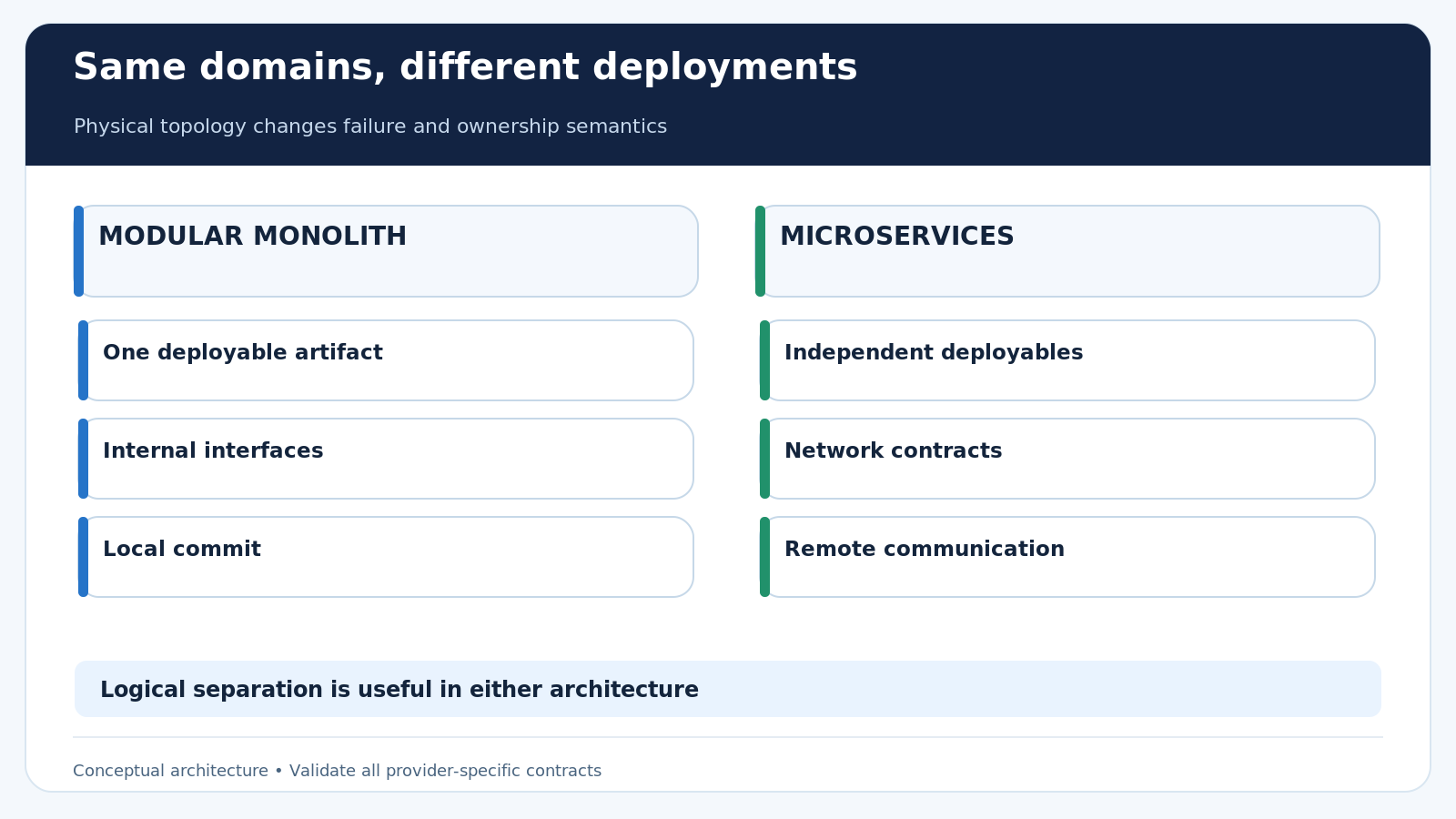
Figure 1. Both models can have the same domain boundaries; microservices add independent deployment and network communication.
A monolith is often effective for a product with a small engineering team, limited providers, and a transactional data model that changes frequently. Testing and debugging can be easier because a request crosses fewer machines and versions. Release coupling, however, means a risky catalog feature and a critical wallet fix may still share a deployment pipeline. A code-level boundary becomes insufficient once different parts of the product require materially different scaling, security, or release controls.
When service separation is justified
Extract a service because you can name the capability, its data owner, its API contract, and the operational benefit—not because the platform has reached an arbitrary number of lines of code. A wallet may justify dedicated release privileges and audit controls. A high-volume provider-adapter fleet may require different scaling and failure isolation from internal back-office APIs. An event-processing pipeline may demand a deployment profile unrelated to synchronous session launch. These are plausible seams, but each must be supported by measurements and ownership.
Look for measurable pressure: one module drives most CPU or queue growth; an external integration frequently exhausts shared request threads; different teams repeatedly block each other’s releases; security reviews require distinct administrative access; or an availability incident shows that a low-criticality component shares a failure domain with transaction posting. Compare those gains against the cost of remote calls, service discovery, network policy, schema versioning, and observability.
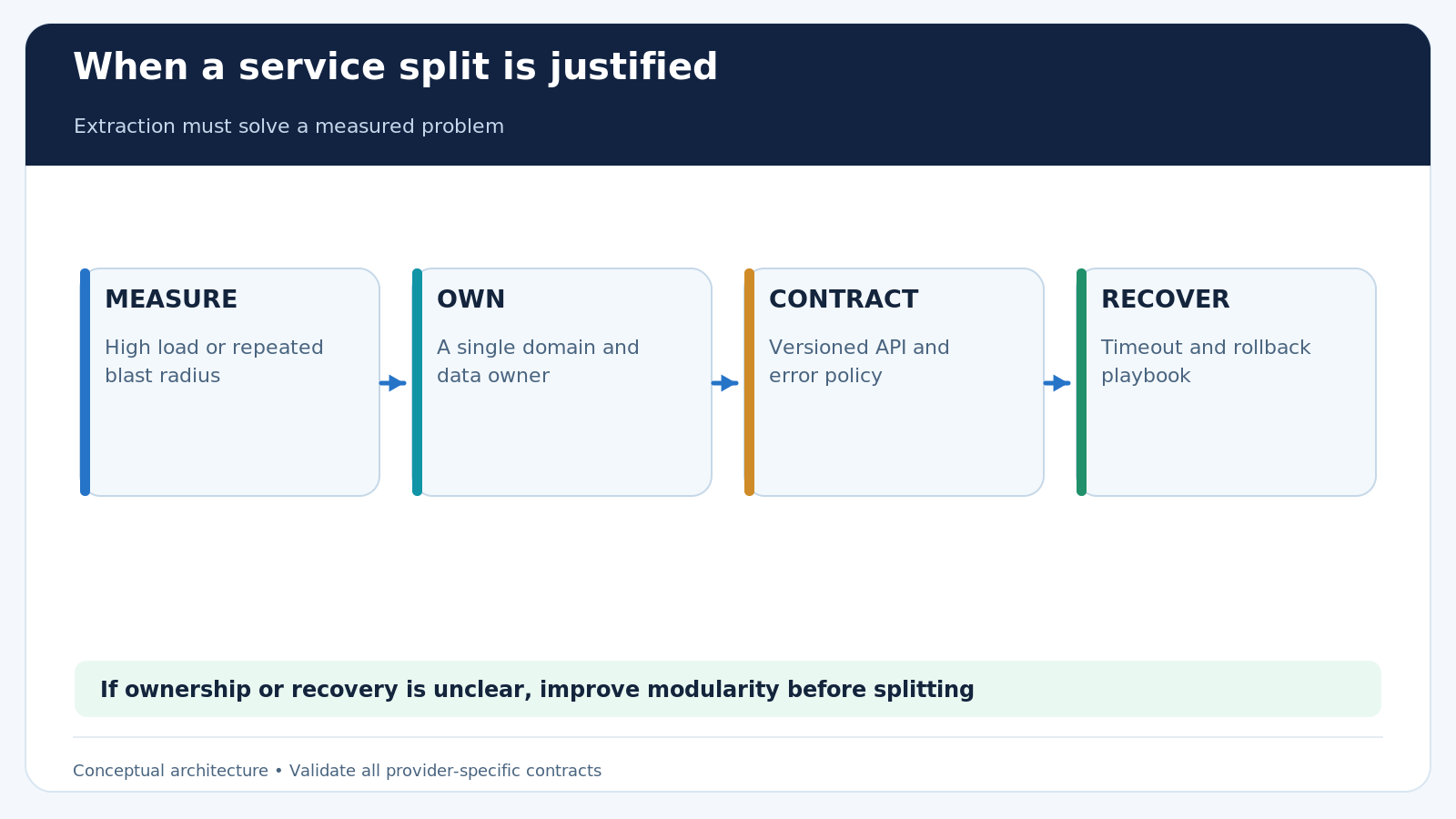
Figure 2. Extraction should satisfy ownership, isolation, and operability checks before implementation.
Avoid using microservices as a substitute for missing modularity. Moving tightly coupled functions into separate containers can preserve the same dependencies while adding latency and partial failure. A “wallet service” whose ledger table is edited by three other services has not achieved data ownership. Similarly, carving one bet workflow into many synchronous hops can turn a simple booking into a chain where each dependency must be available at the same instant.
A useful extraction proposal states its acceptance criteria before code changes: independent deployment must be possible; the old caller must tolerate the new service’s timeout semantics; transaction identities must remain stable during migration; reconciliation must be able to compare old and new paths; and operators must be able to roll traffic back without double-booking money. If the plan cannot explain those points, the boundary is not yet mature enough to split.
Cross-service data consistency and ownership
Financial consistency is the central trade-off. With one database, a local transaction can commit a set of ledger entries and the associated outbox record together. With independent service databases, a transaction in one database cannot automatically commit another service’s database. Teams must decide which operation needs a single authoritative commit, which state may converge later, and how a failed intermediate step is repaired.
Do not distribute ownership of a single balance across session, provider adapter, and wallet services. The wallet should be authoritative for booked money movement. The integration layer can keep request history and provider status; the session layer can keep launch/session state; analytics can keep derived views. They may disagree temporarily because of asynchronous delivery, but the mismatch must not permit a second financial mutation. A provider callback identifies a business operation; it does not become a unique bet merely because it arrived at a new service instance.
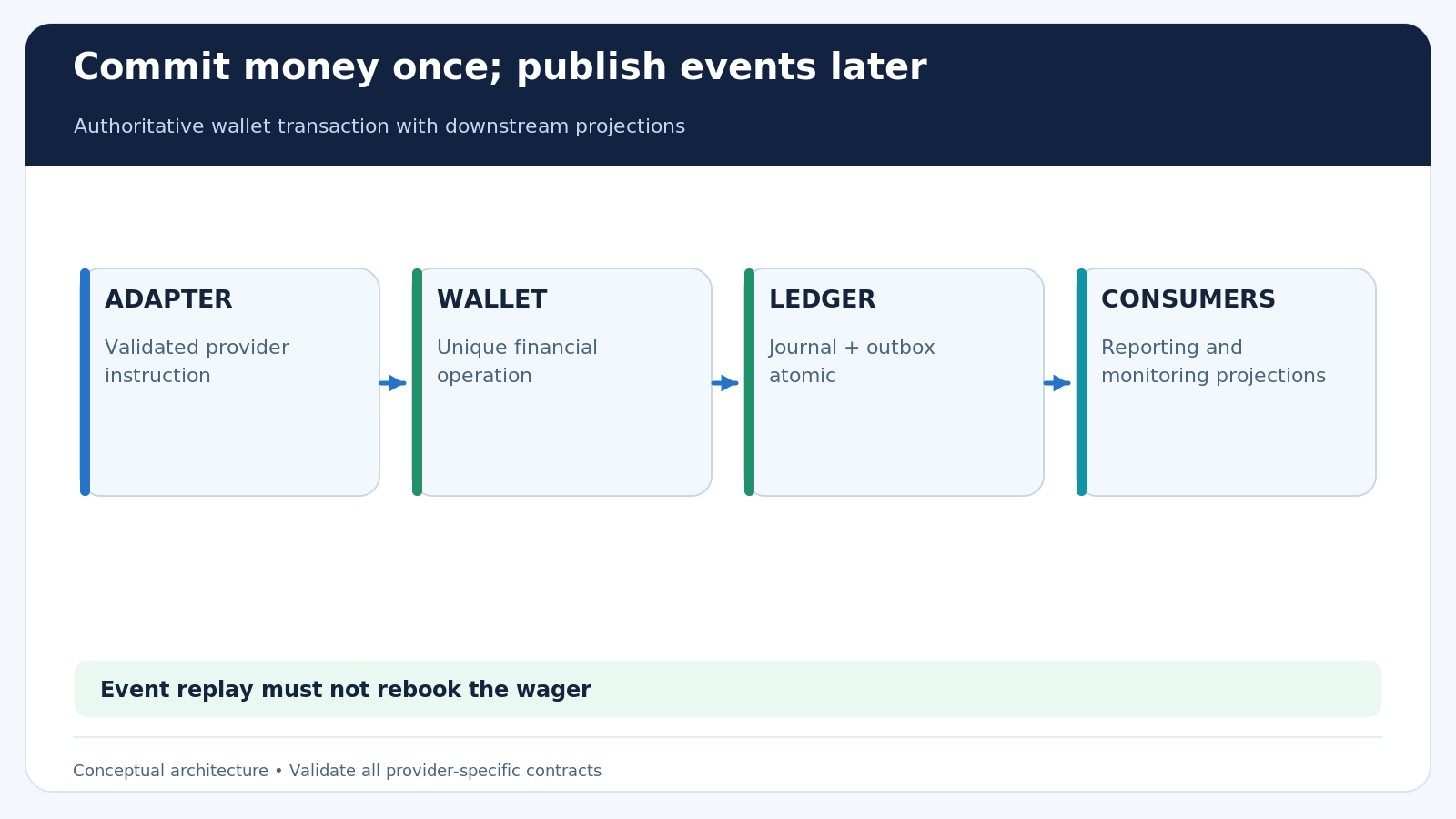
Figure 3. One authority commits the monetary effect; consumers build eventually consistent views from committed facts.
For cross-service workflows, use an explicit state machine. A saga or process manager can coordinate a sequence of local commits and compensating actions where the business model permits them. But compensation is not erasure: if a wager was booked and then reversed, the ledger normally needs a linked reversal rather than deletion of the original posting. A completed payment-like effect should not be described as rolled back merely because another service timed out. Define irreversible transitions, allowable corrections, and the state visible to support agents.
Practical contracts should distinguish transport retry from business re-execution. Use a stable transaction identity scoped to provider and operator, reject conflicting payloads under the same key, and return an existing result when a committed operation is repeated. If the request’s outcome is unknown to the caller, offer a transaction-status query or reconciliation path. Store a durable association between external references and internal journal IDs. An event bus does not, by itself, provide exactly-once financial effects.
For architecture review, document the consistency class of each relationship. Wallet-to-ledger booking may require atomic local consistency. Wallet-to-reporting may tolerate seconds of lag. Game-catalog publication may tolerate minutes. Entitlement or eligibility decisions may need fresh data at the start of a regulated session, depending on the product and jurisdiction. Avoid calling all of these merely “eventually consistent” without defining what inconsistency is allowed and for how long.
Deployment, observability and team overhead
A monolith usually offers one main deployable artifact and fewer network edges. That simplifies local execution and trace interpretation, but a faulty release or memory leak can affect every module in the process. Microservices allow targeted scaling and rollout, but each service requires versioned configuration, secrets, health signals, rollback procedures, and an on-call owner. The infrastructure budget is only part of the cost; diagnosing a multi-hop incident is an ongoing human expense.
Separate the control plane for releases from the data plane for game transactions. Deployments should not change wager handling mid-operation without compatible state transitions. Use expand-and-contract schema migrations when old and new application versions coexist. Apply feature flags at well-defined decision boundaries, record which configuration version was used for an operation, and verify that rollback is safe with already-committed data.
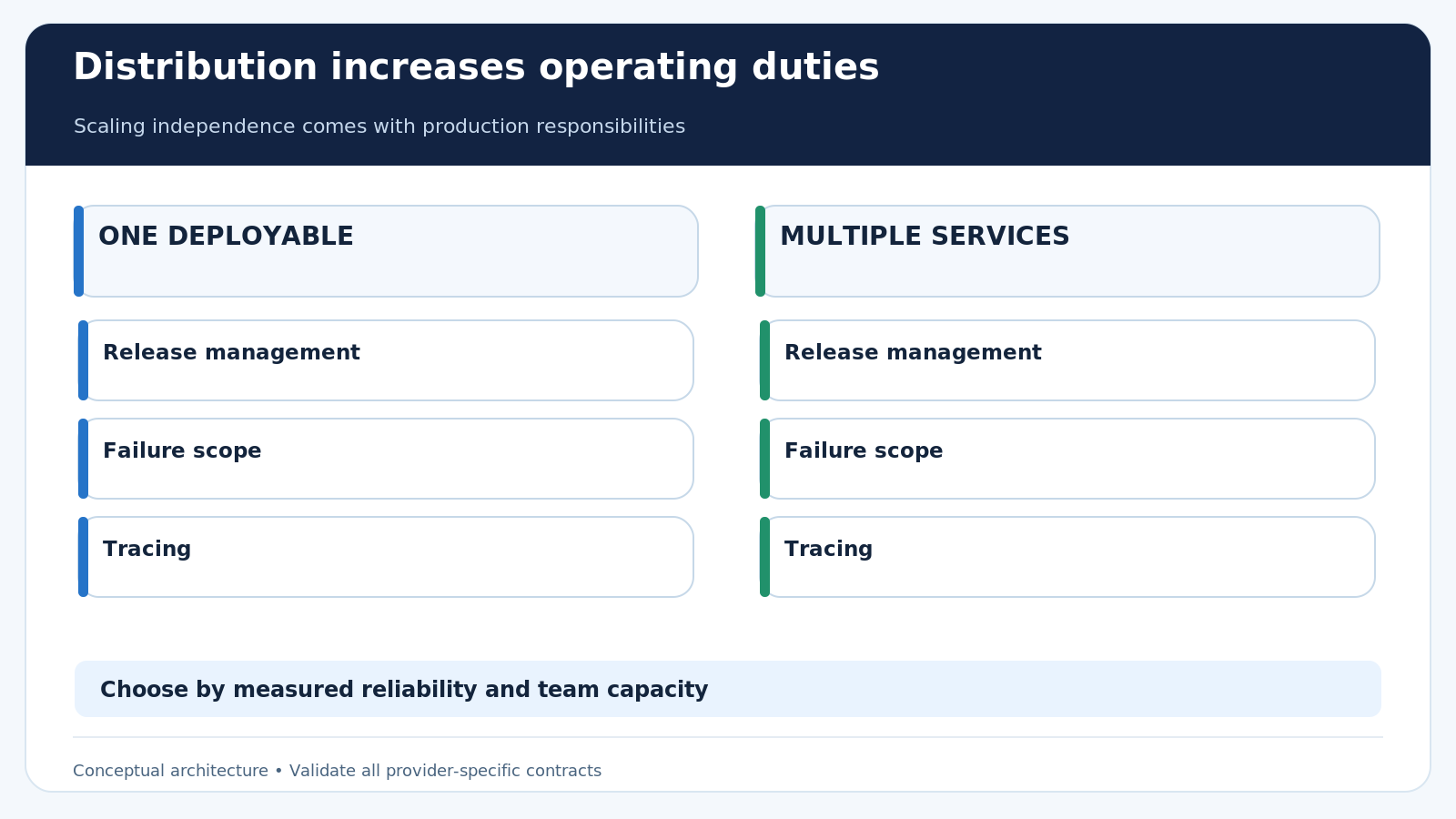
Figure 4. Independence creates additional deployment, telemetry, and incident-response obligations.
Observability should follow the business operation across boundaries. Propagate a trace identifier through the platform, and connect it with a separate stable round or transaction reference in privacy-safe logs. Monitor provider latency, wallet posting results, duplicate requests, queue age, reconciliation gaps, and rejected callbacks. Traces explain timing; ledger IDs explain financial state. Neither alone answers every incident question.
Operational maturity matters more than service-count ambitions. Before extraction, require contract tests, representative failure injection, meaningful service-level objectives, and incident runbooks. A small team unable to provide independent on-call ownership may gain more reliability from a modular monolith with strict code boundaries than from a distributed fleet. Conversely, a mature organization with incompatible release cadences may accept distribution costs to obtain safer isolation.
Migration patterns and anti-patterns
The least risky migration usually begins by making boundaries explicit inside the existing application. Introduce interfaces for the capability to be extracted, stop unauthorized table access, centralize business keys, and add tests for lost responses and concurrent duplicate calls. Then route a narrow, low-risk traffic slice through the new endpoint. A facade or strangler layer can keep calling code stable while the implementation changes behind it.
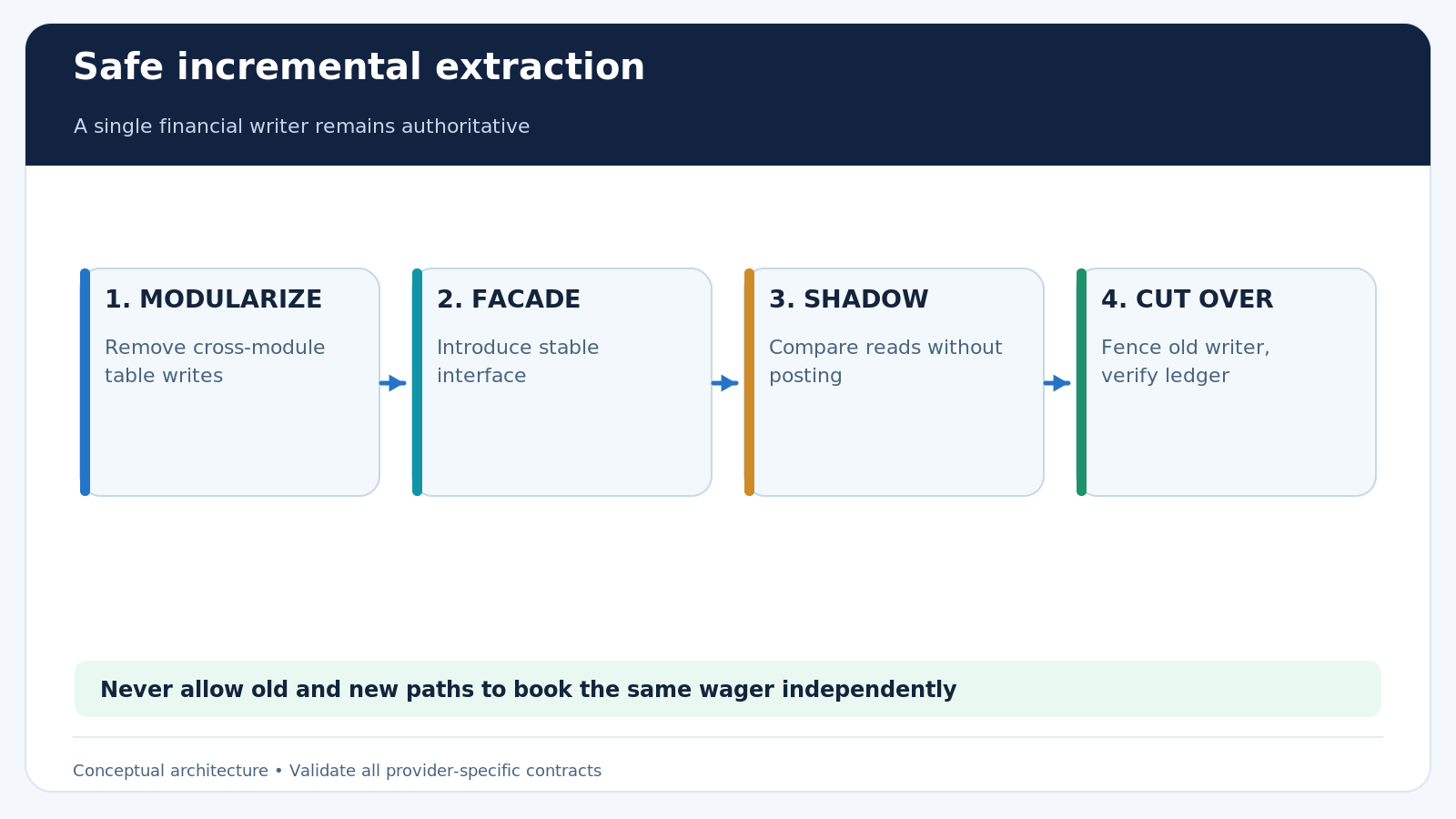
Figure 5. The new component takes ownership gradually; the old and new paths must not both post the same financial transaction.
Data migration is the dangerous step. For reference data such as game catalogs, a period of dual reads and reconciled projections may be manageable. For wallet writes, “dual-write to both ledgers and compare later” can produce irreversible divergence. Prefer one authoritative writer at a time, with controlled cutover, clear fencing, replayable events, and transaction-by-transaction audit mapping. Shadow traffic must be read-only or otherwise prevented from creating economic effects.
Run a cutover rehearsal against realistic in-flight sessions: callbacks that began on the old route may complete after the new route takes over. Both must resolve to the same transaction identity and authoritative state. Record mapping versions and provider configuration. Reconcile before increasing the traffic share, then retain a rollback plan that accounts for ledger entries created after the switch. A rollback of application binaries does not reverse financial history.
Common anti-patterns include a distributed monolith with cyclic synchronous calls; separate wallet microservices sharing one mutable balance table; a central event bus treated as a transactional database; too-granular services with no owning teams; and silent fallback from a failed wallet call to a local balance guess. Another is moving a function because it is “hot” without proving that targeted optimization or asynchronous buffering would not solve the issue more simply.
Architecture decision matrix
Use a decision record that weighs system characteristics rather than declaring a universal winner. Scores below are directional; test them with your own load profiles, change history, and operational capabilities.
| Dimension | Modular monolith tends to fit | Microservices tend to fit | Evidence to collect |
|---|---|---|---|
| Team and release structure | One or two closely coordinated teams | Teams own independently changing domains | Deployment conflicts and ownership map |
| Financial transaction boundary | Strong local transactional grouping | One bounded wallet authority with remote consumers | Ledger invariants and timeout tests |
| Scaling | Similar resource profile across modules | Distinct workloads with material scaling differences | CPU, memory, queue and traffic profiles |
| Provider adapter isolation | Few stable integrations | Many adapters with independent fault patterns | Provider-specific incident frequency |
| Operational readiness | Limited platform/on-call capacity | Mature automation, tracing and incident response | SLO achievement, runbook results |
| Change risk | Shared release cadence acceptable | Separate rollout and access controls required | Audit and change-control requirements |
An architecture decision record should state the proposed boundaries, rejected alternatives, failure assumptions, consistency model, migration path, responsible teams, and measurable success criteria. For example: “Extract provider callbacks because retries saturate shared web workers; wallet ledger remains the sole financial writer; success means lower callback-tail latency without increased reconciliation differences.” That is a falsifiable decision. “Adopt microservices for scale” is not.
The most durable approach is often hybrid. Keep an authoritative wallet and ledger in one tightly controlled transactional boundary. Split catalog ingestion, reporting, and selected adapters where asynchronous communication is natural. Preserve the option to refactor again as the organization learns. Architecture is successful when the platform can explain a disputed bet and recover from partial failure, not when it has the most service names on a diagram.
Further reading
- Microsoft Azure Architecture Center, Saga design pattern and microservices data considerations.
- OpenTelemetry, Context propagation.
Editorial note: These references support general distributed-systems patterns. The iGaming boundaries and examples above are conceptual design recommendations, not claims about a specific provider contract.