Casino API contract testing protects a narrow but costly boundary: the shared assumptions between a platform that owns player balances and the game provider or aggregator that requests financial effects. The most dangerous incompatible changes are not necessarily obvious HTTP failures. A provider may start sending an amount as a decimal string instead of an integer in minor units, introduce a new settlement status, change which identifier survives a retry, or reinterpret the absence of a field. Every message can still arrive successfully while the operator makes the wrong accounting decision.
The purpose of a contract suite is to expose those differences before release. It must test more than whether JSON parses. It should document exactly which client and provider versions agree on the structure, meaning and error behavior of bet, win, refund, cancellation, balance and launch-session interactions. Tests are illustrative here: use the authenticated specifications and staging rules of the actual provider before encoding them into executable checks.

What a provider contract guarantees
A contract defines promises at an integration point. A request contract may specify the HTTP method, endpoint, authentication headers, canonical signing input, request body, required identifiers and permissible amount representation. A response contract may specify status codes, result fields, what counts as a final financial decision and how the result can be retrieved after a connection drop. An event contract may additionally define ordering expectations, deduplication keys and how redelivery is acknowledged.
For a casino platform, describe both directions separately. When the provider calls an operator wallet API, the provider is the HTTP consumer and the operator is the API provider. When the operator requests a game launch from the provider, their roles are reversed. The word “provider” in game distribution is not synonymous with the provider role in consumer-driven testing; otherwise ownership confusion leads to missing tests.
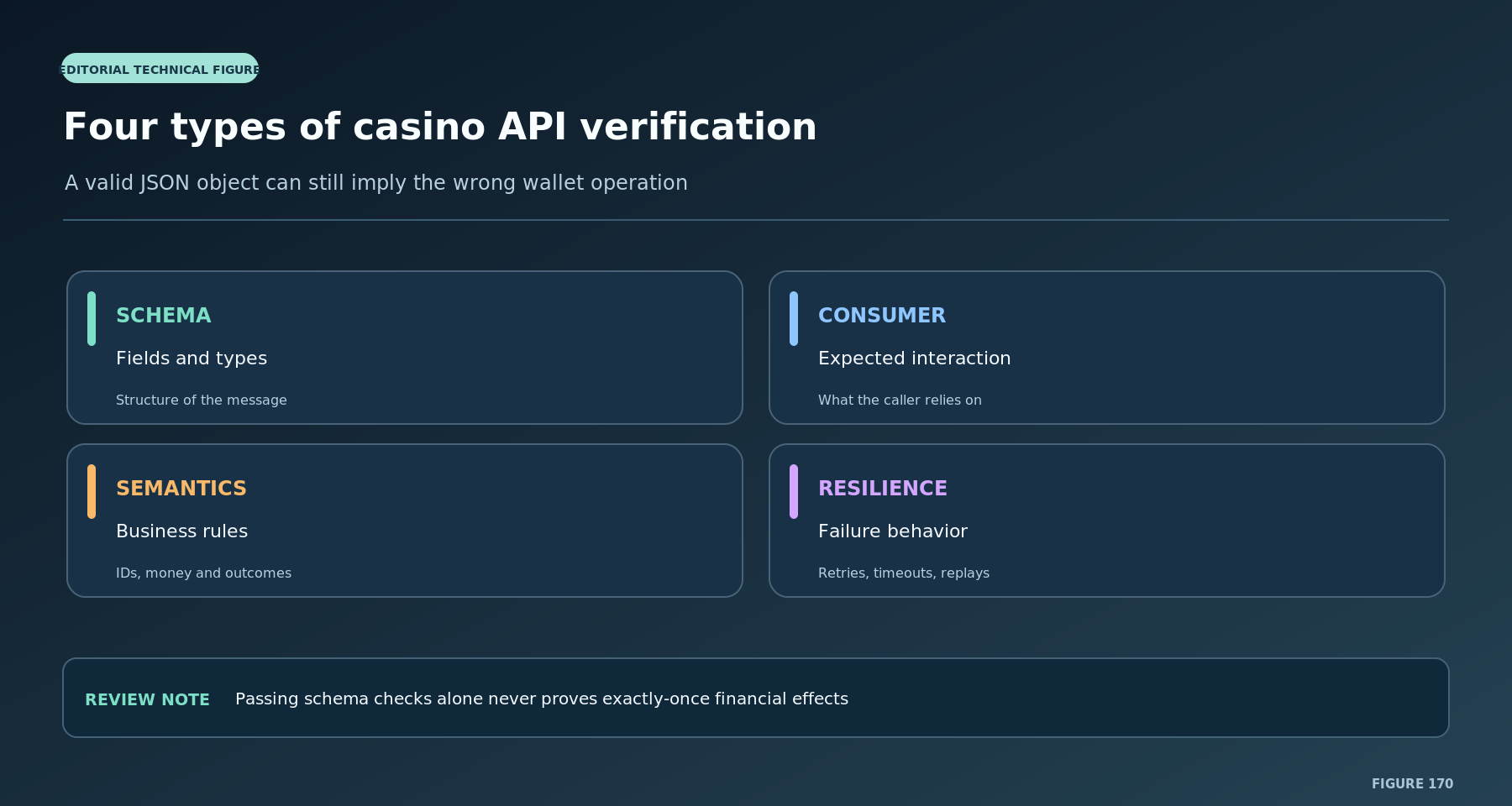
A passing schema contract says that particular examples conform to a declared interface. It does not prove that a ledger write is atomic, that a refund is authorized or that a downstream event was processed once. Those are semantic and system properties needing additional tests. A useful release gate therefore combines structural contract checks, consumer behavior verification, financial invariants and a smaller set of fault-injection tests.
Schema and semantic compatibility rules
First pin canonical representations. For money, choose a documented unit, currency and precision. An integer amount_minor: 125 and a decimal amount: "1.25" are not interchangeable without a shared conversion rule. For identifiers, distinguish immutable business IDs (transaction_id, round_id) from transport IDs (request_id) and retry attempt IDs. A field called transactionId may have an entirely different uniqueness scope in two systems.
Second decide how clients handle extra fields, missing optional fields, null, empty strings and unknown enum values. Rejecting unknown properties can prevent accidental misuse, but can also turn harmless additive updates into outages. Silently discarding unknown financial statuses can be worse: a new PENDING_REVIEW value should not be interpreted as APPROVED. Define extensibility on a per-field basis and make unknown-value handling explicit.
Third verify semantic constraints absent from most machine-readable schemas: an amount cannot be negative unless a documented transaction type permits it; the callback currency must match the session’s wallet currency; the idempotency key must identify one immutable business operation; a successful response should refer to the same operation; the same transaction ID with different financial content is a conflict, not a second valid transaction.
A conceptual callback fixture might be:
{
  "transaction_id": "tx-test-0042",
  "round_id": "round-test-17",
  "operation": "BET",
  "amount_minor": 125,
  "currency": "EUR",
  "session_id": "session-test-9"
}
This is a non-vendor example, not a recommended universal schema. Its purpose is to show distinct business identities and unit choices. A separate contract artifact should define allowed operation values, reconciliation fields, signing rules, amount limits and every error outcome. Do not put live player identifiers or credentials in fixtures.
Versioning and breaking-change scenarios
A breaking change is measured against real consumers, not just a schema diff. Deleting a required field is usually breaking. Changing a response from 200 to 202 may be breaking when callers post to the ledger on receipt of a final success; it may be appropriate only with a migration plan to handle pending states. Adding an optional metadata field is often backward-compatible, but only if consumer deserializers and signature canonicalization tolerate it. Even renaming a JSON property while keeping its value “the same” can break the integration immediately.
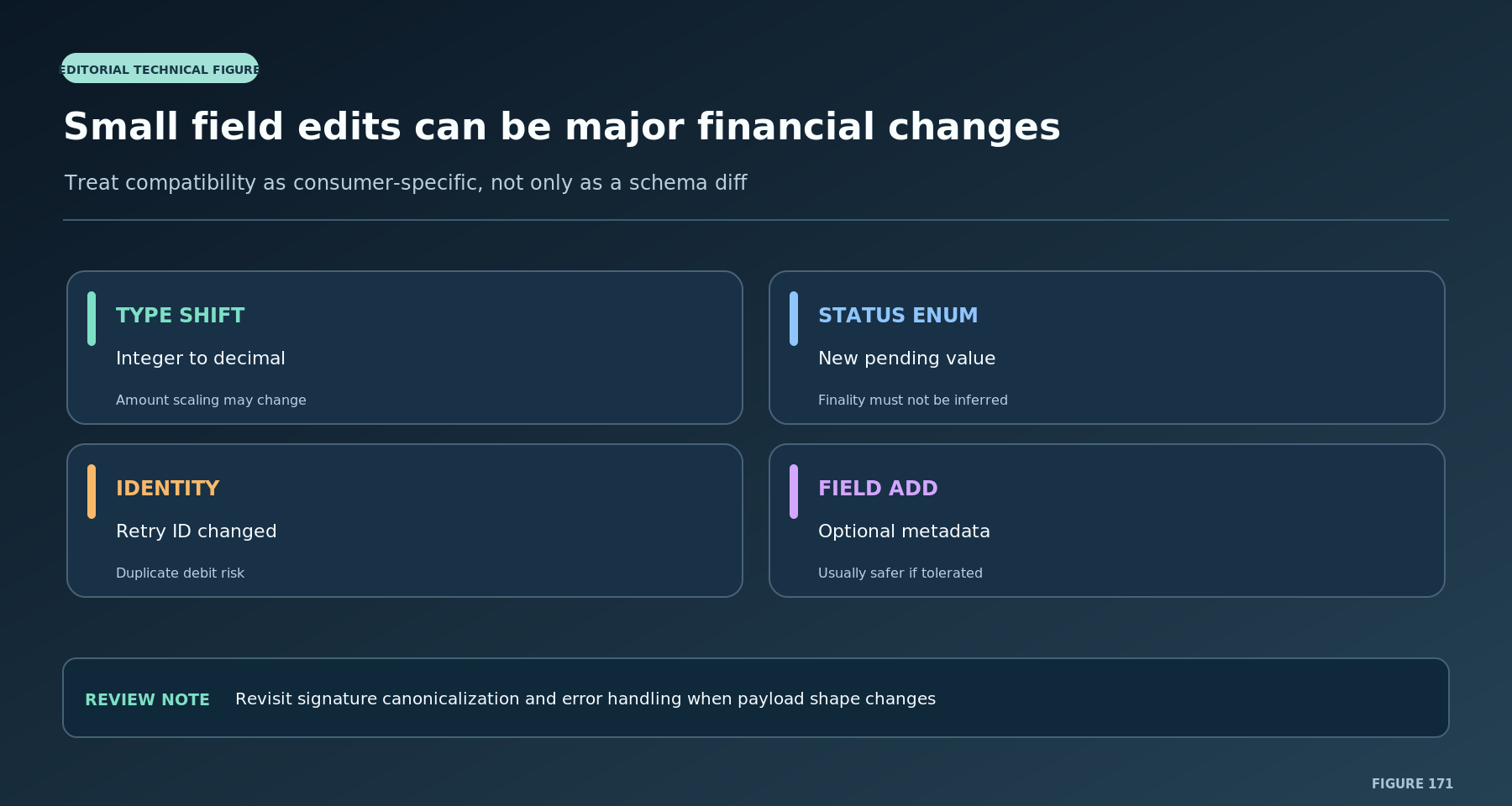
Maintain a contract-change log with proposed version, affected operation, old and new examples, consumer inventory, compatibility decision, rollout sequence and rollback plan. For simultaneous support, allow old and new formats only where message identity remains unambiguous. A compatibility adapter can bridge versions, but it must not infer a missing currency, silently rescale money or map a new financial outcome to an existing one for convenience.
Version negotiation may use endpoint paths, headers or documented capabilities; there is no one rule for all vendors. If multiple providers share an aggregator facade, the aggregator’s stable outward contract can conceal individual provider drift. Test the facade and each provider adapter separately. Include the provider’s change notice, contract snapshot and deployment date in the evidence record.
Consumer- and provider-driven tests
A specification-first approach starts from an OpenAPI description or equivalent approved interface document, then validates request and response shapes using a schema validator. A consumer-driven approach records which interactions a consumer actually needs and verifies them against a provider implementation. The Pact documentation distinguishes these approaches: an OpenAPI description can represent a broad set of possible interactions, while executable consumer contracts express concrete expectations.
For a wallet callback consumer, test the exact result and error handling the client depends on. For provider verification, run these interactions against a controlled provider state so they are deterministic. Avoid asserting arbitrary response fields that the consumer does not care about; that creates brittle tests. Conversely, explicitly assert the fields that determine ledger behavior. accepted, rejected, already_processed and pending must not collapse into a single “HTTP 200” expectation.
Consumer/provider verification is strongest when both teams publish the outcome against immutable release identifiers. If the provider changes without warning, a scheduled contract run can detect drift, but a sandbox pass does not guarantee production uses the same version. Periodically compare the production-visible capability version or response metadata with the approved build record when the provider offers such evidence.
CI integration and failure reporting
Run fast schema validation and recorded interaction tests on every affected pull request. Verify released consumer contracts against provider candidates before a provider rollout; then run a smaller set of authenticated staging checks and safety-specific fault cases. A CI pipeline should fail closed for breaking financial incompatibilities, while allowing narrowly reviewed exceptions for harmless additions. Avoid bypasses justified only by the fact that the response is valid JSON.
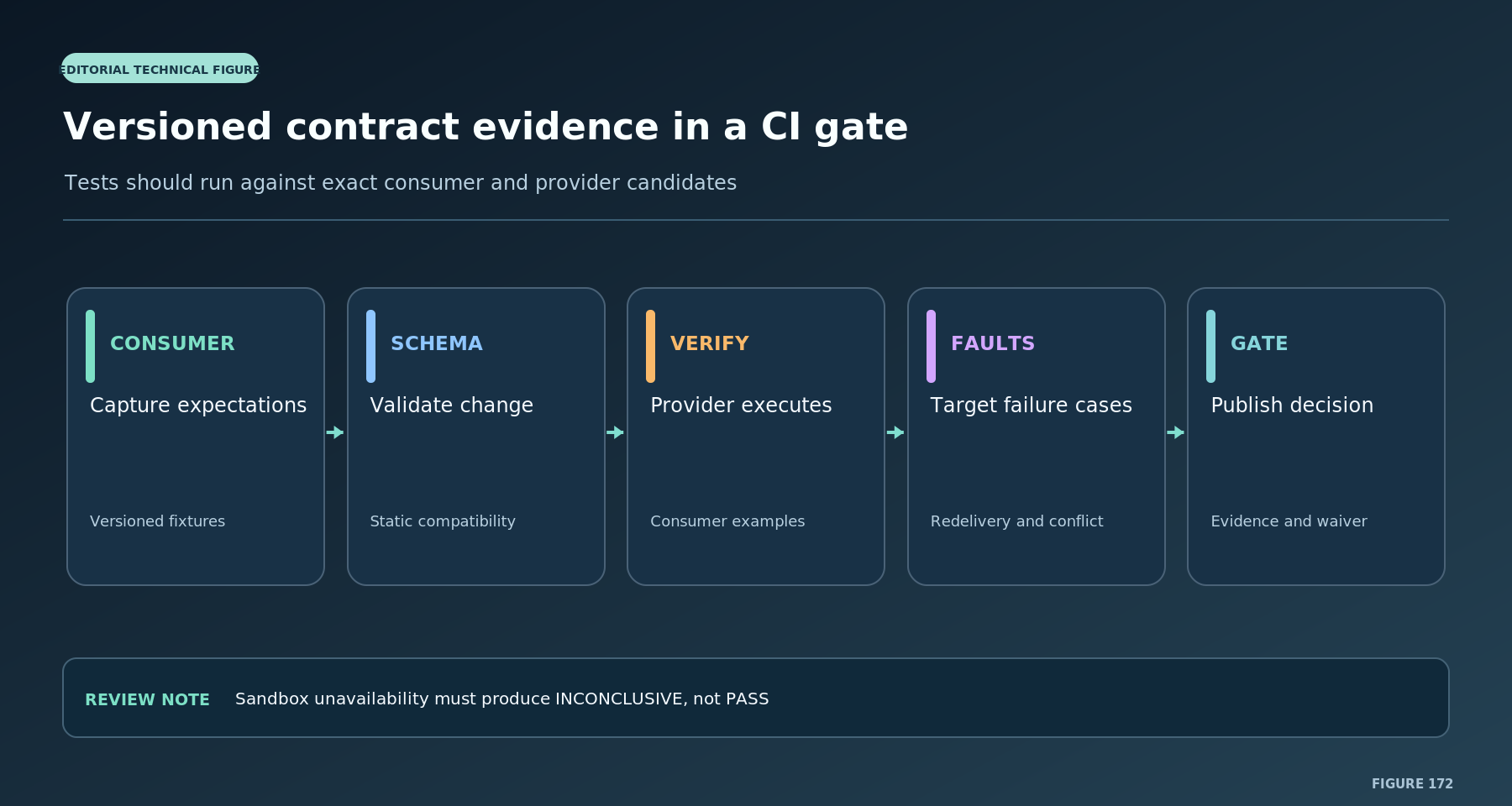
A useful failure report includes: contract version, test name, request fixture hash, provider build, expected and actual redacted output, nature of mismatch, severity, owner, retry procedure and reference to the issue or waiver. Keep secrets, tokens, account numbers and personal data out of reports. If the provider sandbox is temporarily unavailable, distinguish test could not run from test passed; do not paint an unavailable dependency green.
Not all failures block a full deployment equally. A missing optional display label can receive a limited exception if its impact is understood. A new currency default, a changed idempotency identity or an unrecognized financial status should generally stop financial-path deployment until investigated. Capture the decision and approval so future incident reviews can reconstruct the rationale.
Representative contract test cases
Use a suite that makes compatibility observable at the boundaries most likely to change:
| Interaction | Positive expectation | Negative or changed-contract expectation |
|---|---|---|
| Bet debit | Stable transaction identity and amount unit | Reject same ID with changed amount |
| Win credit | Correct round linkage and legal payout representation | Unknown currency does not default silently |
| Retry of prior bet | Same business result, no new operation | New transport ID does not create another debit |
| Refund or cancel | References an eligible original transaction | Missing original ID is not guessed from time |
| Game launch | Signed scope includes intended player and game | Stale or invalid signature fails without session creation |
| Provider upgrade | Supported existing fields and enums remain valid | Unexpected new financial status is surfaced explicitly |
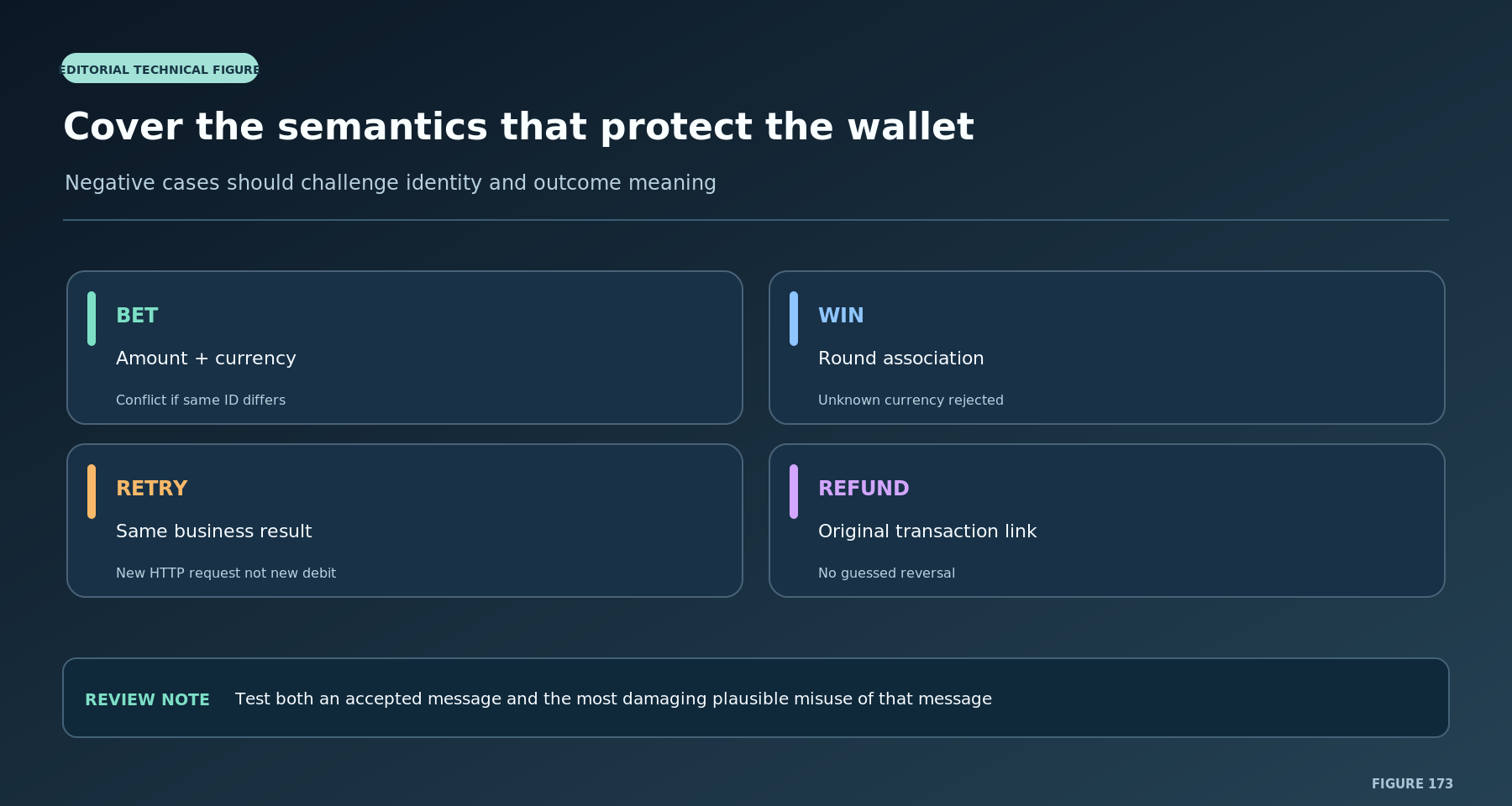
For every test, store a reproducible fixture and the expected accounting consequence, not only the raw HTTP response. Add concurrency testing at the service layer: two callbacks with the same transaction ID, out-of-order win and refund, duplicate finalization and a timeout after a committed ledger transaction. These cases often exceed the scope of an isolated contract tool but are essential to meaningful integration confidence.
The final release question is not “Did all contract tests pass?” It is “Did we verify the actual interactions, semantic constraints and failure behavior used by this consumer against the provider build we intend to deploy?” That is the right unit of evidence for a casino API upgrade. Contract testing should reduce ambiguity; it should never encourage false certainty about financial correctness merely because a mocked response matched a schema.