iGaming ML model monitoring is a production reliability discipline, not a one-off accuracy chart. A transaction-anomaly detector, API-abuse classifier or AI-assisted triage service may continue responding successfully after its inputs, users or threat patterns have changed enough to make predictions unhelpful. Monitoring must therefore cover data provenance, input health, output behavior, decision quality, latency, human review costs and the ability to fall back safely.
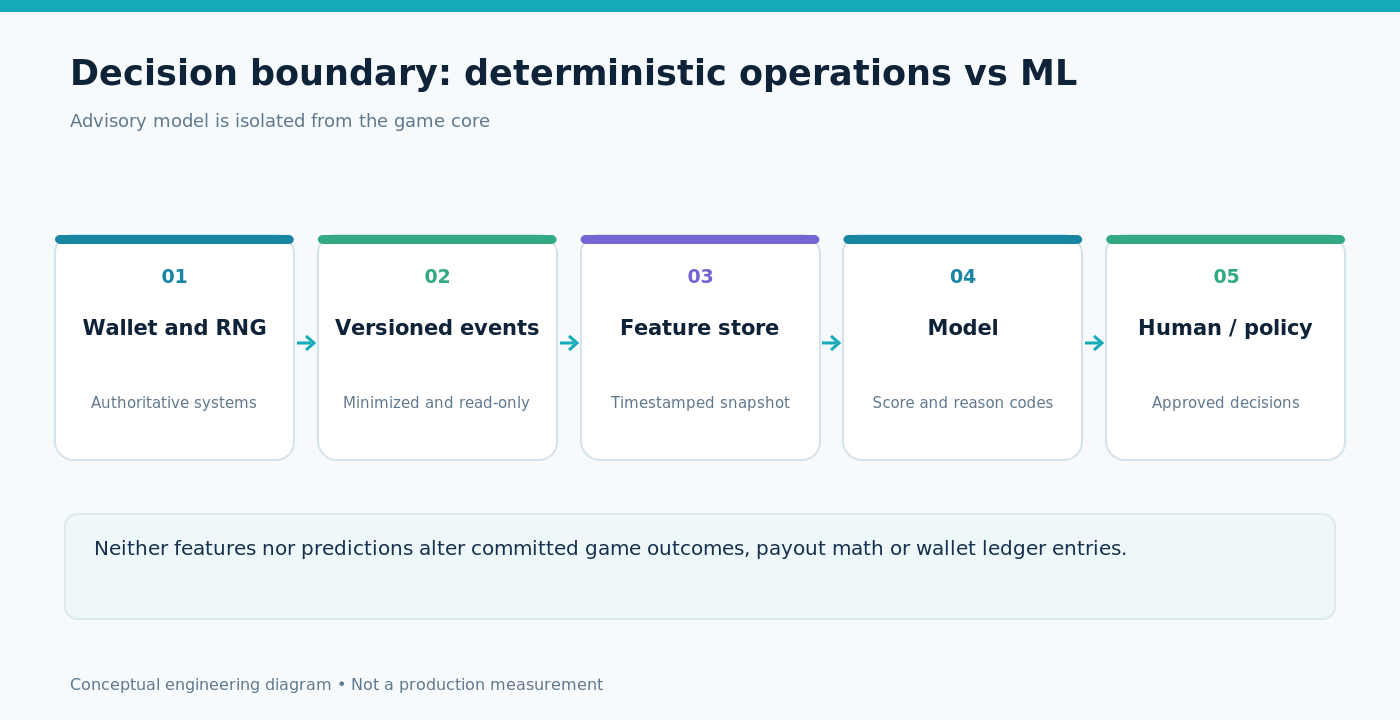
This guide concerns post-deployment monitoring. It assumes a model has already been trained, approved for a narrow use and released behind a versioned inference interface. It does not prescribe an algorithm or claim that ML is necessary for every gaming control. Critical accounting rules, authorization and game-outcome determination stay deterministic. Figures are illustrative, and no synthetic dashboard is evidence of real-world model effectiveness.

Monitoring goals and failure modes
Define the model’s decision contract: the population it scores, the action permitted, upstream dependencies, expected latency, fallback path, accountable owner and objective measures of utility. For a suspicious-transaction ranker, success may mean more verified accounting defects found at a fixed analyst workload. For API-abuse scoring, it may mean earlier detection without blocking legitimate provider callbacks. A model can have a healthy response-time SLO yet fail its business objective if its alerts become noisy.
Distinguish at least five failure classes. Serving failure covers timeouts, missing versions and malformed scores. Data failure covers missing features, incorrect currency parsing, schema changes, stale windows and wrong time zones. Behavioral drift covers changing inputs or score distributions. Decision failure covers deteriorating precision, recall or calibration when labels are available. Governance failure covers absent review ownership, privacy overcollection or an inability to explain or revert a decision.
A useful monitoring contract links every inference record to a model artifact hash, feature schema, preprocessing version, threshold policy, scoring timestamp, tenant or provider cohort, trace ID and permitted action. Raw customer identifiers need not be widely exposed: pseudonymized references are generally sufficient for performance monitoring, with controlled access when an actual case is investigated. Record both inference throughput and the share of events never scored because the upstream feature pipeline was late or unavailable.
Set risk tiers by impact, not only by model complexity. An internal incident-triage suggestion has a different consequence from a model that can require additional authentication or delay a payout review. The higher the potential customer impact, the stronger the evidence and human-review requirements should be. Never assume that a model score is a probability unless it has been calibrated and validated for that population.
Data and concept drift signals
Data drift means the distribution of input features changes over time, while concept drift means the relationship between inputs and the target outcome changes. These can occur independently. A new game provider might change the distribution of callback intervals without creating more accounting defects. Conversely, an attacker may change tactics while high-level request-rate distributions remain similar. A model monitoring pipeline needs both data signals and downstream quality feedback.
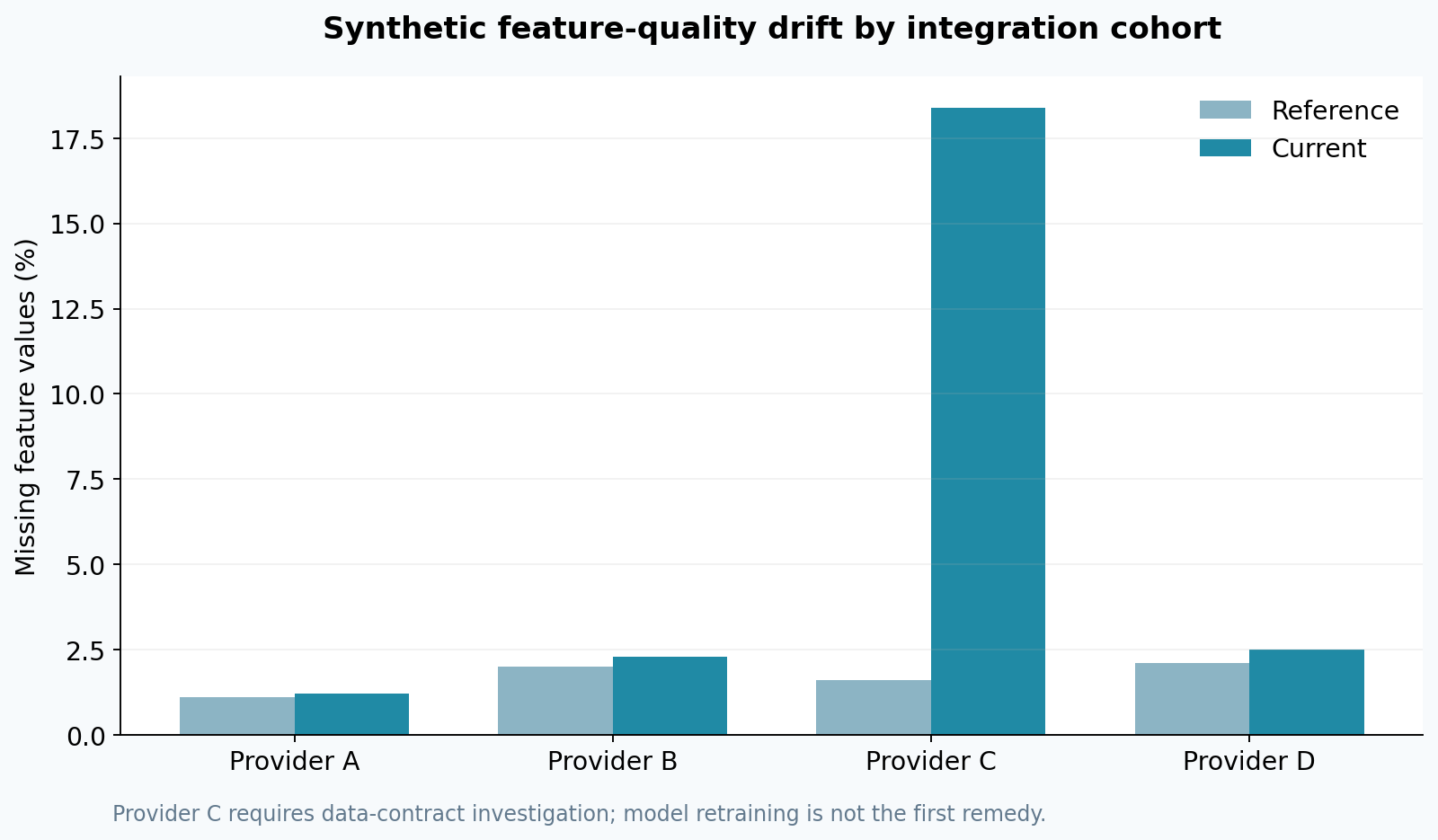
Use interpretable measures by feature type. Numeric features can be tracked through quantiles, missingness, out-of-range rates, PSI-like summaries or two-sample comparisons; categorical features through cardinality, unseen values and frequency shifts; sequences through lengths, gaps and unexpected transitions. Sample-size and seasonality controls matter. A tiny cohort can appear unstable because of noise, while a very large cohort can produce a statistically significant but operationally trivial difference.
Always segment drift reports by provider, API version, game family, traffic source, region and authorized client class where relevant. Global aggregates can hide serious local failures: one new provider might have 40% missing settlement-lag features while the overall population still looks normal. Establish a reference population with a time window, known release version and measurement contract. If the system changes the event schema, treat it first as a data compatibility incident, not merely a model drift observation.
Monitor feature freshness separately from value distribution. A perfect-looking score produced from transactions that are two hours behind is not a successful real-time detector. The Google Cloud model-monitoring documentation discusses feature and attribution drift concepts; it is a tooling reference rather than a regulatory requirement or recommendation to adopt that vendor.
Precision, alert fatigue and human feedback
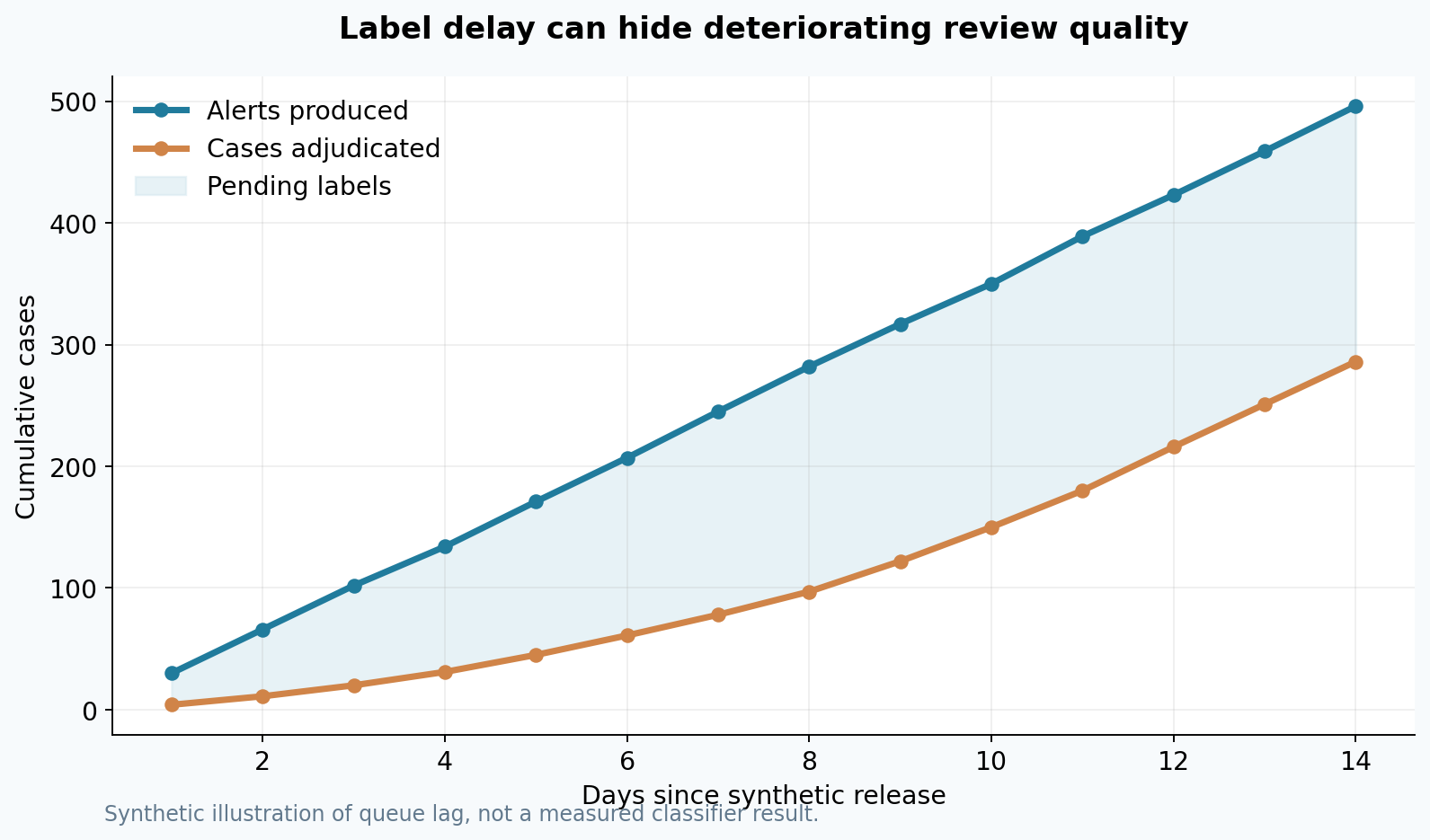
A model that flags more cases may appear to improve recall while overwhelming reviewers and increasing customer friction. Track alerts per day, unique cases, analyst time per case, repeat-alert rate, precision among adjudicated cases, severity-weighted misses, escalation time, override frequency and queue aging. For rare-event classifiers, precision–recall curves usually communicate the operational trade-off more clearly than a headline accuracy number. However, confirmed labels often arrive days or weeks late, so instantaneous quality estimates may be biased.
Keep three denominators visible: events scored, alerts raised and alerts independently reviewed. If only high-scoring alerts are ever labeled, calculating precision on reviewed cases may still be useful for queue management, but it does not estimate recall over the full population. Add an ethically and operationally appropriate sampling plan for lower scores when measuring missed incidents. Record cases that are pending or unverifiable, rather than automatically treating them as clean negatives.
Feedback should distinguish reasons for false positives. A new bonus campaign, a provider retry storm, an incorrect data join and a genuinely unusual but authorized settlement are different problems. Some can be fixed by adjusting upstream normalization or adding a deterministic exception, avoiding retraining altogether. Feedback labels need reviewer identity or role, timestamp, evidence references and appeal outcomes. A decision should be reproducible from the relevant model and feature snapshot.
A practical quality dashboard separates leading indicators (data freshness, missing values, score distribution, serving latency) from lagging indicators (confirmed precision, misses, complaint outcomes). The leading indicators support rapid incident response; the lagging ones tell the team whether the model is actually useful. Neither view should be hidden under a single health score.
Thresholds, retraining triggers and rollbacks
Define threshold policies in terms of customer harm and team capacity. Example: raise an engineering investigation when feature missingness for a critical provider rises past a documented limit for a sustained window; downgrade a model to advisory-only if false-positive review burden exceeds the agreed budget; or disable automated challenges when a new version causes a material spike in legitimate user friction. Those are examples of decision logic, not universal numeric standards.
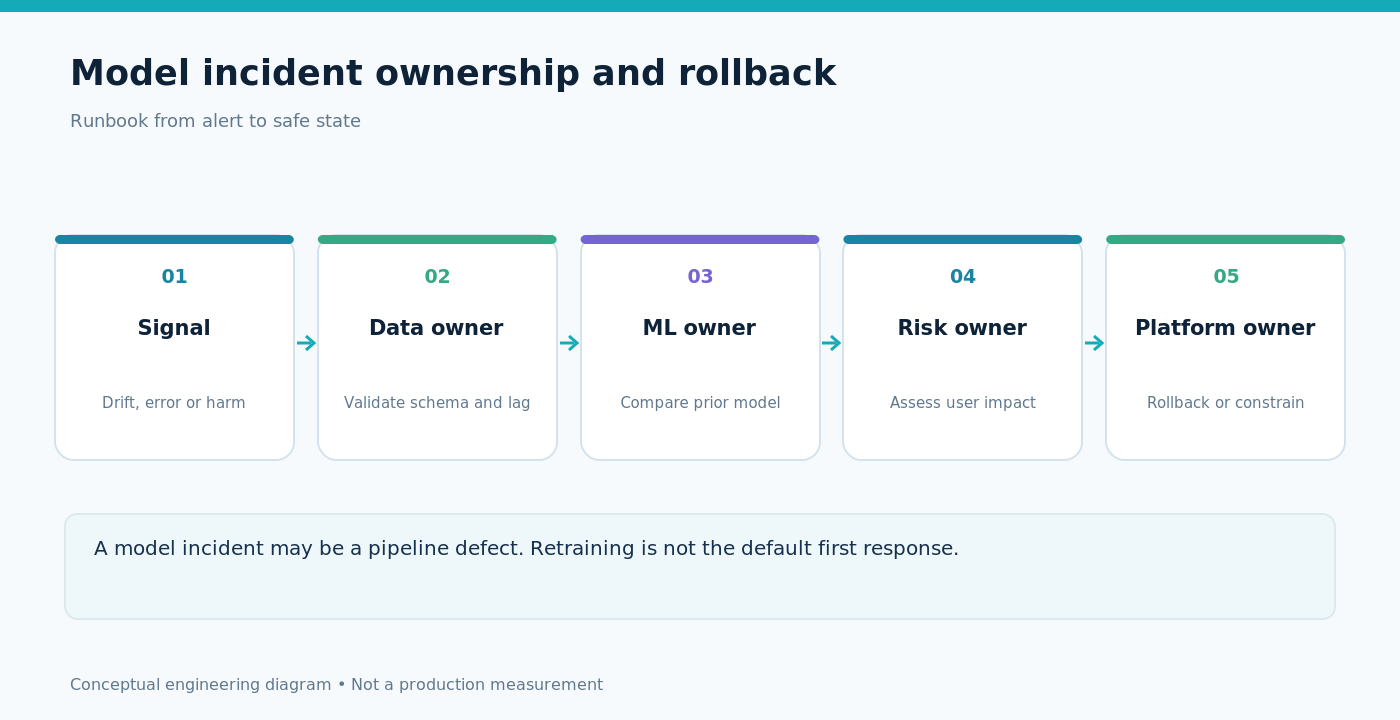
Drift alone should not automatically retrain a model. It may indicate a data-pipeline error, a legitimate release change, a provider migration, a new class of authorized traffic or an actual shift in the target concept. Retraining on contaminated or unlabeled data can make the model worse. Require diagnosis, dataset lineage, independent evaluation, owner approval and a comparison against the active model and baseline rules. Retain rollback artifacts and historical scoring rules so an auditor can reconstruct the intervention.
Practice a progressive deployment: offline evaluation, shadow scoring, limited canary, monitored expansion, and full rollout only after the pre-agreed checks pass. Use a champion/challenger comparison with matched cohorts when possible. Test what happens if the feature service, inference endpoint, model registry or analyst queue fails. For a detection model, the fallback may be rules-only alerting and increased manual sampling; for customer-facing controls, an explicit safe-state policy must be documented.
A rollback should revert the model, preprocessing schema, thresholds and routing policy as a coherent version. Reverting the model binary while continuing to serve features produced by a new incompatible parser can be worse than the original fault. After any rollback, reconcile decisions already emitted, particularly those affecting customer access or payment review. Do not undo legitimate ledger transactions based on a model rollback.
Observability dashboards and ownership
A useful dashboard is layered. The operations panel shows availability, inference p95/p99, queue backlog and dropped-score fraction. The data panel shows source lag, schema conformance, missingness, cohort distributions and feature lineage. The model panel shows score histograms, calibration where labels permit it, drift diagnostics and version comparisons. The review panel shows queue capacity, confirmed outcomes, false positives, overrides and delayed evidence. Each chart should display its denominator, window and model version.
Assign an owner for each layer. Platform/SRE owns serving reliability and rollback mechanics; data engineering owns event contracts and freshness; the ML owner owns feature definitions and evaluation; trust/risk teams own analyst procedures and decision thresholds; privacy and security own data access and retention. One accountable product owner must be able to pause enforcement. A dashboard without escalation rights is not an operational control.
Every material alert needs a runbook with a first question: is the data valid? If no, repair or quarantine the pipeline rather than tuning the model. If yes, inspect the affected cohort and recent deploys; compare against rules-only or previous model baselines; quantify customer impact; and decide whether to observe, constrain, roll back or retrain. Preserve incident timelines, deployment versions and reviewer dispositions. Check whether alerts correlated with changes in upstream providers rather than real-world abuse.
Model monitoring checklist and limitations
Before launch, confirm a versioned inference contract, known feature lineage, privacy minimization, offline and shadow baselines, alert ownership, quality metrics, and a tested fallback. Set refresh cadence by data velocity and business risk, not by a generic daily schedule. Document how labels are acquired, their delay and uncertainty, and which decision can be automated versus merely recommended.
In an incident review, capture the affected time range, model digest, rule policy version, upstream schema, critical cohorts, measured change, protective action and customer impact. Replay cases against previous versions where permitted, but avoid leaking later information into historical scores. Confirm that no model-controlled path can alter game RNG outcomes, paytables or authoritative financial effects. Treat compliance claims independently of system monitoring metrics.
The voluntary NIST AI Risk Management Framework can help structure ownership, measurement and risk response, but it does not itself certify an iGaming implementation. Monitoring is only as trustworthy as the input semantics, the adjudication process and the willingness to roll back a model whose impact is no longer acceptable.