A game provider’s happy-path API demo can prove that a session launches and that a wallet callback reaches an endpoint. It cannot prove that a casino platform behaves safely when the callback arrives twice, a response is lost after a debit, or a game round is settled out of order. A dependable casino provider integration sandbox must exercise those uncertain states deliberately, without touching real player funds or production credentials.
A provider sandbox and an operator-built emulator solve related but different problems. The provider sandbox validates against the supplier’s implementation under its test rules. An emulator reproduces the operator’s understanding of the agreed contract so the team can run deterministic, repeatable scenarios at any time. Neither replaces the other. The emulator can be wrong about undocumented provider behavior; the supplier’s test environment might be unreliable, shared or unable to simulate rare network faults. Together they expose different risk classes.

Sandbox goals and system boundaries
Define the objectives before building fixtures. The minimum contract often includes player session creation, launch authorization, currency and jurisdiction context, game selection, balance inquiry, bet/debit request, win/credit request, reversal or refund handling, round identity and callback acknowledgement. Some providers combine or rename these operations, or maintain their own internal wallet. The emulator should model the contract you actually signed, not assume every supplier implements a universal casino protocol.
The key test subject is the operator integration boundary: adapter, authorization logic, wallet idempotency store, ledger posting, callback responses, outbox, reconciliation worker and observability. A mock that returns HTTP 200 to every request may test request routing but tells you little about financial safety. A useful emulator tracks business state and rejects logically inconsistent requests. It can be configured to behave badly, while the system under test must still obey its own invariants.
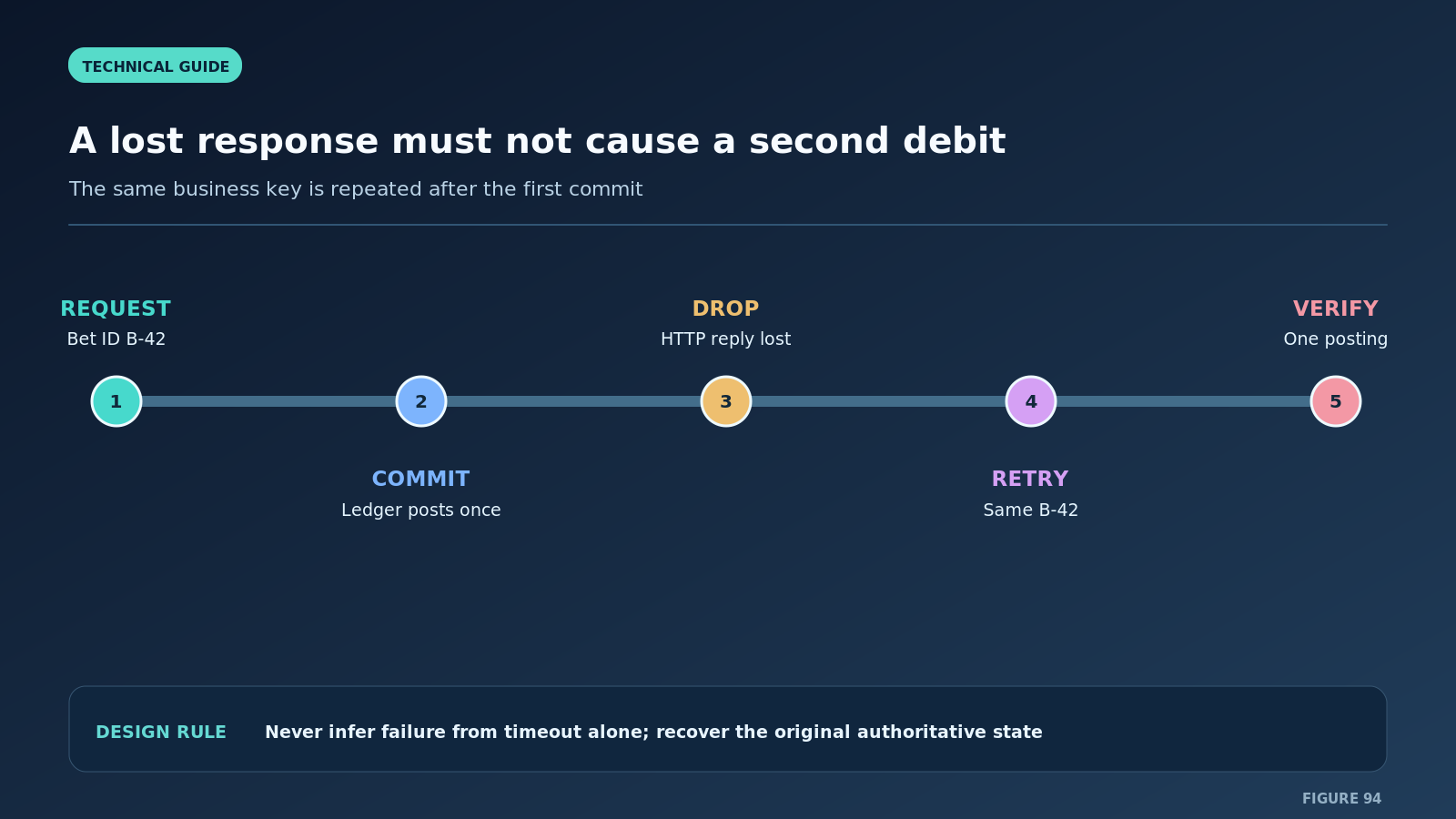
For example, a test provider can accept a debit and then deliberately drop the HTTP response. The operator cannot infer from the timeout that the debit failed. The correct design must recover the result from the original transaction identity or reconciliation process; it should not retry the debit under a new ID. Make this scenario a first-class acceptance test.
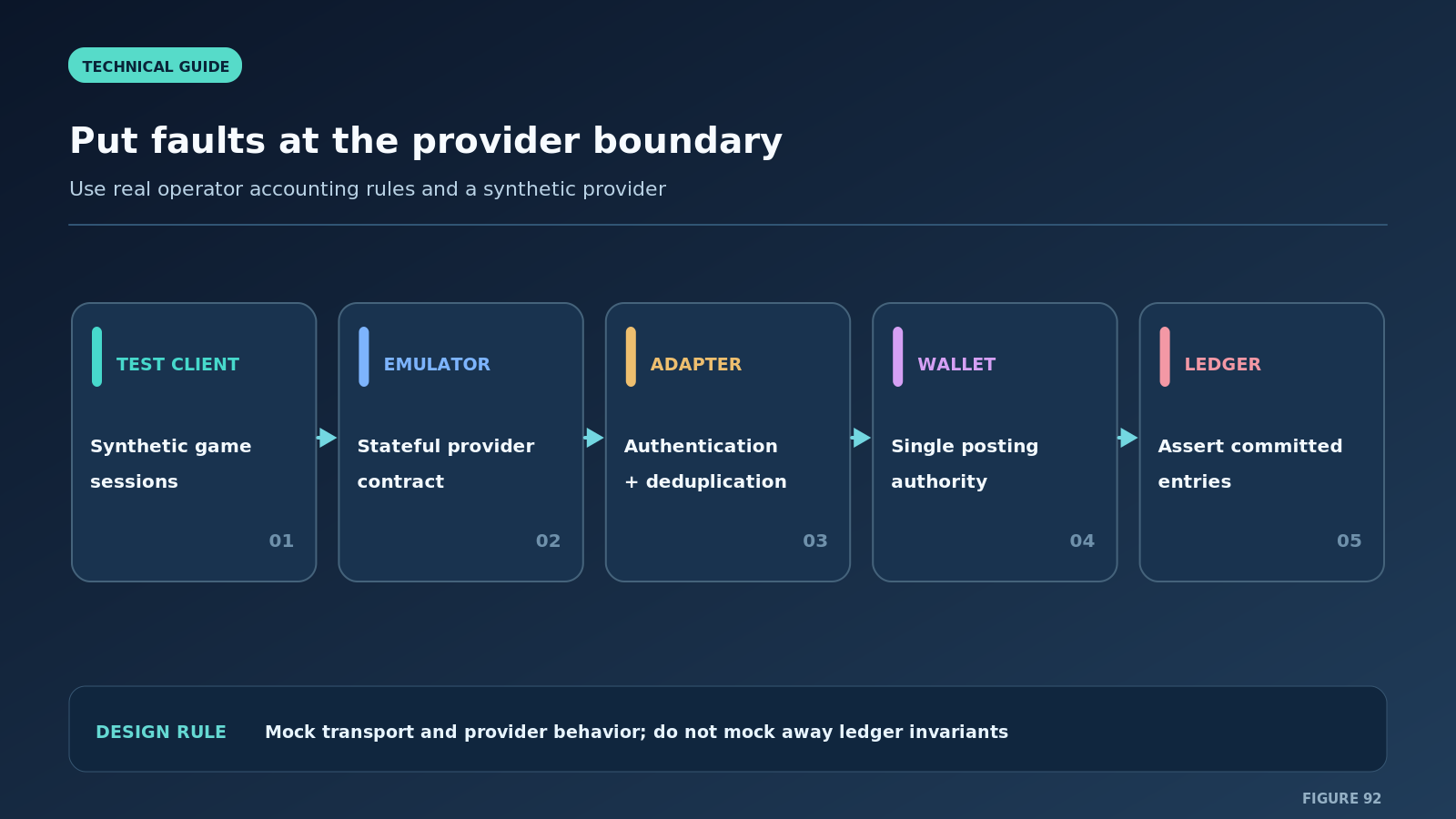
Establish what will not be simulated. A sandbox does not certify RNG behavior, real payment rails, actual regulated game approval or provider operations you cannot observe. It can test agreed protocol semantics and safety properties. Keep assumptions explicit in fixtures, with a link to the contract revision or provider test specification that justified each one.
Emulating launch sessions and wallet callbacks
Use a stateful model instead of disconnected example responses. A launch session should have an identity, player or test-account reference, game title, currency, jurisdiction context, issue time, expiry, eligibility constraints and status. The emulator may reject an expired or replayed launch token, a game not enabled for the test account or a currency mismatch. These are more useful tests than merely validating JSON syntax.
Once a session exists, simulate a round lifecycle. A bet instruction carries stable provider transaction and round references; the operator validates it, applies idempotency policy and records the result. A win or reversal relates to the appropriate prior operation and must not create unauthorized money movements. If the provider model permits a win before a recognized bet, the integration must define how that exceptional ordering is handled. If it does not, the test must reject it and record why.
Fixtures should include both functional and semantic validation. A callback with an amount field containing 100 may represent minor units, major units or a fixed-decimal representation depending on the contract. Test currency decimals, zero amounts, maximum values, negative values and overflow boundaries using contract-specific rules. Assert the exact ledger entries produced, not just an updated displayed balance.
Record request and response pairs, but redact secrets and replace identifiers with synthetic references. Treat captured production traffic as sensitive; do not simply replay it into CI. A test fixture should be inspectable by an engineer and legally safe to store in source control.
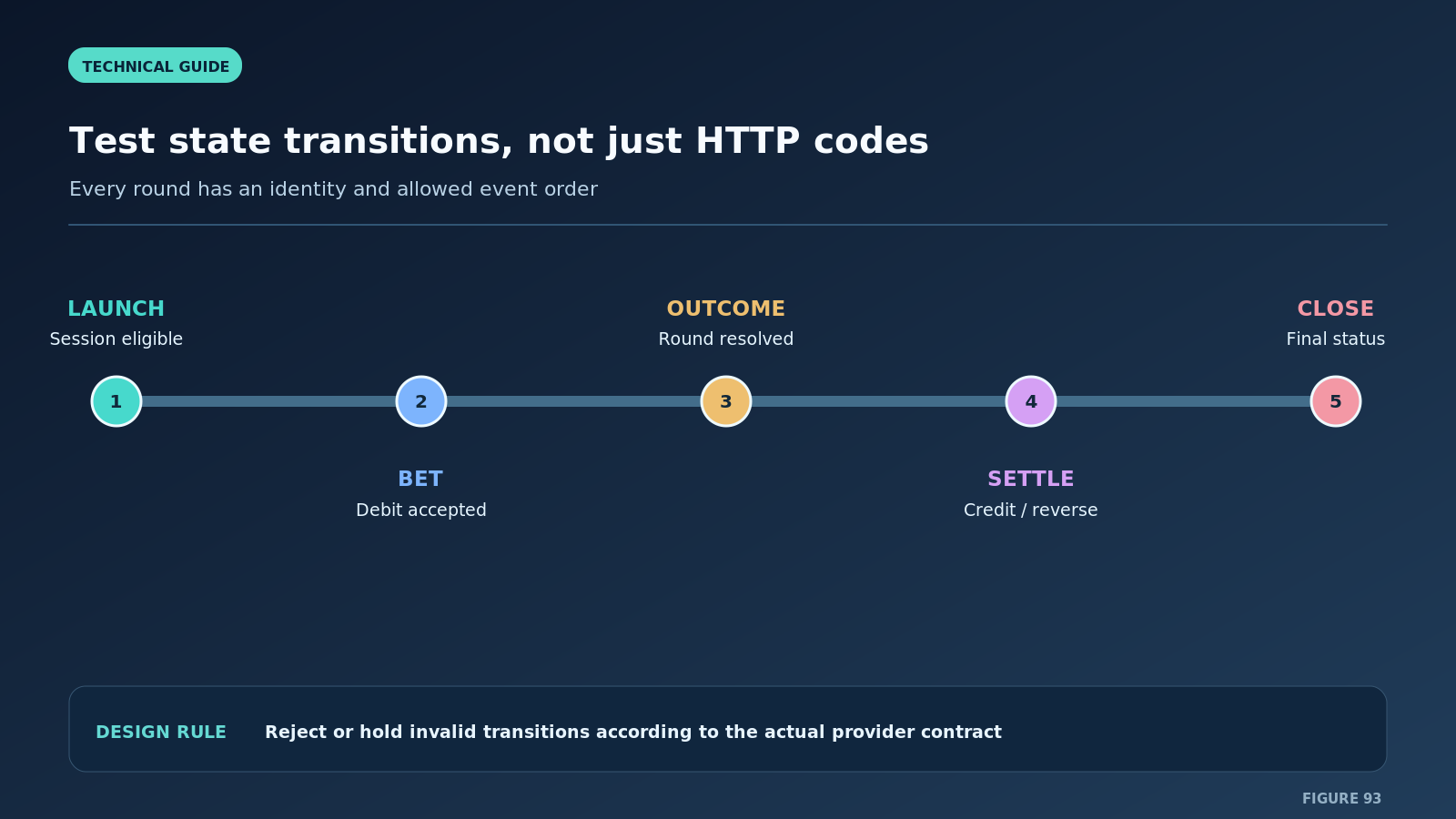
For a sample synthetic test, start with wallet balance 1,000 minor units. Issue one bet of 150 minor units under provider transaction bet-1001, then deliver the same callback twice. The final booked balance after the bet must be 850, not 700. Issue one win credit of 240 under win-1001 and repeat it: the final balance is 1,090, not 1,330. These are test numbers, not stake recommendations or actual operator data. The test should also assert one ledger posting per unique authorized business transaction and a repeatable response to duplicate delivery.
Fixtures for delays, duplication and outages
Model at least four kinds of failure: application responses, network behavior, message delivery and dependency state. Application failures include explicit validation errors or provider-side 5xx responses. Network behavior includes delay, abrupt disconnect, TLS negotiation failure and a response that never arrives. Delivery anomalies include duplicate callbacks, reordering and bursts after a long silence. Dependency failures include unavailable wallet database, saturated queue and expired signing credentials.
Keep the scenario deterministic. Use a seed for randomized schedules where needed, but also publish the exact fault timeline so a regression can be reproduced. A case can state: “At the first debit response, commit the wallet result; after commit, sever the connection; deliver a retry with the same provider transaction ID after two seconds.” A vague “simulate bad network” flag is insufficient for asserting financial correctness.
Tools can help with narrow layers. WireMock supports configurable HTTP response faults and delays; Toxiproxy can introduce network latency and connection failures between test services. They are not replacements for an emulator that understands game and transaction state. See WireMock fault simulation and Testcontainers Toxiproxy.
| Fault fixture | Injection point | Required assertion |
|---|---|---|
| Duplicate debit | Callback delivery | Only one ledger debit |
| Response lost after commit | HTTP transport | Retry returns original outcome |
| Win arrives before bet | Event ordering | Safe hold/reject according to contract |
| Invalid signature | Adapter authentication | No wallet mutation, auditable rejection |
| Expired session | Launch/session boundary | No unauthorized new round |
| Wallet unavailable | Ledger dependency | No false success; ambiguous result tracked |
| Queue replay | Async consumer | Stable idempotent projection |
| Provider callback storm | Ingress/queue | Bounded load, recovery without loss |
When running destructive network scenarios, isolate them within the test environment. A proxy that intentionally cuts traffic should not accidentally sit on a shared staging gateway or route real production requests. Label fault tests as controlled and make them safe to interrupt; a failed cleanup step must not leave subsequent tests running under an injected partition.
Failure injection and recovery assertions
Write assertions in terms of invariants. Balance conservation: the ending balance agrees with committed debits and credits. Idempotency: a repeated instruction with the same permitted business key does not cause a second posting. Authorization: invalid signature or forbidden session context causes no financial change. Traceability: every state change has an allowed correlation path. Recoverability: after a fault clears, the system can reach a definitive state or explicitly surface an unresolved item for reconciliation.
Do not confuse a green response-code test with a successful financial outcome. Suppose the wallet committed a debit but the adapter crashed before returning a response. On restart, the provider retries with the same key; the adapter should consult the persisted idempotency result or a transaction status interface. If neither can establish the state, the system should route the transaction to a documented ambiguity and reconciliation flow rather than invent an outcome.
A robust test needs a source-of-truth comparison. Query the authoritative ledger and verify entry count, transaction IDs, account ownership, amounts and state transitions. Also examine outbox publication and consumer projections to ensure asynchronous retry did not multiply a downstream metric. Expected financial records should be independent of the emulator’s claimed balance, otherwise two incorrect components can agree with each other.
Test recovery timing, but avoid defining universal latency objectives. A realistic goal might be to process the backlog within a defined operator-specific window after reconnection, while preserving ledger invariants. Instrument oldest pending callback age, retries by reason, reconciliation queue count and provider response class. Time-bound expectations should come from your architecture and contracts.
Sandbox data, isolation and CI pipelines
Separate production and test in identity, network, data and secrets. The sandbox should use synthetic players, bounded test wallets and unmistakably non-production provider credentials. Prevent production callback endpoints from accepting emulator signatures. Deny test jobs access to production storage and deployment credentials even if the CI runner has broad connectivity elsewhere.
Seed fixtures deterministically and reset state between tests. Parallel pipelines must not share mutable account IDs or round references in a way that creates nondeterministic collisions. Give each test run a namespace and run ID; clean it up with an explicit lease or expiry. Retain the result summary, relevant sanitized traces and ledger assertions long enough to investigate a failed build.
Organize CI in layers. Contract tests validate schemas and signatures cheaply. Component tests exercise the adapter against a stateful local emulator. Integration tests run the adapter, wallet and ledger with a fault proxy. Provider-environment tests confirm compatibility with the supplier’s current sandbox, subject to availability. Release gates combine these with an approval process for behavior affecting money or regulated game configurations. A passing local emulator test does not erase the need for real provider conformance testing.

One useful habit is to retain failure evidence rather than just a pass/fail marker: scenario ID, contract version, emulator version, fault schedule, transaction identities and ledger query result. This makes it possible to compare a regression across code branches and identify whether an interface change or a recovery algorithm caused it.
Scenario matrix and coverage checklist
Coverage is not the number of mock HTTP routes. A better measure is which business states and failure transitions have been asserted. Organize the test matrix by operation (launch, bet, win, refund, balance, close), actor (provider, operator, player/session) and fault class (invalid input, duplicate, delay, lost response, outage, reordering). For each cell, record the expected authoritative financial state and the observable response.
Prioritize scenarios that can lose or duplicate money, create an unauthorized session, hide an unresolved transaction or leave a round permanently ambiguous. Load tests can follow, but they should not precede correctness tests. Millions of successful synthetic requests do not compensate for one untested lost-response window around a ledger commit.
The final review asks: Does every callback type have valid and invalid fixtures? Are amounts and currency units explicit? Can the emulator commit then fail before acknowledgement? Can the system reject a replayed signature or expired token? Does the idempotency key persist across restarts? Do we verify ledger entries directly? Does the provider-specific contract define reversal and out-of-order behavior? Can the failed scenario be reproduced locally without production data? Do CI results clearly identify contract and emulator versions?
An effective sandbox turns integration risk into a repeatable engineering exercise. It makes uncommon failures ordinary test cases, while keeping authoritative financial accounting and actual supplier conformance separate from the simulation.
Technical references
Editorial note: workflows, balances and responses are synthetic. Replace them with the actual provider contract before implementation.