Live casino video event synchronization is not about forcing every player to see the same frame at exactly the same moment. It is about preserving one coherent, auditable account of what happened in a round even while cameras, encoders, networks, browsers and game APIs introduce different delays. A person watching a dealer close a betting window may receive those video frames seconds after the game authority records the closure. Another player may see the frames sooner but have a slower path for submitting a wager.
The central design rule is that stream time is not game time. Video timestamps help a renderer play frames in order. Game-event sequences determine accepted bets, betting cutoffs, confirmed results and settlement. A trustworthy integration correlates those timelines for presentation and dispute investigation without using a screenshot or video buffer as an accounting authority.
This article explains clocks and ordering, then proposes a synchronization design and test cases for ambiguous or delayed events. The example round, message names and event fields are fictional. Actual regulated games, provider APIs and studio procedures vary.
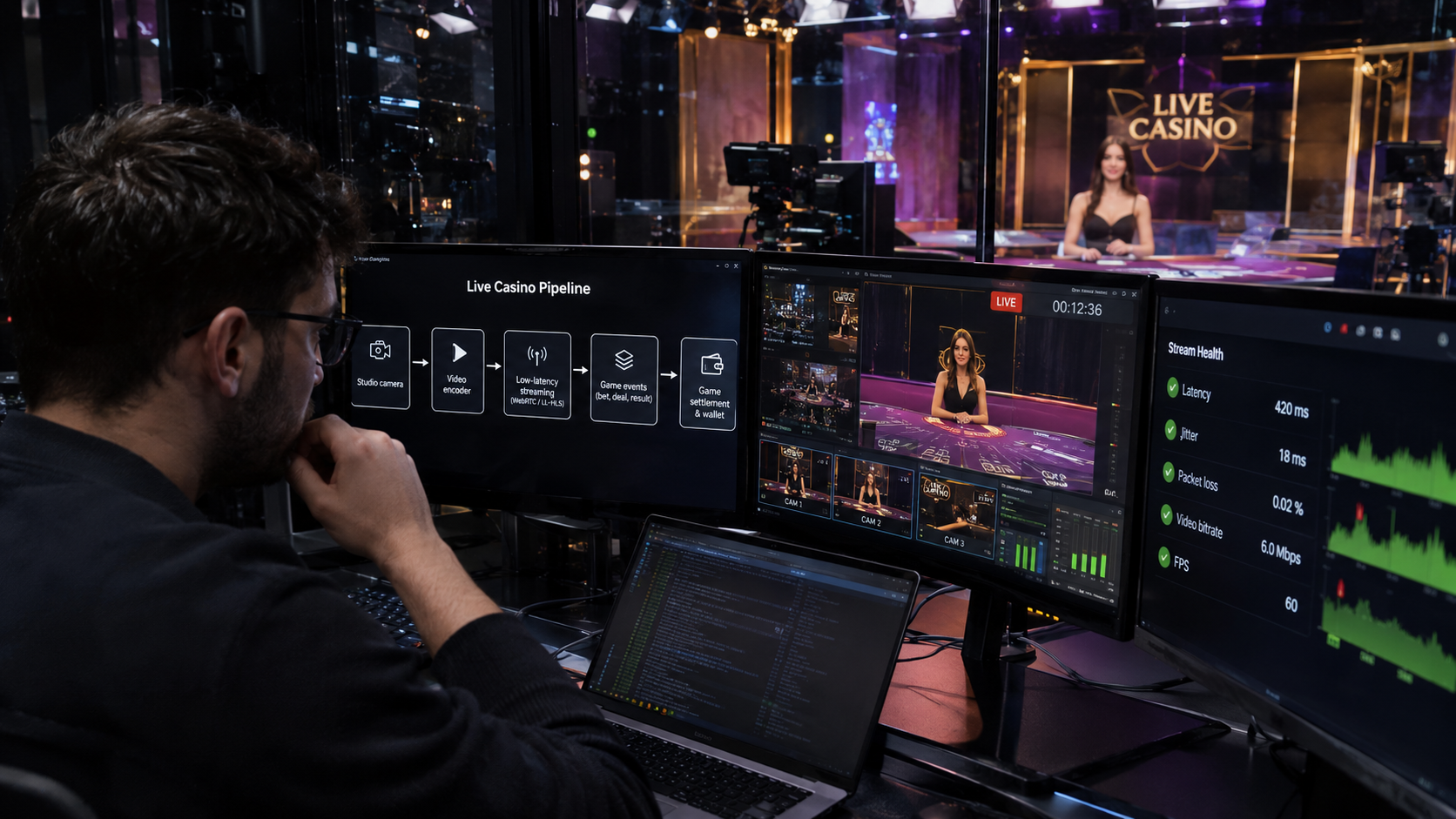
Why stream time is not game time
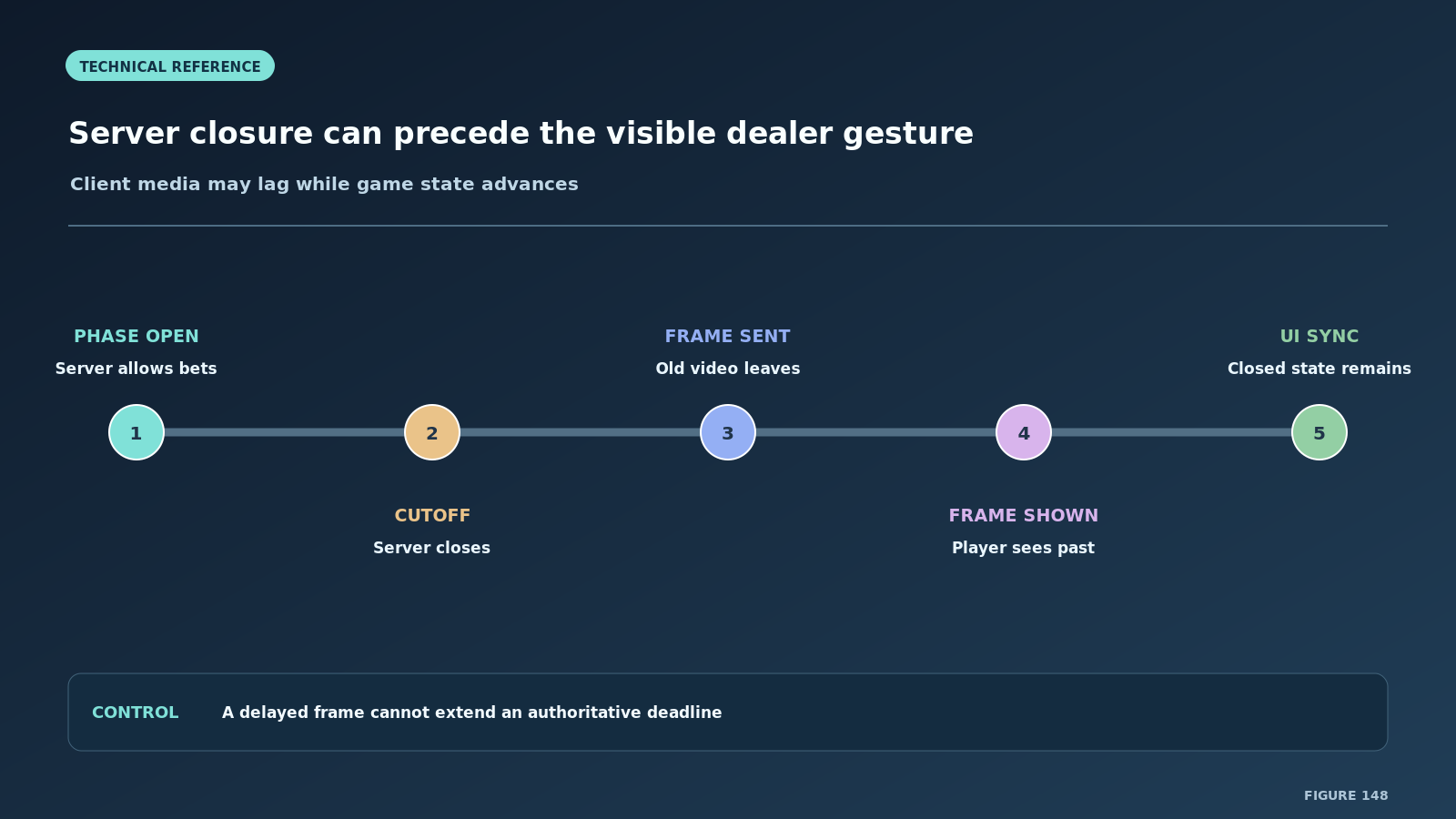
A single round can have several apparently reasonable timestamps. The camera captures a moment; an encoder packages a frame; a server publishes a betting-closed event; the browser receives a message; and the screen finally renders a frame. Different transport routes mean the last two events need not arrive in causal visual order. A frame that looks like betting is open can be received after the server’s authoritative cutoff has passed.
A media pipeline measures progress in frames and presentation time. A game service measures progress in validated round transitions and accepted business actions. The service cannot prove a wager was accepted by replaying frames because frames are delayed, may have been dropped, and often lack the business identity needed to distinguish one wager from another. Video can support investigation, but it cannot replace the signed or authenticated event record.
Make the authoritative domain model explicit: table_id, round_id, round_sequence, phase, server_deadline, event_id, event_version and the relevant accepted bet identities. Each state transition must obey a defined contract, for example that no new bet is accepted after the server-authoritative cutoff, subject to product-specific approved timing rules. Store the effective decision and reason rather than recomputing a historical result from the user’s wall clock.
A robust player interface can show Betting Closed before the visible dealer gesture appears. That may look counterintuitive, but it is truthful if the server has already closed the phase. Avoid artificially pretending that the server is still open simply to make video and UI appear synchronized. If a business wants a visible countdown, derive it from an authenticated deadline with uncertainty bounds and correct it when the server state changes.
Wall clocks, media timestamps and event time
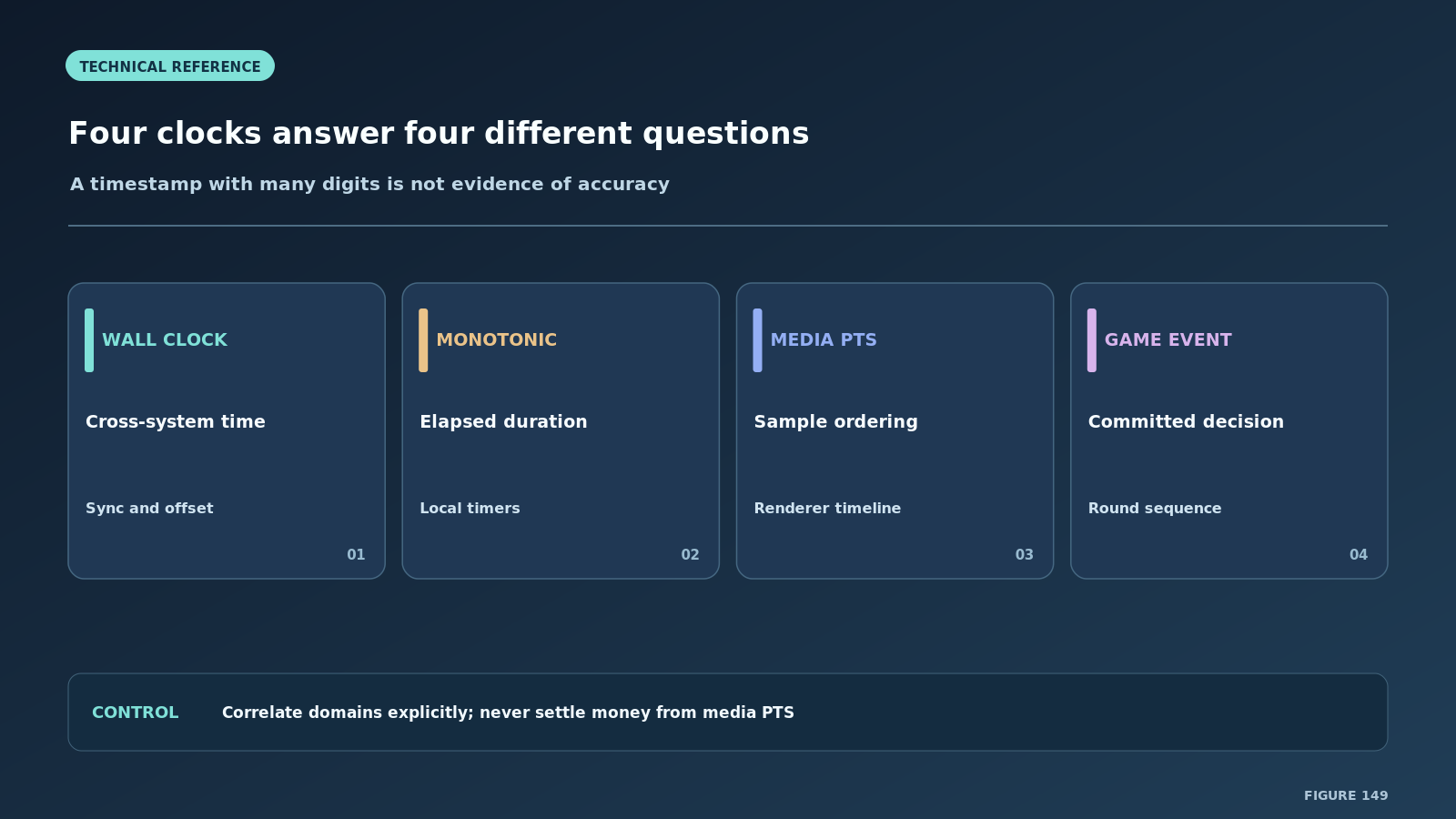
Different timestamp families answer different questions. Wall-clock time is a civil-time representation useful for cross-system correlation and operations. Its accuracy depends on clock synchronization and on recording clock error. Monotonic time is useful for local elapsed durations because it avoids discontinuities when a device’s wall clock is corrected. Media presentation timestamps (PTS) instruct players on the order and timing of decoded samples; they are not generally authoritative accounting times. Event time should be defined as the game authority’s persisted decision point, subject to its ordering guarantees.
The RTP specification distinguishes a media timestamp counter from wall-clock mappings. RTCP sender reports can associate an RTP timestamp with an NTP-format timestamp for synchronization. In HLS-style systems, program-date-time metadata or similar mapping can connect media samples to wall-clock references when generated consistently. These mechanisms assist media correlation; neither turns video transport into a trusted betting engine.
Use clocks with documented accuracy and drift-monitoring where cross-system comparison matters. Store the clock source or uncertainty when relevant. Timestamp precision is not the same as truth: a value printed to a microsecond does not imply microsecond accuracy. Avoid trusting a player device clock as the final arbiter of an action that affects money, even if it appears well synchronized.
A practical event record can carry two timestamps: occurred_at (the provider-approved effective event time) and recorded_at (when the receiving authority persisted the event). Also store source_id, sequence, schema_version and, for corrections, an immutable relationship to the original event. If ingest arrives late, it may still be legitimate, but the event must not silently rewrite a final ledger entry without a supervised correction process.
Authoritative event sequence and late arrivals
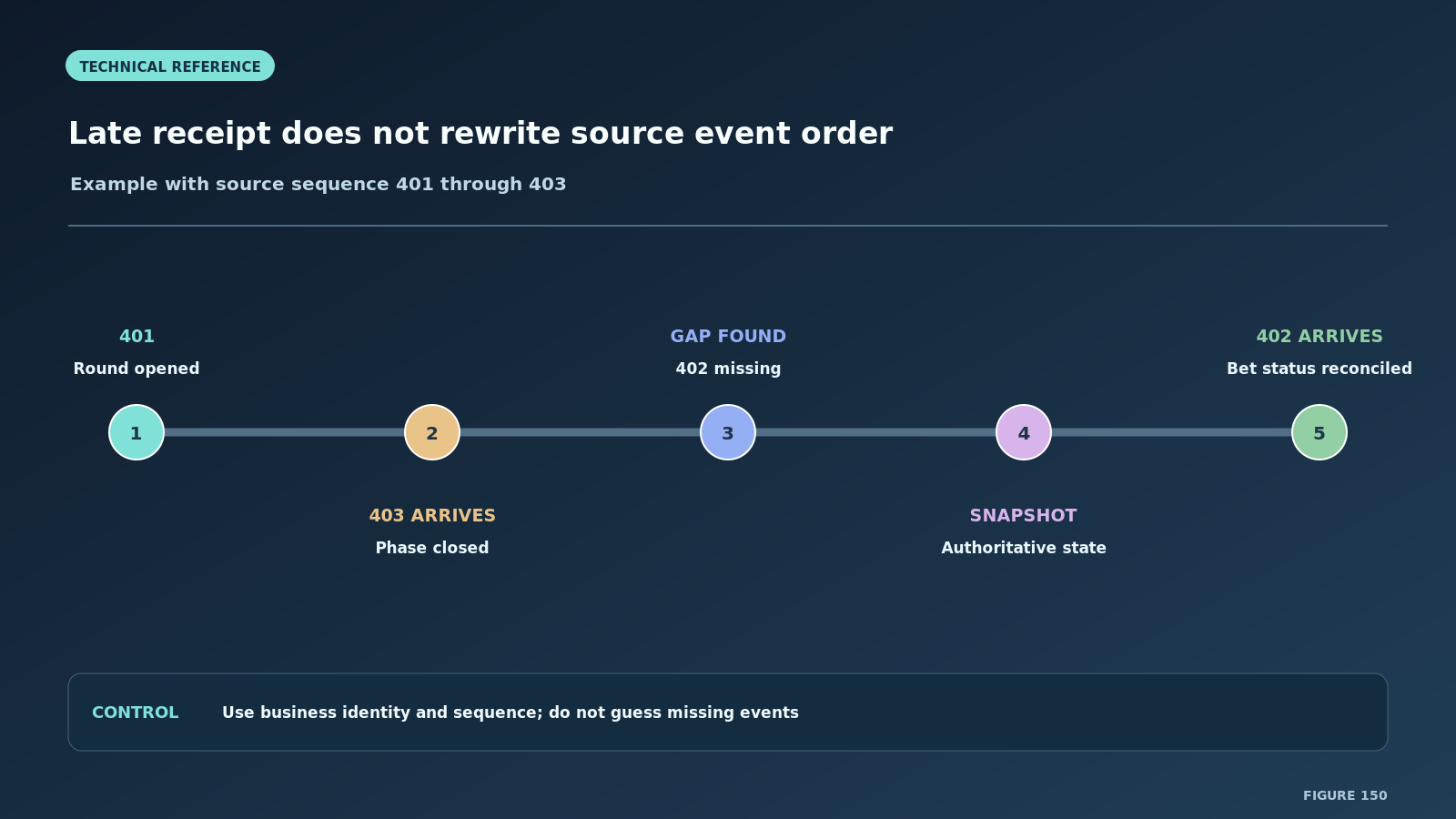
Network delivery is not guaranteed to preserve source order across reconnects, brokers and regions. A ROUND_CLOSED event can arrive before a delayed BET_ACCEPTED notification, even if the stake was validly accepted earlier. Consumers must evaluate each message against the persisted round identity, source sequence and business decision time, not simply apply messages in HTTP arrival order.
Use a stable partition or serialization key for events whose order is contractually meaningful, such as a particular table and round. An event identifier supports duplicate suppression; a monotonically increasing version can detect gaps. A gap does not mean the consumer should guess the missing state: it should request a snapshot or missing range and pause sensitive transitions until the inconsistency is resolved.
The producer should define whether the event log itself is authoritative or a derived publication of a committed database state. The financial service needs stronger guarantees than “at least once message processing”; each accepted bet or settlement should have a unique, idempotent business identity. The consumer may read the same event again without creating a second debit or credit. If a late event conflicts with an already finalized round, place it in an exception workflow with traceable ownership rather than mutating history without evidence.
For example, suppose sequence 401 reports a betting window open, sequence 402 confirms a wager accepted, and sequence 403 closes betting. A client receives 401 then 403 while 402 is delayed. The interface can present betting closed, but must still show the accepted wager once sequence 402 or a fresh snapshot proves its status. It must not claim that the missing acknowledgment voided the wager. The sequence is not just a visual animation order; it is a contract for reconciling the user’s economic action.
Drift correction and client presentation
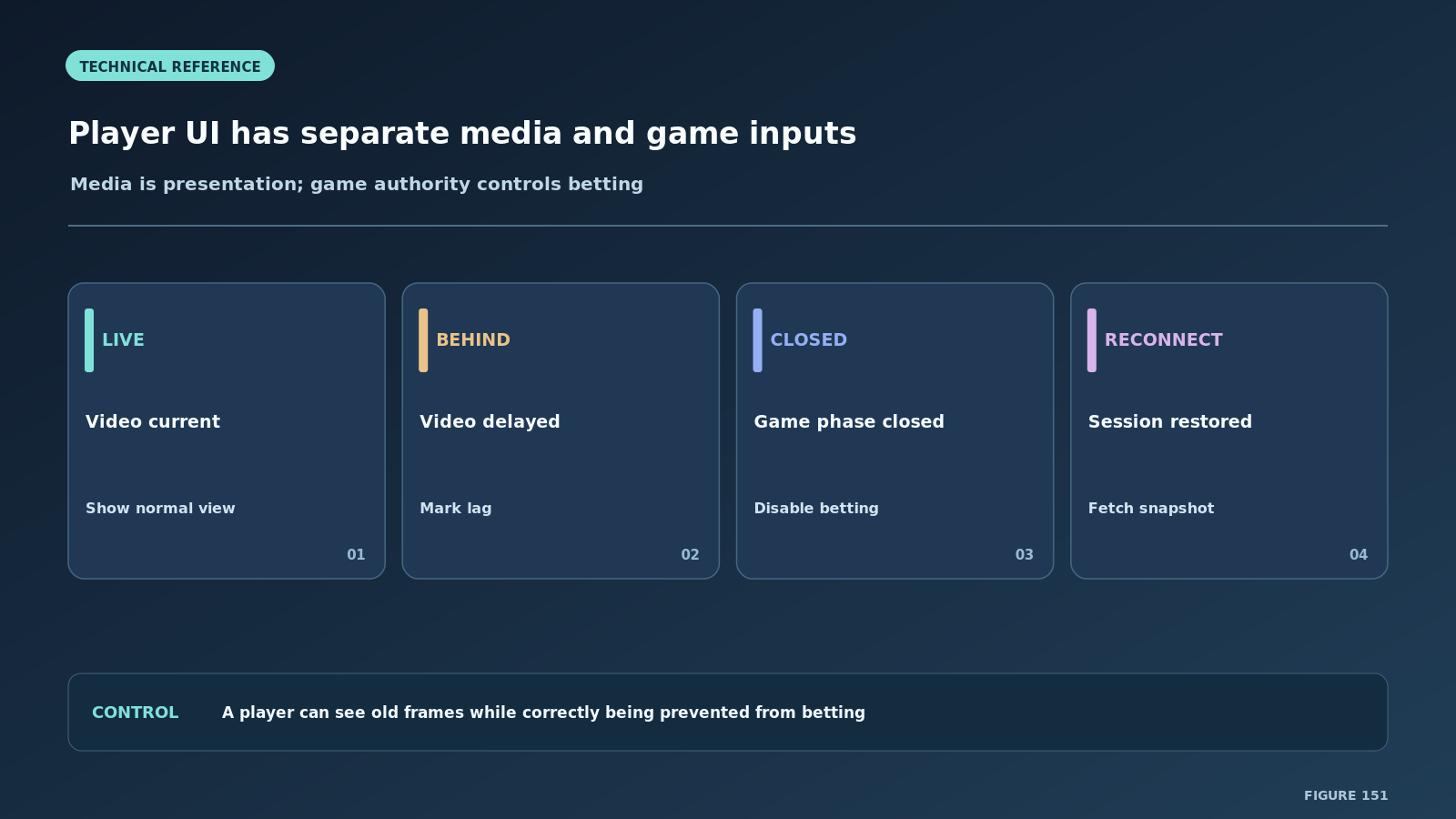
When media lags behind authoritative state, there are at least three strategies: accept a controlled display offset; gently speed up or seek the media toward the live edge; or mark the stream as delayed and rely on live state text. An aggressive catch-up strategy may lose frames that explain a dealer action. A frozen stream with an unmodified countdown can mislead players. Choose presentation behavior by game phase and the meaning of the missed frames.
Measure the difference between an expected media marker and its actual presentation, not only time from server event receipt. If a sender clock is corrected, RTP clock mapping changes or an encoder restarts, a previous offset may no longer be valid. Reset synchronization anchors at explicit media epochs. Keep separate metrics for audio/video sync, video/game state lag, authoritative event delivery lag and client-side clock uncertainty.
An appropriate player presentation might maintain a discrete stream_health status: LIVE, BEHIND, REBUFFERING, RECONNECTING or UNAVAILABLE. The separate round_phase status remains sourced from the game service. If the latter says closed, the betting control must not become active merely because the video still shows an open phase. Handle accessibility: a user who cannot hear the dealer should still receive authoritative text for the current state.
Mobile apps need specific protection. A tab can be suspended for minutes, causing many messages to be buffered. On foregrounding, do not animate every obsolete event in rapid succession as if it were current. Fetch a fresh authorized snapshot, reconcile any pending request IDs and resume at the currently valid round or table state. Old events may be available for history but not for opening controls again.
Timing disputes and consistency checks
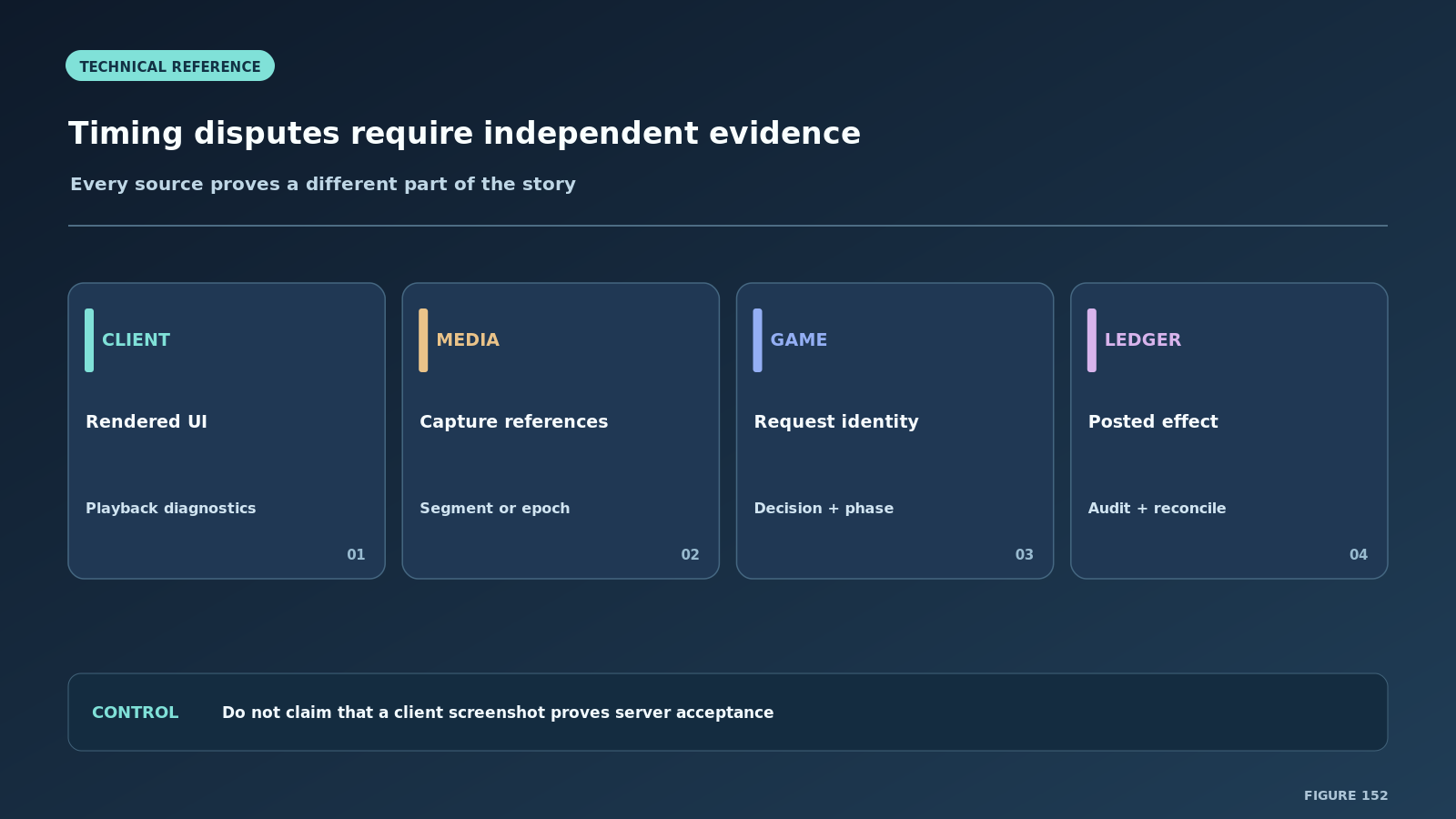
Disputes often involve an apparent difference between what a player saw and what the game system accepted. A useful evidence bundle contains the authenticated action identifier, server receipt and decision records, round state/version, relevant provider or studio event IDs, ledger entries, client playback diagnostics, clock uncertainty and the media segment or capture reference where legally and operationally permitted. Preserve access controls and retention rules because video and event logs may include personal information.
Be precise about what each artifact can prove. A client screenshot can show what was rendered, but not necessarily the authoritative server phase at receipt. A CDN request log can show media object delivery, not whether the frame was displayed. A server action log can show accepted or rejected wager decisions, but may not explain why the player’s picture was stale. The investigation should reconcile those facts without giving any single artifact powers it does not possess.
Reconciliation queries should confirm that each accepted wager has at most one relevant settlement path under the game contract and that each terminal round state is backed by a validated result. Check missing source sequences, mismatched table IDs, unexpectedly large media lag, duplicate callbacks and corrections after finalization. A false impression of “perfect sync” can mask more consequential issues than a visible and properly handled delay.
Synchronization design and validation scenarios
A sensible reference architecture includes: a studio event producer with an approved time source, a trusted game orchestrator serializing round transitions, a durable event publication mechanism, a media encoder/packager recording stream epochs, and clients that maintain separate playback and authoritative state machines. Correlation IDs link them for diagnosis, while independent security controls protect event injection and wallet APIs.
Test at least these conditions: a delayed video stream at betting cutoff; the game’s close event arriving before an earlier accepted-bet notification; a media timestamp reset; a clock adjustment; a temporarily disconnected client; a duplicate settlement callback; and a player reconnecting to a new table while old events are still in flight. For each scenario, define expected controls, accepted wagering actions, ledger effects, player notifications and retained evidence. The critical assertion is economic: there must not be an extra or silently lost monetary effect merely because media and event timing diverged.
A final test should deliberately delay the player’s UI while keeping the game service healthy. If the UI displays outdated dealer video but keeps the authoritative round phase, bet action status and audited result correct, the architecture is doing its job. Good synchronization does not remove all latency; it maintains truthful behavior despite latency.
Source notes: IETF RFC 3550 (RTP and RTCP timestamps); Apple HLS authoring specification; W3C WebRTC Statistics. The game-event model and examples are editorial design guidance, not statements of any particular vendor’s certified workflow.