AI software testing in iGaming can be useful for discovering candidate edge cases, drafting fixtures and helping reviewers navigate complex specifications. It can also produce plausible but invalid tests, hallucinate nonexistent API fields, mistake an illustration for a regulatory requirement or assert the wrong financial result. The distinction is critical: a generated test is a hypothesis. A valid test is one whose preconditions, expected results and evidence can be independently derived from an authoritative, versioned contract.
This guide describes a bounded workflow for AI-assisted quality assurance in game-provider integrations, wallet callbacks and game-round processing. It does not delegate certification or financial correctness to a language model. Random outcomes, authorized bets and ledger effects are governed by deterministic implementations and independent verification. Examples use synthetic test data and non-production environments.

Where AI-assisted QA fits the test process
Separate the test lifecycle into requirements analysis, scenario design, fixture construction, automated execution, oracle evaluation, defect triage, and release evidence. AI is best used to accelerate candidate generation and summarization in the first stages. It can propose boundary conditions from a wallet API schema, list retry and timeout scenarios for a provider callback, or help cluster repetitive logs for review. It should not independently approve a release or redefine the expected result when code behavior conflicts with the specification.
Start with an explicit source-of-truth hierarchy. At the top are approved game rules, jurisdiction-specific requirements where applicable, versioned API contracts, financial ledger invariants, and authorized test specifications. Below those are examples, historical incidents and documentation comments. A language model may read all of them, but the test oracle must cite the controlling source. When sources conflict, a human owner resolves the ambiguity rather than allowing the model to synthesize a third rule.
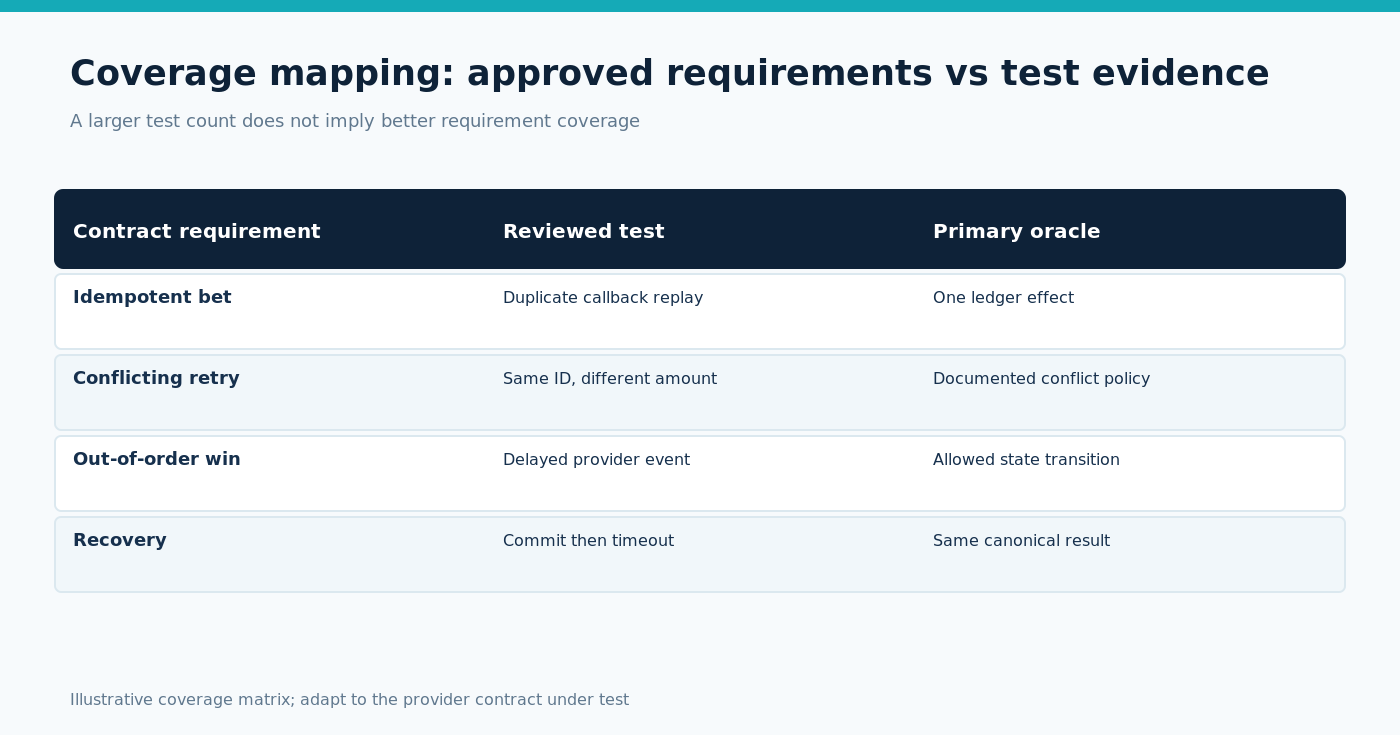
The fit is strongest in domains with rich structured contracts and expensive manual scenario design. For example, a provider API callback might require a stable business transaction ID, currency-specific integer amounts and idempotent repeated replies. AI can propose the cases “same ID, same payload,” “same ID, conflicting amount,” “timeout after committed debit,” and “out-of-order win.” Engineers then turn the proposals into deterministic fixtures and evaluate them against documented semantics.
Define a limited production policy: model suggestions are never sent to real-money endpoints; no live customer wallet data is passed to an external model without approved handling; generated assertions require a reviewer; and each accepted test is stored with its source references, author, reviewed version and expected output. Such rules reduce the risk that productivity gains create an untraceable test suite.
Test generation from requirements and code contracts
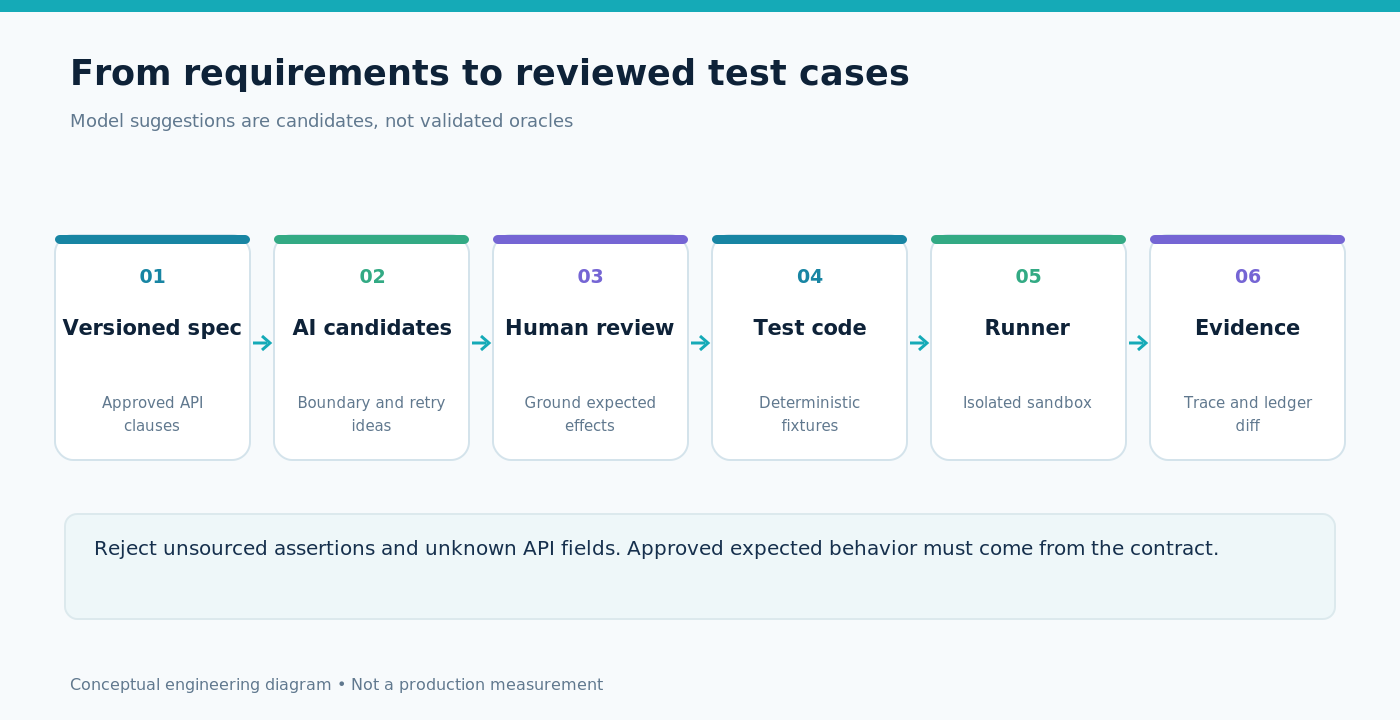
A controlled generation process begins by parsing a fixed set of documents: the canonical OpenAPI specification, a wallet state machine, a test environment configuration, and any approved certification or internal acceptance criteria. Extract exact field names, allowed enum values, constraints, error codes, and state transition rules. Provide version identifiers in the prompt or retrieval context, and instruct the generator to mark missing or ambiguous information explicitly instead of guessing.
Generate a scenario catalog rather than executable tests first. Each candidate should state objective, source clause, preconditions, setup fixture, input sequence, expected ledger and API effects, cleanup and failure category. Group by equivalence classes: valid operation, rejected input, duplicate transport event, conflicting idempotency key, delayed response, provider disconnection, partial service outage, and retry after recovery. Review duplicates and impossible combinations before code generation.
Use boundary-value testing where contracts actually specify numerical ranges. For amounts, test permitted minimum and maximum minor-unit values and currency exponent handling; for identifiers, test allowed characters and length; for times, test documented expiration windows. Do not invent regulatory numeric limits. For randomized game outcomes, generated fixtures should request specific testable deterministic outcomes via an approved test harness, not attempt to predict a secure production RNG output.
Generated snippets should compile in the repository’s test framework and run only against isolated accounts, synthetic balances and stubbed provider endpoints. Protect secrets, strip player personal data and prevent retrieval sources from injecting arbitrary commands into the test runner. Review generated shell commands and network destinations. A test suggestion that requires broad administrator credentials is a reason to redesign the harness, not grant the model more privileges.
Deterministic oracles and acceptance criteria
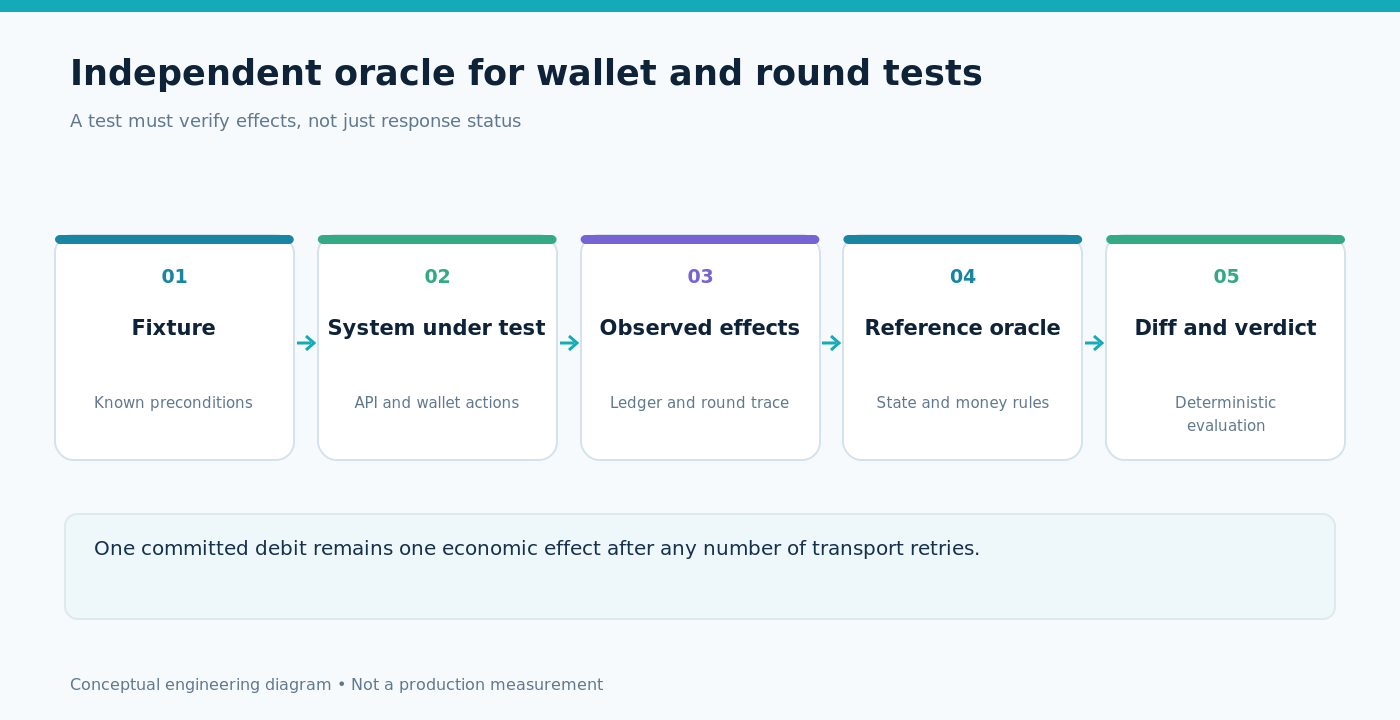
A test oracle decides whether observed behavior is correct. For wallet operations the oracle can be a reference ledger, conservation invariant, state-transition contract or independently calculated settlement. For API integration it may be a schema check plus documented response semantics. For RNG-sensitive behavior it may use a deterministic test fixture and a separately evaluated statistical or certification process. A generated test that merely expects whatever the application returned is a tautology, not validation.
Take idempotency. Suppose a provider sends the same economic bet twice after a timeout. The oracle should verify one posted debit, a stable canonical business result, and a replay-compatible response under the platform’s defined contract. A test that expects two successful HTTP replies but never checks the ledger can miss a serious financial defect. A second test should send the same idempotency key with a conflicting amount and verify that the platform follows its documented conflict policy without silently posting another effect.
State machines give powerful reusable oracles. Legal transitions must be explicitly enumerated: created → authorized → resolved → settled, plus approved cancellation or reversal paths. A late callback should not reopen a terminal state without a documented compensating workflow. Assertions should cover unique ledger references, sum of debits and credits where applicable, ordering constraints, and replay stability. If a rule is jurisdiction-specific, record the governing requirement and applicability instead of turning a general engineering preference into universal law.
Use independent checks to avoid oracle contamination: a language model should not generate both the implementation and the only test of that implementation without external validation. Reviewers should compare test results with specifications and reference models. Property-based tests can explore valid input spaces, but constraints must come from approved contracts. A failed assertion needs a reproducible event log and stable fixture, not a vague model explanation.
Coverage, hallucinations and unstable outputs
Count coverage by requirements and risk, not only lines of generated code. Track each approved clause, transition, failure mode, provider-specific behavior and relevant game type against at least one reviewed test. A hundred AI-generated variations of the same happy-path login do not cover a missing wallet refund branch. Pair structured coverage maps with mutation testing or deliberately injected defects to check whether the suite catches meaningful failures.
Hallucination appears in subtle forms: a plausible parameter absent from the API contract, an incorrect default currency, a guessed RNG seed behavior, a nonexistent provider webhook, or a made-up compliance citation. Build validation gates: schema lints, compilation, static checks, test-source citations, approved endpoints and human review. Reject generated tests with unsourced assertions. When documentation is incomplete, create a clarification task rather than filling the gap with a model guess.
Generation can also be unstable: repeated prompts produce differently named fixtures or inconsistent preconditions. Pin the model configuration when the tool allows it, save the prompt and retrieved document versions, apply structured output schemas, and normalize proposed scenarios before review. The execution stage must be deterministic: a test runner should not need to call an LLM to decide whether an accounting invariant passed. Version generated code and compare diffs like any other contribution.
A release gate should distinguish “AI suggested the test,” “a person approved the test,” “the deterministic runner passed,” and “the evidence package was accepted.” These are not interchangeable statuses. Measure false-positive failures, flaky test rate, reviewer minutes, defect detection improvement and the share of generated cases discarded for poor grounding. Report the baseline manual process so efficiency claims can be audited.
Human review, traceability and privacy
Assign accountable reviewers for each domain. Wallet and payment specialists validate money and idempotency logic; game engineers review approved runtime behavior; security teams review access and adversarial test boundaries; compliance or independent test specialists verify applicable requirements and evidence standards. The AI system is a drafting aid, not an authorizing signatory. Preserve review comments and link test changes to the build and artifact hash.
Protect training, retrieval and log data. Scrub personal identifiers, payment details, live account tokens and sensitive provider contracts unless the intended model environment is explicitly approved for those materials. Use private, synthetic or minimized examples where possible. Control which repository and knowledge-base documents are retrievable, and treat source documents as untrusted input if they might contain malicious instructions. Do not let a generated test rewrite configuration or grant itself privileges to continue execution.
A reviewer should be able to answer: Which source clause did this test implement? What observable effect should occur? Which fixture and simulator version was used? Who approved the expected result? Which release artifacts were tested? Where are the full trace and ledger diff? If any answer is unavailable, the result is incomplete. Transparency about AI assistance is part of the evidence trail, not a substitute for technical rigor.
Sample workflow and evidence checklist
A production-safe pilot begins with a single high-value integration contract in a sandbox. Export the approved spec and sanitized incident examples. Generate candidate test scenarios in a restricted workspace. Have two domain reviewers select the useful cases, then convert them into deterministic automated tests. Run them against a stubbed provider and a reference wallet. Evaluate the added defect detection relative to the prior suite, not just the number of tests written.
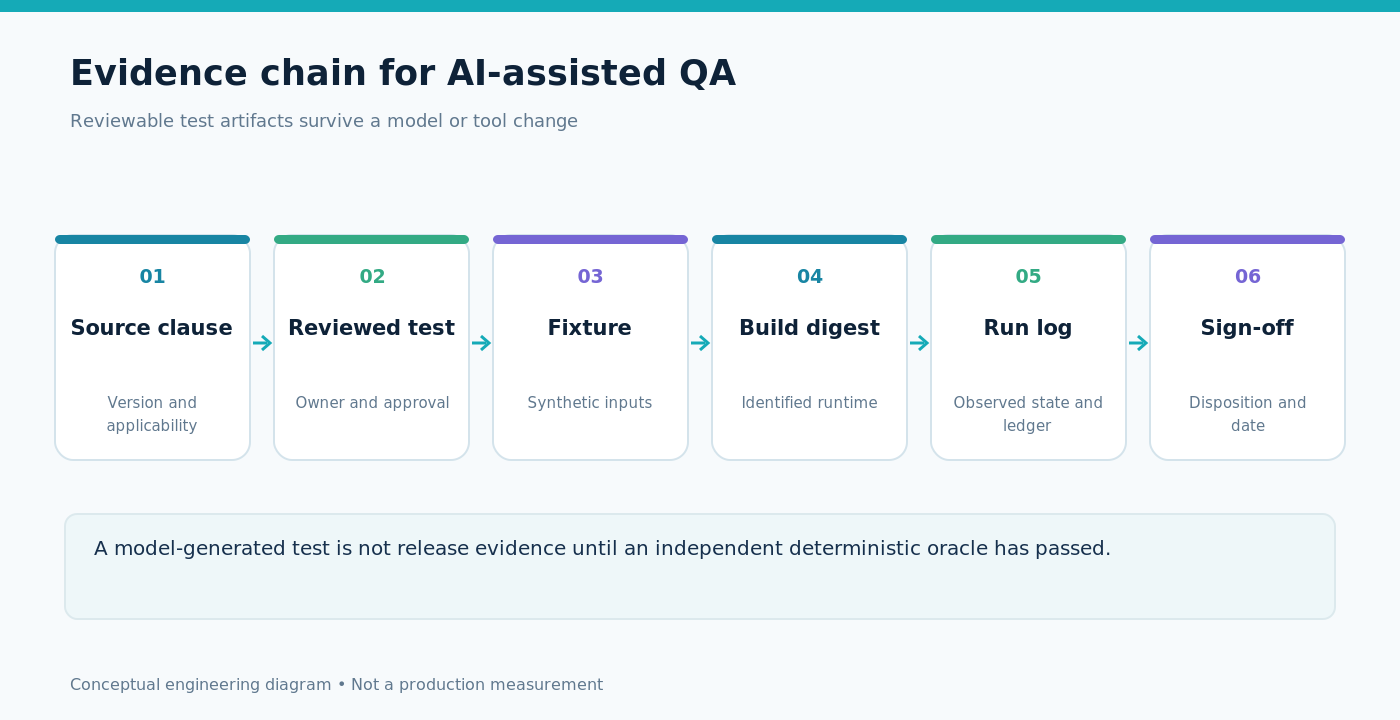
For each accepted test, store a stable test ID, requirement link, model or tool provenance, fixture definition, exact input sequence, expected outputs, reviewer sign-off, execution date, build digest, run log, ledger reconciliation results and disposition. Include negative tests for missing callbacks, duplicate messages, mismatched amounts, stale sessions, round closeout and recovery behavior. Document who can update the oracle and what independent review is required.
Do a post-release review. If generated tests are flaky, too shallow, prone to unsourced claims or expensive to maintain, narrow the scope or pause automation. If they reveal new defects reliably, promote the tested patterns into reusable curated fixtures. No AI-created test suite replaces independent certification where the applicable regime requires it. The NIST AI RMF and its Generative AI Profile provide cross-sector risk-management vocabulary, not iGaming certification authority.
Related guides: provider API contract testing, game-round state machines, and ML model monitoring. Validate these internal links against the site plan at publication.