GLI-19 requirements become useful to engineers only when they are translated into system boundaries, tests and concrete evidence. A statement that a gaming platform is “designed for GLI-19” reveals very little unless the claim identifies the exact document edition, assessed product, jurisdiction, build and configuration. A technical team needs an answer to a more specific question: what behavior is required, who verifies it, and which immutable record demonstrates that the tested behavior belongs to the deployed system?
This guide uses GLI-19: Standards for Interactive Gaming Systems, Version 4.0, revision dated November 3, 2026 as its primary reference. It is an engineering interpretation of selected controls, not a substitute for the standard, an evaluation report, or the legal requirements of a gaming jurisdiction. Authorities may adopt the standard in whole, in part, with amendments, or retain an earlier edition. Accordingly, a project should first verify its regulatory baseline before deriving an implementation checklist.

Standard scope, edition and applicability
GLI-19 v4.0 addresses interactive gaming systems. Its 2026 revision reorganized material into six technical chapters covering system/platform requirements, player accounts, remote player devices and applications, RNG requirements, and game requirements, with associated introduction and appendices. The revision also refreshed terminology such as Gaming Platform, Gaming Production Environment (GPE), Player Account Manager and Player Application. This matters when migrating a compliance workbook built around the headings of v3.0: even when the underlying intent remains, document identifiers and control boundaries may have changed.
Section 1.2 explains the purpose of the standard, while Section 1.3 expressly recognizes the role of local regulatory bodies and additional internal-control requirements. Section 1.5 sets out laboratory testing and operational assessments. The independent test laboratory may need access to source code and evidence connecting submitted source with compiled output. Section 1.5.1 also notes that additional integration testing can be required where previously tested components change or are integrated into a new system; where a regulator has adopted a change management program, that program determines the modification-testing scope.
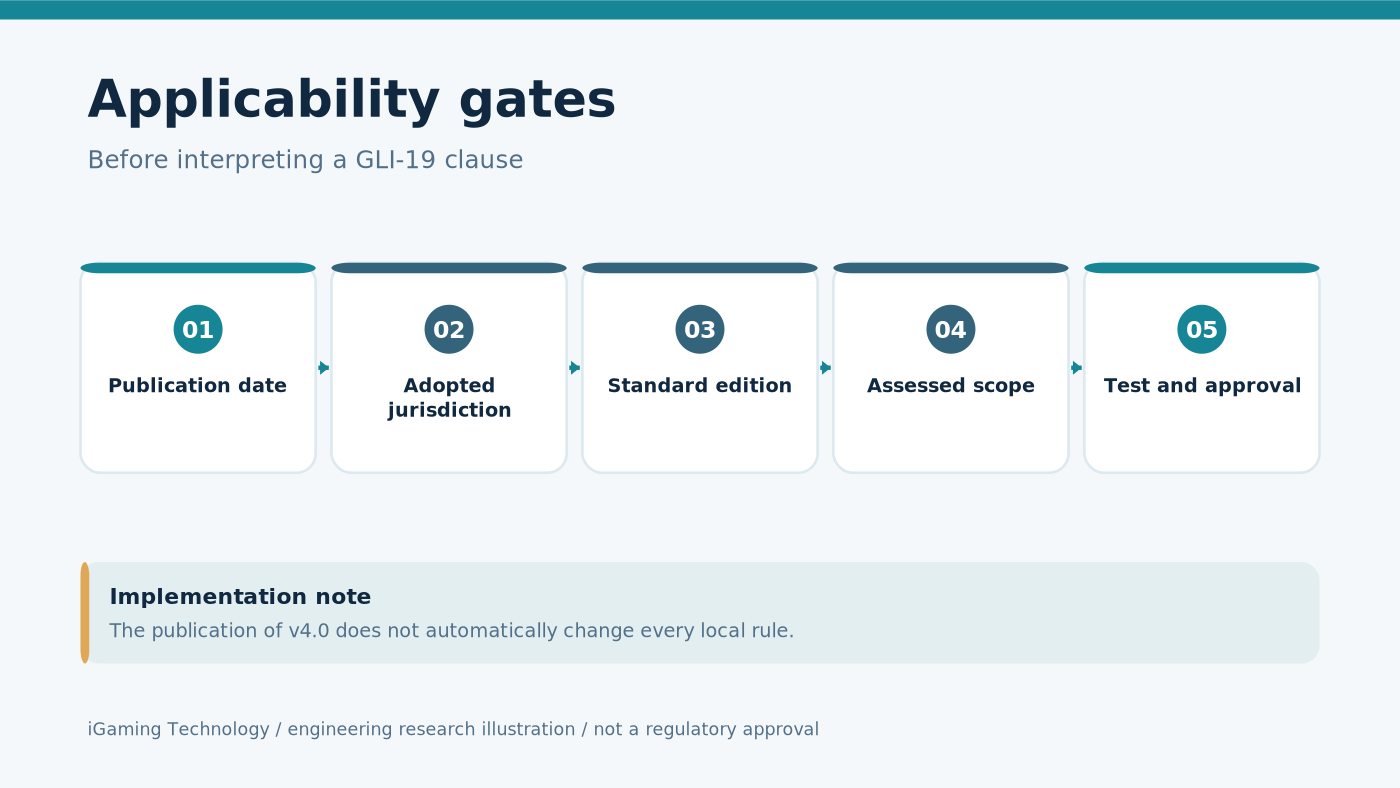
Before implementation, maintain a regulatory applicability record with at least the jurisdiction, operator license and product classification, mandated edition and any amendment, responsible parties, assessment boundary, test-house engagement and applicable operational controls. Distinguish the content of GLI-19 from the regulator’s adoption instrument. GLI’s public standards list being updated to v4.0 does not, by itself, update every approval already issued under v3.0. A legacy test report can still be relevant for an established product, but it must not silently be renamed as a v4.0 assessment.
The current GLI revision history is a useful orientation tool, not an authoritative replacement for the full clauses. For example, it notes that live-gaming studio operational assessments have been separated toward GLI-LGS, while technical live-game provisions remain within GLI-19. That distinction prevents teams from assuming a game-platform test covers physical studio operations.
System integrity, access and operational controls
The starting point for system integrity is a complete inventory of critical components and trust relationships. In a typical interactive gaming deployment, those components include player authentication, account and balance management, game execution, RNG, provider integrations, event transport and reporting. A diagram alone cannot prove integrity. The useful evidence is a versioned description of components, authorized communication paths, privileged actions, security-relevant configuration and the controls that prevent unintended changes.
GLI-19 v4.0 Chapter 2 addresses platform and system considerations, including clocks, control programs, gaming communications, retained information and reporting. Its provisions should be interpreted as a connected control model: synchronized time helps investigators reconstruct the order of events; protected critical components help preserve the validity of outcomes; recoverable retained records help reconstruct financial activity. The specific required controls depend on the adopted clauses and assessment boundary, so engineers should link each design decision to a source paragraph rather than rely on a generic security checklist.
Operational controls have different ownership from purely functional game tests. GLI-19 Appendix A discusses internal procedures, while Appendix B covers integrity and security assessments. A technically capable implementation can fail operationally if privileged access is shared, production changes lack approval, backups cannot be restored or incident records are discarded. Conversely, a documented access procedure does not prove that a game maps randomness correctly. Build separate evidence streams for both and maintain clear links where they intersect.
For access, record privileged identities, service-account purpose, authentication method, authorized role, request approval and revocation evidence. For configuration integrity, preserve deployment manifests, relevant feature flags, protected secrets references, configuration hashes and rollback procedure. For time integrity, store event time and source; distinguish server receipt time from a player device’s reported clock. For resilience, show backup and restore trials rather than a screenshot that merely claims backups are enabled.
A practical review asks what happens when the nominal path fails: an upstream wallet response times out; a replica lags; a session cannot be resumed; a critical service returns conflicting state. The control should not permit accidental repeat credits or a silent replacement of an authoritative result. The requirement matrix should identify which of these properties come directly from adopted clauses and which are engineering safeguards supporting the intended outcome.
Game and transaction controls relevant to system design
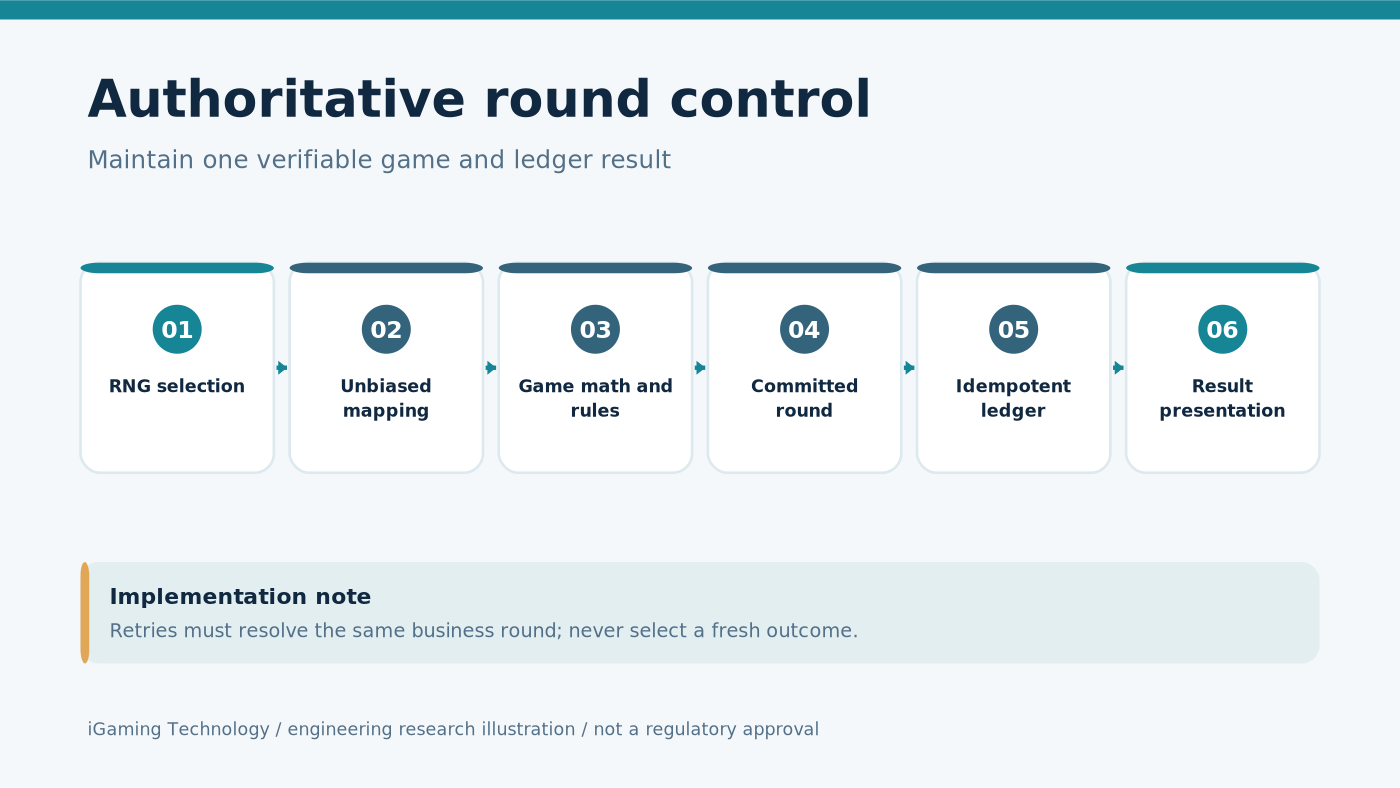
Game fairness is not confined to a random number. A complete outcome path includes RNG selection, scaling or mapping, rules evaluation, amount calculations, state changes, result presentation and wallet settlement. If each stage is correct in isolation but the system applies the result twice after a retry, the player account record is still wrong. Build a transaction model that distinguishes the authoritative game round from a callback or delivery attempt.
Under GLI-19 v4.0 Section 5.2, independent laboratories review randomness algorithms and the scaling, shuffling and other functions that affect the ultimate outcome. The standard calls for statistical examination of final mapped outcomes, not only raw RNG bytes, and distinguishes distribution from independence. For game-dependent non-uniform outcomes, the intended probability model is the reference—not an assumption that every symbol must occur equally often. Section 5.3 addresses RNG strength and monitoring. Engineers should also consult Chapter 6 for the relevant game type and game-outcome behavior.
An authoritative round record should be uniquely identifiable, linked to the applicable math and configuration versions, and immutable in its outcome-defining fields after settlement. A ledger entry should have an idempotency key that survives client and provider retries. Replays should return the committed result rather than select new randomness. Where the game permits an interruption or recovery flow, it must be specified and tested; the engineer should not invent a generic refund policy to cover every case.
Consider a delayed provider callback. The player sends a bet, the platform commits a debit and the network drops the acknowledgment. The provider retries. If the platform treats the retry as a fresh wager, two debits can occur. The correct integration should resolve the same business transaction to its prior result. A companion test must confirm that a request with the same identifier but different amount or currency is not silently accepted as the same operation. This is an engineering pattern, not a claim that a particular GLI clause mandates the exact database implementation.
The released math package, paytable and rules must be traceable to the game code actually running. When comparing two releases, include both ordinary behavior and rare features: multi-step bonuses, jackpots, interrupted sessions, re-entry, duplicate responses and unexpected ordering. Test outcome and financial records together, because reconciling the game result after the fact cannot repair all account-integrity failures.
Logging, audit and change-management evidence
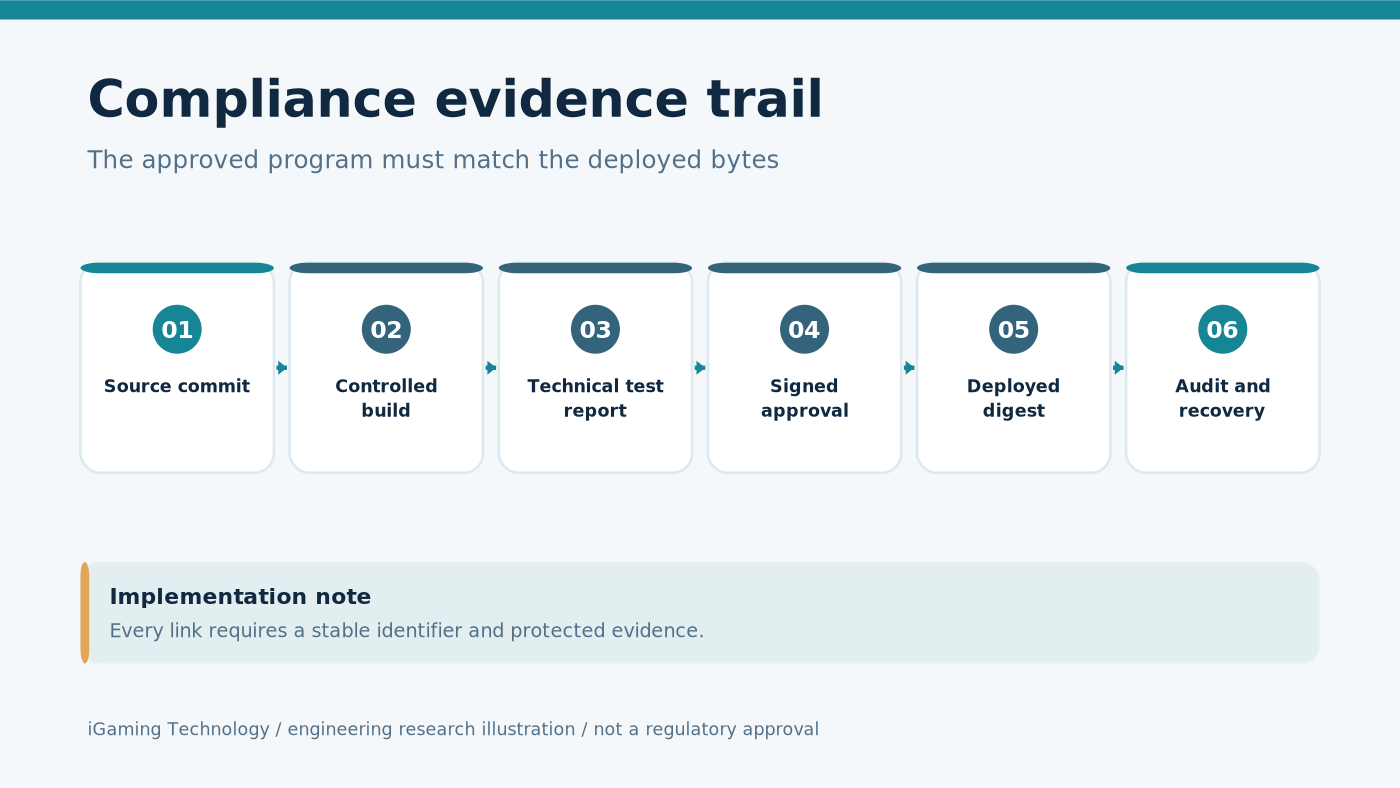
The most useful audit trail answers who did what, to which artifact, when, under whose authority, and with what outcome. Capture source revision, build identity, test evidence, change classification, approvals, release action, live deployment identity and rollback or recovery steps. Include relevant operator configuration and third-party component versions. These records should be retained under the applicable legal and organizational retention schedule, with access controls and integrity protection proportional to their sensitivity.
Avoid designing an audit system as only a high-volume application log. A debug log can be verbose and short-lived; a compliance event requires stable identifiers and interpretable semantics. For example, round_settled should identify the business round, result version, settlement transaction and persisted status. An access-control event should identify the principal, attempted protected action, target and authorization decision. A release event should identify the artifact hash and the environment where it became active. Not every field belongs in a single log stream, and sensitive player information should not be copied indiscriminately.
Version 4.0’s Appendix A consolidates internal-control procedures; Appendix B covers integrity and security assessments. The revision history notes expanded provisions for retained information and reporting. A sensible engineering response is to map these requirements to the retention platform, access controls, independent restore tests, and audit queries that could reconstruct a representative game session. Keep this mapping current when the adopted edition changes.
For change management, the operative question is not simply whether a binary’s version number increased. Did the change affect game fairness, mapped outcomes, settlement logic, access-control boundaries, critical infrastructure or an externally evaluated component? Who determined the impact? GLI-19 Section 1.5.1 describes possible additional testing and, where adopted, use of a change management program. Store the rationale and lab consultation alongside the eventual release decision. A CI pipeline passing is necessary evidence for many controls but is not itself independent certification.
Traceability from requirements to tests
A requirements-to-evidence matrix is the bridge between a long technical standard and a deployable system. Its rows should be small enough that a reviewer can verify a result, but not so fragmented that the spreadsheet duplicates every sentence. One row may represent an individual normative provision; a distinct row may capture an associated engineering assumption or compensating control. Do not label an internal recommendation as if it were quoted from GLI-19.
| Traceability field | Example content | Verification question |
|---|---|---|
| Authority and edition | GLI-19 v4.0; specific jurisdiction and adopted text | Is this actually the applicable baseline? |
| Requirement reference | Section 5.2.3, distribution | Is the intended distribution documented and tested? |
| Component | RNG mapping module and game math package | Which code and configuration implement it? |
| Test method | Source review plus statistical outcome tests | Can the test inputs and expectations be reproduced? |
| Evidence identity | Report ID, build hash, dataset version | Can independent reviewers retrieve the same artifacts? |
| Owner and outcome | Named team, approval, exception | Who is accountable for the remaining gap? |
Start by identifying normative obligations, then record implementation design, risks, test methodology, expected evidence and any accepted deviations. Connect all rows to an immutable build. If the RNG engine and game mapping code are compiled independently, identify both; if the game is a hosted component, preserve external version and contract evidence. Consider an evidence query exercise: can a reviewer choose one production game round and navigate backward to the precise game math version, applicable test report and authorized deployment? If that path breaks, traceability is incomplete.
Automate mechanical checks: missing evidence IDs, expired approvals, unrecognized artifacts, unreviewed changes and links to reports covering other versions. Human review is still required to decide applicability, interpret ambiguities and assess whether a test actually proves the necessary behavior. A passing test attached to the wrong product version is not a small clerical mistake; it undermines the claim.
Jurisdictional adoption and edition-change caveats
Do not equate publication with adoption. GLI published its v4.0 standard on November 3, 2026, but a jurisdiction may require an earlier version or its own rules. A licensing decision may refer to a specific edition, independently adopted provisions or a supplemental program. The laboratory and regulator must resolve this, especially for already-certified components and in-progress submissions.
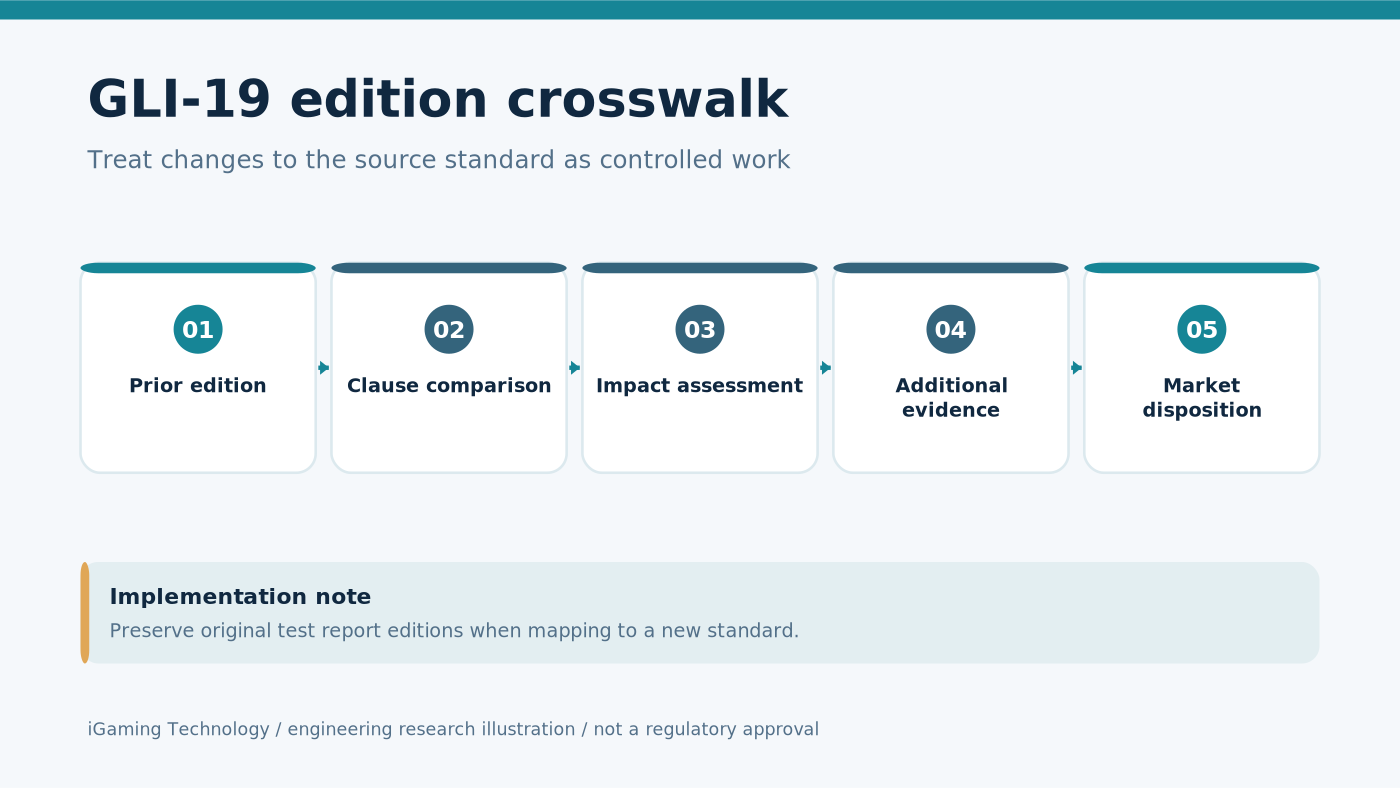
The change from GLI-19 v3.0 to v4.0 is more than pagination. The official revision history documents a new organizational structure, refreshed terminology, expanded controls and new topics. Carry forward previous evidence carefully: build a version-to-version crosswalk; identify sections that moved, expanded or changed meaning; and distinguish reusable evidence from gaps that demand new tests. Do not automatically copy paragraph numbers or treat previous ‘passed’ fields as evidence for rewritten controls.
For multi-market products, maintain separate applicability and approval records per market. Shared source code does not imply shared acceptance criteria. A provider may use a common RNG library while exposing different game variants or configuration capabilities to different regions. Product teams should keep the immutable global binary identity separate from market-specific flags, paytables, controls and approval records.
The safest editorial conclusion is a bounded one: GLI-19 v4.0 supplies a technical framework for assessing interactive gaming systems; compliance claims require edition-specific, system-specific and jurisdiction-specific evidence. The publication of a technical standard does not certify any particular casino, supplier, application or release.