An iGaming software audit trail is valuable only if it allows a reviewer to prove which specific code, configuration and dependencies produced the program that accepted real-money wagers. A release ticket marked approved is not enough. A source commit without a reproducible build identity is not enough. A laboratory report may be perfectly valid for its own subject, yet fail to support the binary actually deployed if the latter was rebuilt differently or selected a different game math configuration.
This guide defines a workable release traceability model for certified iGaming products. It is based on standard software supply-chain practice and the edition-aware testing principles in GLI-19 v4.0 and the UKGC testing strategy. Specific evidence-retention periods, regulator submissions and approval obligations depend on the jurisdiction, operator, product and governing framework; no generic architecture can impose or replace them.

Release traceability goals and actors
Start with four questions: what was reviewed, what was built, what was authorized and what is running? Traceability links the answers without relying on informal memory. A certificate or technical test report has a bounded scope; production has an operational identity; the audit trail bridges the two. The evidence chain should make it possible to select a production game round and identify the software and configuration effective when the outcome was determined and settled.
The main actors normally include developers, release engineering, QA, game mathematics, information security, compliance, independent test laboratories where required, licensed operators and production operations. Their tasks differ. Developers establish source changes; build systems produce artifacts; test teams evaluate fixed artifact identities; compliance interprets applicable standards and external obligations; authorized release personnel approve deployment; operations verifies what ran. Avoid having one unreviewed account both alter game math and silently approve its promotion to production.
A product may consist of many separately deployed components: RGS, RNG service, game math package, wallet integration, player client, content bundle and jurisdiction-specific configurations. Traceability must represent the complete release set, not just a single container image. A game may be served by binary A but use paytable B and feature-flag state C. When a config value determines payout probability or a game’s behavior, that config belongs in the assessed and deployed identity. The system should also identify shared external services that can influence the result.
Define an immutable release_id that references all relevant artifacts, config snapshots and approvals. In production, record the resolved release ID for each active environment and, where practical, for each round or request. Maintain a stable link between game_id, math version, RNG version, platform version and relevant external-provider contract. A descriptive version string remains useful for people, but immutable hashes are needed to rule out multiple different binaries with the same name.
Source commits, build records and artifact hashes
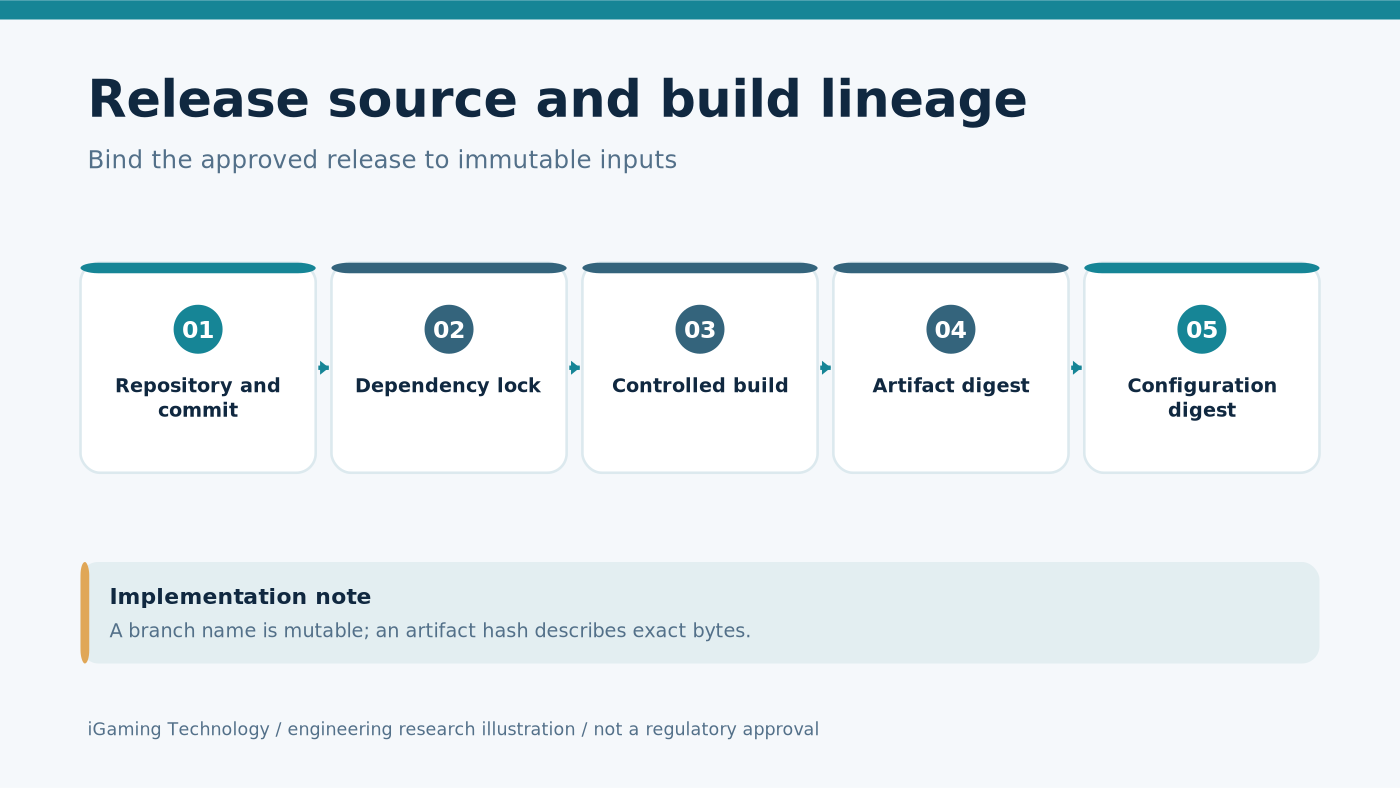
A secure evidence chain begins with source provenance: repository identity, exact commit SHA, authorized merge decision, relevant submodules or dependencies, and the specification for a controlled build. Recording a branch name such as release/november is inadequate because the branch can move. The build record should name the runner or build environment, toolchain, dependency resolution, build inputs and output digest. For sensitive programs, also record signed provenance or an equivalent internal attestation process.
The artifact hash answers a narrow but essential question: are these exact bytes the same? A SHA-256 digest is a common means to identify an image or binary, provided the organization verifies it at the right points and protects the process from unauthorized substitution. A hash does not prove that the binary is safe, correct or certified; it proves identity when compared against a trustworthy expected value. Protect the approved manifest and make its authorization independently verifiable.
Generate software bill of materials (SBOM) or dependency records when useful to assess the impact of library changes. Link each third-party package to a version and package digest where possible. Some regulated builds embed compilation timestamps, environment paths or nondeterministic package ordering; reproducible builds can help but are not always trivially achieved. When byte-for-byte reproducibility is unavailable, provide a controlled build procedure and sufficiently complete compilation/verification evidence as required by the assessment.
GLI-19 v4.0 Section 1.5.1 discusses laboratory access to source code and evidence showing that the compiled output corresponds to the submitted code. This is one explicit reason to treat provenance as a compliance-relevant engineering control. It should not be generalized into a false assertion that every jurisdiction requires the same particular build tool, hash format or signing service.
Linking tests, approvals and deployed binaries
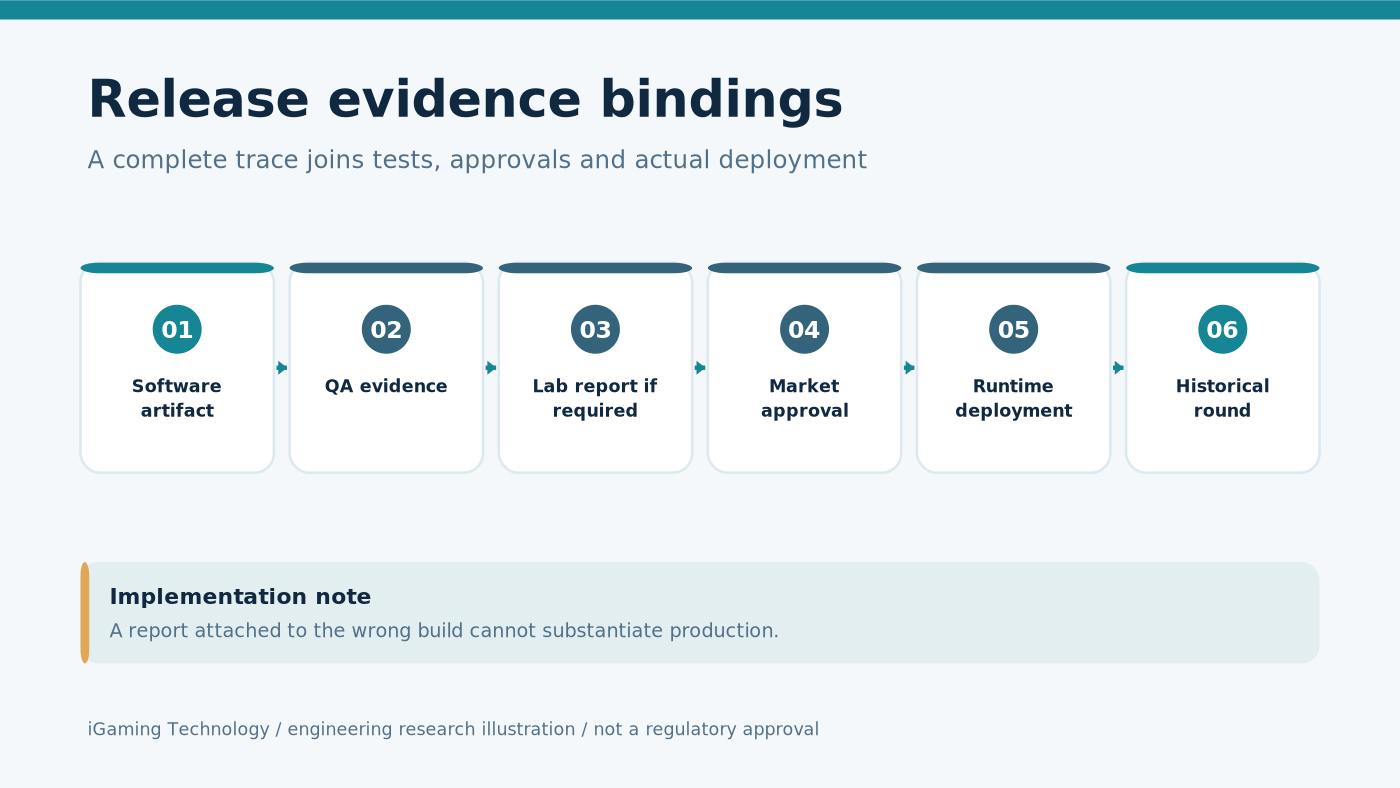
Test reports must identify the exact object they assessed. A report for game client 2.3 with math package 11 cannot automatically cover game client 2.4 and math package 12, even if the visible artwork is unchanged. Make all test jobs write a durable record with artifact digest, configuration digest, test suite revision, environment, time, result, reviewer and any important deviations. Store the artifacts as write-protected objects or in a controlled evidence repository rather than relying on transient CI logs.
The approval stage should ask whether the test set is adequate for this change and this market. That assessment belongs to the appropriate release and compliance owners. Where an independent test house or regulator is required, link the report or submission reference and its exact product scope. A pipeline cannot certify compliance merely because its internal integration tests passed.
Promotion should reuse the already-built, approved artifact rather than rebuild from a tag. The deployment manifest records the digest deployed to each production cluster or region, when it became active, which operator authorized it and how it was verified. For game configuration, save the effective snapshot and version lineage. A canary and full rollout may overlap, so a binary current_version field can be misleading: preserve effective start/end times and traffic routing rules for each version.
A useful production verification query is: for round R, find the serving runtime, deployed image digest, game configuration revision and math model active when R was created; then find the test and approval records applicable to that release set. For financial disputes, independently link settlement entry and callback IDs so a trace of the game result is not confused with attempts to transmit the result.
| Link in evidence chain | Minimum identity | Example failure to prevent |
|---|---|---|
| Source | Repository + exact commit | Branch moved after review |
| Build | Job ID + input digest + output digest | Unreviewed rebuild during deployment |
| Test | Artifact/config digest + test report | Report covers previous math version |
| Approval | Authorized decision + scope + date | Verbal approval without release identity |
| Deployment | Environment + deployed digest + time | Drift between regions or failed rollback |
| Game round | Round ID + effective game/math version | Cannot reconstruct historical outcomes |
Record retention and access controls
Audit evidence has different retention and confidentiality needs from ordinary system logs. Raw request logs may contain personal data or token material that should not be kept indiscriminately. On the other hand, a critical release manifest and associated approval may be needed for much longer to demonstrate which product was running during an investigated period. Define separate classes for source/build evidence, test reports, change records, deployment manifests, critical configuration and player transaction records. Apply the retention schedule required by law and approved organizational policy rather than inventing a universal duration.
Prevent silent modification or deletion of essential records. Useful controls include append-only event histories, immutable object versions, cryptographic integrity checks, restricted roles, separation of duties, backup and restoration tests, and alerts for unauthorized access. A storage system described as ‘write once’ is not enough if administrators can rotate its credentials and delete the account without detection. Periodic evidence retrieval exercises should demonstrate that the records are readable and internally consistent.
The audit trail should remain usable when a vendor or employee leaves. Avoid basing the evidence chain on a personal cloud drive, local build-agent disk or inactive employee credentials. Maintain a service owner, backup access procedure, documented export format and a recovery runbook. If evidence is held by an external game supplier or test house, clarify what must be retained by the licensee and how the corresponding record can be requested, verified and associated with the deployed build.
Privacy and minimization also matter. A compliance audit may require transaction identifiers and controlled player-account references, but it rarely benefits from unrestricted copies of full player profiles in release logs. Store pointers and authorized lookup mechanisms where possible. Configure access logging for evidence retrieval and use a narrowly scoped process for investigations that require joining sensitive account data.
Evidence package examples
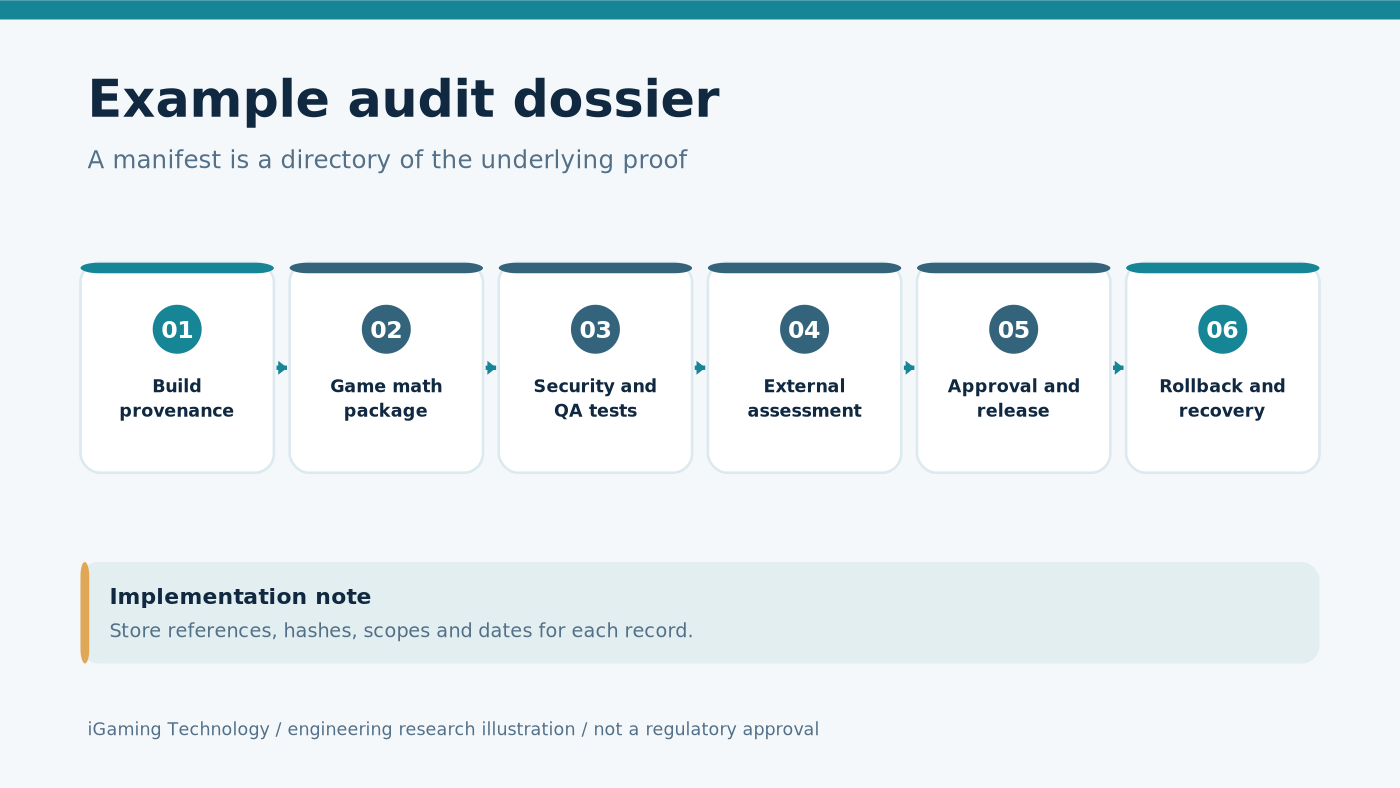
A good release dossier is a manifest plus independently readable supporting materials. For a hypothetical release casino-rgs-2026.11.23-rc2, it might include the source revision, build job, image digest, SBOM, game math package digest, approved configuration revision, RNG interface version, unit/integration/regression tests, completed security scans, change classification, test-house report where applicable, compliance sign-off, deployment approval, active-region manifests, and rollback record. These are illustrative field names, not a real product or mandatory regulator format.
A minimal machine-readable manifest could look like the following, with all example values clearly synthetic:
{
  "release_id": "demo-rgs-2026-11-23-r2",
  "source_commit": "example-commit-sha",
  "build_id": "ci-demo-418",
  "image_digest": "sha256:EXAMPLE_NOT_A_REAL_HASH",
  "game_math_version": "demo-math-v7",
  "config_version": "demo-eu-config-v3",
  "test_report_id": "demo-qa-091",
  "approval_id": "demo-change-052",
  "deployments": ["demo-region-a", "demo-region-b"]
}
Do not mistake this manifest for the evidence itself. It must be possible to retrieve and verify every referenced record. A reviewer should test the path in both directions: from a lab report to the production release that cites it, and from a historical production round back to the applicable report and approved changes. If an external provider’s new API version affects the tested outcome path, the dossier should show that change and its assessed impact.
When several games share a platform, maintain a dependency map from the platform version to affected games. For a new platform release, verify whether previously certified integrations can rely on existing test evidence or require additional assessment. The UKGC testing procedure notes that changes to RGS or RNG can impact many games and describes representative retesting in relevant circumstances. A single platform digest without a dependent-game inventory is inadequate to support the test-scoping discussion.
Audit gaps and verification checklist
Common gaps are predictable: test evidence references a branch rather than a commit; a laboratory report lists a game title but not the effective math version; CI rebuilds the binary after approval; several regions run different digests without a rollout record; an emergency feature flag changes outcomes but is absent from the assessed release set; or a rollback returns code but not configuration. Each issue creates uncertainty about what was actually reviewed and what later handled wagers.
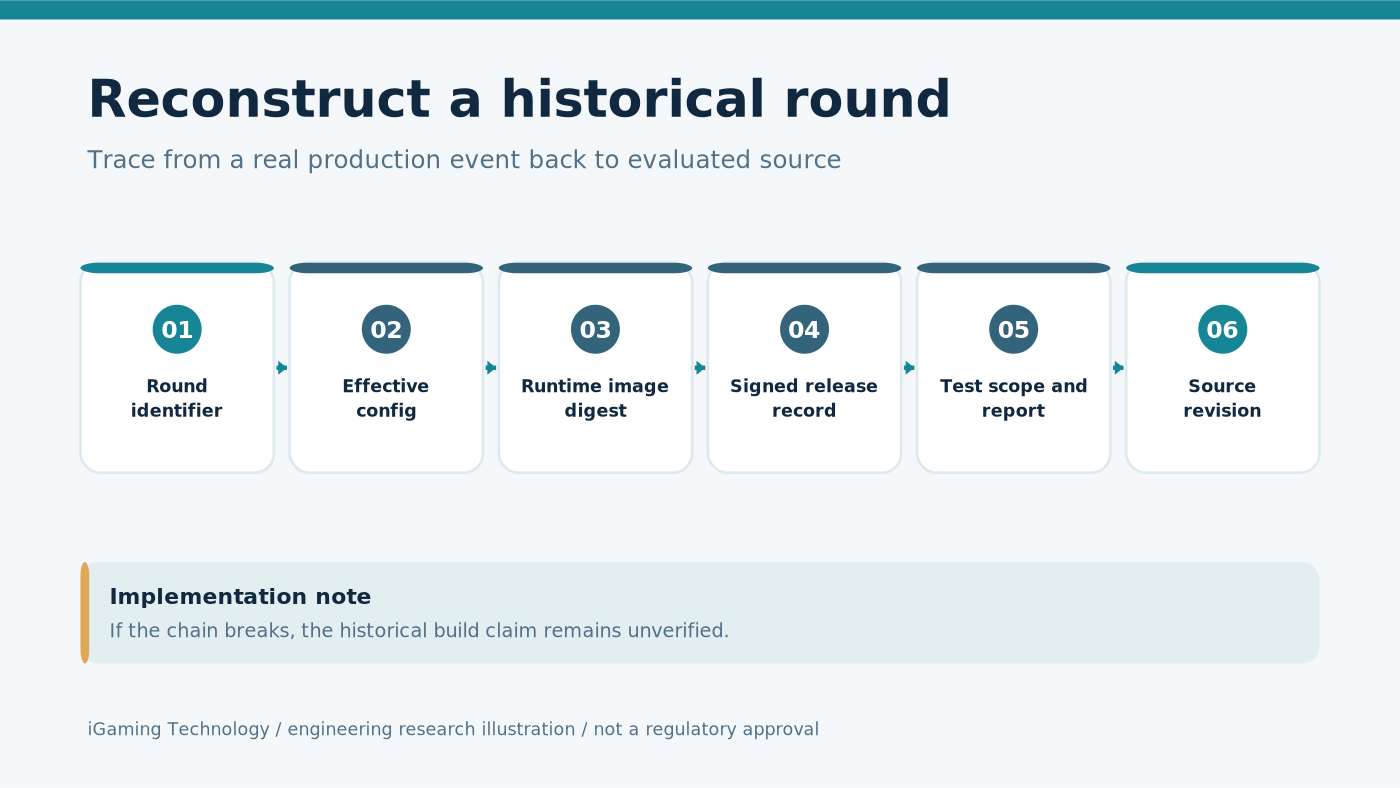
Use a periodic audit rehearsal to find those gaps before a regulator or incident investigator does. Choose a historical production round, then retrieve its game version, RNG component, deployed platform digest, effective configuration, financial settlement record, relevant test evidence and release approval. The reviewer should be able to validate the links without knowing the engineer who performed the deployment. Repeat this for a release with a rollback or hotfix and for a system change affecting multiple game variants.
A practical review checklist asks whether every production artifact has a trusted digest; whether every digest has documented source and build lineage; whether changed dependencies and configs are assessed; whether tests and approvals are bound to that exact release; whether deployments are recorded per region and effective time; whether historical round IDs are sufficient to reconstruct state; whether emergency changes are captured; and whether retention, access and recovery controls have been exercised.
A traceability system cannot itself guarantee fair outcomes, secure keys or valid certification. It provides the evidence linkage by which those claims can be investigated and compared with the actual software in service. This makes traceability a continuously operated control, not paperwork assembled at the end of a certification project.