Gaming API abuse detection is difficult because many legitimate gaming integrations are automated. A game provider may send thousands of authorized callbacks during a recovery window; a mobile client can reconnect after an outage; an operator can run scheduled reporting exports. At the same time, an attacker can spread credential guessing, enumeration or resource exhaustion across many sources at a low per-source rate. A detector must distinguish traffic that violates the API’s security or business contract from traffic that is merely large or unfamiliar.
This is a defensive engineering guide for authorized operators. It focuses on monitoring, admission controls, investigation and reduction of false positives. It intentionally does not provide bypass procedures or attack payloads. In particular, any ML system is subordinate to authentication, authorization, input validation, idempotency and wallet correctness. The figures show synthetic scenarios, not real-world incident rates.

Scope: abusive automation versus normal load
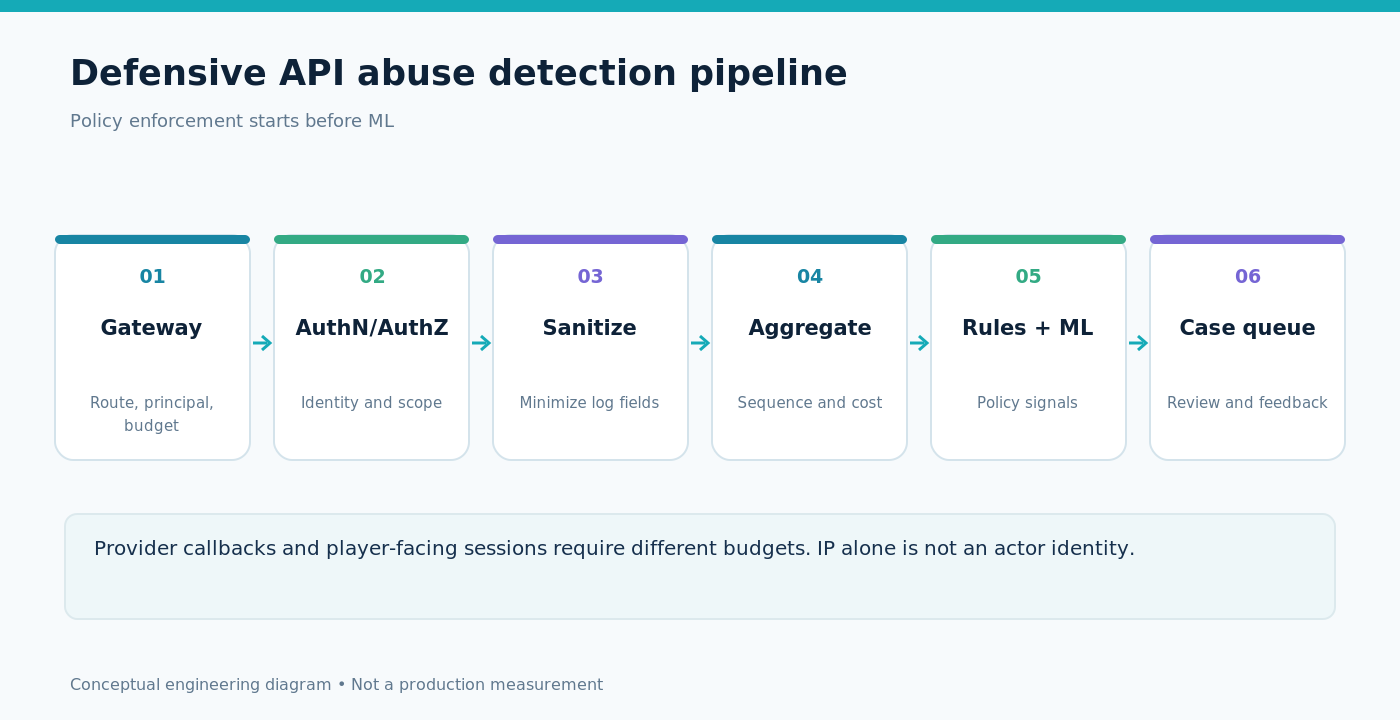
Define an API actor by the principal established at the trust boundary: a provider credential, tenant application, service account or authenticated customer session. IP address is a useful transport attribute, but it is not identity. Partners may send from shared gateways; ordinary customers may share carrier-grade NAT; mobile sessions change network addresses. A classification based solely on IP can harm legitimate users and still miss distributed abuse.
Start with endpoint semantics. Authentication and recovery routes have different threat models from game launch, wallet callbacks, reporting exports and administrative APIs. A settlement callback may legitimately arrive in bursts and must tolerate retries; a player-facing public endpoint should have a different request budget and risk posture. Build inventories of allowed callers, permitted operations, maximum resource costs, request-size constraints, tenant-specific budgets and expected error behavior. A request is suspicious when it departs from that documented contract, not simply when an engineer finds its timing odd.
Common concerns include credential-stuffing attempts, unauthorized resource access, automated account creation, endpoint enumeration, excessive export or search queries, and resource-consumption patterns. The OWASP API Security Top 10:2023 identifies classes such as unrestricted resource consumption and broken authorization; it is a security reference, not proof that a particular casino platform has these vulnerabilities. Detection complements, but does not replace, preventative authorization checks on every relevant operation.
Keep a distinct class for infrastructure incidents: a legitimate provider retry storm after a timeout can resemble attack traffic. Its correct treatment may be backpressure, callback deduplication and joint incident coordination rather than blocking a partner account. Distinguish intentional misuse, accidental integration defects, and normal peak demand in the ground-truth labeling scheme.
Rate, sequence and behavioral signals
Measure rate at multiple scales: one second, one minute, a session, and a longer account or partner window. Include accepted requests, rejected requests, bytes, work units, expensive query cost and response errors. A thousand cheap cached reads may be less dangerous than a handful of resource-heavy export requests. Track request arrivals separately from successful operations: a bot may generate large failed volumes without reaching the business layer.
Sequences can be more informative than counts. A typical session may authenticate, launch a game, place a permitted request and receive its corresponding result. Repeated attempts at invalid resource identifiers, sudden traversals across unrelated objects, persistent authentication failures or implausibly broad query combinations warrant investigation. However, do not treat human-like timing as an integrity guarantee: user behavior and accessibility tools vary widely, and authenticated machine clients do not need to imitate humans.
A practical normalized request event includes principal_ref, tenant_id, route_template, method, authorization_result, status_class, request_cost_units, trace_id, received_at, device_or_client_class where justified, and minimized network context. Route templates prevent a unique customer ID from becoming a different feature value for every request. For wallet and settlement APIs, attach stable business idempotency references so retries can be recognized without treating duplicate transport deliveries as separate economic effects.
Design the features around a clear detection hypothesis. Examples are failed-authentication ratio by account class, number of distinct forbidden route templates, expensive-request units per authorized principal, sudden shift in endpoint sequence distribution, and concurrent requests against mutually exclusive operations. The feature job should observe provider-specific maintenance windows and allowed quotas. Retain a data-quality flag when logs are missing; a pipeline gap should not be interpreted as reduced abuse.
Rule-based detectors and ML features
Begin with controls that are directly enforceable and auditable: per-principal and per-endpoint budgets, schema and size checks, authorization at object and function boundaries, bounded pagination, safe timeouts, and cost controls on expensive operations. Token-bucket or similar admission controls can reduce resource exhaustion, but their limits must account for legitimate retries and service dependencies. The budget for a partner settlement callback should not be copied from a consumer-facing login API.
Rules detect known bad contracts. ML can help prioritize more ambiguous patterns spanning many events, such as an unusual combination of route changes, failure clusters and request cost. Compare a simple statistical baseline with a supervised classifier only when sufficient independent labels exist. An unsupervised anomaly score can highlight outliers but must not be called a calibrated maliciousness probability. Preserve reason codes: unusual route diversity, increased authorization failures or departure from a cohort baseline provide more actionable context than an opaque number alone.
Use time-aware validation to avoid data leakage and overly optimistic evaluation. A bot campaign can have many near-identical requests; splitting those requests randomly across train and test sets can make the model appear smarter than it is. Hold out entire periods, newly onboarded clients and distinct incidents where feasible. Evaluate the model in shadow mode before it can impact a session, and record whether observed uplift over static rules justifies the maintenance cost.
High-confidence deterministic enforcement and advisory model scoring should have different permissions. The gateway can reject a structurally invalid or unauthorized request immediately. A model may recommend additional inspection or a limited challenge, but should not silently override endpoint authorization or create arbitrary changes to a wallet balance. This separation also means a failed model service cannot disable API access-control safeguards.
False positives, evasion risks and human review
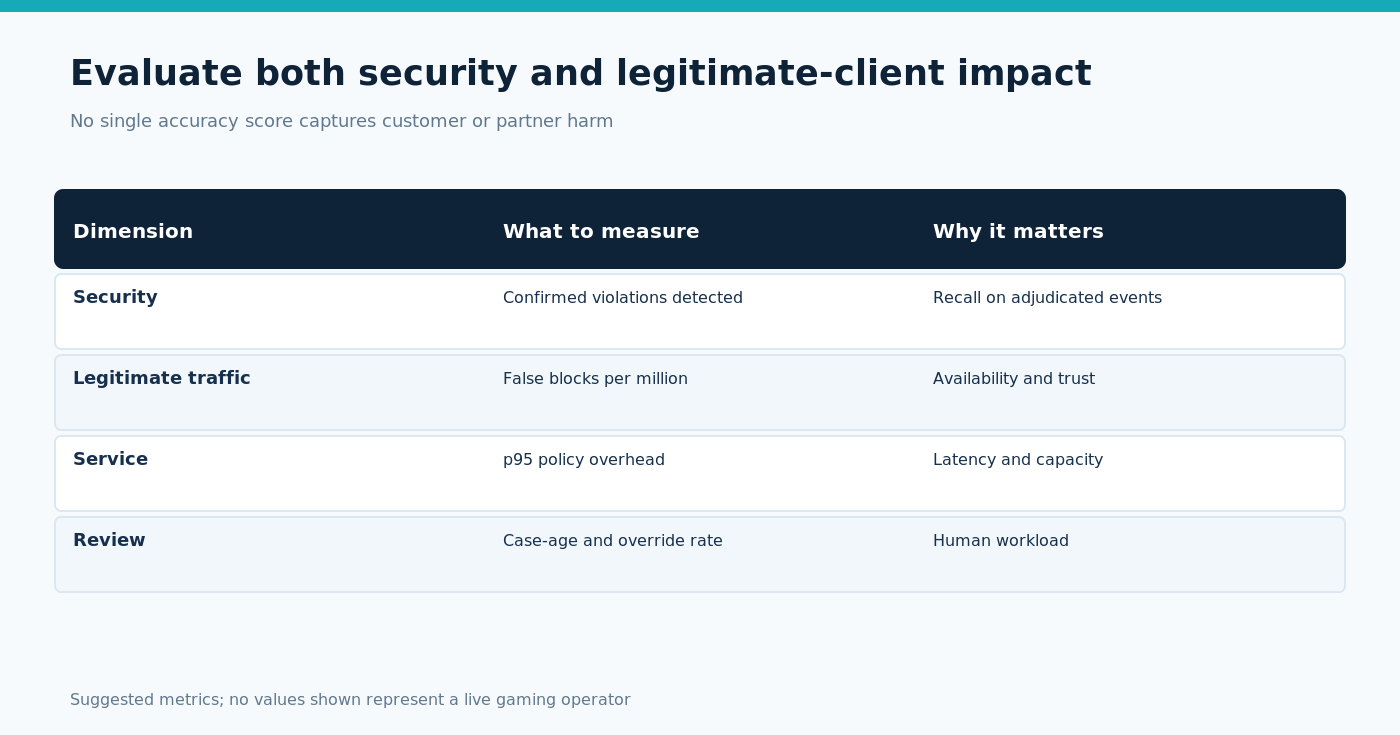
An accurate-looking detector may still be unsafe if it blocks legitimate game providers during a recovery event. Test examples of coordinated callback retries, rotating mobile IPs, partner backfills, accessibility automation, scheduled reports and authorized load tests. Segment performance by principal type and endpoint family. Measure false blocks per legitimate million requests, not merely a global precision percentage. Track customer-support incidents and provider escalations after action.
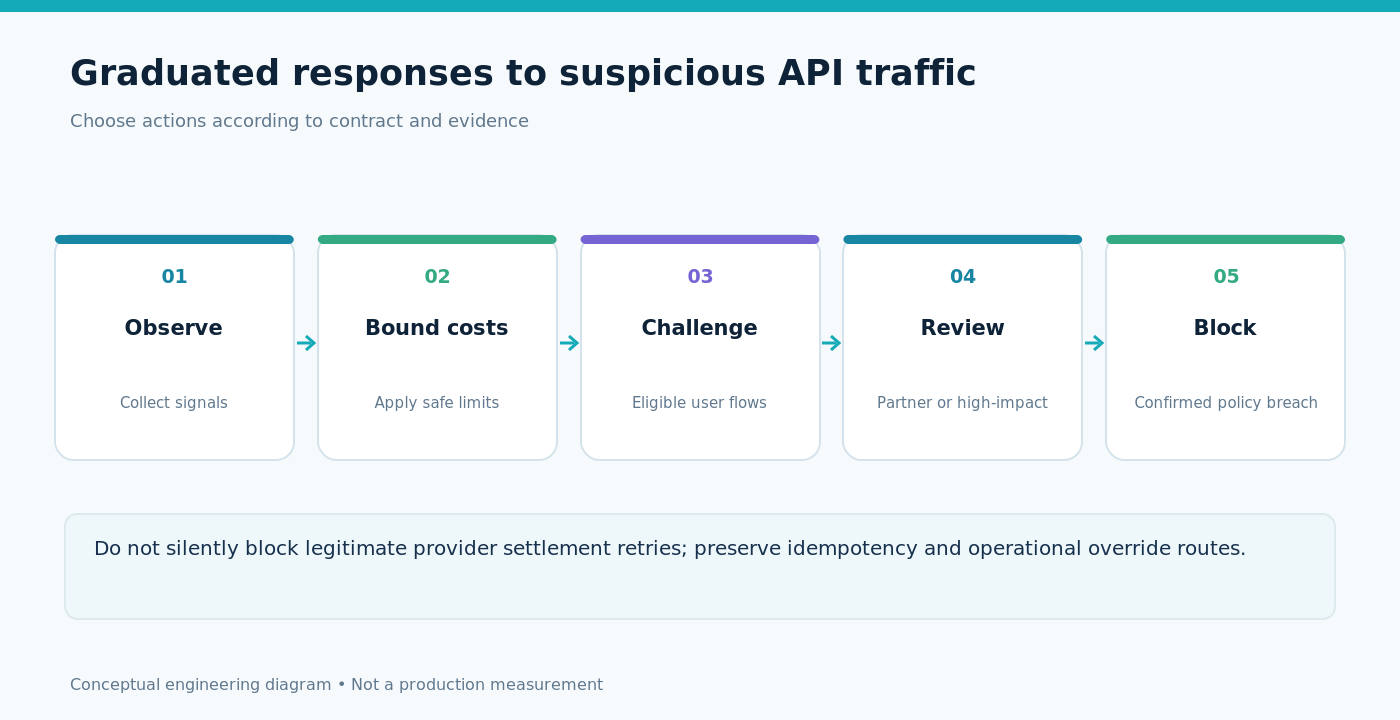
Use a graduated response policy: log and observe low-confidence deviations; issue a bounded rate adjustment where the contract allows; request a step-up challenge for eligible user flows; or escalate to a security analyst before changing a partner integration. Immediate blocks should rely on policy-backed evidence of unauthorized or harmful behavior, with documented appeal and recovery paths. Build a fast override procedure for confirmed false positives and test it during incident exercises.
Because adversaries adapt, avoid displaying exact detection thresholds in client-facing error messages or public dashboards. This does not mean hiding fairness or accountability: the organization should still document its internal decision logic, governance, reviewer powers and customer redress process. Rotate credential material and enforce least privilege independent of whether the model currently raises alerts. A model trained on polluted feedback may normalize abuse; preserve trusted review labels and clean reference intervals.
An analyst case should show a timeline of request classes, policy outcomes, tenant and client context, related account events, recent deployments and network changes. Do not mix unrelated customers into the same case merely because they share an IP. Reviewers should be able to mark legitimate automation, infrastructure error, confirmed policy violation, data-quality defect or unresolved case. Retain evidence safely and include the responsible operational owner.
Privacy and model decision boundaries
Network identifiers, device data and account histories may be personal data depending on jurisdiction and context. Collect only what is necessary for the stated detection purpose; minimize raw payload retention and prefer pseudonymized actor references. Restrict analyst access, audit case retrieval and set retention periods for logs, features, model snapshots and review decisions. Do not treat a convenient analytics warehouse as an unrestricted store of payment or identity information.
Model outputs should not influence RNG bits, game paytables, settlement amounts or game-result selection. Risk controls that delay a new request must be clearly defined before the transaction is accepted. Already-accepted bets require contract-governed completion or reversal; a suspicion score alone is not a valid explanation for a silent financial change. This boundary is essential to preserving auditability and user trust.
Ensure cross-tenant isolation. Aggregated feature baselines may be useful, but a detector should not expose one provider’s traffic characteristics to another provider. When infrastructure supports multi-region processing, review lawful data-transfer boundaries and the consequences of eventual log delivery. A model that requires unavailable cross-border data should not force an undocumented fallback that erodes privacy controls.
Example detection pipeline and quality metrics
A reference architecture is API Gateway → AuthN/AuthZ and cost controls → Sanitized Request Events → Stream Aggregation → Rules + Optional ML Scoring → Policy Decision → Security Case Queue → Analyst Feedback. For high-risk routes, the gateway applies deterministic admission checks synchronously. Feature jobs and statistical scoring can run asynchronously. Only a narrowly governed policy decision can affect user-facing flow, and every action has a traceable reason and expiration.
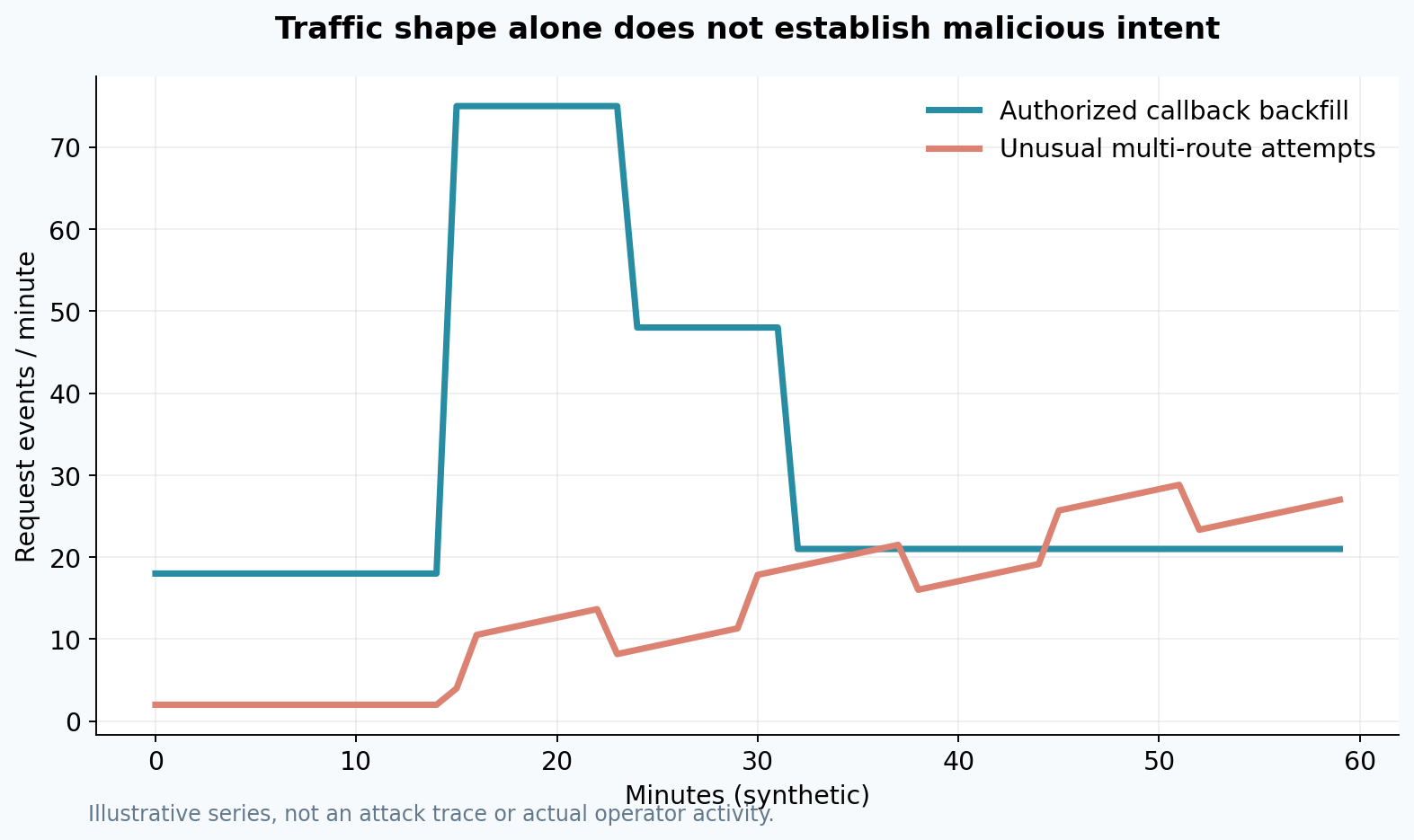
For a reproducible demonstration, generate synthetic legitimate browser sessions, partner callback bursts, authorized QA traffic and suspect unauthorized resource scans. Avoid actual attacks against third-party services. For each scenario, preserve the correct authorization expectation, expected retry semantics and resource cost. Test whether a system continues to enforce object authorization even when the ML scorer is offline; verify that authorized callback retries are not double-charged; and assert that challenges can be reversed after reviewer approval.
Report a metrics matrix: protected endpoint coverage, false-positive rate per principal class, confirmed detection recall on adjudicated cases, analyst queue age, p95 policy overhead, legitimate request completion rate, and time to recover from false blocks. Use an explicitly stated time window and denominator. Do not publish a headline model accuracy figure without the real-positive prevalence and review procedure. A production rollout needs change control, incident ownership and rollback criteria.
Related reading: OWASP API Security Top 10, ML model monitoring and transaction anomaly detection. The OWASP guidance supports the security taxonomy, not any claim of measured effectiveness for this illustrative design.