A casino operations dashboard may show the number of active sessions, failed game launches and settled rounds, while a risk team examines unusual patterns and a finance team compares aggregates with the authoritative ledger. All three views may consume events from the same platform, but they do not share the same freshness, consistency, privacy or correctness requirements. A real-time gaming analytics pipeline must be designed around those differences rather than around a single promise of instant dashboards.
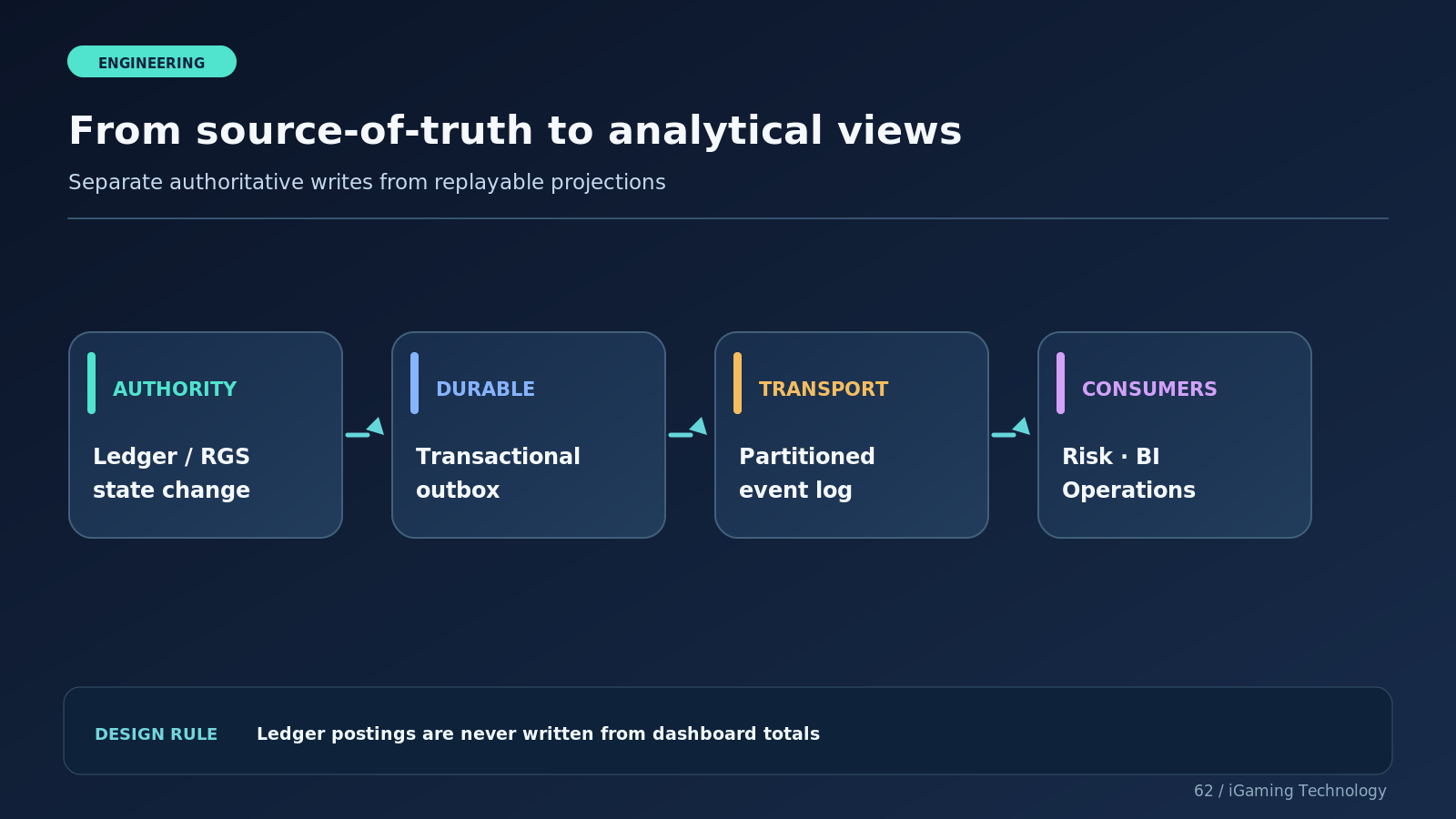
The central architectural distinction is between operational truth and an analytical projection. The wallet ledger establishes which money movements have been booked. An event pipeline transports observations about those movements and other activity so that downstream systems can build views. If the pipeline is delayed, duplicated, replayed or reprocessed, it must not silently change the authoritative account balance. For the financial boundary, see Casino Wallet Architecture and Transaction Reconciliation.

Analytics use cases and event producers
Start with questions, not a choice of streaming technology. A product analyst needs hourly engagement trends; operations needs near-real-time provider error rates; finance needs auditable settlement summaries; fraud and integrity specialists may need low-latency risk signals. Each answer requires a different contract for acceptable delay, source authority, data granularity and correction handling. A dashboard that changes quickly but cannot explain its source may be less useful than a slower, reproducible report.
Common producers include the game launcher, remote game server (RGS), wallet service, provider adapter, identity service, catalog service, payment connectors and observability agents. Their event boundaries overlap. A game round might produce round_started, bet_authorized, bet_booked, result_recorded, win_booked and round_closed. Counting each as a separate wager or using a launcher event as proof of a debit would create inconsistent analytics. Decide which event answers which metric before building ingestion.
A useful event envelope includes event_id, event_type, schema_version, occurred_at, produced_at, producer, tenant_id, correlation_id, source_object_id and a pseudonymous account reference where needed. The payload should distinguish money movement types from mere notifications. For financial aggregates, include stable ledger or provider transaction references, currency, sign convention and status; do not infer a completed posting from an intention to post. Prefer integer minor units or an explicitly defined decimal representation over floating-point arithmetic for monetary values.
Create an ownership matrix: the ledger team owns posted financial facts, the game orchestration team owns launch outcomes, the catalog team owns versioned availability, and the analytics team owns projections derived from those facts. Owners approve schema changes and explain anomalies. This reduces a subtle failure mode in which the same name, such as game_success, means different things across services.
Ingestion transport and processing guarantees
An event broker is useful because producers and consumers evolve at different rates. Producers publish once to a transport; multiple consumers independently build a risk view, operations projection and historical dataset. Kafka-style partitioned logs are a common implementation, but the design principles also apply to other durable streaming systems. A broker does not eliminate the need to handle lost acknowledgements, duplicate submissions and downstream effects.
For source databases, a transactional outbox can make the database update and the record describing it part of one local transaction. A separate publisher forwards outbox records to the broker. This narrows the gap between a successful ledger posting and a missing event. The publisher can still send an event more than once, so consumers retain deduplication and replay strategies. A direct publish performed after a database commit without an outbox leaves a crash window that must be accounted for.
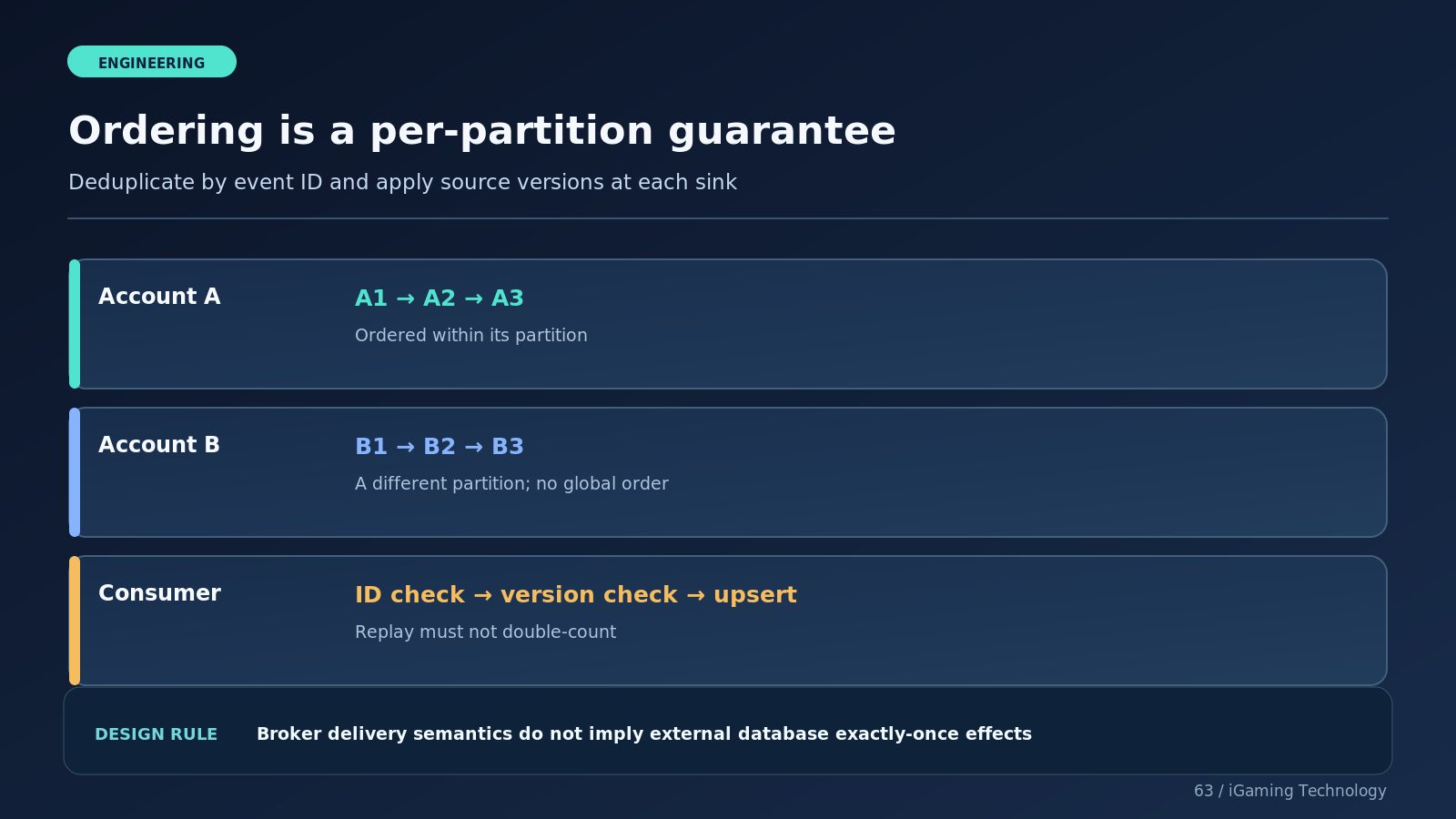
Choose partition keys deliberately. A key such as wallet_account_id preserves relative event order for that account in a single partition, while a key such as provider_id can concentrate hot traffic. Kafka guarantees order within a partition, not globally across a multi-partition topic. A design requiring ordering across independently partitioned wallets needs an application-level reconciliation or sequence rule, not an assumption that arrival order equals source order.
“Exactly once” should name a bounded scope. A stream processor may offer transactional output and offset commits within its supported infrastructure, yet an external SQL warehouse, HTTP service or wallet is a separate side-effect boundary. Use stable event_id values and idempotent upserts for those sinks. For mutable business facts, consider a business key plus monotonic version so a delayed older update cannot overwrite a newer state.
At the transport boundary, configure authentication, encryption, producer authorization, per-tenant isolation and payload size limits. Avoid attaching raw personal identifiers or session tokens to broad analytics topics. A fast system with uncontrolled consumer access is not an acceptable architecture.
Stream transformation and enrichment
Streaming transformations usually normalize different provider vocabularies, enrich events with catalog metadata, classify error codes and compute time-windowed aggregates. Transformations should be deterministic where practical: the same versioned input and reference data should yield a reproducible result. This matters when a historical reprocessing job is run after discovering a producer bug.
The first step is validation. Reject or quarantine events with missing identifiers, unsupported schema versions, invalid units or impossible timestamps. A malformed event should not poison an entire partition. The quarantine record should preserve a safe diagnostic reason and a source reference, with an authorized replay route after correction. Track the quarantine rate by producer and schema version rather than quietly discarding failures.
Time has at least three meanings: when the event happened (event time), when the producer emitted it, and when a processor received it. A provider callback might describe a round that ended a minute earlier. Windowing on ingestion time can misplace its activity into a later period. Event-time processing with watermarks and allowed lateness is often better for behavioral analytics, but it introduces revisions. A published hourly total may be provisional until its lateness window closes.
Enrichment introduces a second clock. If a game’s category changed today, should last week’s event be classified using today’s catalog or the catalog version effective when it occurred? Financial and compliance reports generally require reproducible as-of joins. Store effective dates or snapshots, and distinguish corrections to source data from new business activity. Never recompute money totals by joining loosely defined status events without checking posting semantics.
For anomaly detection, expose features as estimates with documented lag, not as undisputed account truth. If an integrity signal pauses a workflow, its consumer should have its own audit trail and escalation policy. A failure in the analytical layer must not casually mutate posted balances or erase provider evidence.
Storage tiers and serving patterns
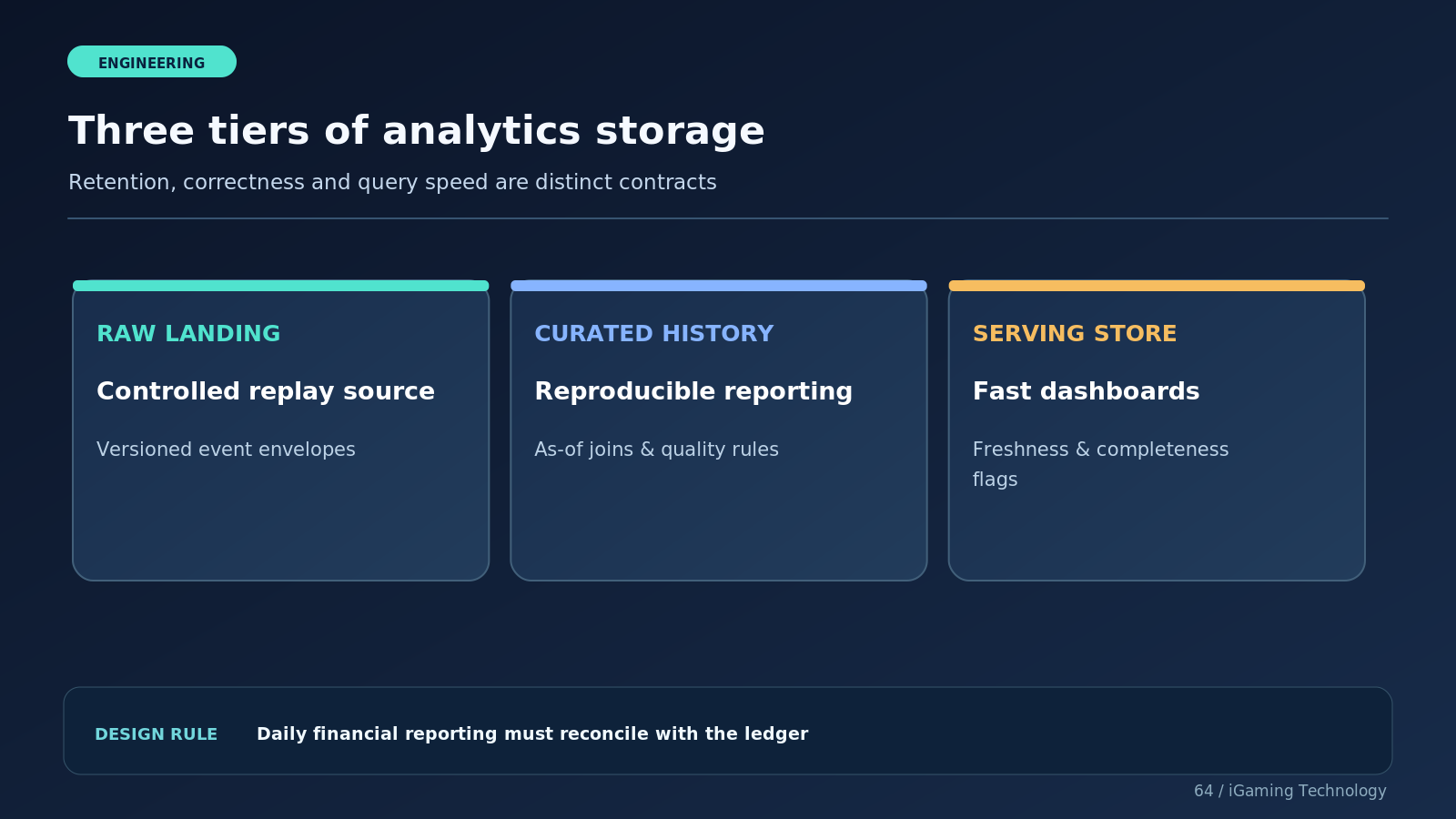
The processing path often splits into three layers. A raw immutable landing zone retains events for controlled replay and investigations. A curated historical store supports large scans, dimensional analysis and reproducible reporting. A low-latency serving layer maintains materialized aggregates for operational dashboards. These can be distinct technologies or logical layers, but they should expose their individual freshness and retention policies.
Raw retention is a governance choice, not an excuse to retain all data indefinitely. Restrict who can read raw payloads, apply appropriate retention and deletion rules, and minimize sensitive fields before broad distribution. Version schemas and record lineage so an analyst can trace a dashboard number back to the transformations and source events that formed it. Some reports need immutable daily exports and approval workflows rather than automatically changing streaming views.
A serving table might be keyed by tenant_id, provider_id, minute_bucket with settled_rounds, launch_failures and latest_event_time. Store a materialization version, update time and completeness flag. This allows a UI to show “last updated” and to warn when a provider stream is delayed. It also prevents a silent operational hazard: a dashboard staying green because no new error events have arrived during an outage.
Lag, backpressure and failure recovery
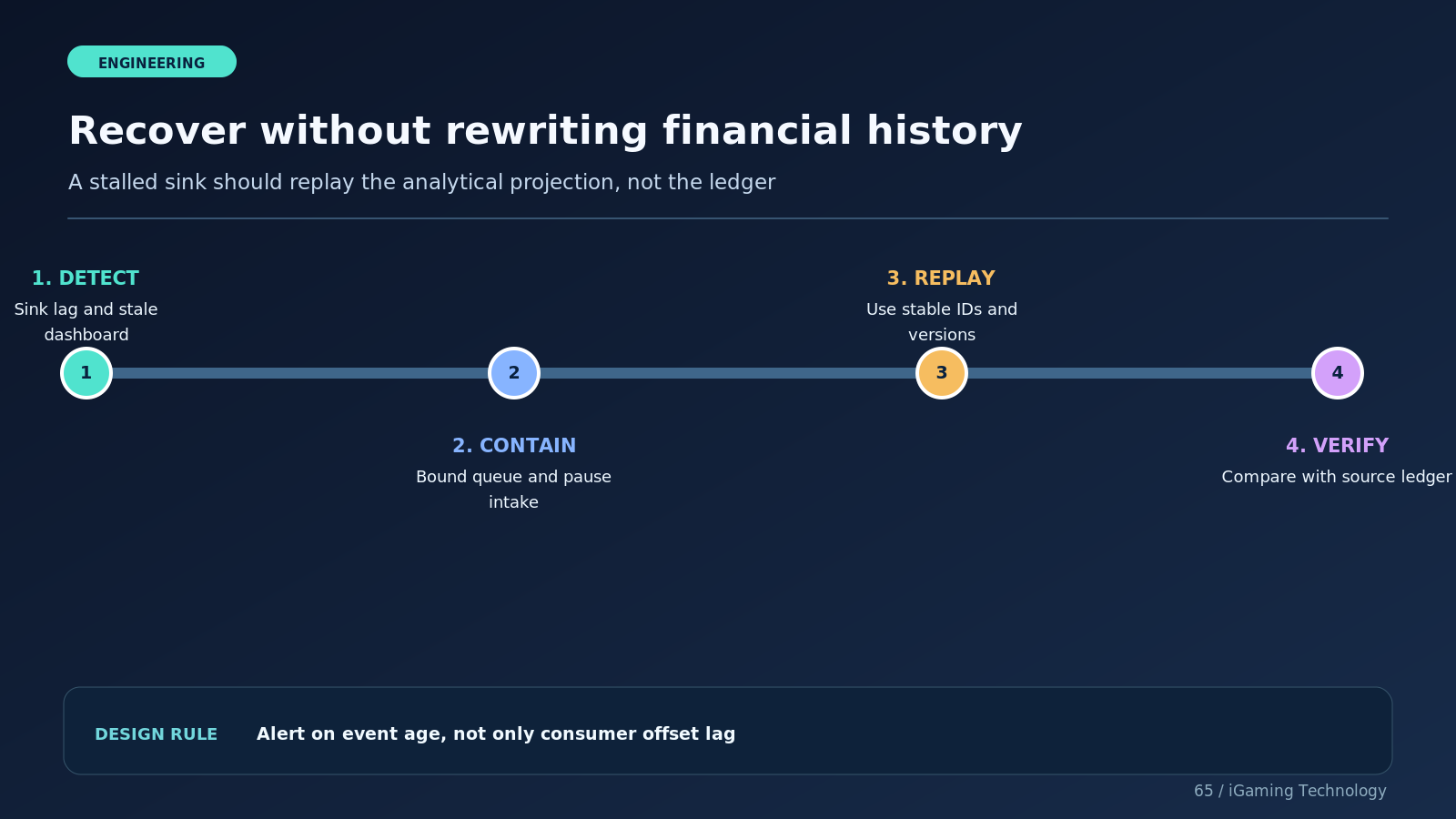
Lag is not only the number of unconsumed broker records. Measure end-to-end event age from occurrence to visible projection, broken down by producer, partition, transform and sink. A zero broker lag metric can hide a stalled source outbox or a warehouse writer that has accepted but not committed a batch. Monitor per-stage arrival rates, processing rates, oldest unprocessed age, retry counts and dead-letter volume.
Backpressure should be explicit. When a warehouse slows down, a consumer can limit concurrency or pause intake while retaining broker offsets for recovery. Unbounded memory queues are not a strategy. Set retention long enough for the expected recovery period, but test whether reprocessing an outage backlog can compete with live production traffic. Run catch-up capacity drills against realistic peaks, including promotional bursts, provider outages and synchronized round settlements.
A robust recovery procedure identifies a safe replay point, checks downstream idempotency, selects a processing version and records any corrected outputs. For example, if an enrichment job used an incorrect catalog version for 30 minutes, the repair should target the affected partition/time range, publish a new projection version, and reconcile the aggregate against authoritative source records. Simply restarting the consumer may reproduce the same error faster.
Protect the system against poison records and schema drift. A newer producer may emit a field a lagging consumer cannot decode. Declare backward/forward compatibility requirements, validate in preproduction and alert on rising parse-error rates. Failed retries should be bounded, observable and routed to a controlled queue, not loop forever.
Reference pipeline and architecture trade-offs
A practical reference path is: producer local transaction → outbox → publisher → durable event transport → validation → normalization/enrichment → raw landing and curated transforms → low-latency serving tables → dashboards and approved exports. Each arrow needs an owner, latency budget, error policy and replay mechanism. A separate reconciliation job periodically checks financial aggregates against ledger snapshots; discrepancies are investigated rather than silently adjusted in analytics.
Consider the design with a worked example. The wallet books a USD 5.00 bet at 10:00:01 and writes an outbox event in the same local transaction. The publisher delivers the event twice after losing its first acknowledgement. The consumer deduplicates the stable ID, updates the per-minute aggregate once and records its transform version. At 10:04, a late win event whose business timestamp is 10:00:58 arrives. The event-time window updates the provisional 10:00 result, while the dashboard exposes its last revision. A separately signed daily financial report later reconciles against settled ledger entries, not against a potentially provisional stream count.
The architecture trade-off is cost and complexity versus latency and recoverability. A small product may begin with an outbox plus scheduled aggregation and a curated warehouse. A large multi-provider estate may need partitioned streaming, dedicated real-time stores and independent consumer teams. Do not migrate to more infrastructure until you can state the freshness SLO, peak throughput, recovery requirements and consequences of incorrect projections.
Design review checklist: Can every metric name its authoritative source? Are event IDs, versions and currencies stable? Can a consumer replay without double counting? Are event-time revisions visible? Does the raw store follow retention policy? Does a source outage trigger a freshness alarm? Can finance reproduce and reconcile the result? A pipeline that passes these tests is more valuable than one that advertises the shortest possible latency.
Technical references
- Apache Kafka documentation — partition ordering, consumers and delivery semantics.
- Apache Kafka design — transactional processing scope and guarantees.
- OpenTelemetry context propagation — cross-service correlation.
Editorial note: examples and event contracts are illustrative. Verify implementation details against the chosen broker, database and provider agreements.