A live casino table combines two very different kinds of systems. The first is a media distribution system that captures real people, game equipment and studio audio, then delivers a watchable stream to thousands of devices. The second is an authoritative game and financial system that determines when wagers may be accepted, which table events have been validated, what each round means and how the resulting wagers are settled. Those systems work together, but they should not be mistaken for one another.
A player can see a roulette wheel still spinning on a delayed stream after the server-side betting window has already closed. A player can also lose video for five seconds while the round progresses normally at the table. Neither situation should make the browser invent a new game result or alter a committed wager. That is why the most important rule in live casino architecture is that video is evidence of an experience, not the primary database of game or money state.
This guide follows the main paths from studio capture to player display and authoritative settlement. The examples are product-neutral and conceptual. Specific table games, provider operating procedures, independent verification requirements and jurisdictional conditions can change the exact design.
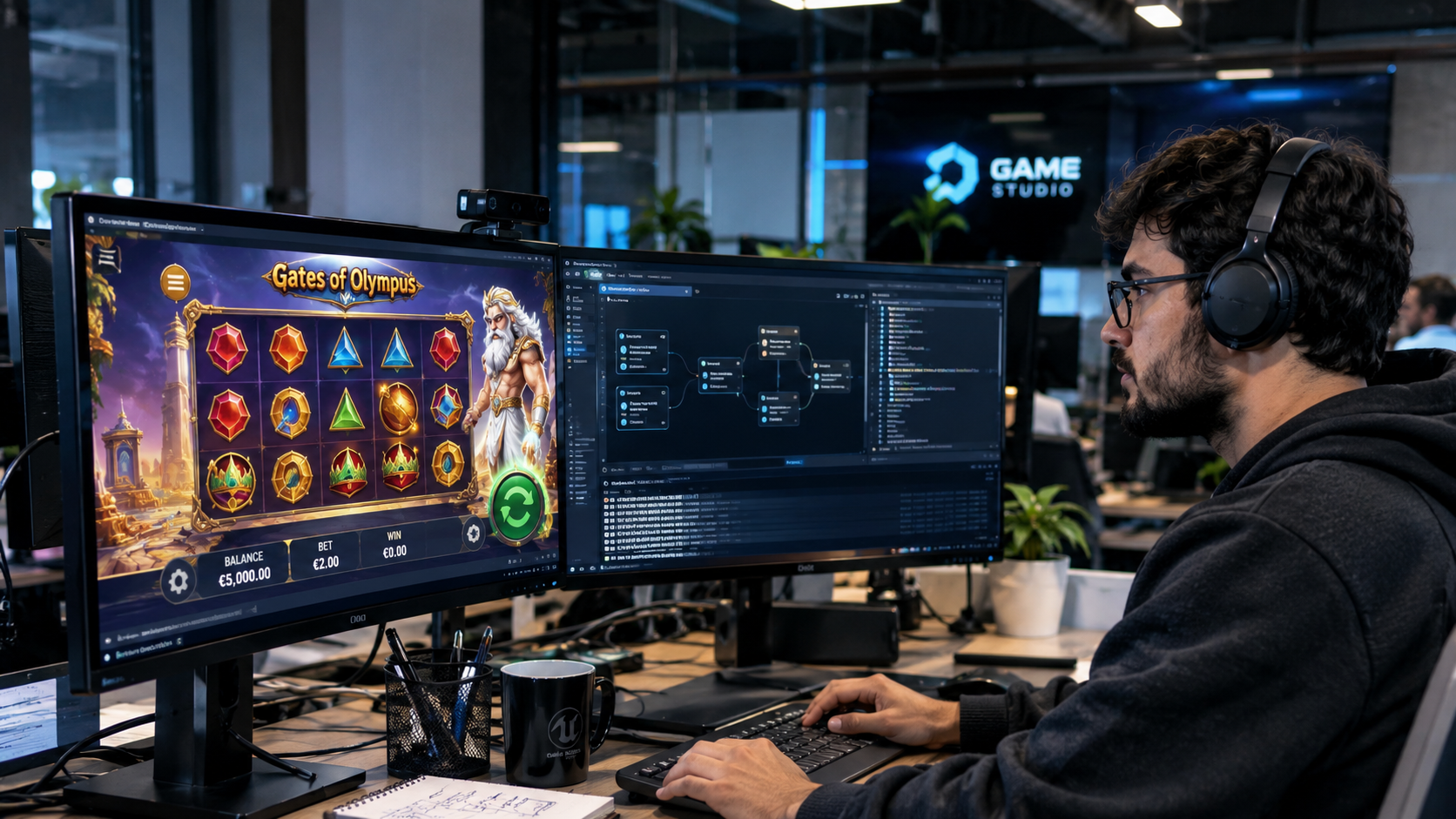
Studio capture and dealer event generation
A live dealer studio resembles a small broadcast production facility. Cameras provide several angles: a dealer view, an overhead view of the playing surface, close-ups of game equipment and sometimes specialized cameras or sensor feeds. Microphones capture speech and ambient cues. Lighting is planned for visual consistency, not simply aesthetic drama, because a player may need to identify physical details and understand the dealer’s actions clearly.
At the media layer, camera outputs feed capture equipment, production switching, monitoring and encoding. Operators watch for dropped frames, audio problems, camera obstructions and alignment faults. A camera changing angle is a normal production action; it must not rewrite a game event. Media operators can recover a video feed without being granted authority to mutate ledger postings.
Separately, the studio creates or confirms authoritative dealer events. A dealer workstation, supervisor console and approved sensing equipment may identify round opening, betting closure, cards dealt, wheel result or other game-specific facts. A sensor should not be considered infallible: detection may need validation, override procedures, dual confirmation or exception handling depending on the game and regulated controls.
Each event needs a stable round identity, event type, source identity, sequence and timestamp policy. A camera frame time and a server event time are not identical. The event system should preserve the reasoning behind a confirmed outcome and the operator actions that led to it. A disputed or incomplete physical event may require RESULT_PENDING or supervisor review, not automatic settlement from a computer-vision guess.
Studio infrastructure should also be treated as a security boundary. Dealer terminals, ingest encoders, monitoring stations and support consoles need appropriate network segmentation, identity controls and audit logging. Protect against unauthorized event injection as well as against media availability failures. A successful stream connection proves only that video is arriving; it does not authorize anyone to submit table results.
Real-time game orchestration and authoritative state
The game orchestrator maintains authoritative round state for the table or game instance. It knows the current round identity, accepted betting phase, relevant game rules and the validated dealer events. It can instruct clients that bets are open or closed and publish a confirmed result when permitted. Where a provider operates the authoritative game service, the operator integrates through the documented contract rather than independently determining the dealer outcome.
A typical conceptual timeline is: open round, enable bet acceptance, validate incoming bets, close betting, gather and verify dealer result, compute award obligations, settle wallets, publish terminal state. Some games have several betting phases, insurance, side bets or multi-hand mechanics; those require a richer state machine. The invariant is that a committed wager must be associated with a specific round and rules version, not with a video frame that might arrive late.
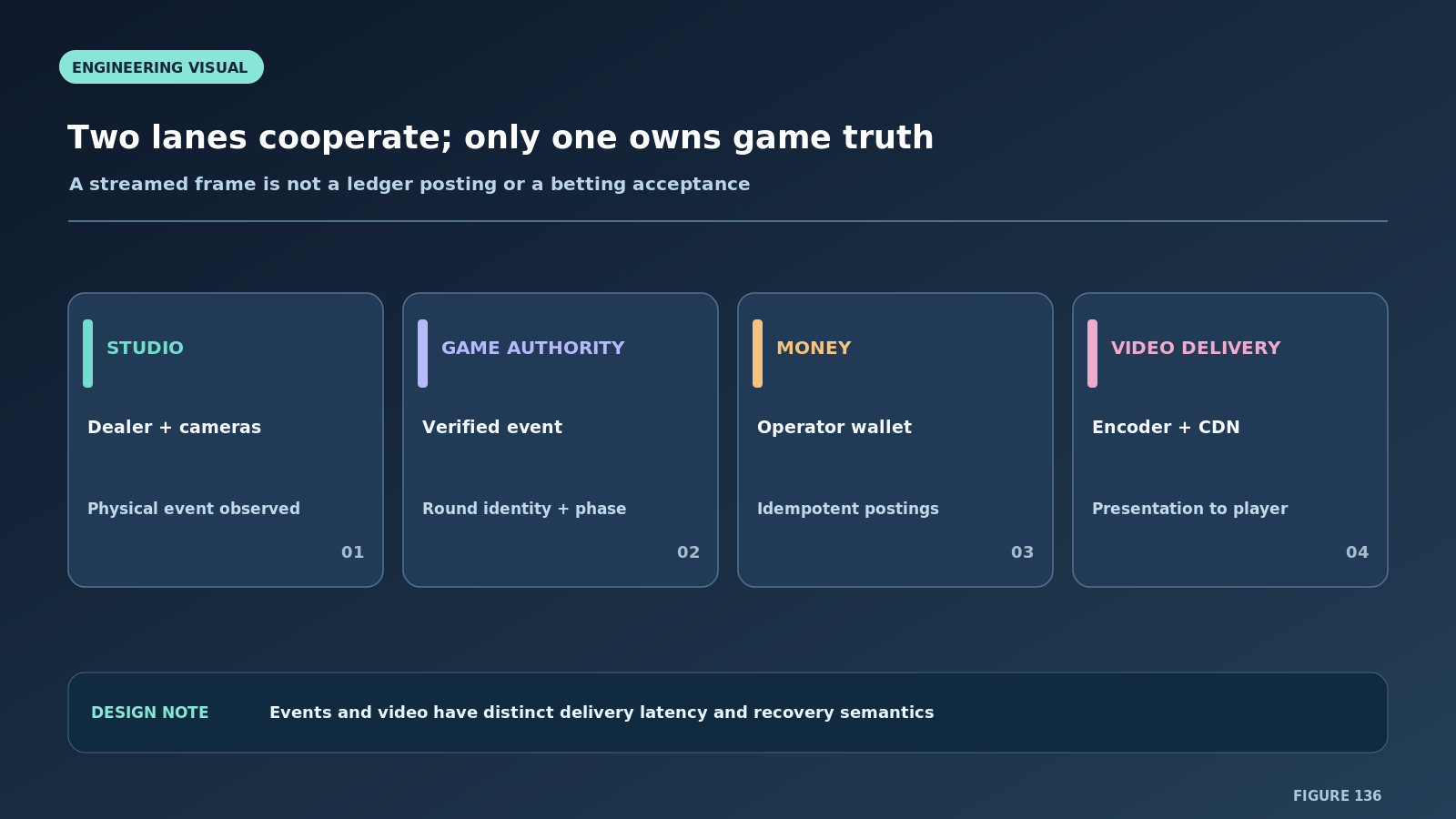
Events should be persisted with idempotent identities and validated sequencing rules. A duplicate betting_closed event should not trigger a second financial action, and a late result_confirmed event from an earlier round must not settle the current round. The system should reject impossible transitions and escalate unresolved conditions using the same state-machine discipline discussed in the companion guide.
Communication from an authoritative service to player sessions can use a documented event channel such as WebSocket delivery. The event channel is a notification mechanism, not automatically the source of truth after a reconnect. If a client missed event sequence 45 and receives 46, it should fetch the canonical current state or request a supported replay window before trusting its local phase assumptions.
A table-specific round clock can be visible to players, but the authoritative server decides whether a wager is accepted under the contractual cutoff. Unsynchronized client clocks, variable stream delay and browser scheduling mean the UI timer is advisory. The player should receive an explicit accepted/rejected response with the correct round ID and financial reference.
A sound observability model records round age, delayed dealer events, unresolved manual reviews, notification lag and mismatches between client-visible and server state. Avoid storing unnecessary player identity or raw media data in generic application traces. Separate operational media logs from game and financial audit logs so access can be governed independently.
Video encoding and delivery path (overview)
The media chain begins with physical sources. Cameras and microphones feed a production switch or capture node. An encoder compresses video using selected codecs and profiles and sends an ingest feed to the streaming platform. Downstream services may transcode into alternative bitrates and package segments or real-time packets. A CDN or real-time media network distributes playback to viewers; the player decodes and renders the chosen stream.
End-to-end delay comes from several components: camera capture, production processing, encoding, network transit, packaging, CDN buffering, adaptive bitrate decisions and the player’s own buffer. Different transport strategies change the trade-offs. Low-latency HLS can scale efficiently through HTTP delivery with segmented media, while WebRTC-based systems commonly serve lower-interaction-latency scenarios but require different network and operational planning. A particular provider’s advertised latency should not be treated as the user’s guaranteed end-to-end delay.
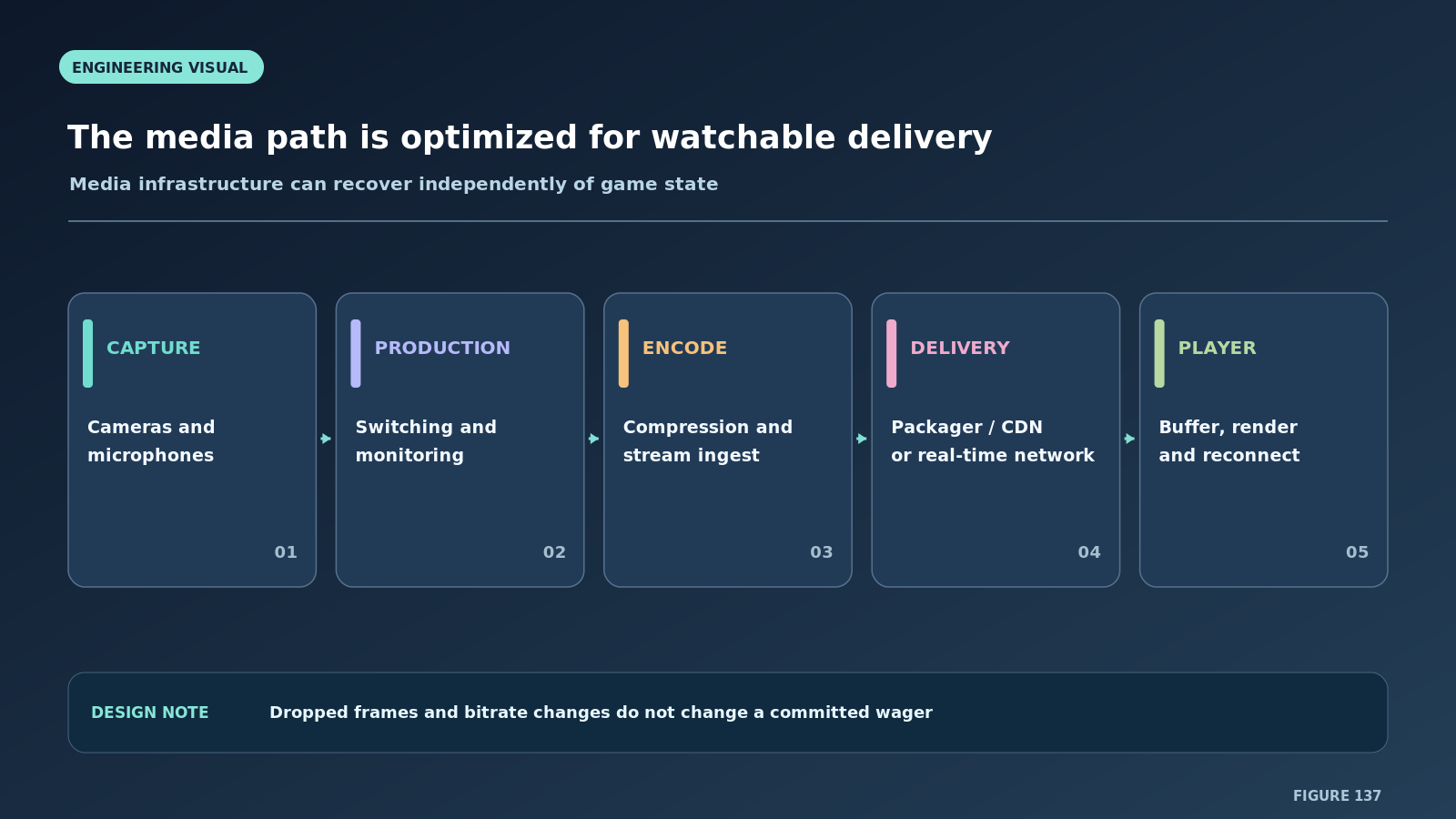
The video player needs recovery behavior: monitor buffer health, detect stalls, reconnect with appropriate backoff, resume at the supported live edge and display a clear degraded state if video cannot be recovered. Changing stream rendition must not duplicate a wager or reset the underlying table identity. Video discontinuities are common failure scenarios that deserve testing at the same level as game callback retries.
Timed metadata can align some visual overlays and interactive experiences with playback positions. For example, Amazon IVS documents timed metadata synchronized to encoded frames. This is useful for synchronized presentation, but a media timestamp is not sufficient authority for accepting a financially binding wager. The browser may receive or display metadata at a time different from the game orchestrator’s cutoff decision. The game action must be validated on the authoritative path.
Security of the media link also matters: control who may publish the ingest stream; rotate stream credentials; monitor unexpected publishers; protect origin endpoints; and restrict access to private or regulated feeds as required. An attacker injecting a misleading visual feed should not be able to create a valid settlement event by manipulating media alone.
Player session and betting window control
The player session joins several independent contexts: account or operator authentication, eligibility checks, table selection, a streaming playback token where applicable, and a game-session authorization to place bets. The first two may be validated at the operator boundary; the provider or orchestrator usually governs the live table’s round semantics. Security and responsible-gambling checks must be server-side and appropriate for the jurisdiction.
When the client submits a wager, it includes the intended table and round identity, stake, denomination, currency and stable request ID under the provider contract. The authoritative service validates the open betting window and any bet limits. The wallet side verifies and commits or reserves funds through a separate business action. A successful-looking button press is not a confirmed wager. A delayed response can require query or idempotent retry; it should not prompt a second new wager under a new key.
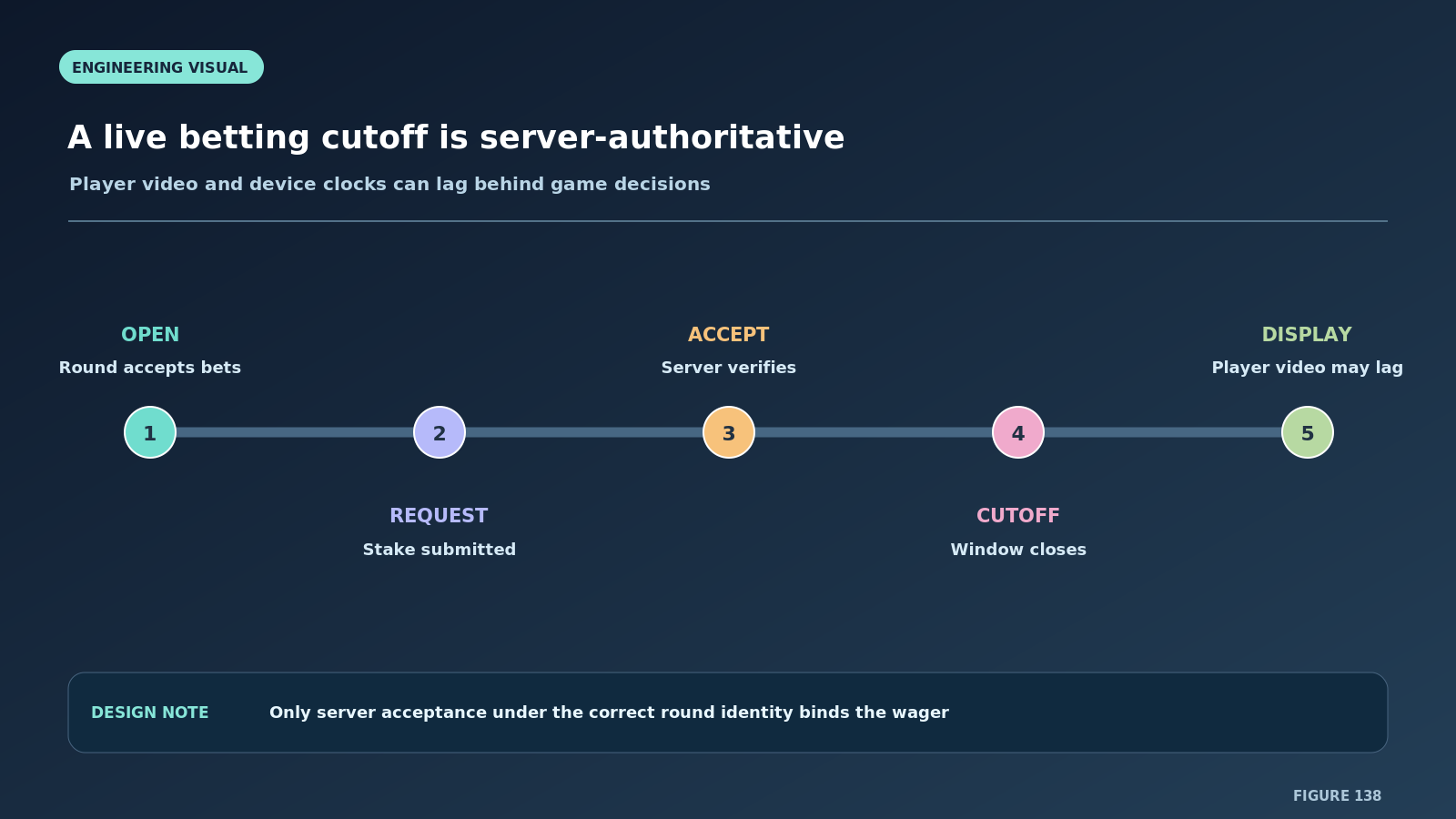
A robust UI distinguishes viewing from betting. The video may continue during a paused session while wager controls are disabled. Conversely, the stream may momentarily stall while a previously accepted wager remains active. If the game rules allow, reconnect should reattach the client to the same round and load authoritative bet acceptance, closure, outcome and settlement state. The client must not assume that a fresh video session corresponds to a fresh financial round.
A design review should explicitly challenge two assumptions: “the event and the video reach every player in order” and “all player devices see the same moment of the table.” Neither is reliable across mobile networks and geographic regions. Use server-generated acknowledgements, durable round identifiers and explicit event versions. Keep user-facing countdowns synchronized as closely as practical, but always define the policy for when the countdown diverges from the authoritative clock.
A side-bet or multi-stage game complicates acceptance because different subwindows may close at different instants. Model each permitted command against its own phase and rules, rather than relying on a single boolean bets_open shared by every market. Betting-window semantics also affect dispute handling: operators need a record of accepted requests and any rejection reason, not just a screenshot supplied by the client.
Settlement and financial service boundaries
After the authoritative game result is confirmed, the system computes obligations for each accepted wager according to versioned rules. It produces settlement instructions tied to immutable round and bet identities. The operator wallet or an approved financial service commits economic effects to a ledger. The result video may show a winning bet earlier or later than the corresponding ledger posting; visual timing does not change the number or amount of the legitimate settlement actions.
Wallet integration needs stable idempotency keys for bet, win, refund and reversal operations. If a callback arrives twice, the receiver should recognize the same economic business action and return the previous authoritative result. If a response disappears after the ledger commit, recovery should query or resend the same key, not create a new payment. Every operation should preserve currency, exact minor-unit amounts and references to the correct provider, game and round.
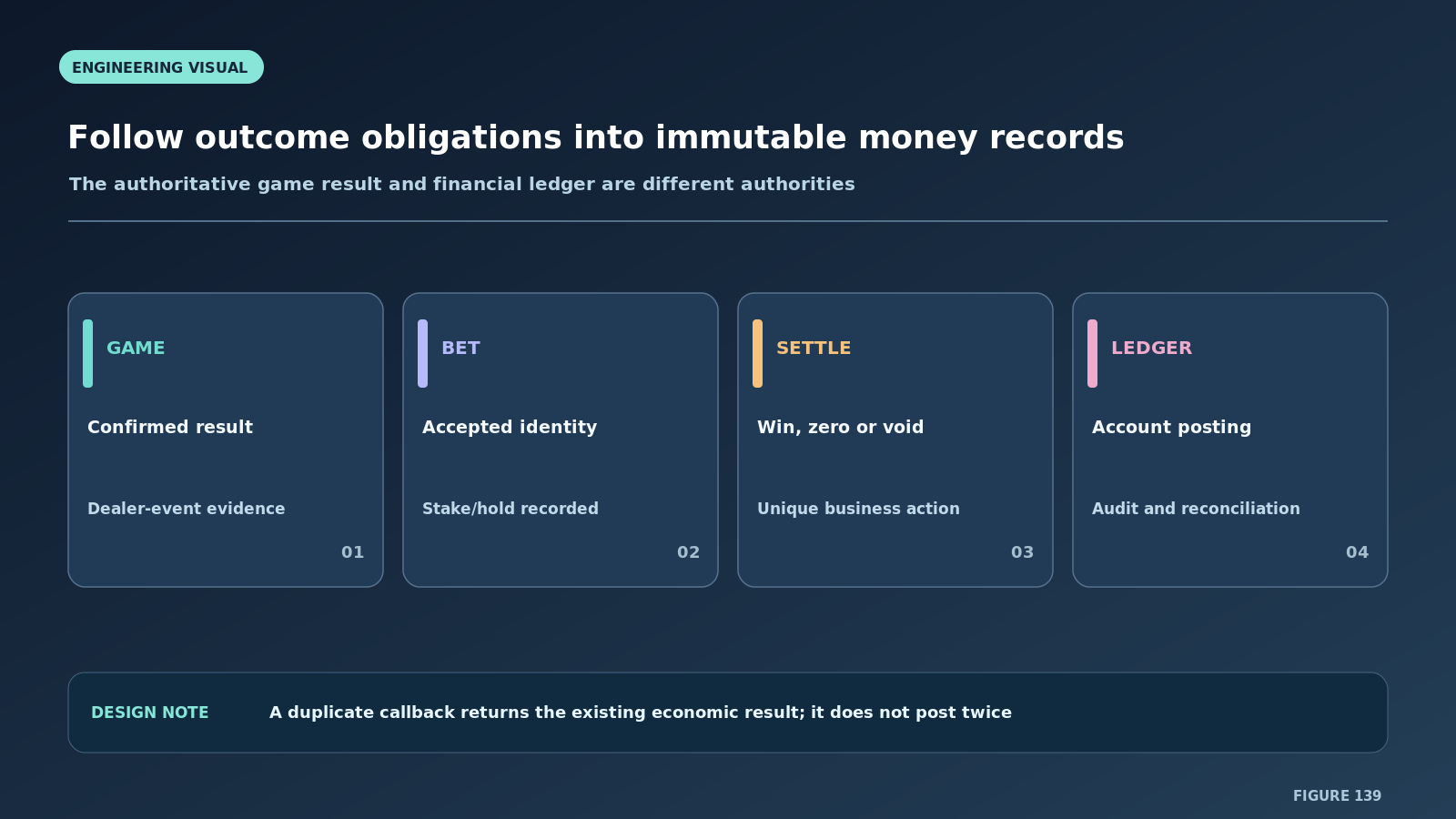
Not all rounds settle immediately. In a live environment, the dealer may need to repeat an action, the sensor may be ambiguous, a physical event may be challenged or the table may be suspended. A financial model therefore needs a clearly defined pending state and, where rules permit, a cancellation or void procedure with auditable compensating entries. A random failure of a CDN node should not authorize a refund by itself if the accepted round already settled correctly.
Reconciliation compares accepted bet identities, authoritative game outcomes and wallet postings. Alerts should isolate missing awards, unexpected refunds, amount or currency mismatches and long-lived pending cases. The result is a stronger explanation than “the dealer’s video looked wrong,” because the economic history can be reconstructed independently of video playback. Media recording, where allowed and retained, can support investigations but does not replace ledger evidence.
Sensitive fields require careful handling. Do not expose player identifiers to camera-control networks, embed wallet credentials in streaming manifests or include secret integration keys in client scripts. Audit trails need sufficient detail to establish who verified an outcome and what posting was made, while respecting privacy obligations and restricted access.
End-to-end diagram and system failure points
A conceptual successful round involves at least three synchronized stories: the studio produces observable physical activity; the game service records authoritative table events; and the financial path accepts and settles a wager. The media path transmits pictures and sound but can lag behind or outrun a client’s event notifications depending on buffering and transport. A resilient architecture explicitly handles the resulting inconsistencies rather than treating every screen as a perfectly synchronized witness.
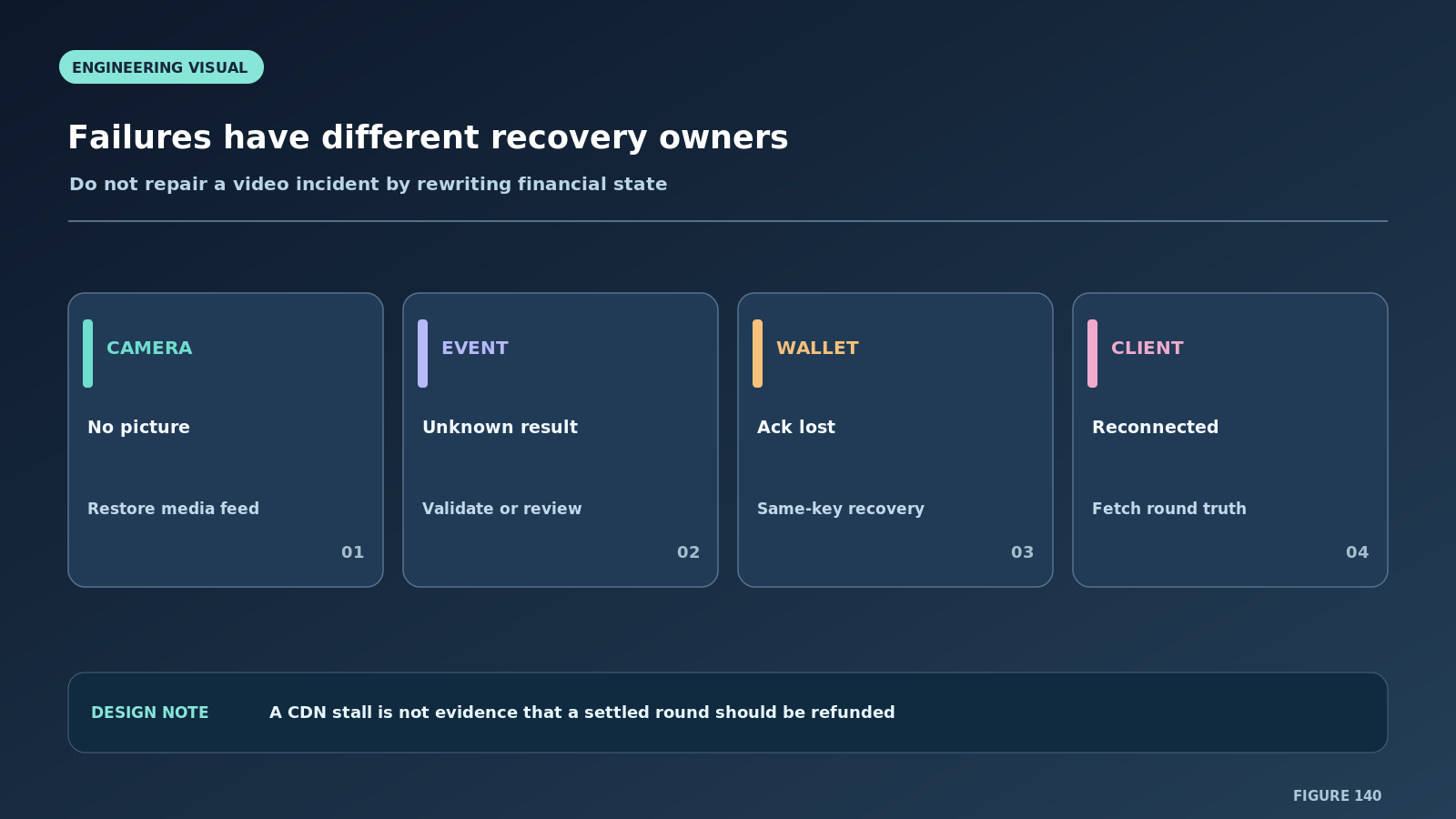
Common failure modes and safe responses include:
| Failure | What must remain authoritative | Preferred recovery principle |
|---|---|---|
| Camera or encoder loss | Round state and accepted wagers | Restore or switch media; do not invent a new game result |
| Client video latency spike | Server betting cutoff | Use server acceptance response; show pending or closed UI |
| Duplicate dealer event | Existing event identity and validation | Ignore equivalent duplicate; investigate conflicting duplicate |
| Lost wallet acknowledgement | Committed economic effect | Query or retry with the same business key |
| Orchestrator restart | Persisted round state and event journal | Recover from durable state before resuming commands |
| Unconfirmed physical result | Validated dealer outcome | Hold settlement and follow documented review procedure |
| Client reconnect during settlement | Server round and wallet status | Fetch canonical state and do not replay wager creation |
Observe each path separately. The media team watches ingest continuity, bitrate changes, buffering, publish errors and player startup time. The gameplay team watches table phase duration, event provenance, invalid transitions and unsettled rounds. The financial team watches idempotency, settlement confirmation and reconciliation age. Combined incident dashboards help teams coordinate without allowing one subsystem’s symptom to overwrite another’s truth.
Testing should include delays between media and game events, stream restarts while wagers remain accepted, duplicate result confirmations, temporary wallet outages, client disconnects at the betting cutoff and two consumers processing the same settlement callback. For each scenario, assert not only that playback recovers but also that the economic ledger contains the correct number of business effects and that the player sees an accurate final status.
The architectural conclusion is that a live casino is not simply video plus a betting button. It is a broadcast system attached to an event-driven, stateful, financially accountable transaction system. Video can be buffered; game events must be validated; money must be posted exactly according to the agreed business semantics. Good system boundaries make those guarantees compatible even during partial failures.
References and further reading
- AWS — Guidance for Optimizing Livestreaming for Betting and Gaming
- Amazon IVS — Timed Metadata
- Amazon IVS — Low-Latency Streaming
- RFC 9110 — HTTP Semantics
Illustrative architecture only: real operators, licensed studios and game providers may use different contracts, media delivery models and round-control procedures.