Every online casino platform generates events. A game launches, a session expires, a provider callback arrives, a ledger posting succeeds and a reporting consumer updates an aggregate. Yet event volume is not the same thing as trustworthy information. Without iGaming telemetry data governance, two teams can use the same event name for different things, retain personal data longer than required, or mistake an operational signal for a financial fact.
Imagine that a new game adapter changes round_completed from meaning “the provider says its round is complete” to meaning “the internal wallet has posted the last credit.” Both definitions sound reasonable, but they differ at exactly the boundary an analyst cares about. A risk dashboard might count a finished round before settlement; a finance reconciliation might count it only after ledger booking. The cure is not more metrics. It is an explicit contract about event meaning, ownership, identity, schema evolution and permissible use.

Event taxonomy and data ownership
Begin by separating business events, technical events and audit records. A business event describes a domain occurrence such as a finalized wallet posting or an approved session. A technical event reports execution such as callback timeout, retry, queue lag or service restart. An audit record documents a privileged decision or access: configuration changed, approval granted, sensitive dataset exported. Those three streams often intersect, but they should not be treated as interchangeable.
Give every event a specific producer and an authoritative state transition. For example, only the ledger service should emit an event claiming that a ledger booking is committed. A game adapter may report provider.win_callback_received, but it must not represent that as wallet.credit_posted. An analytics pipeline can derive metrics from both, with a join between the callback and the authoritative posting. Clear boundaries reduce false totals and simplify incident reconstruction.
A useful naming convention reflects domain and meaning: game.session_started, provider.round_settled, wallet.entry_committed, integration.callback_failed, security.data_access_granted. Keep names stable and avoid embedding tenant names, region names or individual player IDs inside metric identifiers. Put appropriate dimensions in a structured payload subject to cardinality and privacy rules.
Governance needs accountable roles. The domain owner approves semantic meaning. The schema steward maintains definitions, compatibility and documentation. The privacy or compliance reviewer evaluates lawful purpose and retention. The producer owner ensures the event is emitted accurately, and the consumer owner validates downstream business rules. One person can fill more than one role, but every event still needs a clear decision path.
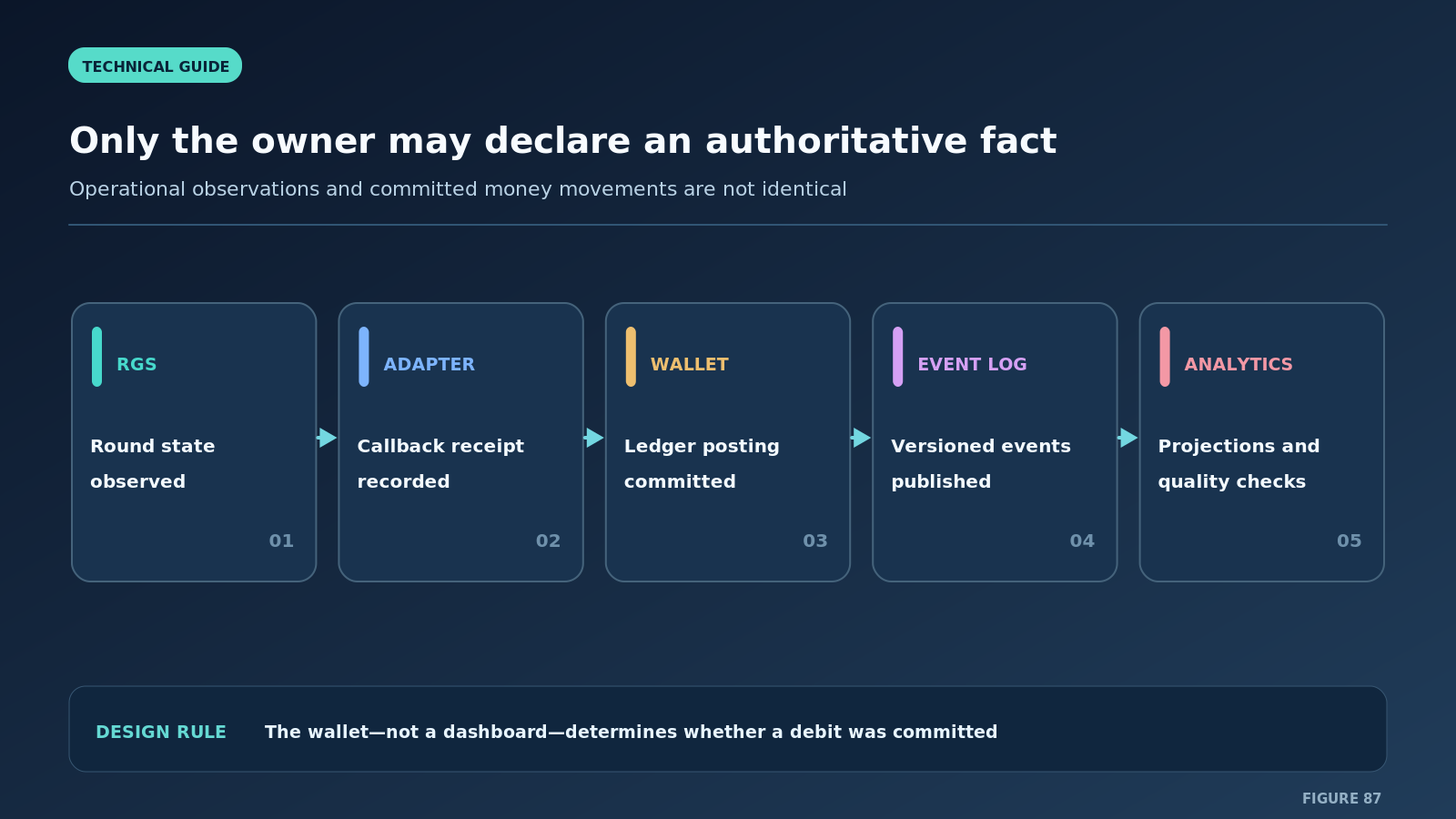
Build a compact event catalog. For each event record its business definition, trigger, producer, schema version, sample fixture, permitted consumers, sensitive fields, retention class, data owner and last review date. A catalog entry should explain how to distinguish a “round complete” from a “settlement complete.” If a field name needs more than one interpretation, the contract is not ready.
Schemas, versions and compatibility rules
A schema is both a format and an agreement. JSON Schema, Avro or Protobuf can enforce field types, but none of them will independently prove semantic compatibility. Changing amount from minor currency units to a decimal major-unit representation could remain syntactically valid while making reports wrong by a factor of 100. Maintain units, currency, identities and timestamp semantics in human-readable documentation as well as machine-readable schema definitions.
Every event envelope should carry an immutable event ID, named event type, producer, schema version, occurrence timestamp and a stable business reference when appropriate. Prefer timestamps with explicit timezone or UTC semantics. Use distinct timestamps for “occurred at source” and “observed by pipeline” so teams can measure ingestion delay. For financial event chains, include an authoritative posting ID without reproducing sensitive account details in every consumer.
Compatibility has direction. With backward compatibility, a new reader can understand data produced using an older schema. With forward compatibility, an older reader can handle new data; full compatibility requires both under the specified rules. Registry settings differ by platform and may be non-transitive. For example, Confluent documents BACKWARD as a default for its Schema Registry, while transitive modes check more than the immediate previous version. Choose the policy according to consumer deployments and replay needs, not the default alone. See Confluent schema evolution guidance.
A practical change policy can classify edits as additive, narrowing, breaking or semantic. Adding an optional, documented field is generally easier to roll out than renaming a required field. Narrowing an enum may be breaking for historical replay. Changing the meaning of a field with the same type is often more dangerous than an obvious compile failure. For semantic changes, publish a new event name or major contract version, support parallel production only where necessary, and document the sunset window.
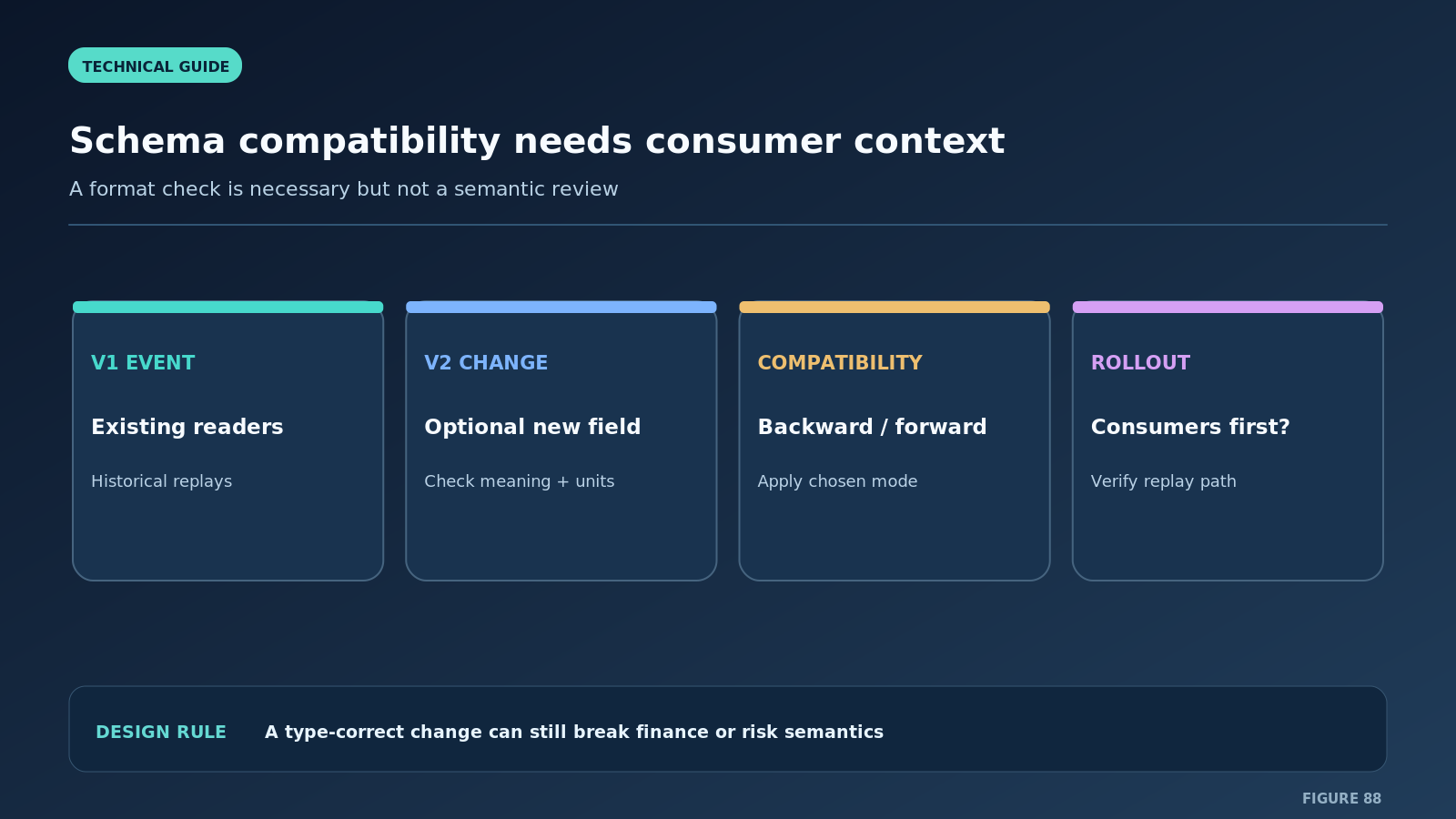
Run schema tests in CI. Validate representative historical messages, proposed new messages, reader deserialization and data-quality invariants. Crucially, test downstream projections with old and new payloads together. A schema registry can reject an incompatible wire format, but it cannot know that jurisdiction changed from a player’s eligible market to a server location. Domain review remains required.
Data minimization and privacy controls
Instrumentation should begin with a purpose: investigate service failures, measure user journeys, detect abuse or support a documented business report. For each field, ask whether the task truly requires personal information and how long the exact value is needed. A trace correlation ID, a restricted one-way mapping or a tokenized account reference may be sufficient where a raw identifier is not.
Do not embed passwords, authentication cookies, payment instrument details, unredacted identity documents or provider secrets in telemetry. Avoid arbitrary request-body logging for wallet callbacks: a debugging shortcut can quietly duplicate sensitive data across log stores, alert systems and third-party observability vendors. Set collection rules at the producer, with redaction or allowlisting at shared collectors as defense in depth.
Distinguish pseudonymization from anonymization. If a pseudonymous identifier can be joined to a player account using a retained mapping, it remains linkable information and may still be personal data under applicable law. Hashing a small or guessable identifier is not automatically anonymization. If cross-system joins are necessary, use tightly controlled mapping services and rotate or scope identifiers according to documented needs.
For EU personal data, the GDPR includes purpose limitation, data minimization and storage limitation principles. It does not prescribe one universal telemetry retention duration. Retention must be determined by the purpose and other applicable obligations, with lawful exceptions handled deliberately. See the European Commission’s GDPR principles and OpenTelemetry guidance on sensitive data. Requirements elsewhere may differ.
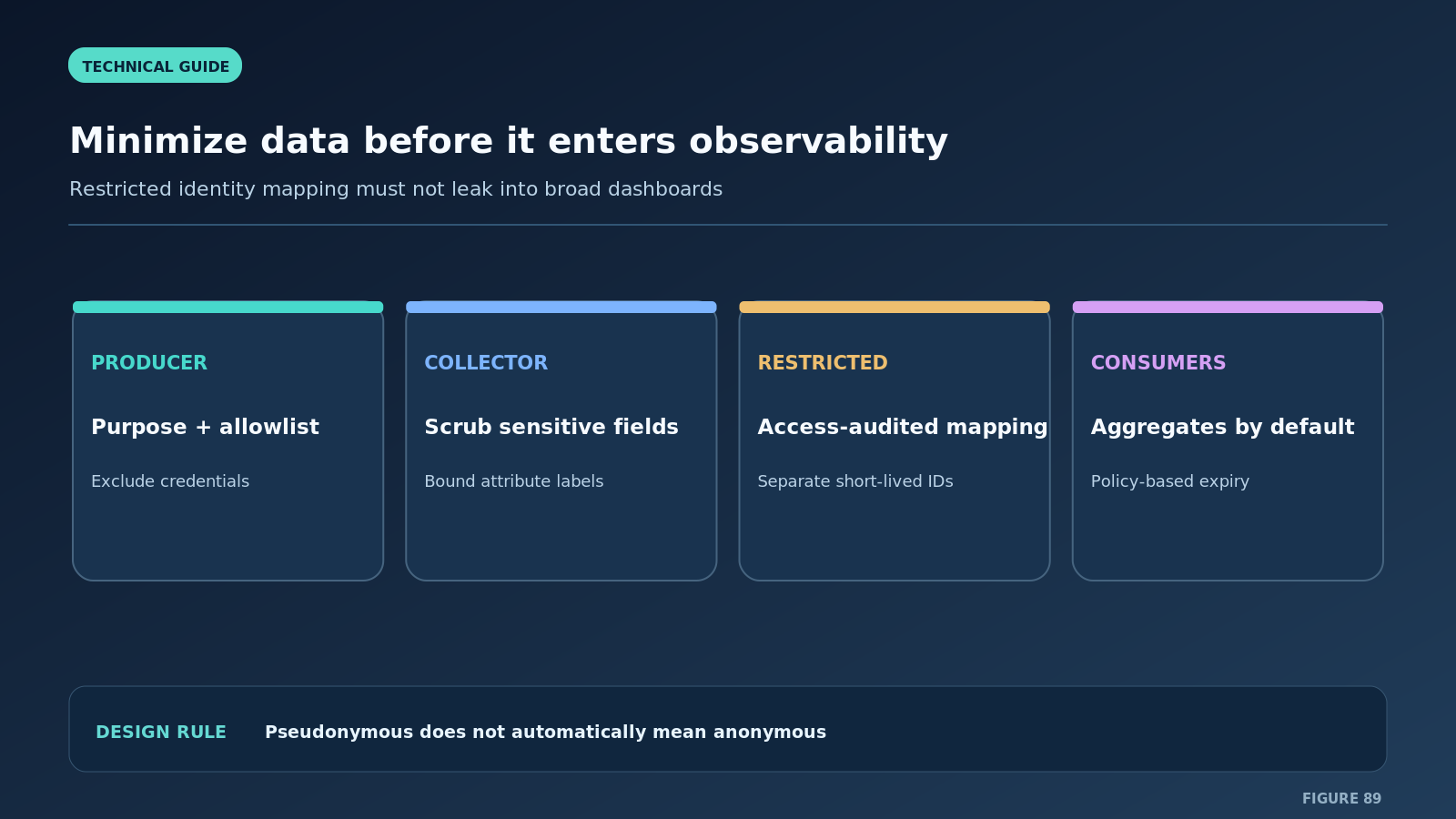
Make access contextual. A support engineer may need the status of a session and its error category but not the player’s legal identity. A financial investigator may need a limited and audited link between a settlement and a ledger posting. Implement role-based access, dataset-level restrictions, request logging and reviewable export permissions. A single unrestricted data lake is an anti-pattern even if the ingestion pipeline is technically reliable.
Retention, deletion and access models
Define retention by data class and system, not one global number. A short-lived debug log, a performance metric, a restricted security audit event and an authoritative ledger record serve different purposes and may be subject to different obligations. Specify both online query retention and backup/archive retention; deleting data from the main index is not necessarily deletion from cold storage or an exported report.
Every data product should have a deletion story. A player-related deletion request may require searching not only raw telemetry but also derived tables, caches, data exports and correlation mappings. Some records may need to remain under a legal or regulatory exception; where that applies, document the reason and access restriction rather than claiming everything was deleted. Coordinate requests with privacy and legal teams before implementing policies that could erase required audit evidence.
Retention is also an operational safety control. Keeping high-cardinality raw events indefinitely makes breaches and accidental overexposure more damaging. Conversely, deleting source events too quickly can make an authorized reconciliation impossible. Define an evidence-preservation procedure for incidents, and ensure legal holds have a controlled owner and expiry review. High-volume event logs should never be mistaken for the sole durable history of financial movements.
A simple access matrix can prevent accidental expansion of privilege:
| Data class | Typical use | Default access | Deletion/review rule |
|---|---|---|---|
| Aggregate performance | SLO reporting | Engineering dashboards | Short review cycle |
| Pseudonymous session event | Technical diagnosis | Restricted engineering | Purpose-based expiry |
| Correlation mapping | Authorized investigations | Limited support/risk | Separate access audit |
| Security audit record | Accountability | Security/compliance | Retention schedule + holds |
| Financial ledger record | Authoritative accounting | Finance-controlled systems | Legal/regulatory schedule |
A matrix is a design example, not a statement of universally mandatory retention periods. The correct schedule comes from concrete purpose, contracts, local law and audit needs. Link it to implementation: partition expiry, object-store lifecycle policy, backup rotation and documented exception handling.
Quality checks and operational accountability
Data governance fails if validation is a one-time kickoff meeting. Monitor for missing event IDs, duplicate IDs, unknown event types, invalid enum values, clock skew, unexpected PII fields, contract incompatibility and stalled consumers. Track field-level null rates and referential integrity where appropriate. For each high-value metric, define the source of truth and a reproducible method to compare it with an independent record.
An ingestion queue can report healthy throughput while silently losing one category of events because a serializer rejects its schema. A dashboard can show a plausible trend while processing yesterday’s data. Put freshness, completeness and validation failure counts next to business charts. On alert, route the issue to the owner of the contract or consumer; “analytics team” as a generic destination delays action.
Treat telemetry changes like production changes. The pull request should include an example before/after payload, schema diff, reason for collection, privacy classification, rollout plan and rollback behavior. Instrumentation sampling must not change the semantics of an authoritative business event: if the system needs a complete record for reconciliation, that record belongs in a durable business system, not a sampled trace pipeline.
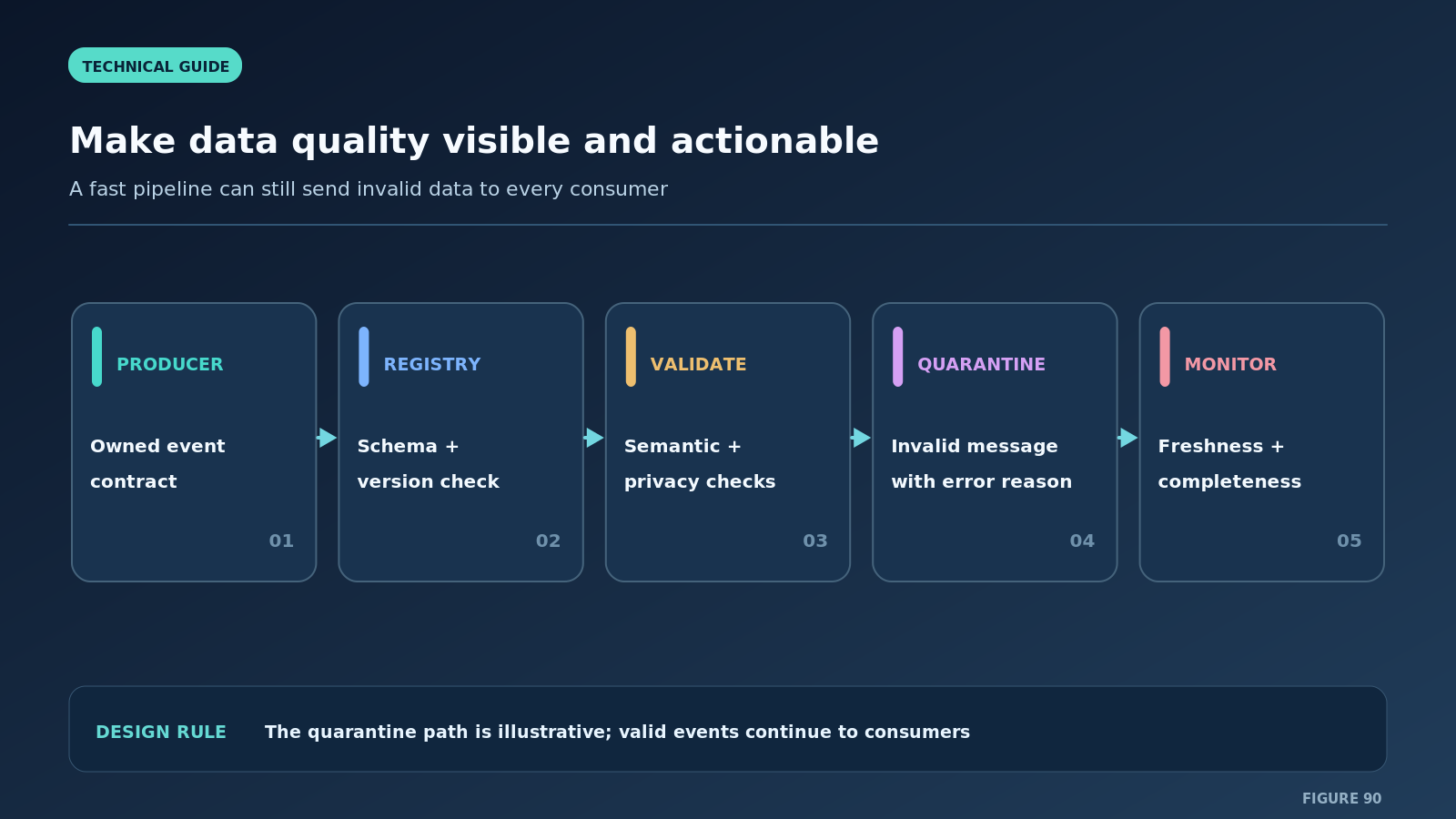
Sample event contract and governance checklist
Here is an illustrative operational event, not an authoritative wallet posting:
{
  "event_id": "evt-example-9271",
  "event_type": "integration.callback_processed",
  "schema_version": "2.1",
  "producer": "provider-adapter",
  "occurred_at": "2026-11-20T14:13:22Z",
  "observed_at": "2026-11-20T14:13:23Z",
  "provider_code": "provider-demo",
  "correlation_id": "corr-example-451",
  "outcome": "accepted",
  "duration_ms": 84
}
The event communicates that an adapter accepted processing of a callback; it deliberately omits player identity, secret headers and the callback body. To establish whether a credit was booked, a consumer must use a separate restricted mapping to authoritative wallet records. If that mapping is not necessary for the consumer’s purpose, the consumer should not receive it.
The governance review should be able to answer: Who owns the meaning of this event? Which state change emits it? What is the difference between event occurrence and ingestion? Can old payloads be replayed? Does every field have a documented purpose? Can collection be disabled without affecting ledger correctness? Who can export the data? How will it expire from primary, replica and backup systems? What happens when the schema check fails? Which alert identifies a stale or incomplete downstream projection?
The most useful outcome of governance is not a long spreadsheet. It is confidence that the team can explain what an event means, which evidence is authoritative, who may see it and how changes remain safe over time.
Technical references
- Confluent: schema evolution and compatibility
- OpenTelemetry: handling sensitive data
- European Commission: GDPR principles
- OWASP Logging Cheat Sheet
Editorial note: fields, records, roles and examples are illustrative. Governance and retention decisions require jurisdiction-specific review before adoption.