A player sees a Spin button, an animation and a balance that changes. Behind those few seconds, the casino game round lifecycle crosses several ownership boundaries: the player client requests an action, the operator validates eligibility and money movement, the game system applies the rules, and durable records establish what happened when a response is lost. Understanding those boundaries is the difference between an attractive diagram and a system that can survive retries, outages and disputes.
This guide follows one illustrative successful wager-based round. Specific contracts differ among remote game servers (RGSs), aggregators, operators, game types and jurisdictions. A game may use a pre-funded wallet, a seamless wallet, a single atomic round call or separate bet and win callbacks. Therefore the sequence below is a conceptual model, not a universal provider protocol or certification checklist.

Session context and game launch
The round begins before any wager is placed. The player signs in to the operator’s service and selects a game. The operator generally checks whether the account may enter the product at that moment: authentication, permitted location, currency, game availability, account restrictions, session validity and any relevant responsible-gambling controls. A launch request can then carry short-lived, scoped proof that a particular player is authorized to open a particular game in a particular context.
An RGS or provider may create its own session reference and return a launch URL or token. The operator should not assume that opening the iframe or mobile view constitutes a completed bet. A launch token authorizes a bounded interaction; it should not turn a user-supplied player ID or currency into a trusted financial claim. Credentials must be protected from browser logs, URL sharing and third-party script exposure as required by the integration contract.
A good session record separates session identity, game identity, operator account identity, configuration version and wallet context. The game title shown to a player is not necessarily a stable technical game identifier. It is also important to know whether the session binds a paytable or rules version. Changing those while a round is in flight can lead to a result that cannot be reproduced from the data retained.
Authentication and eligibility should be reassessed at the appropriate transaction boundary, not only at first launch. A session might outlive a location permission, a balance change, or a player restriction. The game client can display a friendly error, but the trusted server must enforce the decision. Do not use a client-side balance display or a cached flag as the final money-movement authority.
Consider a player whose launch succeeds at 12:00 but whose account becomes restricted at 12:03. A naïve design accepts every subsequent bet because the game tab remains open. A safer design enforces relevant current restrictions at accepted bet time while defining what happens to an already committed round. Refusing a new wager and settling an existing obligation are different operations, often with different business rules.
Creating and validating a bet request
When a player activates a game action, the game runtime creates a request with a business identity. A useful conceptual envelope contains session_id, round_id, bet_transaction_id, game_id, stake_minor, currency, an applicable rules_version and a correlation identifier. Actual provider interfaces may omit, rename or derive these fields. The critical principle is that the server can distinguish one unique wager from a repeat delivery of the same wager.
Validation occurs in layers. Authentication proves the caller’s integration identity. Authorization proves the session may submit the action. Schema validation checks required types and permitted ranges. Domain validation checks stake options, game configuration, round state and applicable wagering restrictions. Financial validation asks the authoritative wallet or ledger whether the committed debit is allowed. A successful-looking game animation does none of these things by itself.
Amounts should use a fixed-point representation or integer minor units under explicit currency precision rules. If stake is 250 minor units in a two-decimal currency, that represents 2.50 monetary units. Using binary floating-point values in wallet contracts risks subtle disagreement about rounding and equality. A stake is also not the same as a charge to a payment card: in an internal game wallet it typically means a transfer or posting within a controlled ledger.
Idempotency is essential. If the provider retries the same bet_transaction_id after a timeout, the operator should return the existing authoritative result, not create a second debit. If the same identifier appears with a different stake or currency, the request should be rejected or escalated according to contract rather than silently treated as a legitimate retry. Business identity must be scoped so that two providers cannot accidentally share an idempotency namespace.
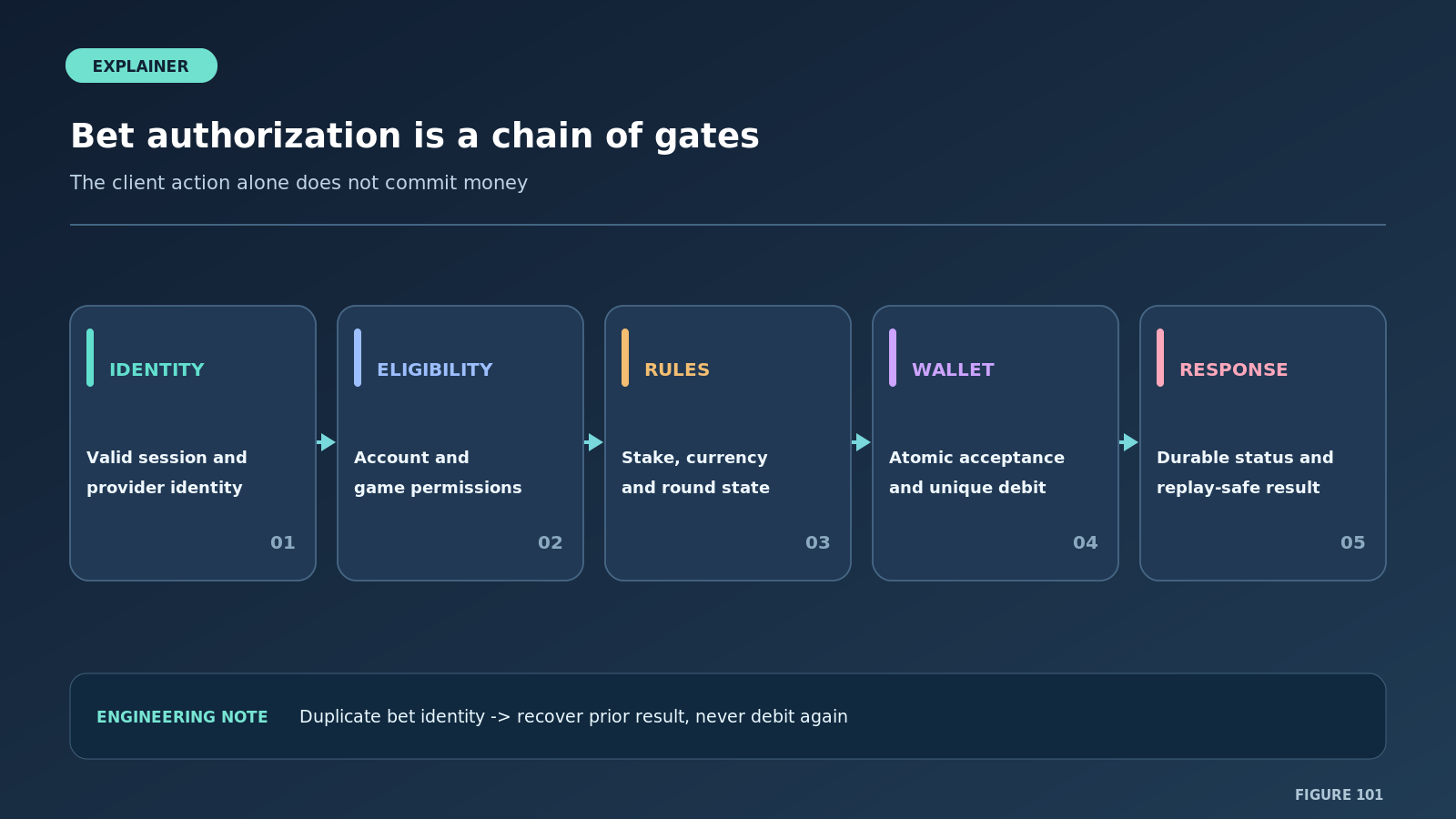
Concurrency requires more than a duplicate-request cache. Two legitimately different bets against the same wallet may arrive simultaneously. The balance check and debit must be safely serialized, reserved, or atomically recorded under a concurrency policy. Reading an available balance and writing a debit in two unrelated operations introduces a race that an idempotency key alone cannot solve.
Outcome generation and game response (overview)
Once the round is eligible for execution under the game’s contract, an outcome mechanism applies the configured game rules. For a software-generated game this may include random values, mapping into symbols or events, application of paytables and bonus rules, and calculation of a final award. The model differs for live-dealer games and games with multiple substeps, but a common invariant remains: the authoritative outcome is generated and persisted in a trusted system, not inferred from pixels on the player’s screen.
A random number generator (RNG) provides random or pseudorandom values; it does not by itself define winnings. Outcome mapping and game mathematics determine how samples become game events and payouts. A game with an unbiased source can still have a defective outcome mapping, incorrect paytable or mismatched configuration. Conversely, a visually random animation is not evidence that the trusted result was independently generated.
For auditability, the system should retain the identifiers and versioned evidence needed to explain the result without leaking sensitive generator state or secret material. Retention may include the round ID, rules version, wager reference, output/outcome representation permitted by policy, final award, timestamps and hashes of relevant configuration. Some systems expose a reproducible test mode; production randomness should not be made predictable simply to simplify debugging.
The order in which wager commitment and outcome calculation occur is a design choice constrained by the provider agreement and game rules. In some implementations the RGS requests the debit before it commits and exposes the outcome; in others a single call encapsulates several actions. Systems must define how to recover when the server has created an outcome but the money movement remains unknown. A timeout is not evidence that the underlying operation failed.
A client may receive an animation seed or rendering instructions based on the authoritative result. Network stalls or browser crashes can interrupt presentation without changing the settled transaction. A reopen flow should retrieve the correct persisted state rather than spin again using a new random result. This distinction is particularly important when an animation can be replayed but a wager cannot.
Debit, credit and settlement sequence
A successful money lifecycle typically requires a committed debit for the stake and a corresponding credit for any award, or another economically equivalent ledger design. A zero-win round still needs an authoritative terminal state even when there is no payout credit. A reversal is not interchangeable with a win: it repairs or cancels a previously committed action under a distinct reason and audit trail.
A sample round with stake 2.50 and a win of 4.00 might produce two separate accounting effects: debit available player funds by 2.50 and later credit 4.00. The change in player funds attributable to this round is +1.50, assuming no other transactions or holds. A zero-win case creates a -2.50 net effect. The game round is the parent business object; bet and win are distinct transaction objects. These amounts are entirely illustrative and should not be interpreted as a prediction of game outcomes.
Double-entry ledger modeling uses balancing entries so that funds are accounted for within the defined system. Merely keeping an integer balance is not enough for forensic explanation. Every posting should have a durable identity, account direction, currency, reference to its business action and reversal linkage if one exists. The system should enforce uniqueness for the intended posting identity and make a replay return the original outcome.
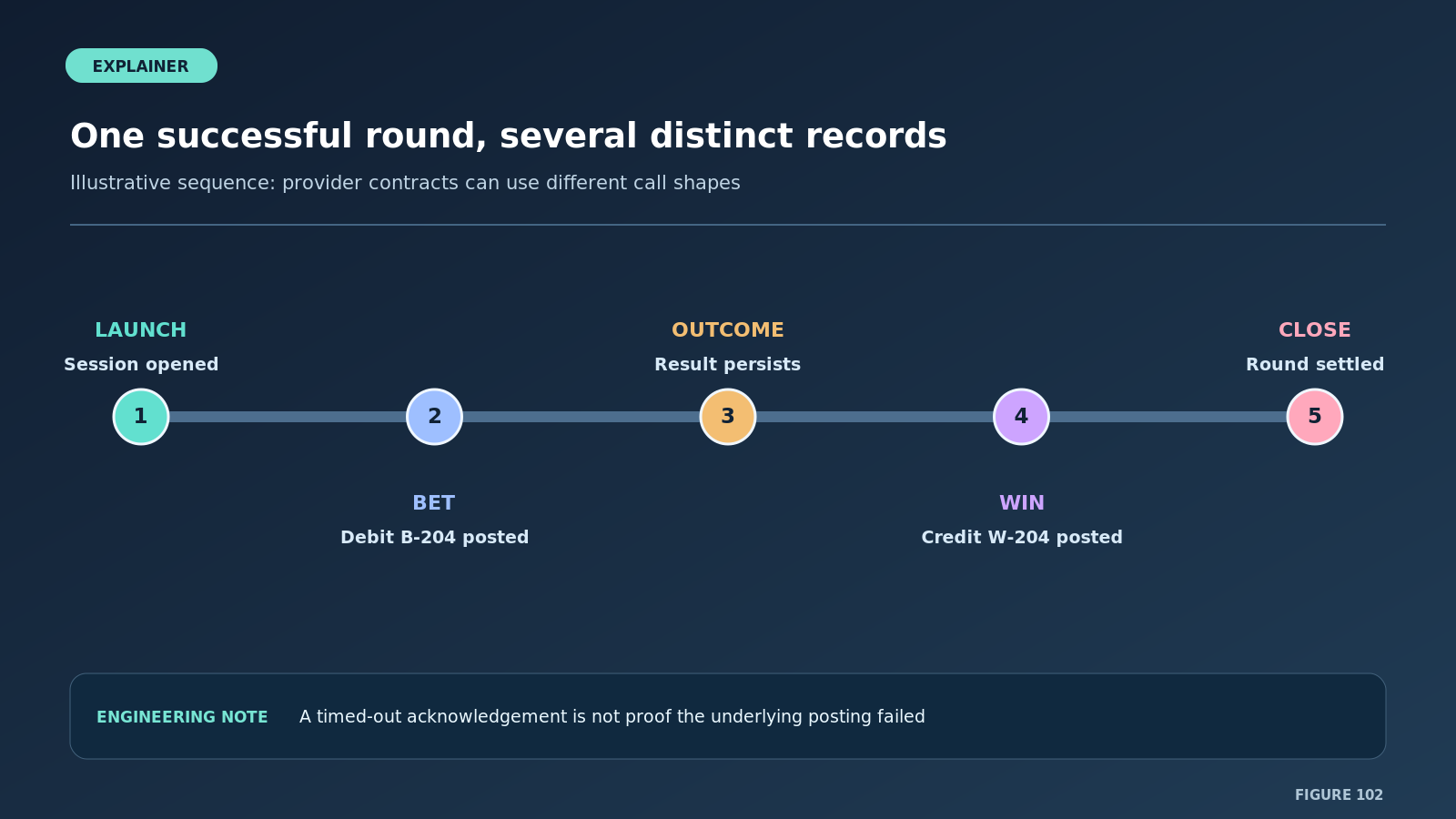
What happens when a credit callback is received twice? A correct financial integration recognizes the duplicate business key and reports the previously committed award without minting additional funds. What happens when the debit succeeds but the response is lost? The retry must recover the existing posting. What happens when the RGS cannot finish after an accepted debit? The round enters an explicitly recoverable state; depending on contractual rules it may resume, settle deterministically or reverse with traceable evidence. It should not disappear because a queue consumer restarted.
The round’s status and the wallet’s status need to be distinguishable. OUTCOME_COMPUTED does not imply CREDIT_POSTED. CALLBACK_SENT does not imply the receiver committed the posting. HTTP_200 may mean an acknowledgement of a prior result, not a new action. Define canonical state names and meanings so customer support, reporting, reconciliation and incident tooling answer the same question.
An effective reconciliation job compares authoritative provider activity, operator transaction records and ledger postings by stable business references. It flags missing records, duplicates, amount mismatches, currency mismatches, unexpected reversals and excessively old nonterminal rounds. Reconciliation is the safety net for silent divergence; it is not a replacement for atomic commit and idempotency on the real-time path.
What the player and operator observe
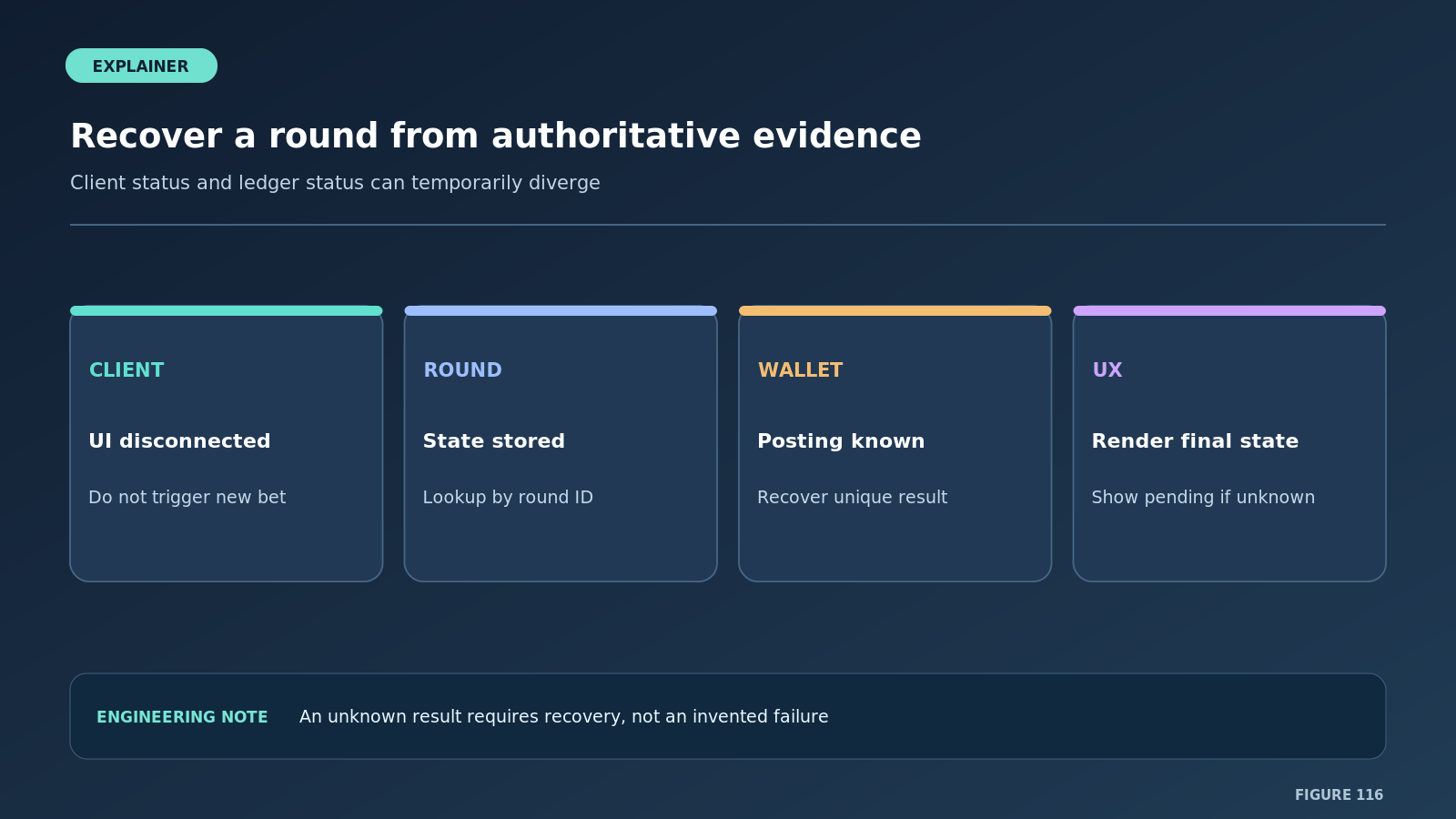
The player typically sees a launch state, an enabled or disabled action, animations, a result and a balance. Each is a presentation of a state owned elsewhere. Clients should show pending or temporarily unavailable status when a financial operation is ambiguous, not confidently report failure and invite a fresh wager. The front end needs a documented refresh path that queries the authoritative round result after reconnecting.
The operator sees a different layer: session IDs, acceptance and rejection rates, provider errors, timeouts, wallet posting outcomes, unresolved rounds, and reconciliation exceptions. Raw traces help engineers investigate, but they should not indiscriminately contain player personal data, bearer tokens or sensitive RNG state. Log correlation identifiers and relevant business status while applying access controls and retention policies.
A useful support explanation is not “the slot glitched.” It might be: “Round R-204 was accepted; stake posting B-204 committed; response delivery timed out; subsequent retry returned the existing posting; outcome recorded; award W-204 posted once; balance updated.” That statement is testable using independent records. If the evidence is incomplete, the support tool should say so and route the case for investigation.
Monitoring should distinguish latency from integrity. A game may have low response latency while settlement confirmations accumulate in a queue. Operational objectives can include age of unresolved rounds, unique ledger postings per business action, callback replay success, reconciliation exception rate, and the share of player sessions with unknown outcomes. A graph of total spins per minute alone will not detect a double-credit defect.
The operator should also plan UX recovery. Following a phone disconnect, the app can retrieve round state and show the known outcome without issuing another stake. If a player opens two tabs, the server must handle concurrency and round IDs deliberately. If a completed round’s animation is replayed for accessibility, it should not be labeled as a new financial event. User-facing product behavior must reflect actual rules, jurisdiction and accessibility expectations.
Sequence diagram and round-level data contracts
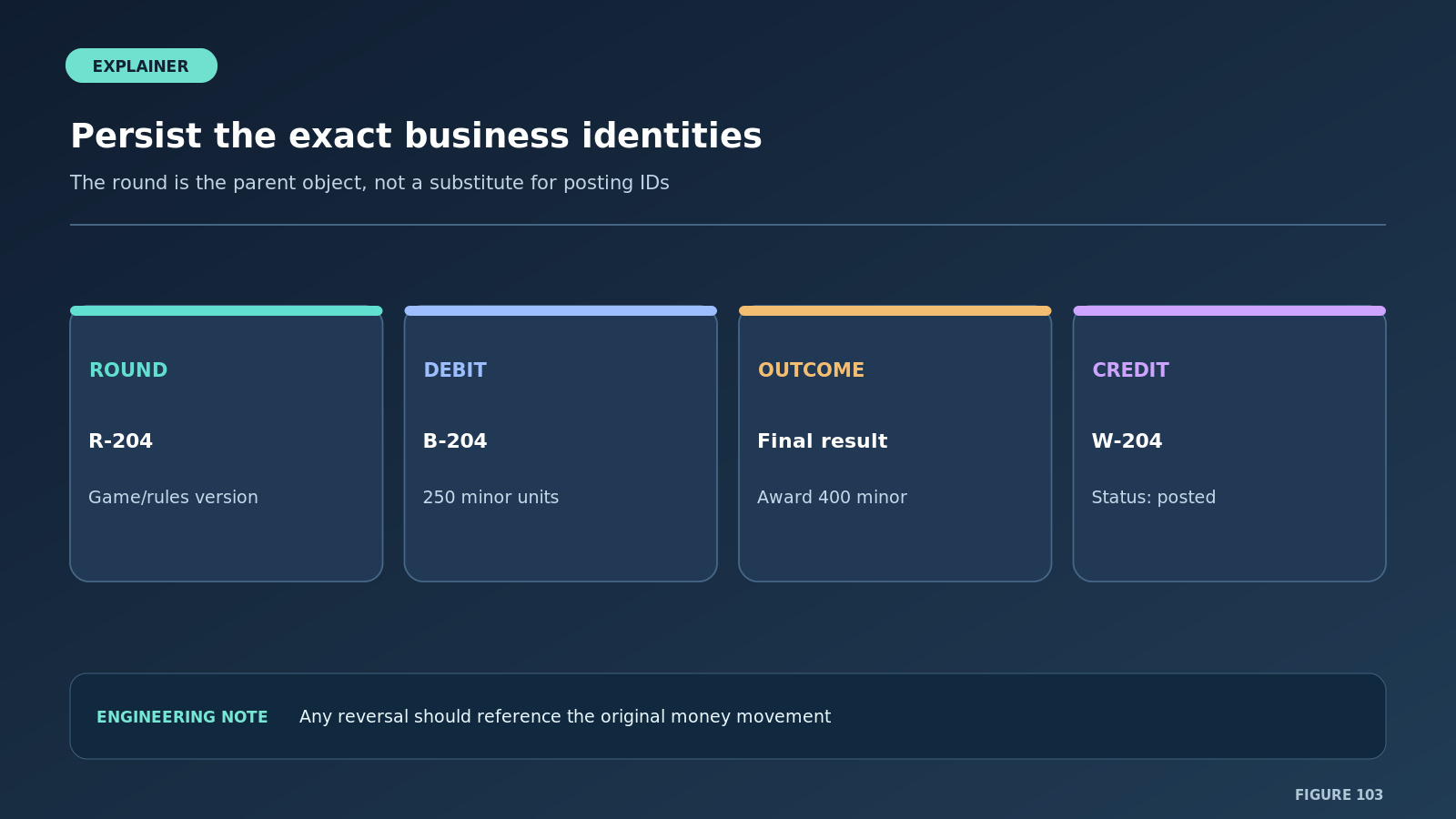
A practical data contract names the round and every financial action separately. The sample below is intentionally schematic, not a ready-to-send provider payload:
{
  "round_id": "R-204",
  "session_id": "S-51",
  "game_id": "G-8",
  "rules_version": "v3",
  "bet": {"transaction_id": "B-204", "amount_minor": 250, "currency": "EUR"},
  "result": {"status": "final", "award_minor": 400},
  "settlement": {"transaction_id": "W-204", "status": "posted"}
}
A production contract should define field types, key scopes, signatures, time representation, currency precision, status transitions and the consequences of missing or duplicated fields. R-204 and the money values above are invented examples. State-changing requests need authenticated transport plus replay resistance at the business layer. Sensitive values must not be embedded in analytics just because the sample is short.
A compact review checklist follows. Can the provider safely retry a debit after a lost response? Can the system distinguish a new bet from a duplicate? Does the round preserve the rules version actually used? Can credit posting fail without losing the outcome? Are reversals linked to original postings? Can both sides reconcile a round without sharing raw sensitive data? Does an operator-facing support record explain every balance movement? Can a disconnected player recover the original state instead of triggering another bet?
When these questions have precise answers, the lifecycle is operationally defined. The important achievement is not that the diagram contains six arrows, but that every arrow has a responsible system, durable evidence and a recovery rule.
Further reading: UK Gambling Commission remote gambling and software technical standards and OpenTelemetry context propagation. These sources provide regulatory and distributed-systems background; provider contracts and local rules remain controlling.