UKGC RTS 7 RNG requirements connect the fairness of remote gambling outcomes to verifiable behavior: appropriate randomness, faithful implementation of the published rules, honest presentation of probabilities and stable game terms. For developers, the difficult work is often between the RNG and the player’s screen. A sound random source cannot compensate for biased mapping; correct mapping does not justify changing a losing result into an apparently almost-winning one; and a statistically plausible distribution does not prove that runtime seeds are unpredictable.
This article translates the UK Gambling Commission’s RTS 7 — Generation of random outcomes into a practical review model. It separates normative requirement from implementation guidance and from engineering recommendations, since those categories should not be confused in a test plan. It does not interpret law for a particular product: license holders should use the applicable current RTS, testing strategy, amendments and competent regulatory advice.

Current RTS 7 wording, publication date and scope
As reviewed on November 23, 2026, the UKGC’s dedicated RTS 7 page identifies its aim as ensuring that games and virtual events operate fairly. The page shows publication on February 2, 2021 and a section last-updated date of May 7, 2024. The broader remote-technical-standards guide reports additional RTS updates effective October 30, 2026; therefore a deployment team must check the complete current RTS and any transitional provisions, not rely solely on the revision timestamp of an individual section. An update elsewhere in the RTS document should not be misrepresented as a change to the wording of RTS 7 itself.
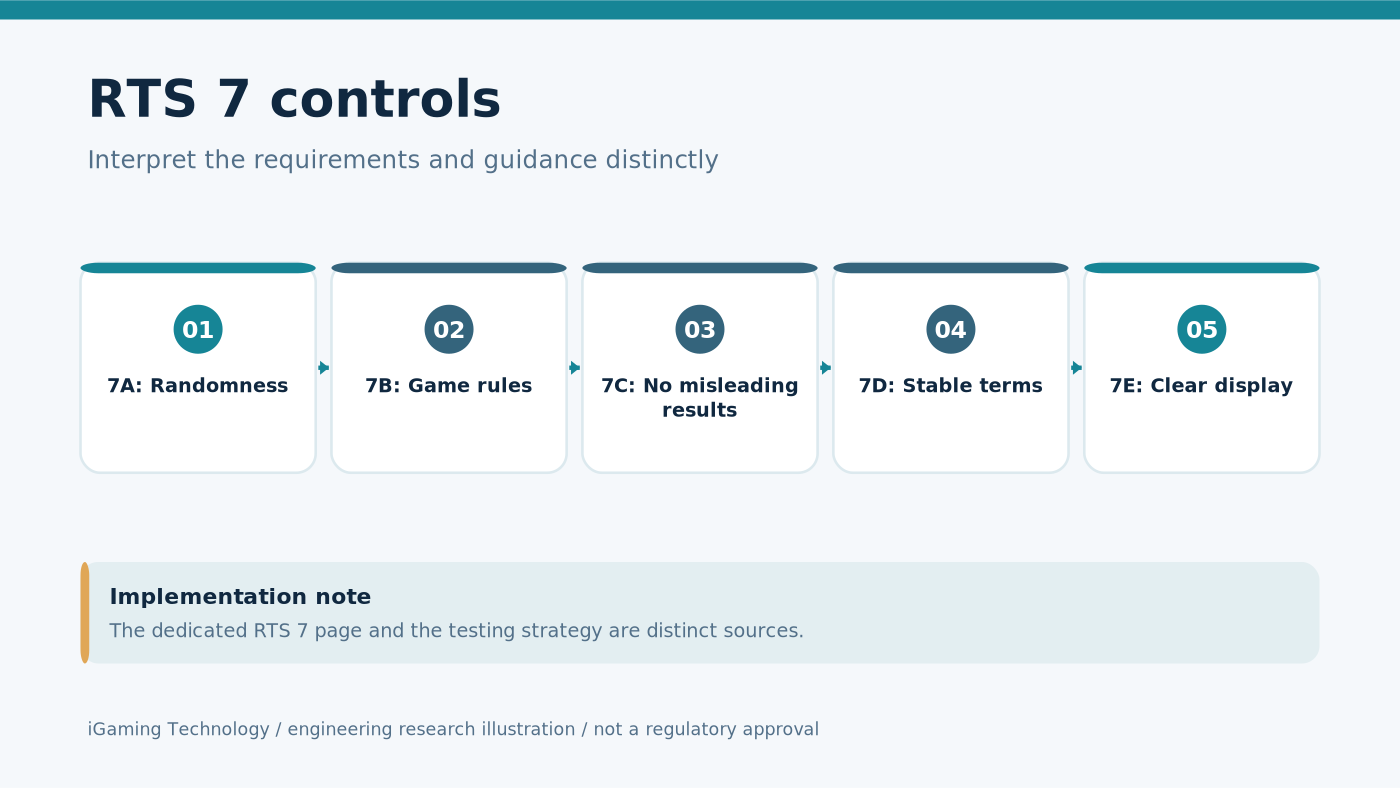
RTS 7 states that it applies to gaming, including bingo, lotteries, and betting on virtual events. The core text is organized into requirements 7A through 7E. In brief, these concern randomness and adaptive behavior, correct implementation against stated rules and payouts, misleading representations, changes to rules/probabilities while a game is available, and clear presentation of results. The implementation guidance provides additional explanations and examples, including seed handling, scaling and sequence use.
The UKGC testing strategy is a separate document that addresses when and how gambling products and RNGs are tested, including independent test-house involvement and reporting. This separation matters. An architecture can support RTS 7’s technical aims but still lack the required external report, or a tested game can later drift away from its submitted version. Do not use a checklist covering just RTS 7 to assert overall UKGC compliance.
A useful baseline sheet includes the page URL, retrieval date, jurisdiction and license type, RTS requirement ID, applicable product or game mode, referenced test strategy, responsible party and evidence ID. Keep the original wording accessible to reviewers. Paraphrased engineering descriptions are more readable for developers but must never replace the controlling source.
Random outcomes and implementation implications
Under RTS requirement 7A, random-number generation and outcomes must be acceptably random. The Commission explains that this includes being able to demonstrate randomness with high confidence, for instance by accepted statistical analyses, and prohibits adaptive or compensated behavior. In the implementation guidance, randomness is described in terms of an appropriate distribution, unpredictability, non-repetition or synchronization of streams, secure seeding and scaling that preserves these qualities.
A developer therefore needs to test two related outputs: the RNG source and the final outcome after mapping. Raw output could be uniform while mapping selects certain outcomes more often because it uses an incorrect modulo operation. Conversely, a particular game may intentionally have a nonuniform final payout distribution: the test must compare observed outcomes to the published game model rather than demand every payout be equally probable. Outcome probabilities should follow the rules and paytables of the assessed game version.
RTS requirement 7B addresses fair implementation of the rules and applicable payouts. The guidance calls for mapping random inputs in accordance with probabilities and paytables and using received random values in order; it cautions against discarding numbers because of adaptive behavior. An implementation that silently retries until a preferred outcome appears would fail the principle even if its marginal distribution looked credible in a small test. Testing should verify the exact input-to-outcome code path, any acceptable rejection to remove scaling bias, and behavior under exceptional input conditions.
RTS requirement 7C addresses misleading game design. The Commission specifically discusses false near-miss substitutions and simulated physical devices whose probabilities differ from the real device being depicted. Design and QA teams need to inspect not just the RNG module but the rendering and animation pipeline. The authoritative selected outcome should determine what is displayed; the system should not switch between equivalent losing outcomes to create a false impression that a win was nearly achieved.
The final two requirements are also relevant to engineers. RTS 7D limits changing game rules, payouts and outcome probabilities while available for gambling, subject to changes explicitly provided for in game rules and notification requirements. RTS 7E requires the result and customer gamble to be displayed clearly and for enough time to be understood, with its stated exception for subscription lotteries. This makes configuration deployment and front-end presentation part of a fairness review, not purely a statistical exercise.
Seeding, integrity and game-result independence (as applicable)
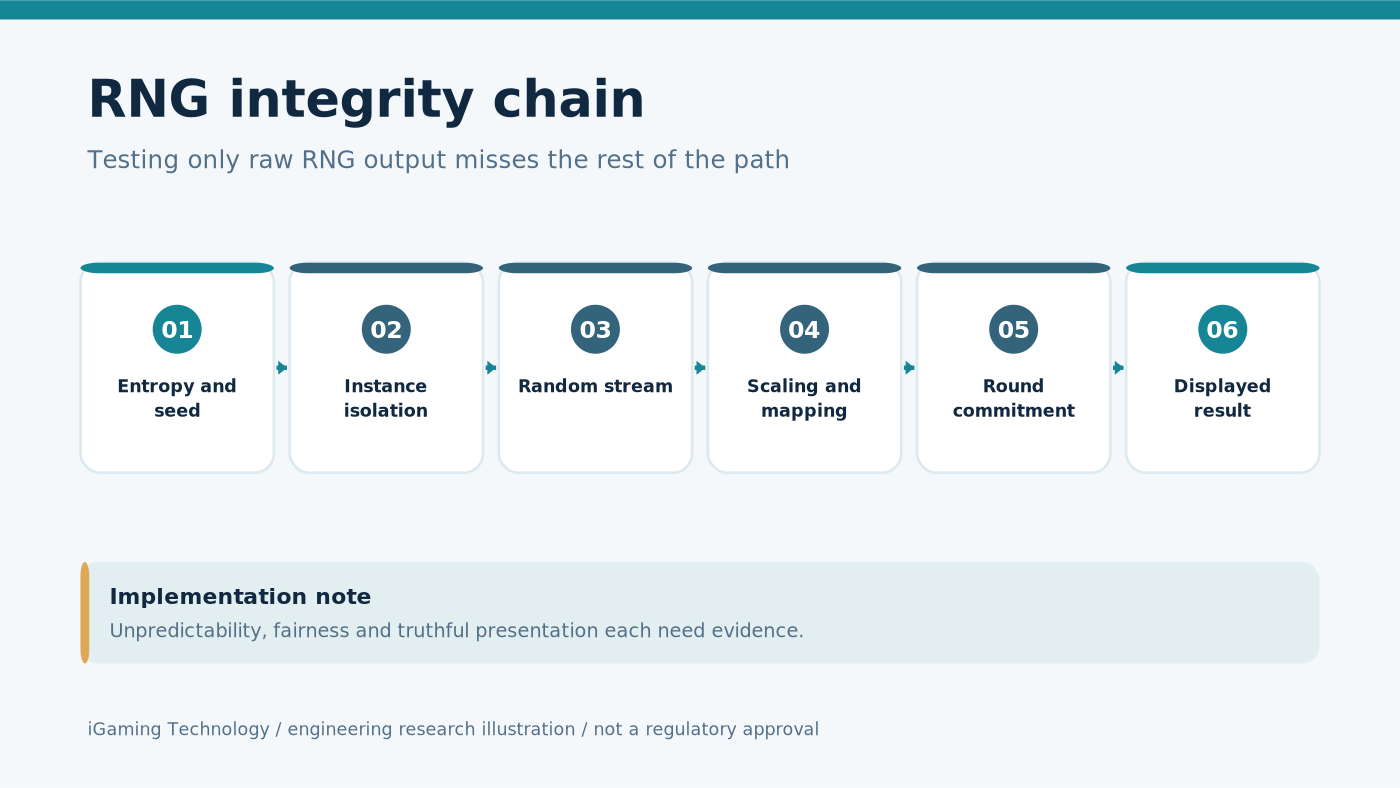
Seeding is called out in RTS 7A implementation guidance because a deterministic algorithm can generate output that looks statistically varied yet is predictable to someone who knows or can guess its state. The architecture should document what introduces entropy, how initial seed material is obtained, how generator instances are separated, how restarts behave and whether seeding or reseeding could create identical streams. The appropriate cryptographic or hardware design depends on the assessed RNG and game model; do not turn a generic rule of thumb into a false claim of approval.
Consider two game workers started from a container image. If both initialize a deterministic RNG using the same fixed seed copied into the image, their outputs can be synchronized. A good statistical distribution from either worker viewed alone would not reveal this across-worker defect. Include concurrent-instance and restart tests. If a cryptographically secure platform RNG is used, review the actual runtime and deployment semantics rather than assuming its name settles seeding controls. Protect keys and diagnostic facilities that could expose RNG state.
Result integrity extends beyond seed confidentiality. The selected outcome should be bound to a business round and math version before settlement is accepted. Duplicate callbacks, retried network requests and stale game clients must not trigger an unrelated redraw. One way to enforce this is to record a unique round identifier and a committed result, then return that result to any authorized replay. The idempotency mechanism is an implementation recommendation supporting fairness and consistency, not a direct quotation from RTS 7.
Independence has multiple meanings that should be tested separately. Statistical independence asks whether knowledge of previous selections helps predict future selections. State isolation asks whether one concurrent worker influences another in an unintended way. Business independence asks whether the result changes in response to player identity, previous payout, current balance or operator profitability unless an explicitly permitted game mechanism provides otherwise. An RTP-convergence chart alone cannot establish any of these properties.
When producing diagnostic evidence, preserve enough metadata to reproduce the test using a test-only harness without exposing live seed material. Real production secrets should not be inserted into a compliance CSV or generalized analytics stream. Document whether the sample represents raw numbers, scaled values, simulated final results or live outcome records; these populations answer different questions.
Evidence to document and test
A defensible evidence package combines design explanation with reproducible measurement. The first layer is an architecture note showing the RNG type, operating environment, seeding and reseeding behavior, instance lifecycle, mapping function, game math version and how the authoritative result is committed. The second layer is source-level review and deterministic test fixtures. The third is sampled statistical analysis with predeclared hypotheses and correct reference distributions.
The Commission’s testing procedure lists RNG documentation review, investigation of known weaknesses, source-code review and statistical testing of raw and scaled/shuffled output. Its game-testing description additionally covers game design, theoretical RTP and implemented results in an environment reflecting intended live use. This is why a provider’s marketing statement that it uses a “certified RNG” is not sufficient evidence for a new game mapping implementation.
For uniformity, choose an appropriate goodness-of-fit test for the defined probabilities. For independence, use methods suited to the expected process and game structure; apparent serial association may be legitimate in without-replacement designs. For predictability, review algorithm, seed entropy and state protection; no single p-value establishes cryptographic strength. For game implementation, include deterministic boundary cases: highest/lowest random values, rare bonus paths, mapping range boundaries and unexpected failures that should produce investigated errors rather than manipulated outcomes.
Set the experimental plan before looking at the data: number of draws, expected probabilities, statistical tests, significance policy, multiple-comparison treatment, sample generation, versions and acceptance criteria. Be explicit about test exclusions and failed executions. A post-hoc choice of tests after inspecting outcomes can make an otherwise reproducible report misleading.
| Evidence component | Primary question | Typical artifact |
|---|---|---|
| RNG design | How is the sequence produced and initialized? | Design document and source revision |
| Mapping verification | Do inputs lead to intended probabilities? | Review notes and exhaustive/boundary fixtures |
| Statistical assessment | Do observations fit the specified model? | Versioned data, scripts and test report |
| Runtime isolation | Can instances restart or interact unsafely? | Concurrent-instance and restart test logs |
| Game UI | Are outcomes represented accurately? | Capture and game-design comparison |
| Change control | Does the released version match tested evidence? | Build digest, approval and deployment manifest |
What RTS 7 does not replace
RTS 7 is not a complete specification for player accounts, interrupted gambling, age or identity controls, transaction presentation, operator security or live-dealer operation. Other RTS sections and applicable requirements address those topics. Its goal is also not to prescribe one approved programming language, RNG library, hashing function or fixed sample-size formula. As a result, a credible evidence report explains the method chosen and why it demonstrates the applicable requirements.
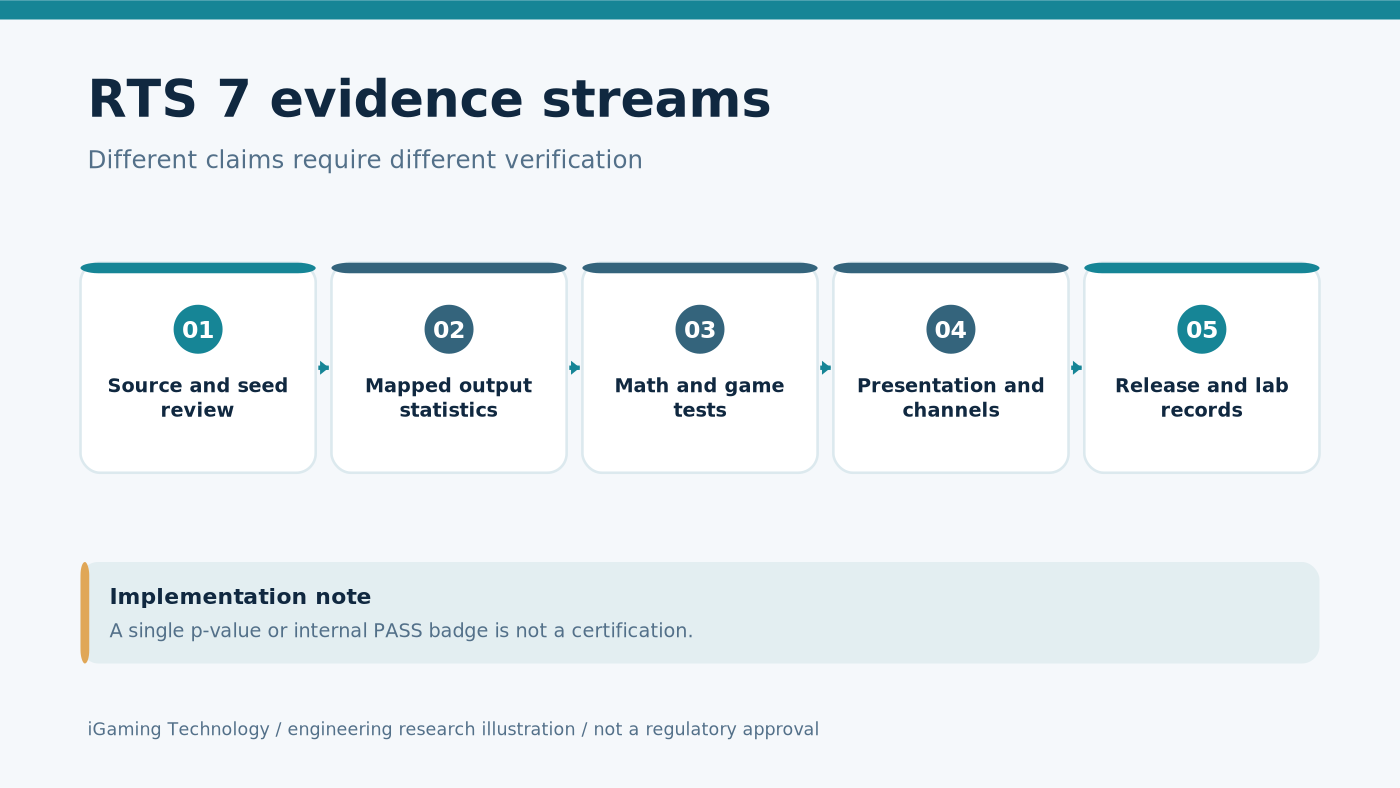
Statistical pass results are necessary in many assessments but limited. A generator with predictable seeds can pass uniformity and serial-correlation tests. A correct RNG cannot fix incorrect paytable logic. A tested model does not establish that the deployment runs the same math and configuration as the submitted binary. A game’s UI may misrepresent outcome probabilities while all backend frequencies are sound. Each failure requires its own control and evidence.
Similarly, RTS 7 is not an authorization to choose a random-number sequence, discard outputs or change a result to match business metrics. The prohibition on adaptive or compensated behavior should not be confused with legitimate game-state transitions or bonus mechanics that are part of disclosed rules. For example, a correctly implemented feature that switches into a bonus state’s specified paytable can be different from undisclosed operator-driven adjustment of outcomes.
When an RNG or game changes, consult the current UKGC testing strategy for the correct scope of third-party testing and submission. This decision cannot be inferred from RTS 7 alone. See the companion change retesting guide for a structured risk review.
Compliance review checklist with source citations
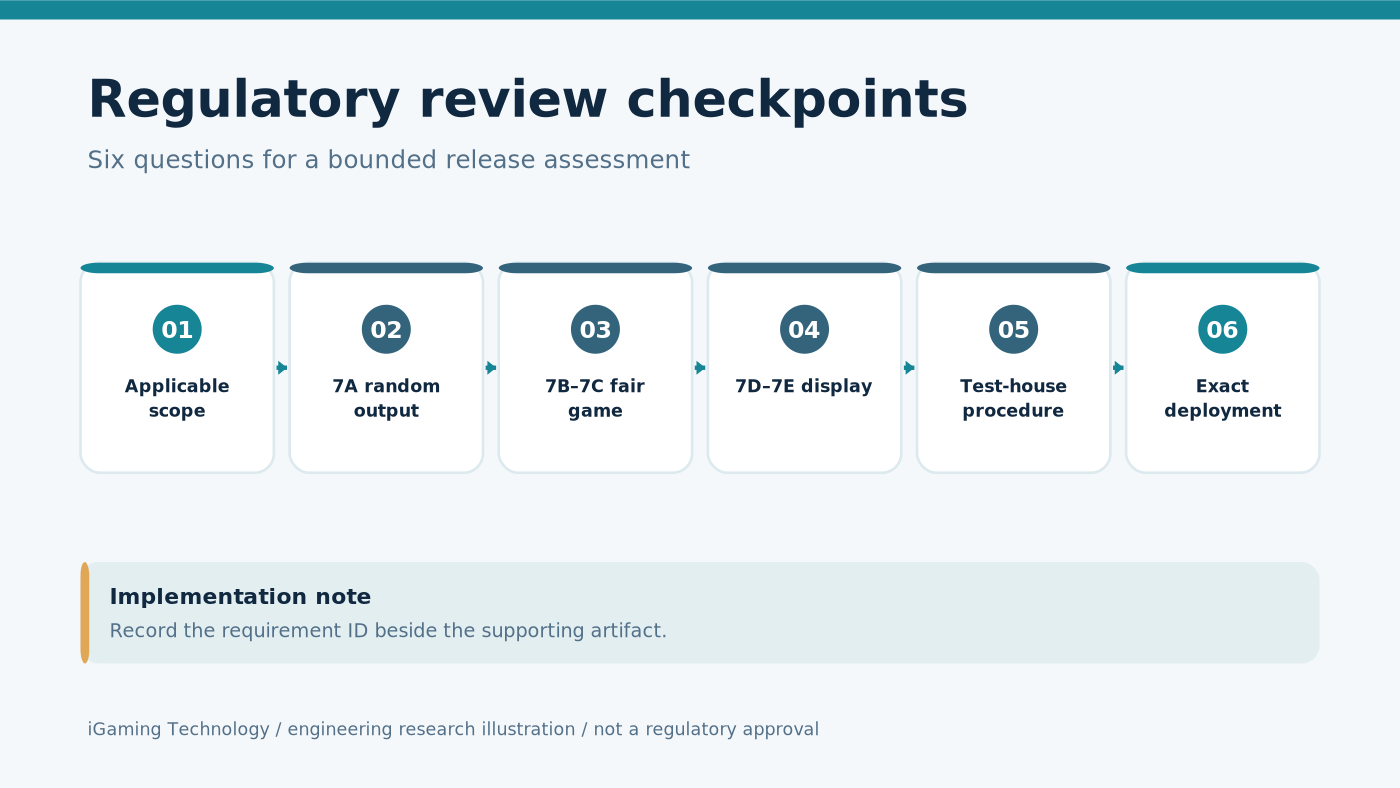
A practical review should produce evidence, not a collection of unqualified green ticks. Use the following questions as a starting point and retain the reference beside each answer. The normative source is the linked UKGC page; the evidence examples are engineering suggestions unless the adopted testing procedure expressly requires them.
| Source | Review question | Suggested evidence |
|---|---|---|
| RTS 7A | Are RNG and final outcomes acceptably random, without adaptive behavior? | Statistical plan, raw and mapped output tests, algorithm/seed review |
| RTS 7B | Does code implement the published rules and payouts? | Math specification, source diff, deterministic fixtures |
| RTS 7C | Could presentation falsely imply near-misses or different physical probabilities? | UI capture compared with authoritative outcomes |
| RTS 7D | Are changes to rules/odds handled within the permitted conditions? | Configuration version, suspension/notice design, approval log |
| RTS 7E | Can players understand their result and gamble? | Device/channel tests and timed capture |
| UKGC testing procedure | Have required RNG/game tests and reporting steps been completed for this release? | Test-house report, submission record and build identity |
Before release, confirm which evidence belongs to the exact artifact and configuration that will operate in production. Resolve failed tests and document exceptions with the competent owners. An internally completed checklist must not be called a UKGC approval or independent test-house report. Recheck the source pages and applicable guidance before publishing a compliance claim, because the standards framework can change over time.