A secure RNG implementation is not established by showing that a long output file passes a frequency test. For an iGaming outcome service, the review must establish how unpredictable state is established, how that state is protected and isolated, when it is refreshed, what happens after crashes and how raw random bits become game outcomes. An implementation can produce an apparently uniform output stream while using a predictable initial seed, copying state across workers or replaying the same stream after a process restart. Those are security and integrity failures that statistical tests alone may not discover.
This guide is an engineering audit framework, not a certification report. The appropriate requirements depend on the jurisdiction, product and exact approved design. As technical references, NIST SP 800-90A Rev.1 documents deterministic random bit generators (DRBGs), SP 800-90B addresses entropy sources, and SP 800-90C specifies constructions combining those components. These publications are not a claim that every gaming jurisdiction mandates a particular NIST construction.

Implementation security threat model
Begin with the assets that must be protected: entropy-source trust, DRBG internal state, seeds and reseed material, configuration, game-mapping code and the authoritative round record. Identify which actors can alter each asset. A compromised deployment pipeline might substitute a test-mode implementation. Excessively privileged monitoring code might log state. A process manager might clone a preinitialized worker. A restore operation might recreate an old seed and reproduce a sequence. A game engine might use correct random bits but introduce a biased range mapping.
Do not use “randomness” as a single requirement. Distinguish unpredictability (an observer should not feasibly infer future values), integrity (an attacker should not alter the selection path), separation (unrelated sessions or workers should not share state) and auditability (the reviewer can verify which implementation ran). Also distinguish outcome fairness, which depends on the full mapping and game rules, from the cryptographic strength of the bit generator.
The threat model should map privileged roles and interfaces. Can developers toggle deterministic test mode in production? Can application support read diagnostic snapshots? Can configuration scripts override the entropy source? Does an operator share an RNG process across game tenants? Which service can request output, and what rate limits prevent abuse? Which services can deploy new binaries? For each trust boundary, define a prevention, detection and recovery control.
A useful architecture constrains the RNG service to a narrow interface: authenticated requests for bounded, well-defined randomness or for an authoritative game-resolution operation. Avoid exposing raw seeds, internal state and unrelated tenants’ results. Log requests, state-transition categories and control-plane actions without logging the secret state itself. Reference unique round identifiers so an audit can link the result to an execution context without making future output predictable.
Entropy intake and seed lifecycle
Entropy is a physical or environmental source of uncertainty; a deterministic algorithm cannot create entropy from nothing. The purpose of a DRBG is to expand securely established state into an unpredictable stream within its security model. A review should record the entropy-source design, claimed assurance, data path, conditioning stage, startup and continuous health checks, and how any failure propagates to game services.
In a conforming construction, the entropy-source and DRBG relationship matters. SP 800-90B addresses assessment and health testing of entropy sources; SP 800-90C describes RBG constructions built from those components. Merely invoking a system API with a reassuring name is not complete evidence unless the reviewer knows the runtime, operating system, deployment constraints and configuration. Conversely, application developers should generally favor carefully maintained platform cryptographic facilities over inventing a generator from timestamps, process IDs or user events.
Document the seed lifecycle as a state machine: uninitialized → validated entropy → instantiated → generating → reseed required → reseeded → terminated. Define who triggers each transition and what evidence is produced. Never start serving gaming outcomes while the entropy intake is unavailable or an initialization health test has failed. If a startup service retries, its failure mode must be visible and bounded; silent fallback to a lower-assurance source is not an acceptable default.
Seed material and internal state must be protected as secrets. Exclude them from normal logging, traces, diagnostic dumps, application metrics, analytics streams and customer-support exports. Evaluate memory lifecycle, access rights and whether a crash dump or swap file can contain sensitive state. Secure deletion in managed runtimes is difficult to guarantee; use platform facilities and architecture boundaries that reduce unnecessary exposure rather than making unverifiable absolute claims about perfect memory erasure.
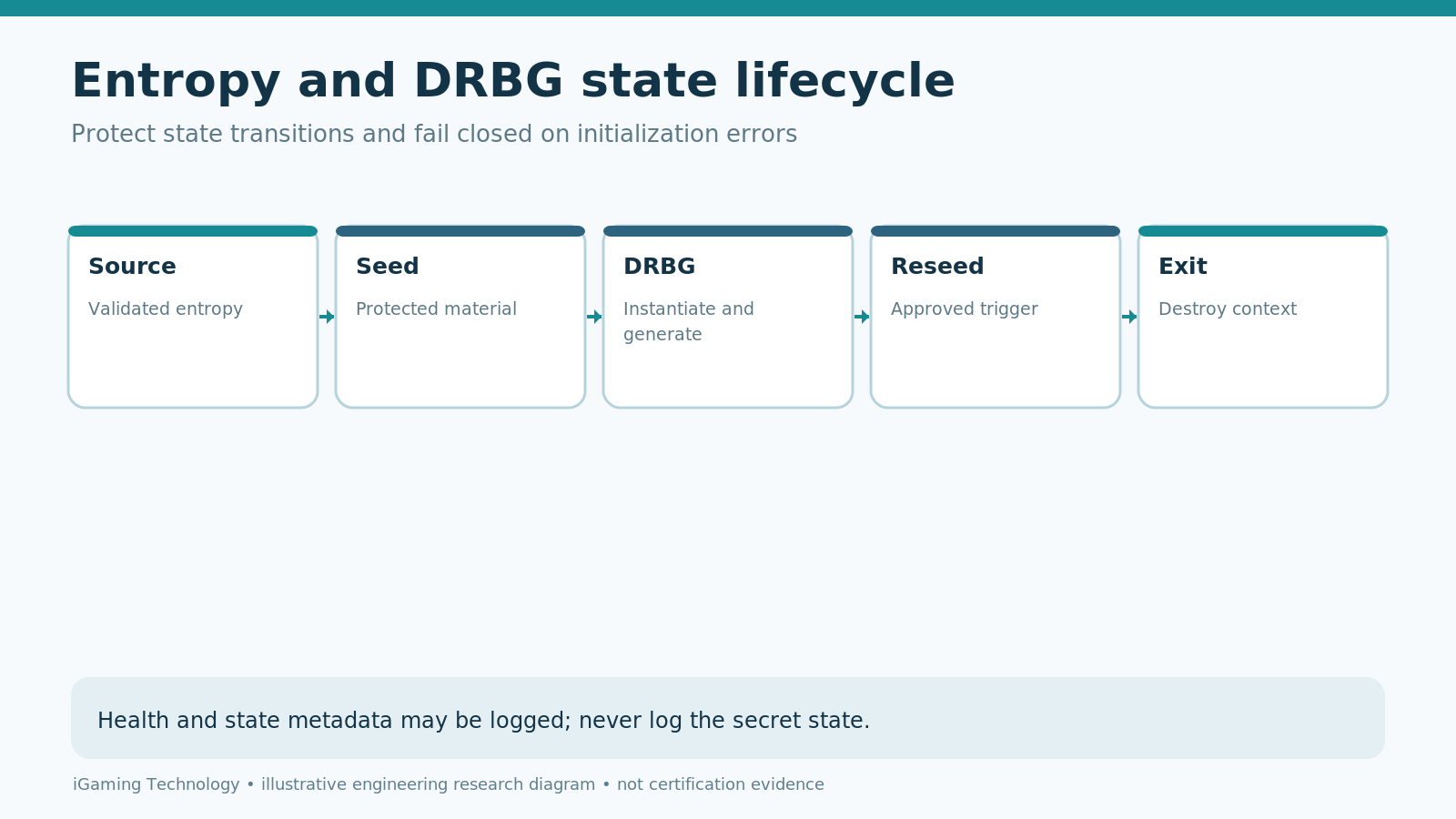
Testing interfaces need explicit isolation. Deterministic seeds are useful for reproducing math fixtures in a non-production environment, but the release process must prevent them from being reachable through production configuration or API paths. A signed build and a protected deployment manifest should prove that the approved RNG mode is active. A configuration value that can be toggled at runtime by a general operator account weakens that assurance.
State reuse, isolation and concurrent instances
Multiple game servers do not automatically imply independent RNG streams. If a container image or process snapshot contains an initialized DRBG state, clones can begin from identical state. A fork()-style process model can have similar concerns depending on the runtime and cryptographic provider. Review when state is established relative to spawning, snapshotting, restoration and scaling. Establish a policy that ensures each relevant instance receives appropriate initialization or reseeding from an approved source after cloning or restore.
A unit test with a single worker cannot validate this boundary. Add controlled parallel-start tests: launch multiple instances, record nonsecret initialization identifiers, compare output behavior under the permitted validation method and verify that health-check state remains independent. Do not log secret seeds or internal state in order to perform that test. Test scaling from zero, autoscaling during spikes, rolling restarts, cold boot, deployment rollback and region failover; they exercise different lifecycle paths.
State isolation extends across tenants and games. Some designs use one well-managed generator service with controlled request serialization; others use independently instantiated worker DRBGs. There is no universal rule that one generator per player is automatically safer. The review should instead ask whether compromise of one consumer exposes other streams, whether the API permits correlation, and whether concurrency can reorder or replay an authoritative game outcome.
The game round requires separate idempotency. If a request times out after a round is committed, the retry must return the committed result. It must not simply call the RNG again to obtain a fresh outcome under the same business identifier. Store the binding among round ID, effective game math version, selected outcome and settlement reference in an authoritative record. This protects accounting consistency as well as auditability.
An RNG’s final output still needs mapping. Naive modulo reduction can introduce bias when the source domain is not a multiple of the target range. Use an appropriate unbiased mapping such as rejection sampling, then test the distribution of the mapped outcomes, not only the bits. Paytable and feature probabilities must correspond to the approved game model. These fairness requirements are related to, but distinct from, cryptographic-state security.
Recovery, startup and failure modes
A resilient system sometimes chooses availability over consistency. That trade-off is unacceptable for outcome generation when the proposed fallback sacrifices unpredictability or makes previously committed results ambiguous. Define which failures cause the RNG service to refuse new game-resolution requests, and how in-flight rounds are recovered from the authoritative record. The business system may temporarily suspend launches or bets; it should not silently substitute an unreviewed generator.
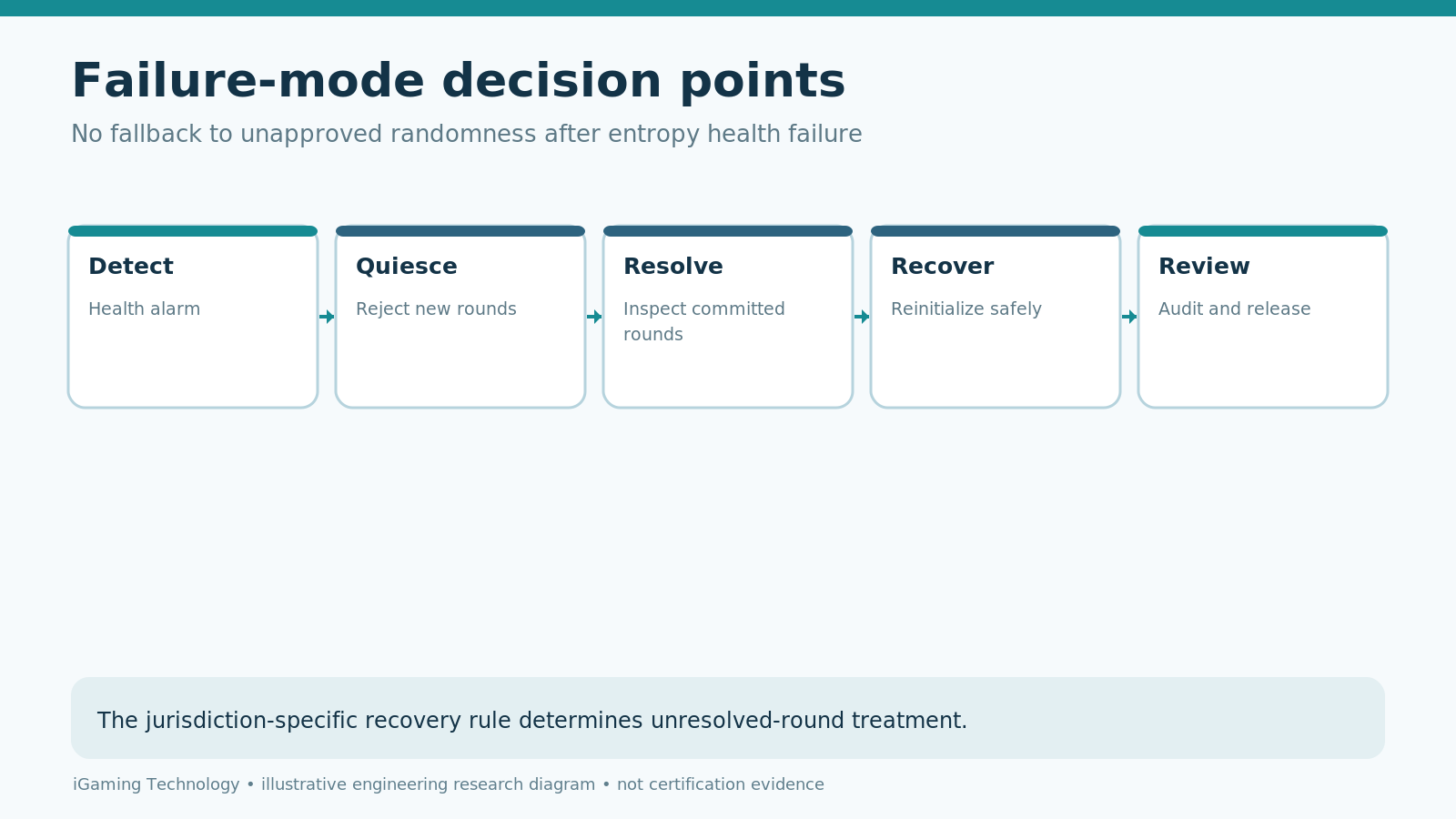
Include fault injection for lost entropy access, failed health checks, corrupted initialization data, incomplete state restoration, process crash between outcome selection and settlement, and duplicated resolution messages. Specify whether the outcome was committed before the crash. If committed, recovery resumes the same round without drawing new randomness. If no authoritative outcome was committed, the product-specific recovery policy must determine whether a new operation is permitted or the transaction is canceled; never guess based only on client timeout.
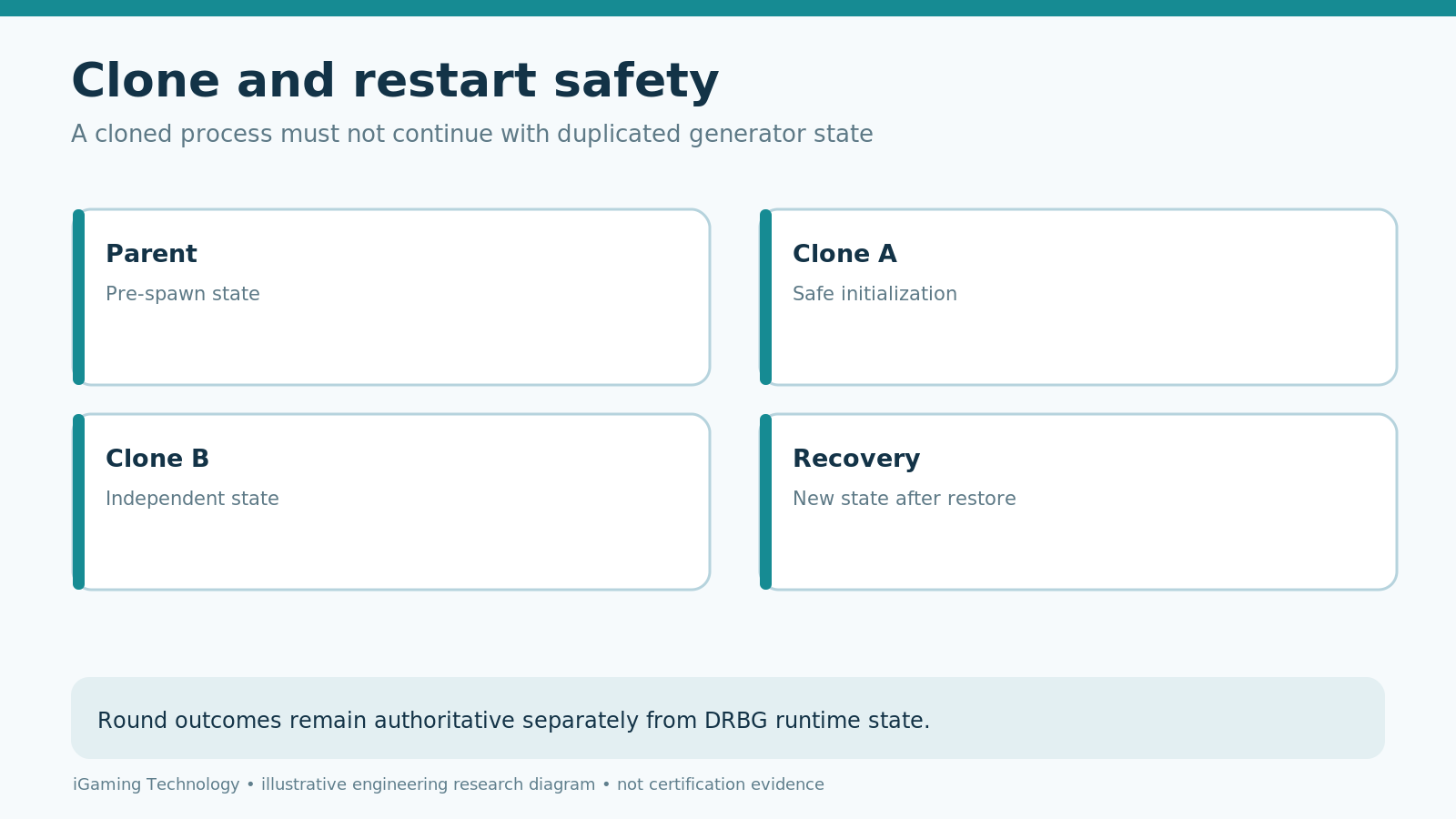
Disaster recovery raises a subtle question: does a backup capture RNG state or only business records? If restored nodes recover a stale secret state, output repetition may result even when the ledger data is consistent. Prefer designs that regenerate appropriately initialized cryptographic state on service restart and separately restore only those authoritative game outcomes needed for accounting and dispute resolution. Verify behavior in an isolated recovery drill and capture a reviewable timeline.
Observability should disclose health, not secrets. Useful metrics include initialization failures, entropy-source health alarms, reseed operations, rejected requests, restart frequency and unexpectedly correlated event patterns. Do not publish per-round raw entropy or private state. Access to advanced diagnostics should require controlled escalation, short-lived authorization and an audit record. Limit the retention of security-sensitive debug exports.
Source review and targeted test strategy
A source review begins at the actual production entry point, not at a library description. Trace calls from the game-resolution API to RNG allocation, entropy intake, DRBG initialization, output generation, range mapping, round commitment and presentation. Search for environment-dependent branches, debug mode, deterministic fixtures, weak fallback seeds, mutable shared state, logging of seed material and ignored error codes. Review dependency and build provenance so the tested source can be tied to the deployed binary.
Use several test layers. Static analysis checks code paths and prohibited calls. Unit and integration tests exercise lifecycle transitions. Chaos tests examine failures and recovery. Distribution tests examine the final mapped outcomes against specified probabilities. Penetration-oriented review examines privilege boundaries and state exposure. Finally, release verification checks the exact binary, configuration and platform versions under assessment. A passing test from another image or game-math package is not transferable by assumption.
| Risk | Targeted review or experiment | Required evidence |
|---|---|---|
| Predictable startup | Verify approved entropy/DRBG initialization path | Source references, runtime configuration, health-check outcomes |
| Cloned state | Scale/fork/restore instance lifecycle tests | Instance-scoped event records without secret state |
| Debug seed in production | Build-time and deployment policy test | Signed release manifest, negative access test |
| Leaked state | Examine logs, traces, dumps, permissions | Redaction and access-control test results |
| Repeated outcome after retry | Crash/replay financial workflow | Unique authoritative round and ledger references |
| Biased range mapping | Exact proof or bounded distribution check | Mapping implementation and math-model tests |
One important limitation: a random-bit output file that passes statistical tests cannot prove entropy quality, resistance to state compromise or correct process isolation. Similarly, a design called “cryptographically secure” needs a maintained implementation, legitimate seeding and a documented deployment model. Mathematical properties, implementation integrity and operational controls must be evaluated together.
Audit evidence and review checklist
The evidence package should contain a threat model, architecture and trust boundaries, source-code identification, cryptographic-provider and runtime versions, seed and reseed lifecycle design, entropy-source provenance, health-test specification, process-isolation analysis, test suite and results, defect decisions, and a manifest linking all evidence to an exact release. Include the relevant independent evaluation or jurisdiction-specific assessment if required; do not confuse an internal review with certification.
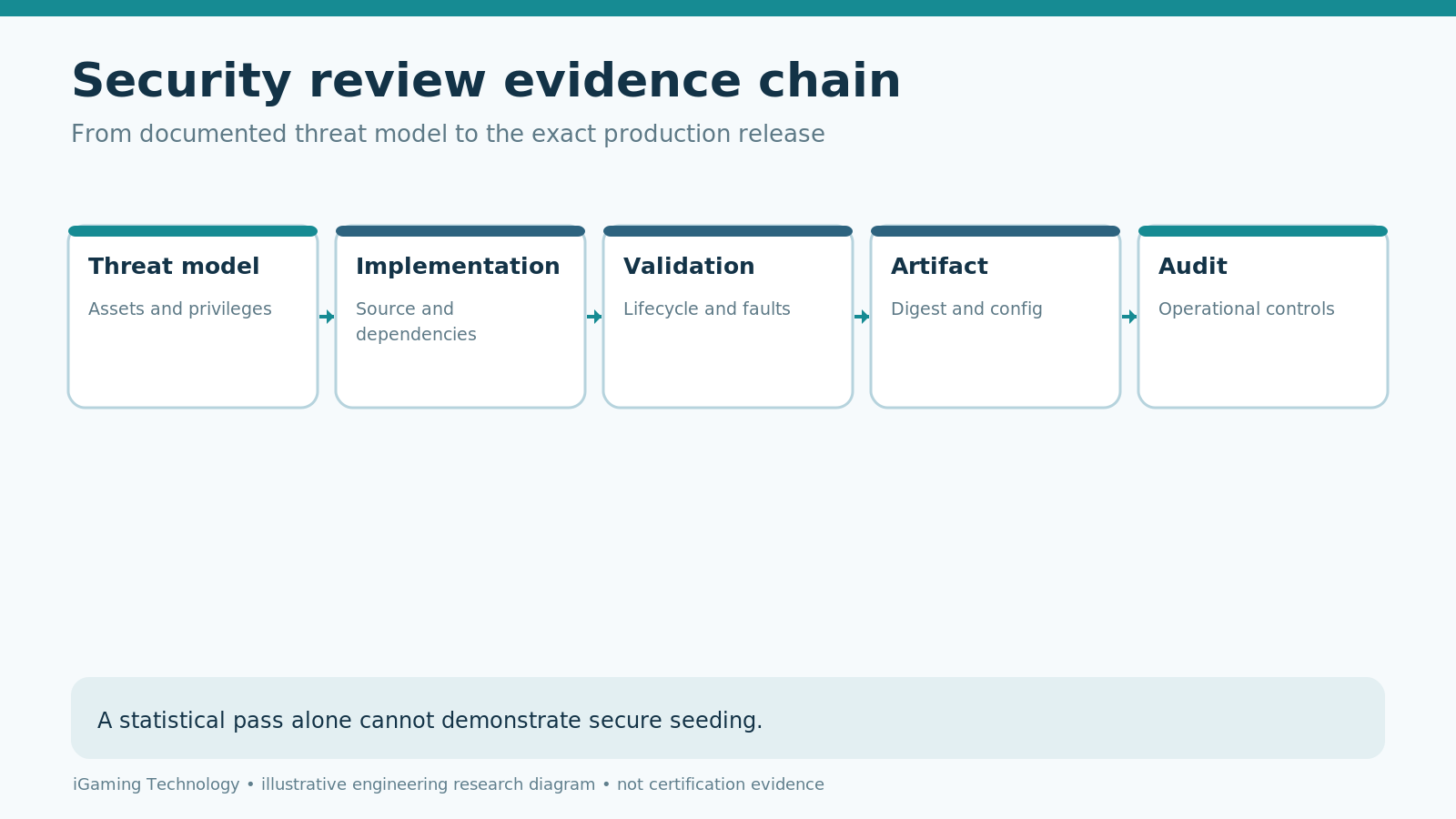
A second reviewer should be able to answer: Where does uncertainty enter the system? Which module transforms it into DRBG state? Can an instance be cloned or restored without safe reinitialization? Can any non-production seed leak into production? Can a retry select a different outcome under an already committed round? Are mapping and game math versioned? What alarms fire when initialization or health checks fail? Can the organization demonstrate the exact code and configuration that handled a historical round?
The goal is not an absolute promise of perfect randomness. It is a bounded, inspectable assurance case that addresses both randomness generation and the surrounding software lifecycle. Security review must be repeated when changes alter the RNG provider, seed source, deployment topology, fork semantics, runtime behavior, mapping logic or relevant game rules. Use the applicable licensed-product change process to decide whether external review and retesting are required.
Technical references: NIST SP 800-90A Rev.1, SP 800-90B, SP 800-90C. These publications describe technical constructions; actual gaming compliance depends on the adopted regulatory standard and approved product scope.